
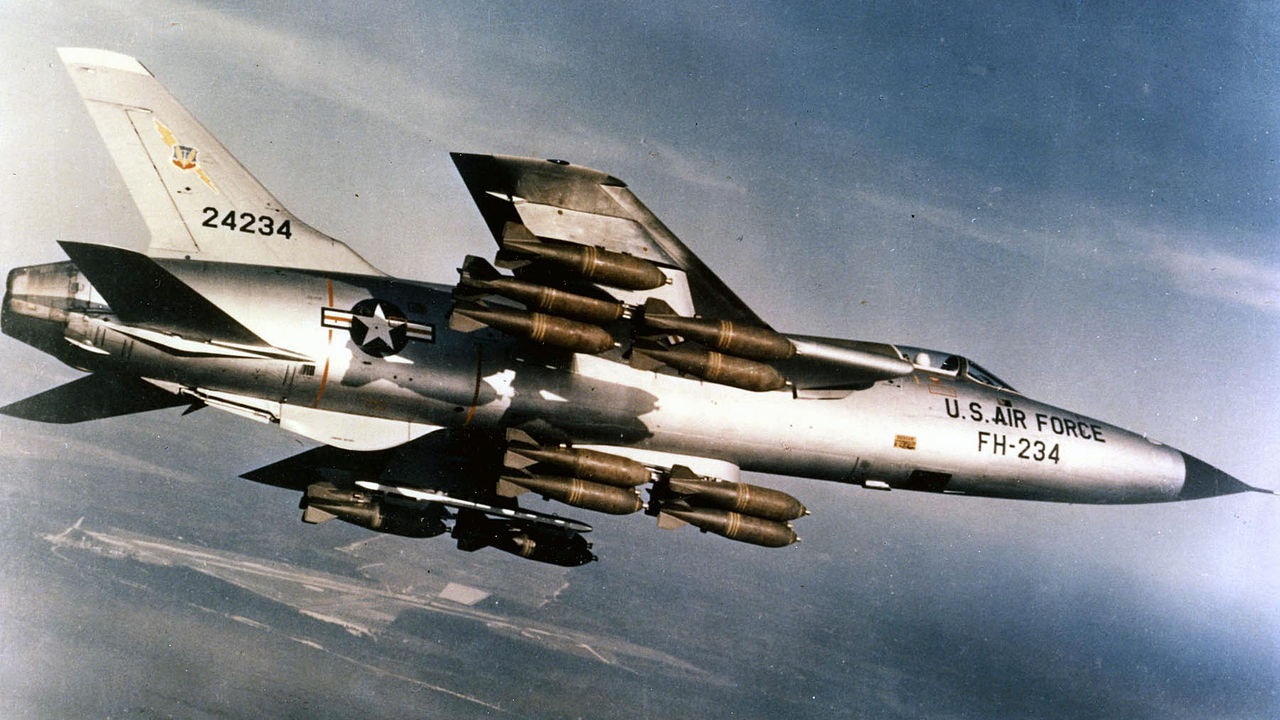
Article Summary – The F-105 Thunderchief, or “Thud,” began life as a supersonic nuclear striker before becoming the U.S. Air Force’s primary fighter-bomber over North Vietnam.
-Built by Republic Aviation, the big single-engine jet could haul a heavier bomb load than a WWII heavy bomber and still reach Mach 2.
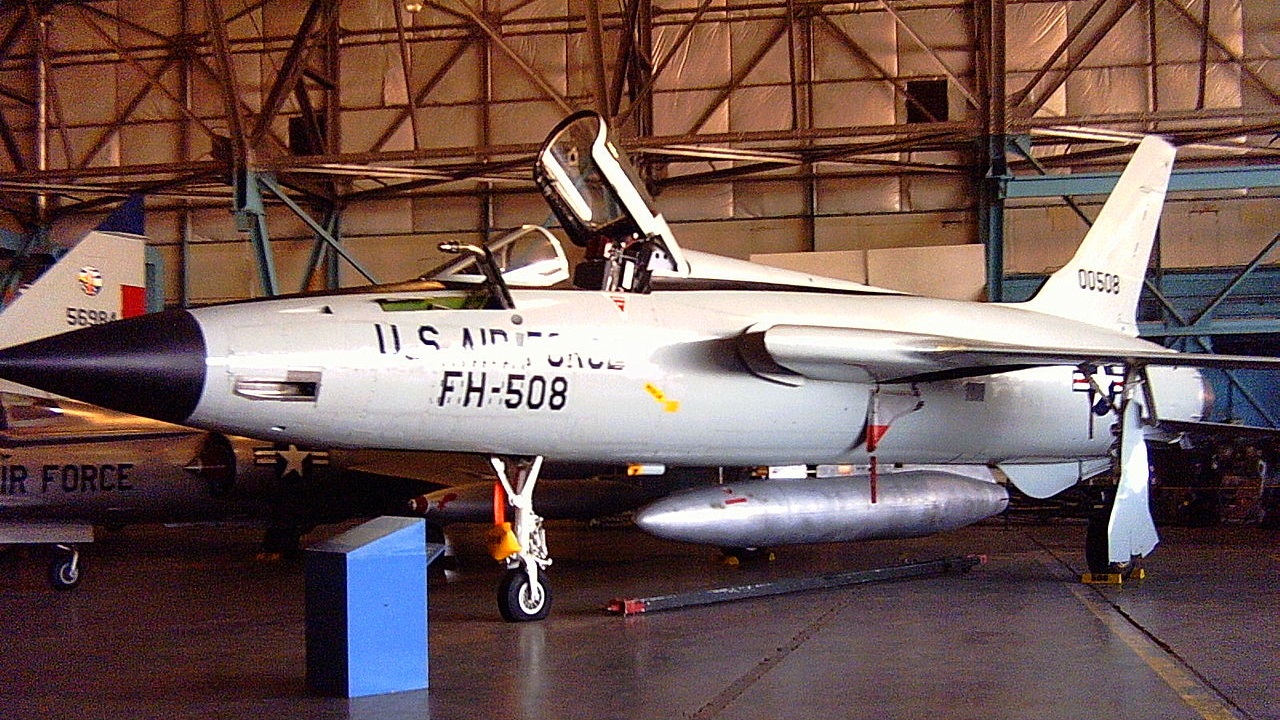
F-105D 60-0508, formerly with 49th TFW, at Wings Over the Rockies Museum, Denver, Colorado.
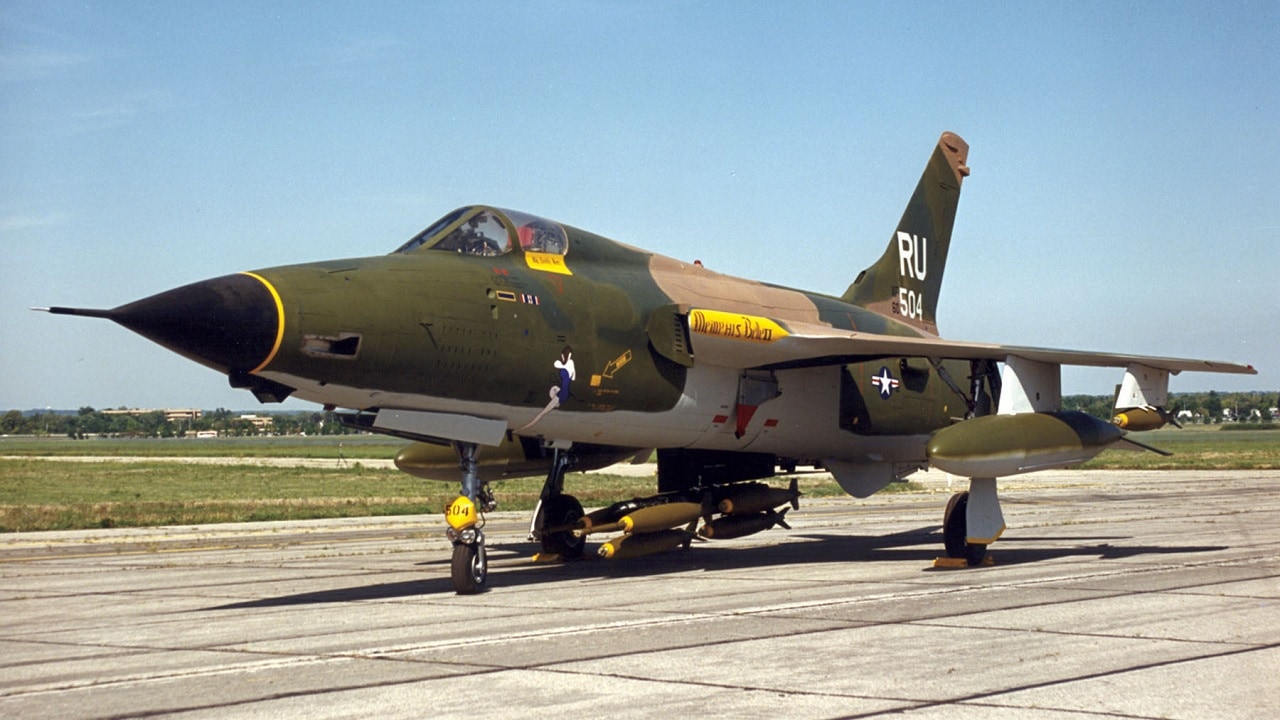
DAYTON, Ohio — Republic F-105D Thunderchief at the National Museum of the United States Air Force. (U.S. Air Force photo)
-In Vietnam, it flew the majority of deep-strike sorties. It pioneered the deadly Wild Weasel SEAD mission, producing Medal of Honor pilots—but also suffering the highest loss rate of any U.S. aircraft in the war. Fast but not very agile, the F-105 fell to MiGs and dense flak, yet still finished with a positive air-to-air kill tally.
F-105 Thunderchief Fighter Profile — The Tale of the Thud
“I was rollin’ in my F-105, back rollin’ in my F-105/Out across the Bac-9, I was sure feelin’ fine/I was rollin’ in my F-105”
Thus goes the refrain to the song “Rollin’ In My F-105” by Irv Levine (Maj., USAF, Ret.), who flew the famous F-105 Thunderchief fighter-bomber during the Vietnam War and later flew the F-16 before retiring from the U.S. Air Force and finding a new career as a professional singer along with his fellow “fighter pilot’s minstrel Dick Jonas (Lt. Col., USAF, Ret.; who flew the F-4 Phantom II in Nam) on the Erosonic record label.
National Security Journal now tells the tale of the Thunderchief, affectionately nicknamed the “Thud.” (And appropriately enough, this writer is wearing an F-105 t-shirt as he types these very words.)
(NOTE: The American-made F-105 is not to be confused with the ill-fated Canadian-made Avro Canada CF-105 Arrow.)
F-105 Initial History
Built by the sadly now-defunct Republic Aviation (which had also built such famous fighters as the P-47 Thunderbolt of World War II and the F-84 Thunderjet of the early Cold War era), the F-105 Thunderchief made its maiden flight on October 22, 1955, and was officially introduced into U.S. Air Force service on May 27, 1958.
The warbird was initially designed for nuclear strike, more specifically for high-speed low-altitude penetration carrying a single thermonuclear device, the flip side to the slow & lumbering B-52 “BUFF” strategic bomber’s high-altitude approach to a would-be nuclear war with the Soviets.
Thankfully, WWIII and its resultant nuclear Armageddon never happened, so the F-105 soon found itself assigned to conventional air-to-ground attack duties (more on this in a bit).
F-105 Technical Specs and Vital Stats
Crew: 1
Fuselage Length: 64 ft 4.75 in (19.628 m)
Height: 19 ft 8 in (5.99 m)
Wingspan:34 ft 11.25 in (10.649 m)
Empty Weight: 26,855 lb. (12,181 kg)
Gross weight: 35,637 lb (16,165 kg)
Maximum Takeoff Weight: (MTOW): 52,838 lb. (23,967 kg)
Powerplant: 1 × Pratt & Whitney J75-P-19W turbojet engine, generating 14,300 lbf (64 kN) dry thrust and 26,500 lbf. (117.88 kN) in afterburner mode with water injection
Combat Range: 676 nmi (778 mi, 1,252 km)
Service Ceiling: 48,500 ft (14,800 m)
Rate of Climb: 38,500 ft/min (196 m/s)
Max Airspeed: Mach 2.1 (1,390 mph; 2,240 km/h; 1,207 kn)
Armament:
1 × 20 mm (0.787 in) M61A1 Vulcan gun
Up to 14,000 lb. (6,400 kg) of rockets and/or general-purpose bombs and/or missiles (air-to-air, air-to-surface, and anti-radiation alike)
In December 1959, an F-105B set a world speed record, carried out over a 62-mile circuit that required the pilot to maintain a precise course while pulling a steady 3.5 G’s for three minutes.
Moreover, this mere fighter-bomber toted a bigger payload than the B-17 Flying Fortress and B-24 Liberator, which had been considered “heavy bombers” by WWII standards.
Operational History/Combat Performance
Going back to the subject of that conventional air-to-ground role, the “Thud” soon became one of the primary attack planes of the Vietnam War, with over 20,000 F-105 sorties flown during the conflict. The all-weather F-105D variant, in particular, was initially the only USAF jet capable of penetrating North Vietnam’s Soviet-sourced defenses.
F-105s flew more than 75 percent of all the bombing sorties against North Vietnam, including the hair-raising “Wild Weasel” missions that performed Suppression of Enemy Air Defenses (SEAD) duties. Two of these Wild Weasel Thud fighter jocks, then-Capt. Merlyn H. Dethlefsen (eventual Col.) and then-Maj. (later lt. Col.) Leo K. Thorsness earned the Medal of Honor.
However, that affectionate nickname, “Thud,” had a tragic undercurrent, as it was inspired by the plane’s rather disconcerting tendency to blow up in midair. As Dick Jonas sang in one stanza of the morbidly humorous ditty “Give Me Operations, “Don’t give me an F-15, ’cause I like being alive/She’s great for attack, she soaks up mach-mach flak/Don’t give me an F-105.”
The” soaks up mach-mach flak” line makes for a convenient segue to the other tragic component of the Thud’s history: as if her penchant for self-destruction weren’t bad enough, she was also quite vulnerable to enemy ordnance.
320 airframes out of 833 total produced were lost in combat over Vietnam, making for the highest loss rate of any U.S. aircraft during the war, which soon compelled the USAF to make the F-105 the only American aircraft to be removed from combat operations due to high loss rates (though the plane still performed Wild Weasel duties all the way until the plane’s retirement 1984). In the course of the Thunderchief’s career, various causes destroyed 612, a whopping 75% of the entire production run.
A concurrent morbid moniker of “Thud Ridge” would be bestowed upon a mountainous landmark northwest of Hanoi.
Though the F-105 was super-duper fast, it lacked maneuverability, thus leaving the jet vulnerable to shootdown by the nimbler MiG-21 “Fishbed” and MiG-17 “Fresco” fighters piloted by the North Vietnamese Air Force, which downed 15 and seven Thunderchiefs, respectively.
However, the air-to-air combat picture for the Thud wasn’t an entirely one-sided affair. Though the Thunderchief drivers didn’t down any of the Fishbeds, they did tally 27.5 air-to-air kills against the Fresco—two with the AIM-9 Sidewinder missiles and the rest with the cannon—thus making for an overall favorable kill ratio of 1.25:1. The Maj above. Thorsness nabbed one confirmed MiG-17 kill and one probable on his Medal-winning mission.
Indeed, arguably the most famous air-to-air combat photo from the war is a gun-camera shot of a MiG-17 being blasted out of the sky by Major Ralph Kuster Jr. of the 469th Tactical Fighter Squadron.
Where Are They Now?
There are no airworthy Thuds left today. However, 96 F-105 airframes preserved for posterity as static displays at multiple museums and airbases spread out across six different countries, including the Steven F. Udvar-Hazy Center in Chantilly, Virginia (which this author can personally vouch for) and the National Museum of the United States Air Force at Wright-Patterson AFB in Dayton, Ohio.
About the Author: Christian D. Orr, Defense Expert
Christian D. Orr is a Senior Defense Editor. He is a former Air Force Security Forces officer, Federal law enforcement officer, and private military contractor (with assignments worked in Iraq, the United Arab Emirates, Kosovo, Japan, Germany, and the Pentagon). Chris holds a B.A. in International Relations from the University of Southern California (USC) and an M.A. in Intelligence Studies (with a concentration in Terrorism Studies) from American Military University (AMU). He is also the author of the newly published book “Five Decades of a Fabulous Firearm: Celebrating the 50th Anniversary of the Beretta 92 Pistol Series.”