
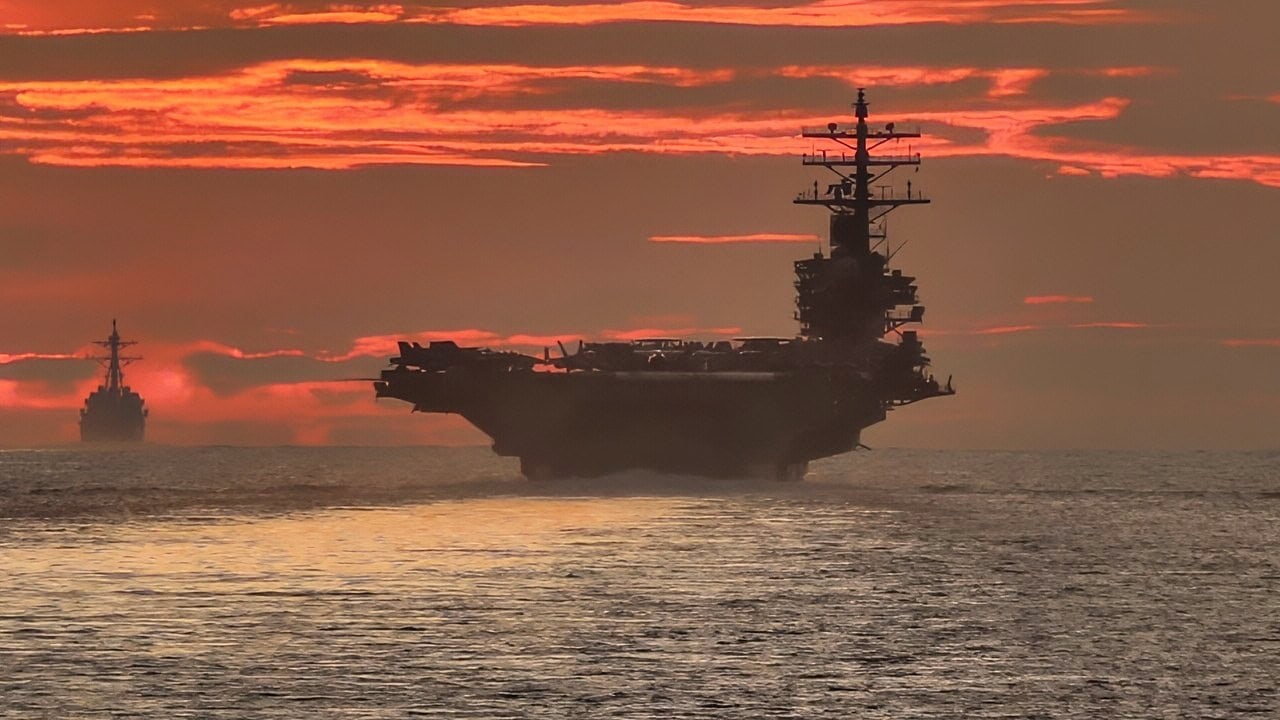
Key Points and Summary – During a 2000 joint U.S.–Australian exercise, an Australian Collins-class diesel-electric submarine reached a valid simulated firing position on a U.S. aircraft carrier, earning an exercise “kill.”
-The episode highlighted an enduring undersea asymmetry: on battery power, conventional boats can be exceptionally quiet at low speed, making them difficult to track in cluttered, thermally layered waters.
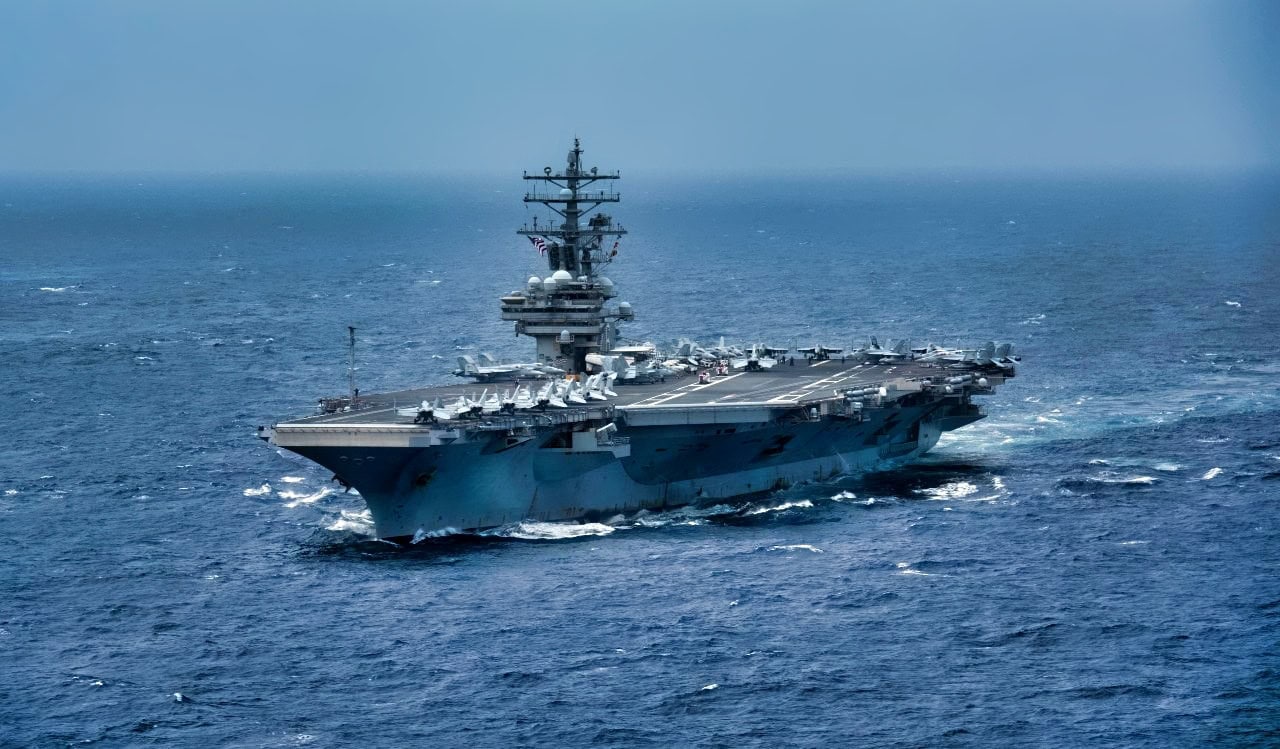
INDIAN OCEAN (June 24, 2021) The U.S. Navy’s only forward-deployed aircraft carrier, USS Ronald Reagan (CVN 76), steams in the Indian Ocean. Ronald Reagan, the flagship of Carrier Strike Group 5, provides a combat-ready force that protects and defends the United States, as well as the collective maritime interests of its allies and partners in the Indo-Pacific region. (U.S. Navy photo by Mass Communication Specialist 2nd Class Jason Tarleton)
-The result did not “prove carriers are obsolete,” but it underscored how anti-submarine warfare is probability management, not certainty—especially when defenders operate under realistic training constraints.
-The takeaway was sharper ASW tactics, better screening, and respect for quiet conventional submariners.
An Australian Submarine “Sank” a U.S. Aircraft Carrier in 1 Exercise—and the Navy Took Notes
During a joint US-Australian naval exercise in 2000, a conventionally powered Australian submarine penetrated a US carrier strike group (CSG).
The episode exposed the unique danger of quiet diesel-electric submarines, an asymmetry that exploited the vulnerability of an American supercarrier, one of the most expensive warships ever fielded.
Yet the incident didn’t necessarily represent a failure of US naval dominance, merely a vulnerability that needed to be accounted for, and better defended against, in the future.
What Happened?
In the exercise, an Australian Collins-class submarine achieved a simulated firing position against a US aircraft carrier. In exercise terms, the submarine remained undetected long enough to generate a valid torpedo solution, resulting in a “kill” on the aircraft carrier.
Now, it’s important to note that this occurred under exercise rules, in an exercise designed to test ASW realism, not defend US naval prestige.
The US acknowledged the lesson without disputing the outcome.
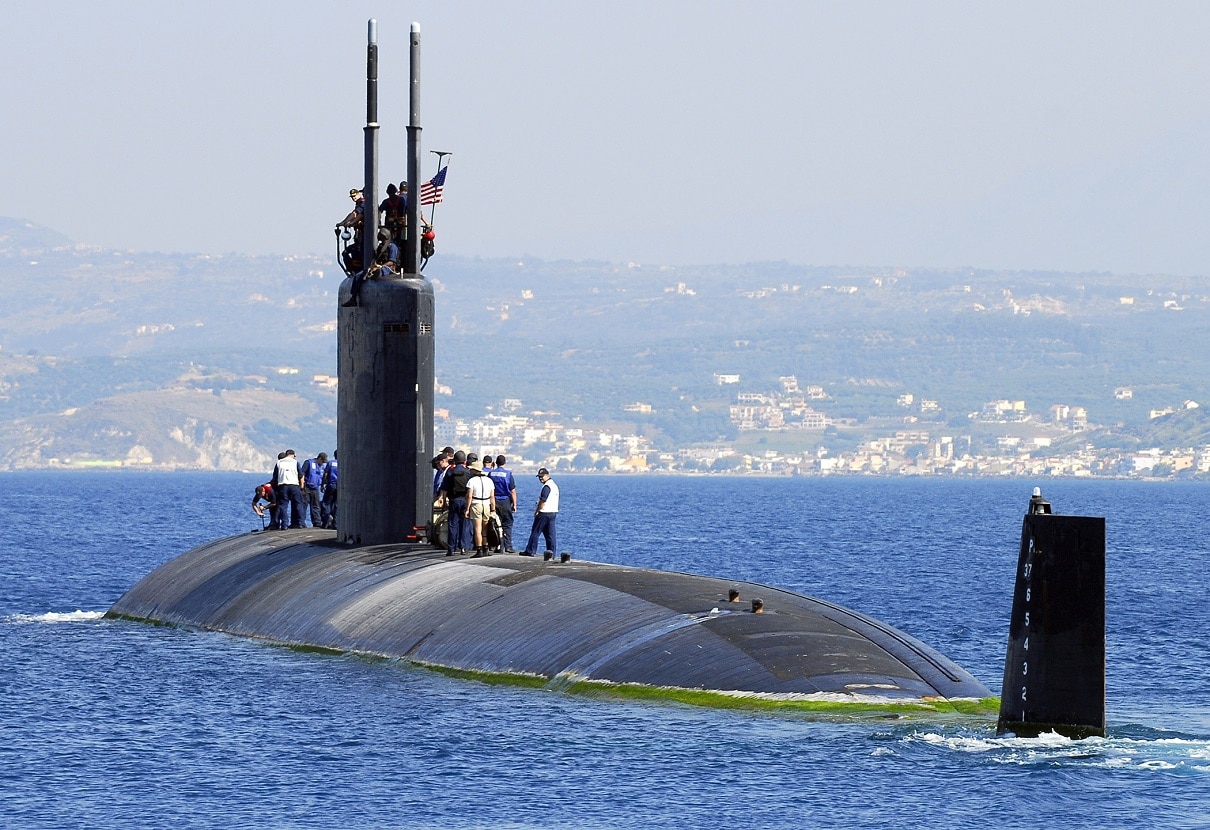
070615-N-0780F-004
SOUDA BAY, Crete, Greece (June 15, 2007) – Los Angeles-class fast-attack submarine USS Scranton (SSN 756) departs Souda harbor following a routine port visit to Greece’s largest island. Scranton is on deployment as part of the Bataan Expeditionary Strike Group (ESG), which returned earlier this month to the 6th Fleet area of responsibility. Bataan ESG has the capabilities to support maritime operations, combat operations and humanitarian assistance/disaster relief. U.S. Navy photo by Mr. Paul Farley (RELEASED)
The Collins-Class Submarine
The Collins-class submarine is a diesel-electric attack submarine, outdated relative to the nuclear attack submarines populating the US Navy.
But the diesel-electric variety does have significant advantages. Running on battery power, the Collins is extremely quiet—quieter than a nuclear boat.
The Collins is also large for a conventional submarine and optimized for long-range patrols in the Indo-Pacific.
She was explicitly designed to deny sea space, conduct ambush-style engagements, and operate in chokepoints and littoral waters.
As the exercise demonstrated, diesel-electric submarines are pretty dangerous. While nuclear submarines are faster and have longer endurance, diesel-electric boats are stealthier at low speed and harder to detect acoustically.
In exercises, the Collins-class was able to successfully exploit thermal layers, background noise, and gaps in ASW coverage.
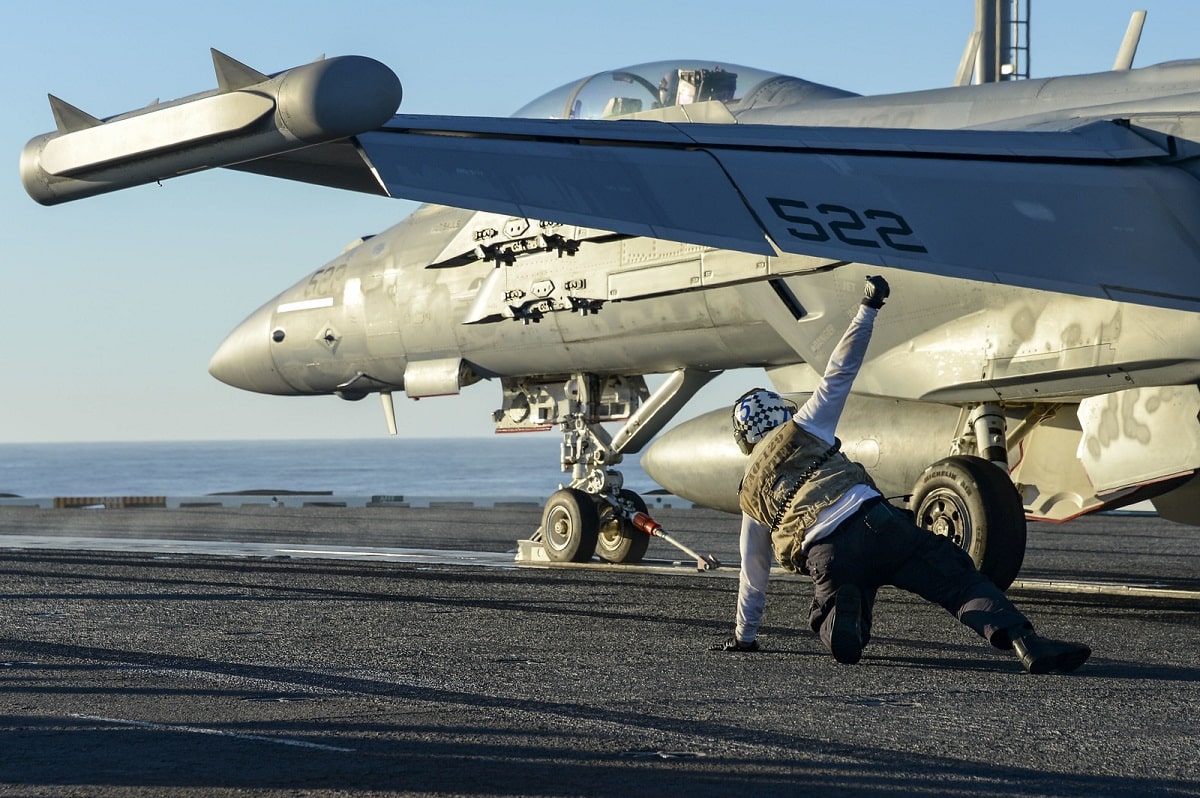
PACIFIC OCEAN (Nov. 16, 2020) Aviation Machinist’s Mate 2nd Class Ryan Rogers, from St. George, Utah, shoots an EA-18G Growler from the “Vikings” of Electronic Attack Squadron (VAQ) 129 on the flight deck of the Nimitz-class aircraft carrier USS Carl Vinson (CVN 70). Carl Vinson is currently underway conducting routine maritime operations. (U.S. Navy photo by Mass Communication Specialist 3rd Class Aaron T. Smith) 201116-N-SS900-1640
And as the exercise showed, a submarine doesn’t need to be consistently technologically superior; a submarine only needs one opening to execute.
The U.S. Navy Aircraft Carrier Strike Group (CSG) Explained
The CSG is, in its entirety, a marvel of naval technology.
But the CSG does have vulnerabilities. CSGs rely on surface vessels with sonar, helicopters with sonar, and maritime patrol aircraft.
But those features are confronted with the reality of ASW operations, namely, the vastness of the ocean, the limitations of sensors, and the fact that tracking is never continuous.
So, defending a carrier becomes a game of probability management, not a matter of absolute certainty.
And as the exercise demonstrated, it is exceedingly difficult to maintain a perfect ASW screen at all times.
What the U.S. Navy Learned
The US Navy extracted tactical lessons from the encounter.
Specifically, speed and size are liabilities in submarine warfare. Quietness and patience often matter more than raw power.
And ultimately, carrier defenses are strongest against air threats and missile threats. Submarine threats, meanwhile, are slow-burning and require constant vigilance.
But the exercise was not a declarative statement about US naval failures, by any means; exercises are intentionally designed to allow the defenders to “lose” to learn from mistakes.
Strategically, the exercise validated investment in submarines over surface combatants for the sake of sea denial.
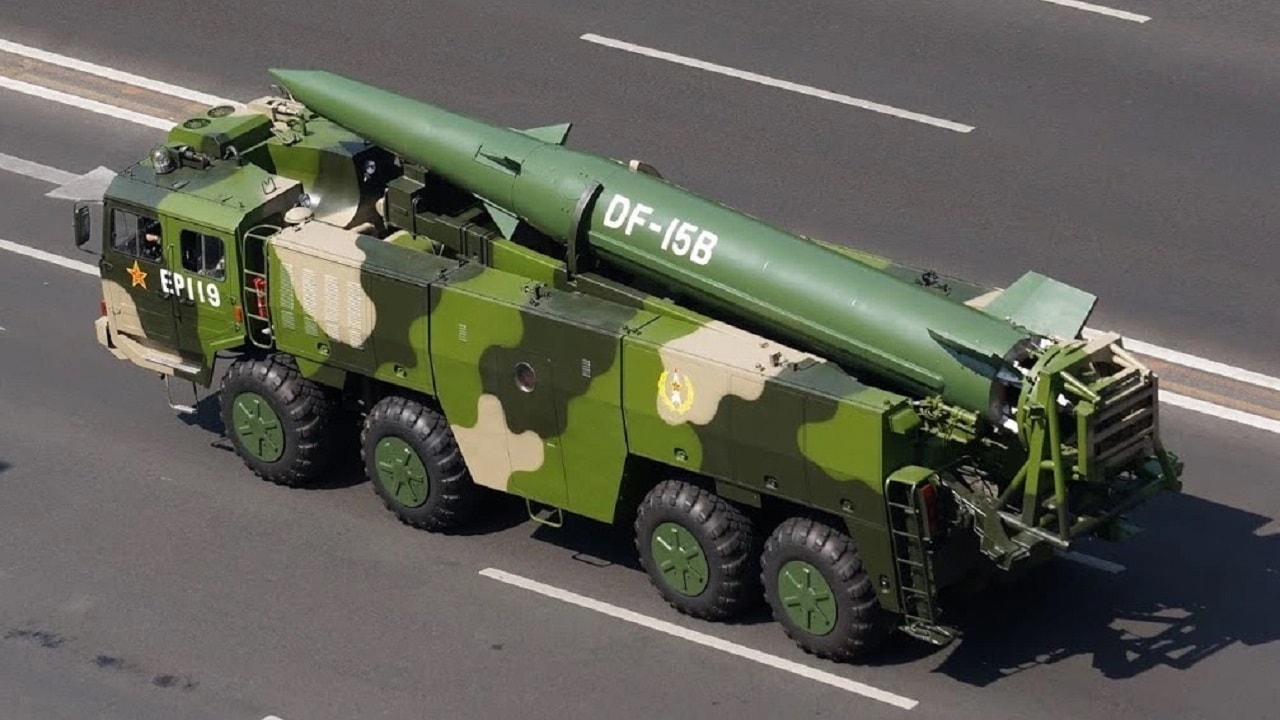
DF-15B missile from China
And the exercise validated Australia’s strategic posture: fielding a small navy with an outsized deterrent effect. For the US Navy, the exercise reaffirmed the importance of ASW training—and emphasized the danger of conventional submarines.
Russia and China, no doubt watching from afar, saw proof that affordable and relatively modest conventional submarines can threaten American supercarriers.
Within the broader Indo-Pacific, where the future of great power competition lies, the exercise offers insights.
The region is full of shallow areas that are acoustically complex—the type of places where diesel-electric submarines thrive, with checkpoints and archipelagic waters.
The implications for China help explain the emphasis on ASW expansion and validate US and allied submarine investment.
The exercise helps to clarify why submarines will remain central to modern naval strategy for the foreseeable future.
But the exercise does not mean carriers are obsolete, or that the US Navy is egregiously vulnerable to any submarine.
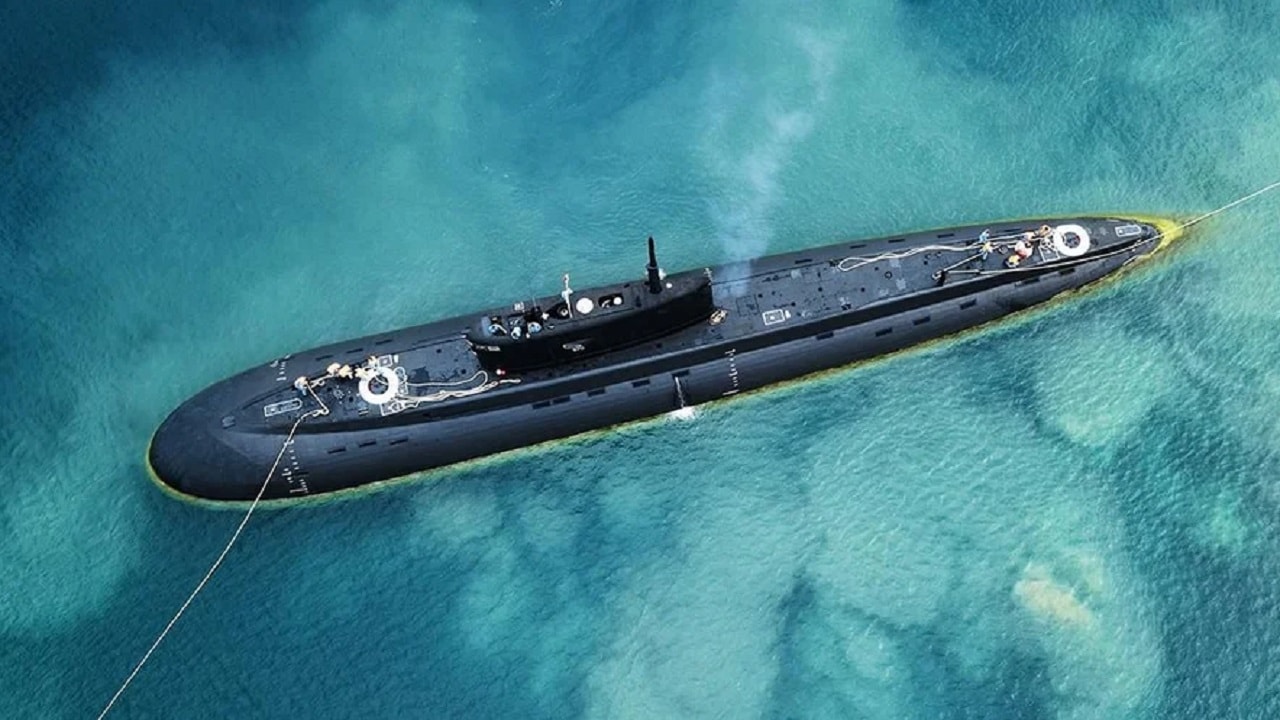
Kilo-Class Submarine. Image Credit: Creative Commons.
Exercises tend to exaggerate attacker success by placing the defender under meaningful constraints. Real-world combat would look different, with a layered response, aggressive countermeasures, and a higher risk tolerance.
So while the Collins showed that cheap platforms can cause problems for expensive ones, aircraft carriers remain unmatched tools for power projection.
But submarines, tranquil, conventional ones, remain the aircraft carriers’ most serious threat.
About the Author: Harrison Kass
Harrison Kass is an attorney and journalist covering national security, technology, and politics. Previously, he was a political staffer and candidate, and a US Air Force pilot selectee. He holds a JD from the University of Oregon and a master’s in global journalism and international relations from NYU.