
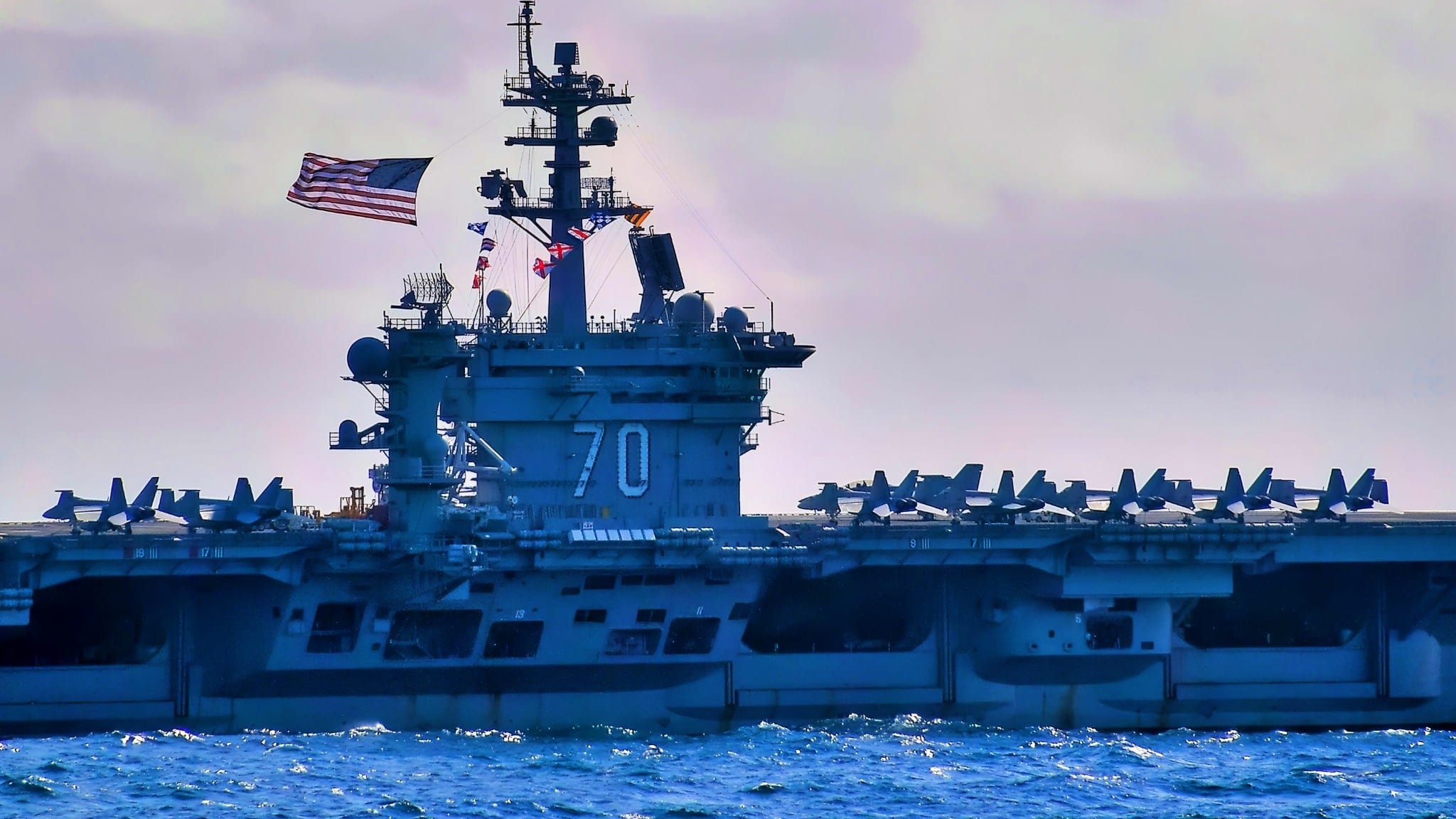
Key Points and Summary – China is racing to expand its aircraft carrier fleet, but its real bet is on land-, air-, and sea-launched missiles designed to keep U.S. supercarriers at arm’s length.
-Expert Harrison Kass explains how DF-series anti-ship and hypersonic weapons, plus YJ cruise missiles, form the backbone of Beijing’s A2/AD strategy inside the first and second island chains.
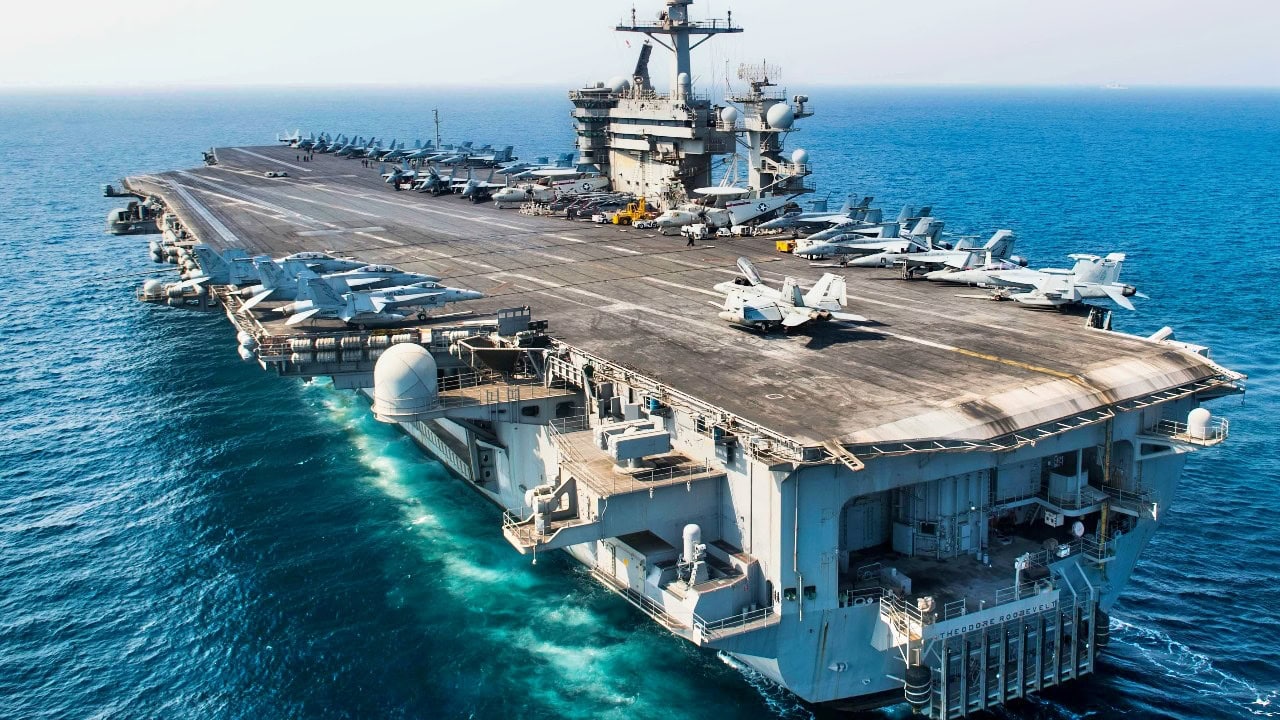
(Oct. 10, 2015) The aircraft carrier USS Theodore Roosevelt (CVN 71) transits the Arabian Gulf. Theodore Roosevelt is deployed in the U.S. 5th Fleet area of operations supporting Operation Inherent Resolve, strike operations in Iraq and Syria as directed, maritime security operations and theater security cooperation efforts in the region.
-China doesn’t need aircraft carrier parity to win; it just needs to push U.S. strike groups far enough east to blunt their impact.
-Washington is adapting with longer-range airpower and unmanned systems, but any fight near Taiwan will start under a Chinese missile umbrella.
China’s Aircraft Carrier Strategy Against the U.S. Navy Is Clear
China currently fields three aircraft carriers, with plans to field six by 2040—ambitious, but still far fewer than the 11 nuclear-powered super carriers the US operates presently.
Despite China’s ambitious shipbuilding spree, Beijing is in no way close to threatening the US with carrier parity; China cannot match the US carrier-for-carrier.
But China doesn’t need to. Whereas the US employs a blue-water navy to project power globally, China’s intentions are calibrated to establish regional dominance.
To that end, the Chinese carrier fleet won’t pose the primary threat to US carriers in the region; instead, a sophisticated missile architecture will keep US aircraft carriers operating in the Indo-Pacific in check.
Different Strategies
US aircraft carriers allow the US military to project power anywhere on Earth, a capability compatible with America’s global ambitions.
But China’s immediate ambitions are more humble: to project power (and deny access) regionally, within the first and second island chains. The Chinese navy is designed accordingly: for conflict with Taiwan, for defense of the South and East China Seas, for deterring US intervention, and for maintaining sea lines.
Carriers can support these aims, yes. But carriers are extremely expensive, slow to build, and vulnerable once deployed. Missiles, meanwhile, are cheap, high-volume, and quite threatening to US surface forces. Missiles will form a critical component of China’s imposing A2/AD network.
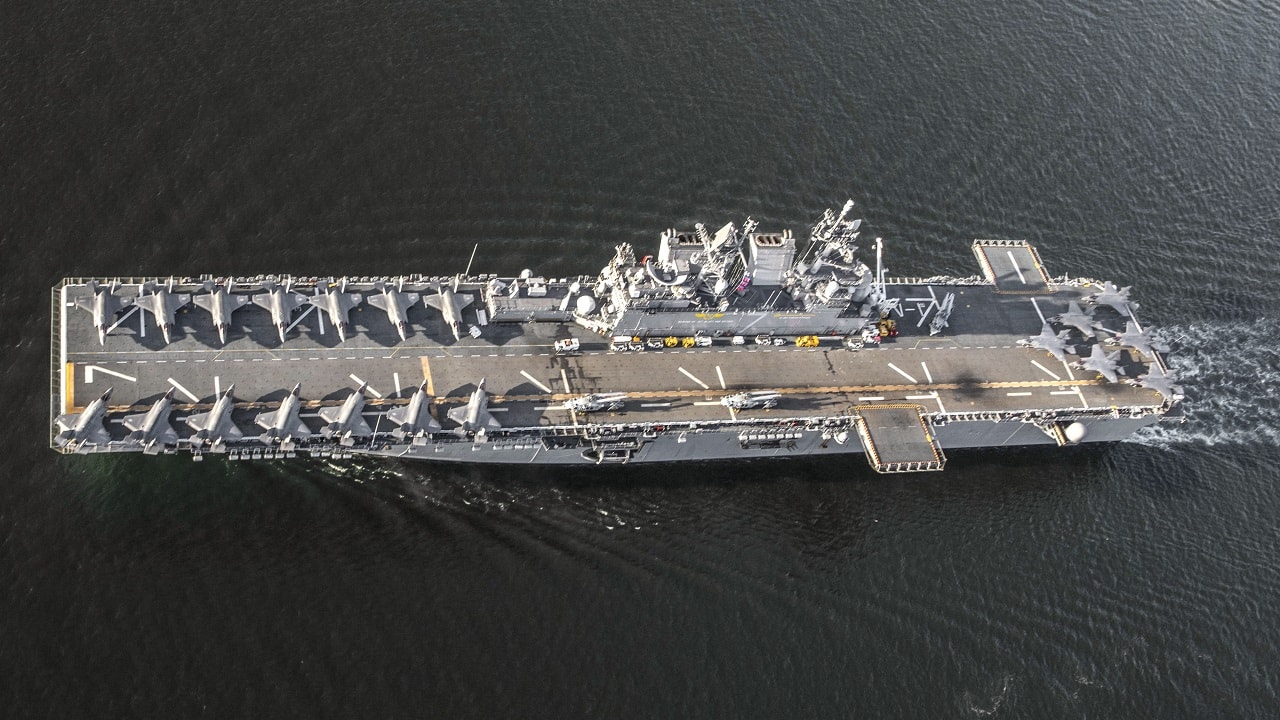
Amphibious assault ship USS Tripoli (LHA- 7) , departs Naval Air Station North Island, Calif., April 7, 2022. Tripoli completed flight deck operations with 20 F-35B Lightning II jets from Marine Fighter Attack Squadrons 211 and 225, Marine Aircraft Group 13, and 3rd Marine Aircraft Wing, as well as Marine Operational Test and Evaluation Squadron 1, as part of the U.S. Marine Corps’ Lightning carrier concept demonstration. The Lightning carrier concept demonstration shows Tripoli and other amphibious assault ships are capable of operating as dedicated fixed-wing strike platforms when needed, capable of bringing fifth generation Short Takeoff/Vertical Landing aircraft wherever they are required. (U.S. Marine Corps photo by Sgt. Samuel Ruiz)
A2/AD or anti-access/area-denial is designed to prevent US forces from entering the region, and to punish them if they do.
In support of the A2/AD strategy, rather than meet the US Navy at sea in a Midway-style carrier showdown, China is building an arsenal designed to engage carriers from a distance using precision fire.
Specifically, China is developing a variety of missiles. Here’s an inventory rundown.
First, Land-Based Anti-Ship Ballistic Missiles (ASBMs), including the DF-21D “carrier killer” and DF-26B.
These missiles are launched from mainland China, offering depth and dispersal.
Second, hypersonic missiles like the DF-17 and DF-27. These missiles, capable of exceeding Mach 5, are extremely difficult to defend against.
They attack from high altitude, high speed, and unpredictable trajectories. The DF-27 is particularly concerning, with a range of 5,000 miles, potentially forcing US carriers to operate outside an envelope from which they can meaningfully participate in a conflict.
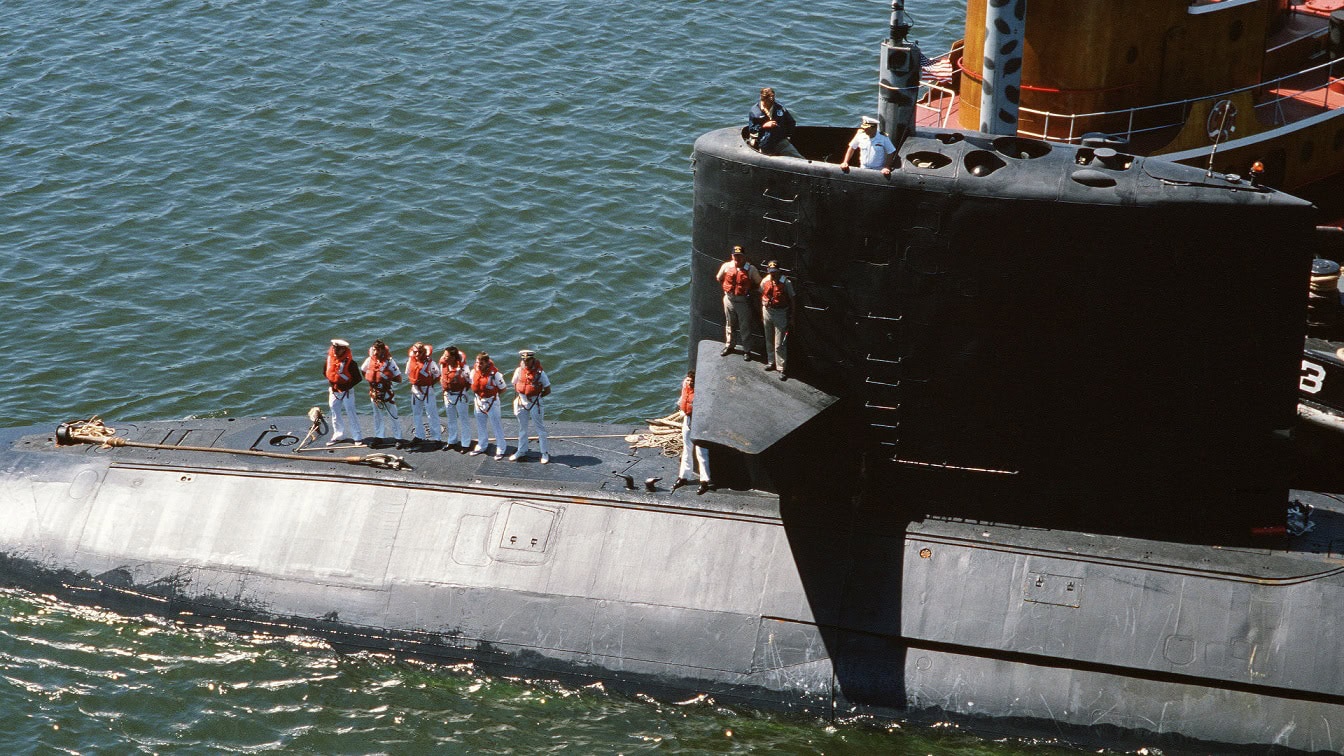
DF-ST-89-02248 A mooring party stands by on the deck of the damaged submarine USS BONEFISH (SS 582) as tug boats assist the ship into a berth. The BONEFISH became disabled when it experienced a mid-ocean engine problem. Location: NAVAL STATION, CHARLESTON
Third, Submarine-Launch Ballistic Missiles (SLBMs), like the YJ-18 and YJ-21, can be launched from submarines, which can be difficult to detect. Last, Air-Launched Anti-Ship Missiles.
The H-6K bomber, J-16, and J-20 fighter carry the YJ-12 supersonic anti-ship missiles, posing a stand-off airborne threat to US surface vessels.
Centering missiles in the A2/AD strategy makes more sense than investing heavily in carriers. Missiles are a cheap way to generate quantity. Carriers are costly and will never be produced in large quantities.
Carriers take many years to build, whereas missiles can be produced quickly in large numbers.
Then, once operational, missiles can be launched in saturation waves that overwhelm defenses. And China’s goal isn’t necessarily to sink US carriers, but only to force them beyond their effective range.
US carriers are vulnerable to Chinese missiles; carriers are slow-moving targets that will not be able to operate close to Taiwan or the Chinese mainland without incurring significant risk.
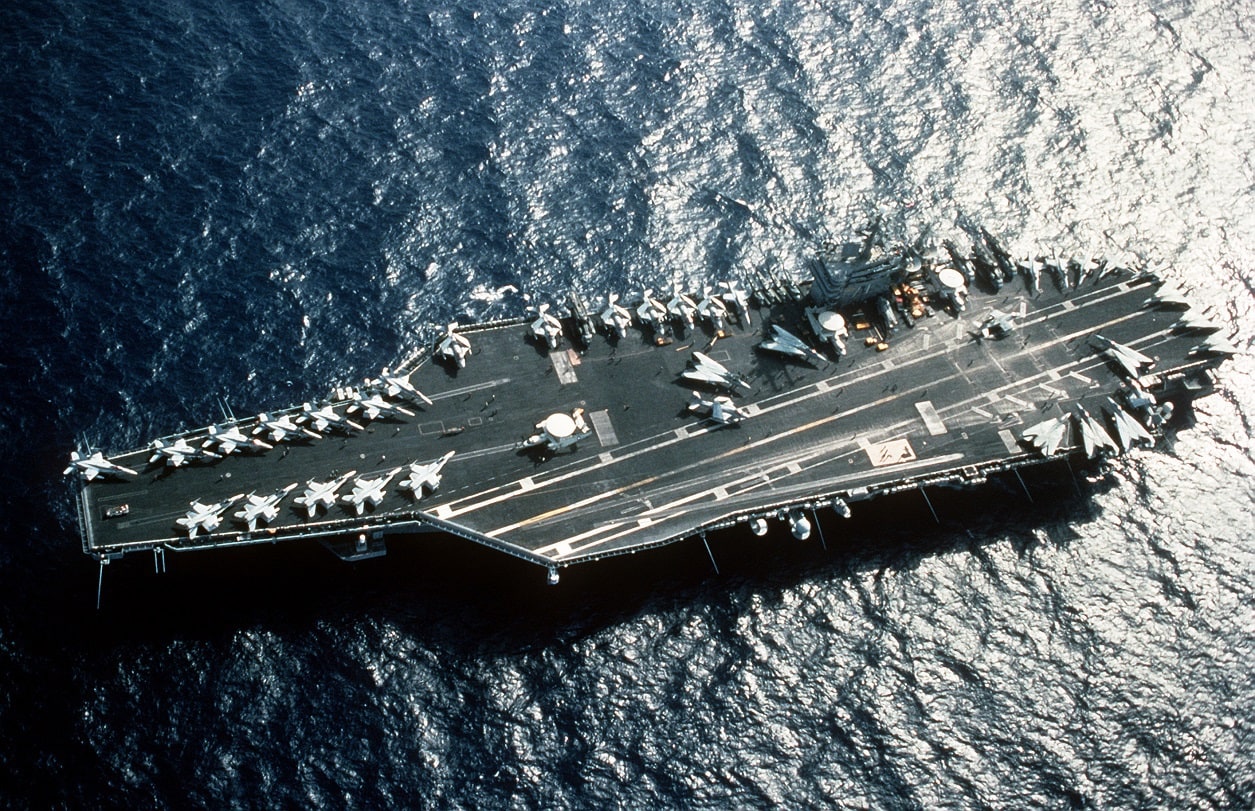
An overhead view of the nuclear-powered aircraft carrier USS THEODORE ROOSEVELT ( CVN-71).
The U.S. Military Sees the Threat
But as China has adapted to deny US carrier access, the US is adapting to sidestep Chinese missiles.
Specifically, the US is modifying its tactics and doctrine to operate further outside of the A2/AD bubble, where missile strikes become less likely.
Longer-range aircraft capabilities, complemented with enhanced stealth features, are being developed.
And reliance on autonomous and undersea assets will likely increase. So the US will not be rendered entirely incapable just because China employs missiles capable of targeting US carriers.
But the Chinese missile investment is significant, extending a massive A2/AD umbrella that the US must penetrate just to intervene. US forces will likely need to fight from farther out, which slows response times, reduces sortie rates, and exacerbates the US disadvantage of operating far from home.
In effect, China has built a system that depends upon missiles, not carriers. America’s carrier fleet is still a global outlier, an unrivaled source of power projection.
But in the Indo-Pacific, China has developed a defensive architecture that gives the US fleet pause.
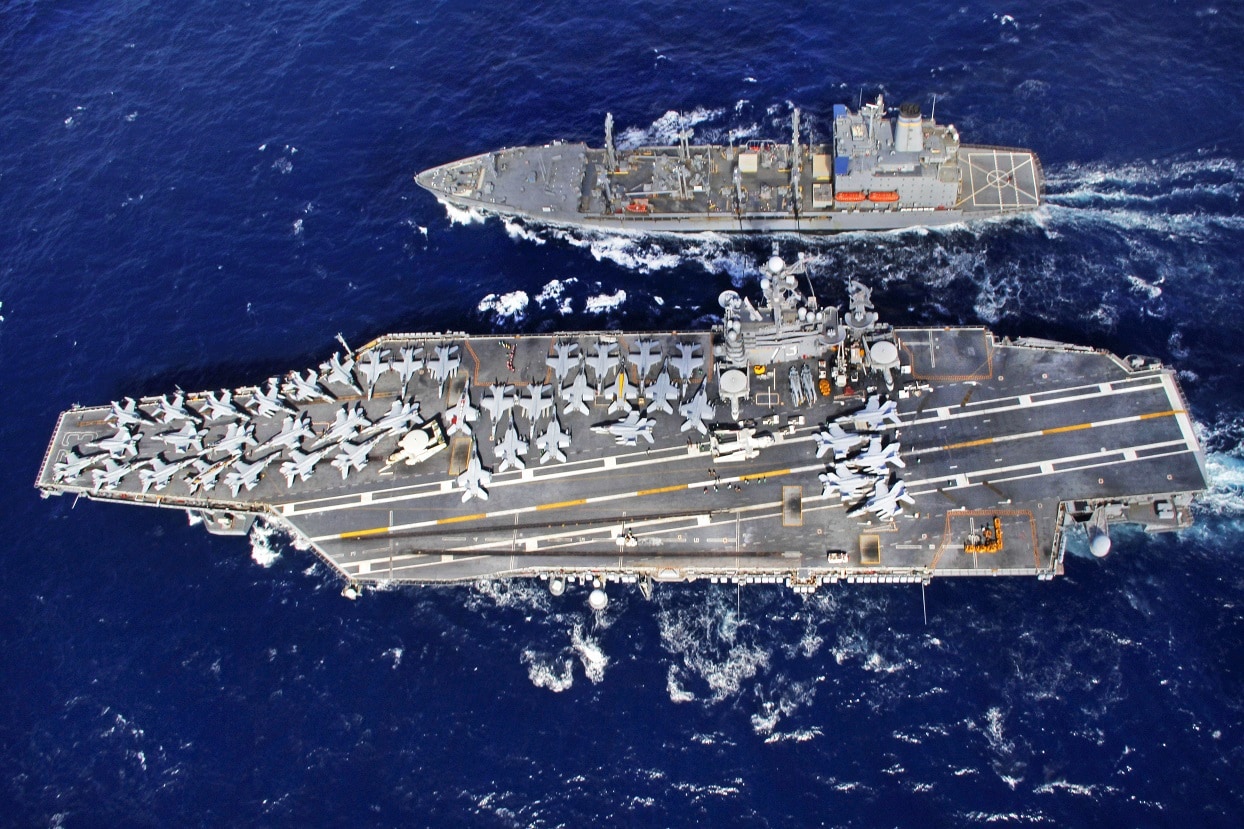
(July 19, 2013) The aircraft carrier USS George Washington (CVN 73) conducts a replenishment-at-sea with the Military Sealift Command fleet replenishment oiler USNS Yukon (T-AO 202) during Talisman Saber 2013. The exercise is a biennial training event aimed at improving Australian Defense Force and U.S. combat readiness and interoperability as a combined joint task force. (U.S. Navy photo by Mass Communication Specialist 2nd Class Benjamin K. Kittleson/Released)
About the Author: Harrison Kass
Harrison Kass is an attorney and journalist covering national security, technology, and politics. Previously, he was a political staffer and candidate, and a US Air Force pilot selectee. He holds a JD from the University of Oregon and a master’s in global journalism and international relations from NYU.