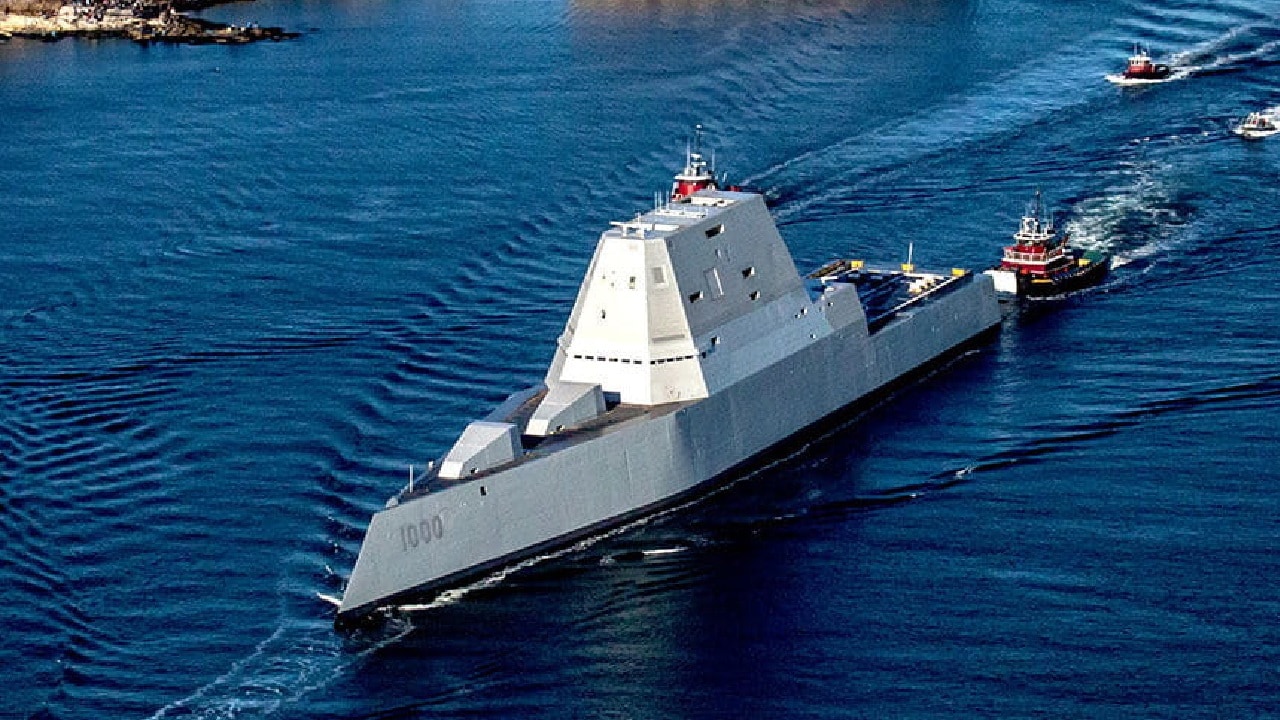
Key Points and Summary – The troubled USS Zumwalt class is about to get a defining mission: launching long-range hypersonic glide weapons under the Navy’s Conventional Prompt Strike program.
-These ultra-fast missiles, shared with the Army’s Dark Eagle system, can reach thousands of miles, maneuver in flight, and are extremely hard to track and intercept.
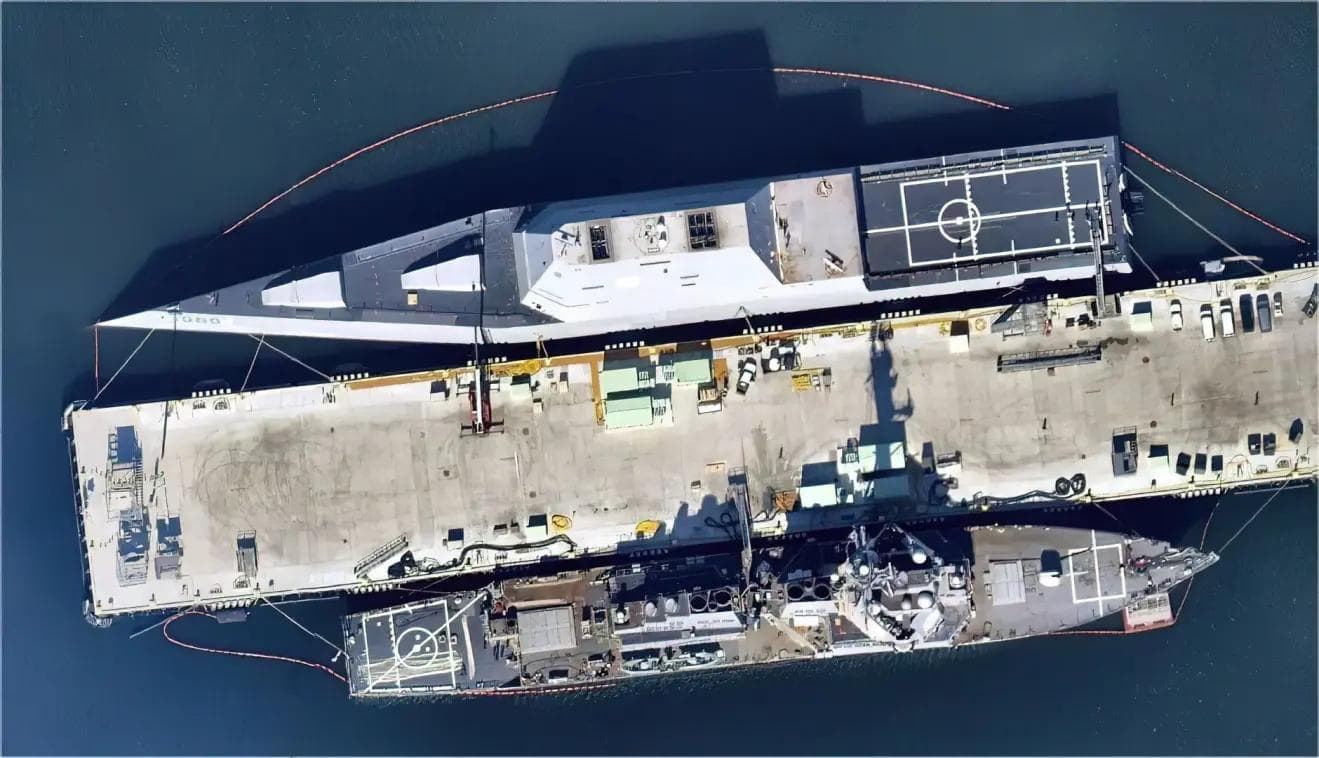
Zumwalt-Class. Image Credit: Creative Commons.
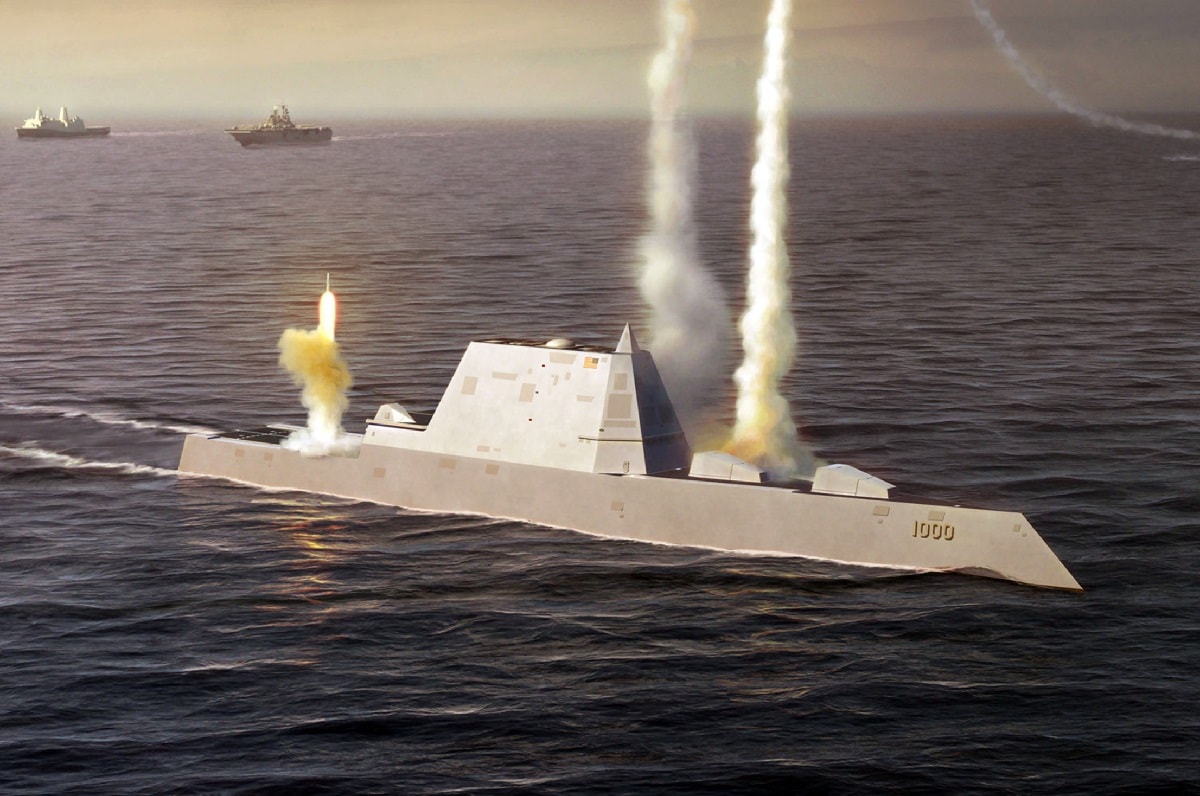
An artist rendering of the Zumwalt class destroyer DDG 1000, a new class of multi-mission U.S. Navy surface combatant ship designed to operate as part of a joint maritime fleet, assisting Marine strike forces ashore as well as performing littoral, air and sub-surface warfare. (U.S. Navy photo illustration/Released)
-Mated to the Zumwalt’s low-observable hull, they turn the stealth destroyer into a surprise deep-strike asset against high-value targets, including Chinese forces inside A2/AD zones.
-As Beijing fields its own DF-17 and YJ-series hypersonics, a Zumwalt-based hypersonic punch becomes central to U.S. deterrence in the Western Pacific.
USS Zumwalt Is Finally Getting Hypersonic Missiles – Here’s Why It Matters
The destroyer USS Zumwalt and her two sister ships have surely had their share of problems. However, they might soon be armed with hypersonic missiles.
Able to strike targets from thousands of miles at five times the speed of sound, this future attack option will likely be able to hold even the most advanced adversaries at risk.
Hypersonic missiles introduce new tactics and concepts of operation for maritime warfare.
Going Long, Striking Fast
The U.S. Navy’s plan to arm its three Zumwalt-class vessels with hypersonic missiles first came to light some years ago. The technology has progressed to the point now that the tactical advantages of the plan have some shape and context.
The destroyers will be armed with a hypersonic glide vehicle developed under Conventional Prompt Strike—a program to create a precision missile intended to hold any target in the world at risk of an ultra-long-range, high-speed missile attack. When launched, an aerodynamic projectile will travel up to the boundary of the Earth’s atmosphere with a booster, then enter a glide phase during which the hypersonic projectile uses its speed of descent to glide into and destroy a target.
Stealthy Zumwalt
Years ago, U.S. Naval Sea Systems Command published an essay stating that the stealthy, curved USS Zumwalt appeared as a “small fishing boat” to enemy radar. The hull of the ship is smoothly curved to avoid sharp edges or protruding structures more likely to generate a return signal to enemy radar.
A ship able to launch hypersonic missile attacks while obscured from view presents a significant tactical advantage.
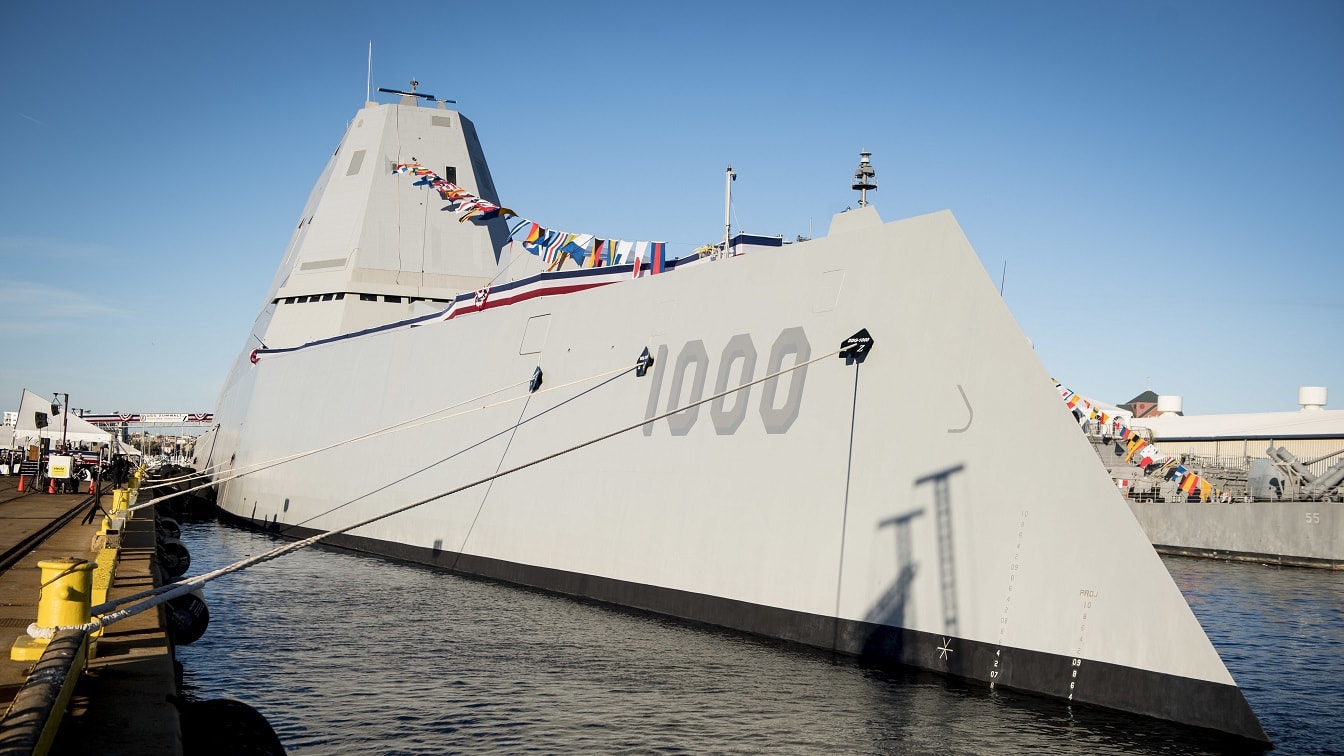
(Oct. 15, 2016) The Navy’s newest and most technologically advanced warship, USS Zumwalt (DDG 1000), is moored to the pier during a commissioning ceremony at North Locust Point in Baltimore. (U.S. Navy photo by Petty Officer 1st Class Nathan Laird/Released)
It could introduce an element of surprise to the surface Navy while also improving survivability. The capability could expand the concepts of operation for the Zumwalt-class, a small group of high-tech destroyers initially envisioned for land attack missions.
Hypersonic Glide Vehicles
Conventional Prompt Strike has developed in collaboration with the U.S. Army initiative to build the Long Range Hypersonic Weapon – both programs will integrate a common hypersonic glide body.
This common projectile, described as an “all up round,” integrates differently into each weapon to enable a long-range, maneuverable projectile. That maneuverability will make the missile much more difficult to track and intercept than a standard ballistic missile, which follows a predictable parabola-like trajectory.
The pure speed of a hypersonic glide vehicle makes it harder to target as well, given that it transits from one radar’s field of view to another so quickly that radar defense systems are challenged to develop a continuous target track.
Unlike an air-breathing scramjet, which uses sustained rocket propulsion to sustain hypersonic speed, a glide vehicle uses the purse speed of its descent to strike targets.
Typically, hypersonic glide vehicles have a much longer range than scramjets – that and its maneuverability are key reasons the U.S. Navy envisions them as a tool to strengthen the threat of long-range strike and enhance deterrence.
Most of the maneuvering of a glide vehicle is programmed prior to or at launch, and many of them can use GPS or an inertial navigation system for guidance.
Developers of Conventional Prompt Strike and the Long Range Hypersonic Weapon are already anticipating the next generation of hypersonic attacks and are working on software to enable a hypersonic glide vehicle to hit moving targets.
Deter Chinese Hypersonics
The arrival of sea-launched hypersonic weapons is potentially critical to deterrence, given the known progress of the People’s Liberation Army (PLA) in the realm of hypersonics.
The PLA is known to operate the DF-17 hypersonic weapon, and the sea-launched YJ-20 projectile has been tested several times.
Further, the Chinese government–backed Global Times newspaper published an essay last year stating that an H-6 bomber has carried an air-launched YJ-21 variant of this weapon.
During a recent parade, China also showed off several hypersonic weapons that had not been seen publicly before.
China’s YJ-20 was shown, a fact cited in the Global Times, but the display also included the YJ-15, YJ-17, and YJ-19.
The YJ-19 shows an air inlet, which hints at an air-breathing scramjet type of technology, yet much is unknown about the technical specifics of China’s hypersonics arsenal.
Hypersonic Offense and Defense
The arrival of Conventional Prompt Strike on Zumwalt-class destroyers could be especially important in the Western Pacific.
Moving forward, it seems conceivable that ship-launched hypersonic weapons could be used for defensive purposes to help stop, blunt, or slow down an incoming salvo of ballistic and hypersonic weapons.
This is significant, given the concern that China might seek to exploit its current advantage in hypersonic weapons to create a defensive bubble within which opposing forces could not operate.
Such a capability could support a surprise attack on Taiwan, given the PLA’s known arsenal. Should the U.S. Navy develop a comparable hypersonic attack capability, it could very well function as a deterrent.
About the Author: Kris Osborn
Kris Osborn is the President of Warrior Maven – Center for Military Modernization. Osborn previously served at the Pentagon as a highly qualified expert in the Office of the Assistant Secretary of the Army—Acquisition, Logistics & Technology. Osborn has also worked as an anchor and on-air military specialist at national TV networks. He has appeared as a guest military expert on Fox News, MSNBC, The Military Channel, and The History Channel. He also has a Masters Degree in Comparative Literature from Columbia University.