
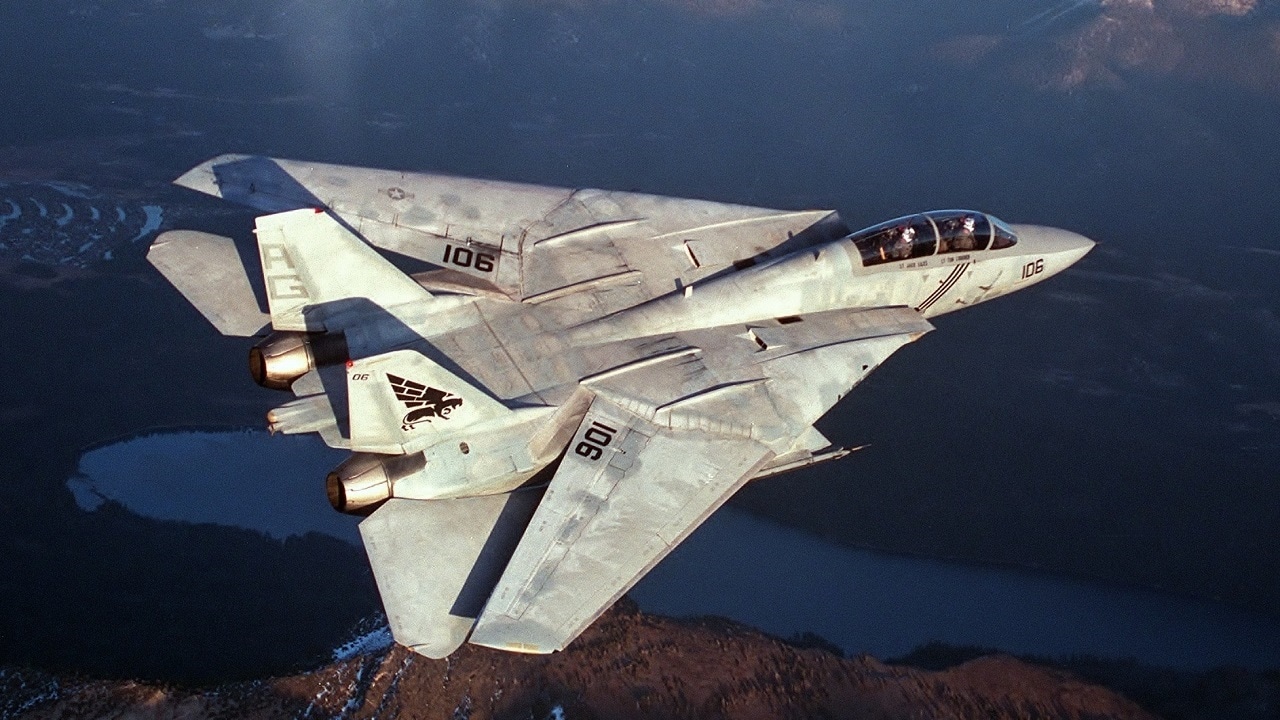
Key Points and Summary: During the early days of the war in Afghanistan, the F-14 Tomcat proved its versatility not just as a fighter, but as a formidable close air support platform.
The Incident: On November 17, 2001, an F-14B from VF-102 ran out of guided munitions while defending Special Forces near Tarin Kowt.
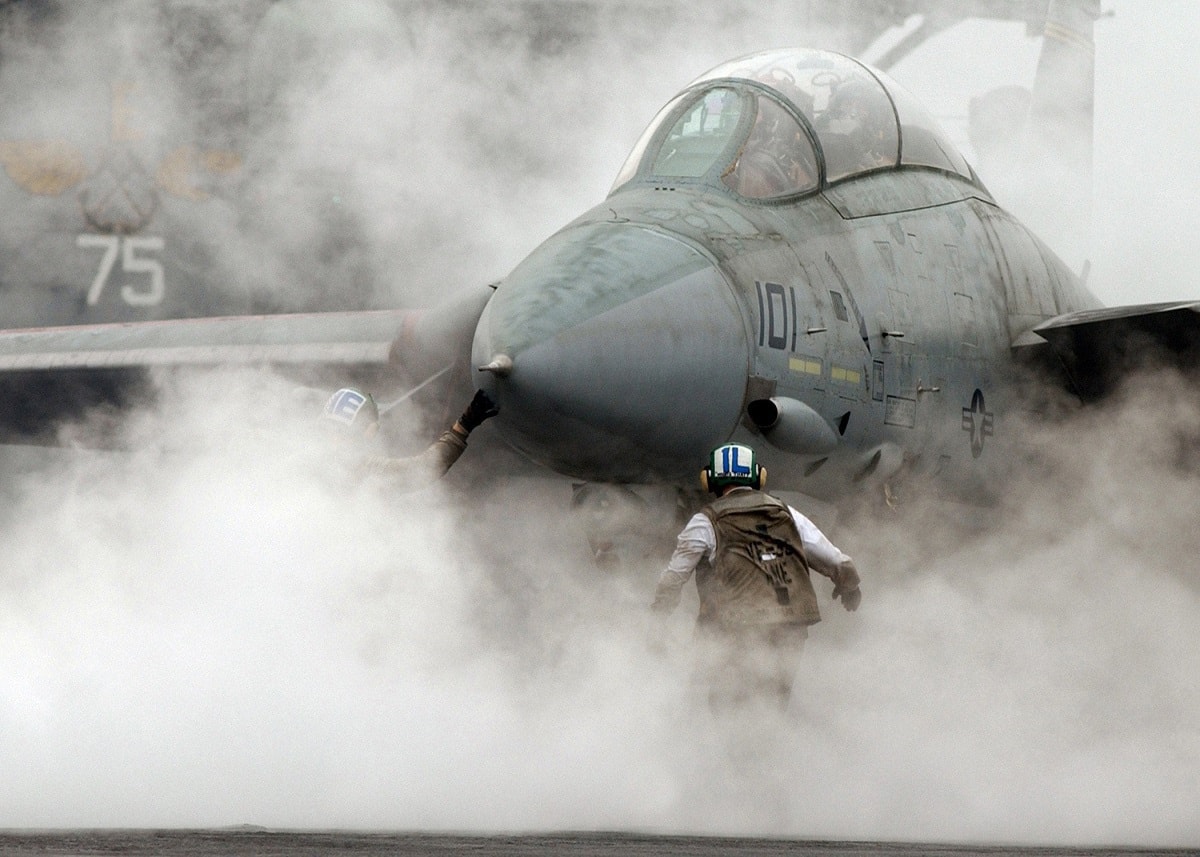
F-14 Image Credit: Creative Commons.
The Action: With a Taliban tank advancing, the pilot executed a strafing run using the jet’s 20mm M61 Vulcan cannon—a “weapon of last resort”—successfully stopping the armor.
The Legacy: This event highlighted the F-14’s evolution into the “Bombcat,” flying some of the longest carrier-launched strikes in history before its 2006 retirement.
During Operation Enduring Freedom, the campaign to invade Afghanistan that followed the 9/11 attacks, the F-14 Tomcat was a big part of the air power on display. In fact, in 2012, a whole book was written about it—”F-14 Tomcat Units of Operation Enduring Freedom,” by aviation expert Tony Holmes.
The book, according to its description, provides a study of that jet and the role it played in Afghanistan, using testimony and photographs from the private collections of those who flew the F-14s.
The book description calls it “the weapon of choice to strike against the enemies of the United States in the wake of the September 11 attacks, with F-14s flying thousands of bombing missions on al-Qaeda and Taliban positions.”
Last month, drawing on that book, Aviation Geek Club wrote about an important moment from that war, when an F-14 Tomcat stopped a Taliban tank.
Setting the Stage
It happened in the early weeks of the war, when the F-14, per Aviation Geek Club, “led the first manned air strikes during Operation Enduring Freedom on Afghanistan in October 2001.” The F-14s took off from aircraft carriers in the Northern Arabian Sea, usually on six-to-eight-hour missions.
Then came what’s known as the Battle of Tarin Kowt.
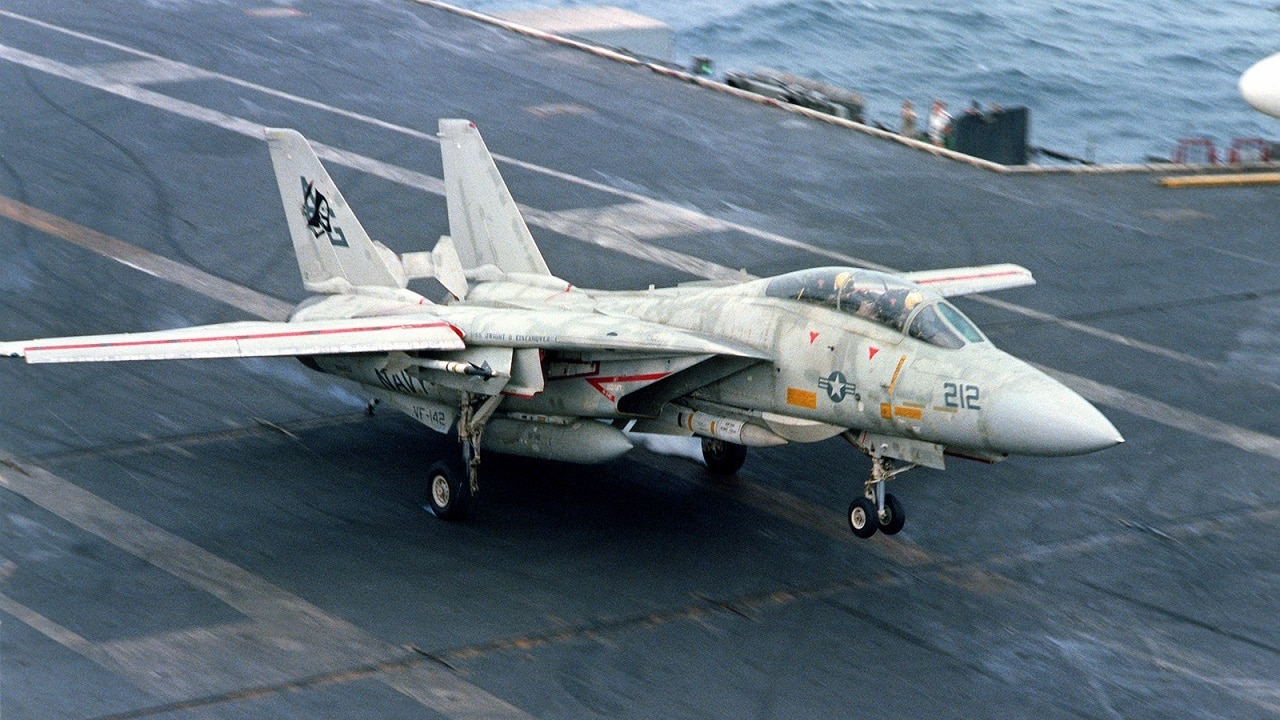
An F-14 Tomcat aircraft makes an arrested landing on the flight deck of the nuclear-powered aircraft carrier USS DWIGHT D. EISENHOWER (CVN-69). The F-14 is assigned to Fighter Squadron 142 (VF-142).
The following month, specifically the morning of November 17, 2001, Fighter Squadron 102 (VF-102) “Diamondbacks” was defending Tarin Kowt, the capital of Uruzgan province. Pashtun leader Hamid Karzai had just sparked a revolt against the Taliban, and Karzai moved in, along with members of SOF A-Team 574.
That day, with the Taliban’s tanks and trucks headed to Tarin Kowt when airstrikes were called in, the first on the scene were Hornets and Tomcats from the CVW-1’s VMFA-251 and VF-102.
“Flying the lead F-14B (BuNo 163225) in the Diamondbacks section was the unit’s maintenance officer and his RIO,” the Aviation Geek Club account said. “Over the next two hours, they provided more than 30 FAC(A) controls for Hornets and Tomcats dropping precision-guided munitions and Mk 83 airburst bombs (the latter exclusively from F-14Bs).”
The Weapon of Last Resort
The Taliban, however, kept moving towards the city, with a tank among its vehicles. By that point, the crew of BuNo 163225 had used all of their LGBs, with only a 20mm cannon remaining.
“The cannon was our weapon of last resort, as we had run out of ordnance and there was no one available to relieve us on station,” the maintenance officer said in the book. “We didn’t want to strafe, but we had no choice, as the nearest jet with bombs was ten minutes away.”They therefore moved into a “classical forward quarter attack.”
“My wingman strafed first, and his gun jammed after he had fired just a single burst,” the maintenance officer said in the book. “We then came in from the same direction and made two passes, and although I am uncertain as to whether we hit the tank or not, it stopped, and at least one crewman got out. A third pass was made on a truck that was also on the move, and it too was stopped in its tracks.'”

Although the F-14 was originally developed as an air superiority fighter and long-range interceptor, its potential as a strike aircraft was recognized years after it entered the fleet.
The VF-102’s maintenance officer and his RIO were both awarded the Distinguished Flying Cross.
It’s not clear if the tank was destroyed, but it was struck. And Tarin Kowt was not recaptured by the Taliban that day. However, 20 years later, in August of 2021, after the US withdrawal and shortly before the Taliban’s return to power, they recaptured what had been an Australian base in Tarin Kowt.
“The latest significant blow was the loss of the capital of Helmand province, where American, British, and allied NATO forces fought some of the bloodiest battles in the past 20 years. Hundreds of foreign troops were killed in the province, which is also a major opium hub,” The Sydney Herald wrote of the 2021 fall of the base.
The Tomcat in the War
Per an article in The Aviationist in 2020, its use in Afghanistan was part of the significant evolution of the Tomcat from a part of the Fleet Air Defense into what became known as the “Bombcat.”
As the Afghanistan war began in 2001, “the F-14As of VF-14 ‘Tophatters’ and VF-41′ Black Aces’ were embarked on USS Enterprise on their last cruise with the Tomcat,” The Aviationist reported. “They were on the closest carrier to Afghanistan and, with the F-14Ds of VF-213 “Black Lions” embarked on the USS Carl Vinson (CVN-70), arriving in the area, they became the first aircraft to be employed in Operation Enduring Freedom (OEF).”
Tomcats, Hornets, and Prowlers, the piece said, “flew more than 700 miles (1,126km) from their carriers in six to ten hours-long missions in the longest carrier-launched strikes in history.”
Meanwhile, VF-11 “Red Rippers” and VF-143 “Pukin Dogs” headed to Afghanistan the following year. The Tomcats of VF-31 “Tomcatters” and VF-213 “Black Lions ” received the 500 lb GBU-38 JDAM by 2005, the year before the Tomcat was retired.
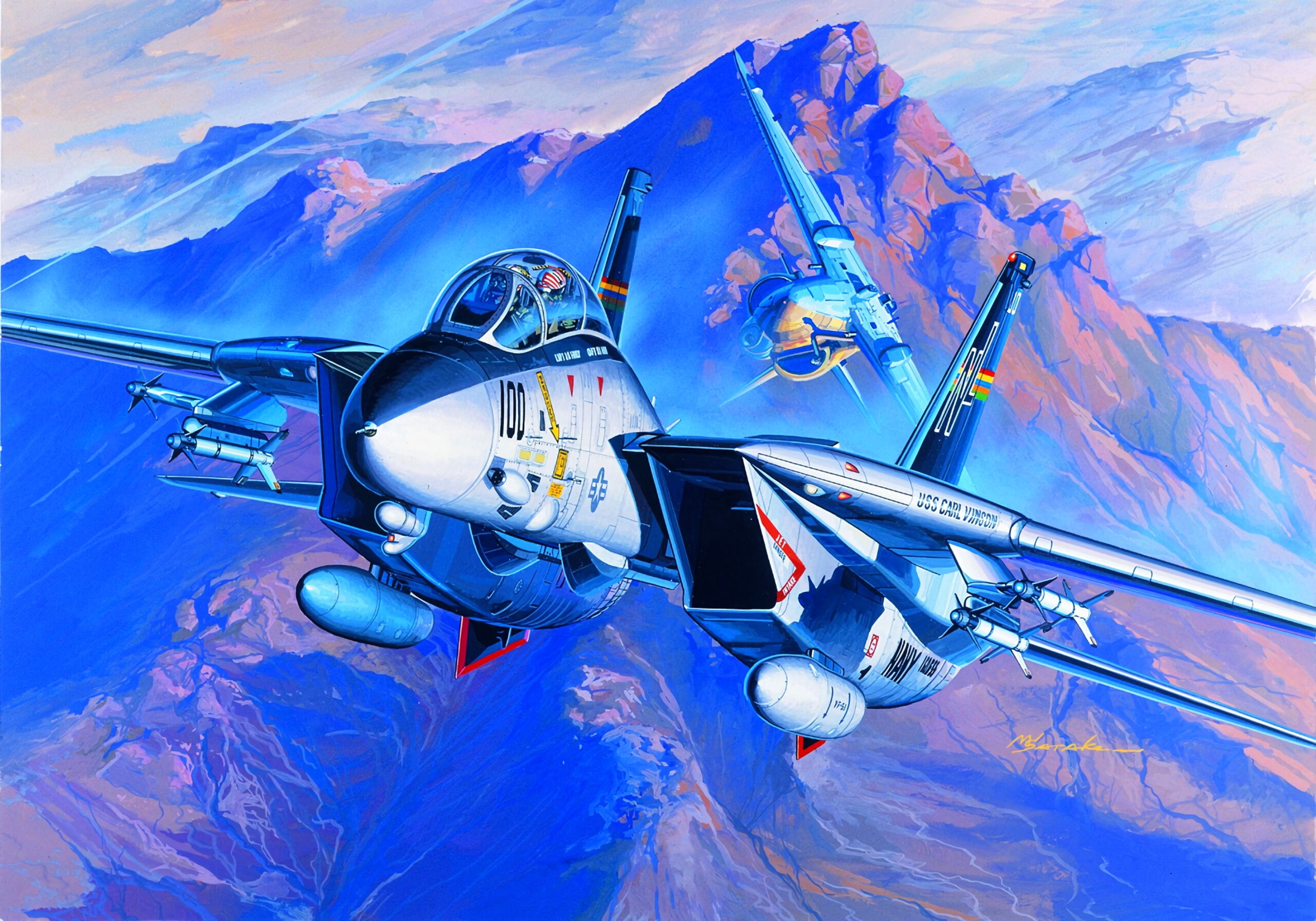
F-14 Fighter. Image Credit: Creative Commons.
Retirement for the F-14 Tomcat
The F-14 Tomcat was retired in September 2006. In addition to its exploits in military combat over the course of 36 years, the Tomcat is also known for its fictional use in the 1986 movie Top Gun.
TV station 13 News Now paid tribute to the final flight earlier this year, to mark the 19th anniversary of its retirement.
“I think just the size and what it does. It was the premier fighter in the mid-80s. After Desert Storm, we strapped some bombs on it and it did precision strikes in the next Gulf War,” Captain Skip Zobel told the station.
“The celebration’s always great, but yeah, sure, a few tears have already been shed,” Zobel said of the jet’s retirement. “But I’ll tell you, this is one of the greatest events I’ve seen in 30 years and will probably never see it again in my lifetime.”
About the Author: Stephen Silver
Stephen Silver is an award-winning journalist, essayist, and film critic, and contributor to the Philadelphia Inquirer, the Jewish Telegraphic Agency, Broad Street Review, and Splice Today. The co-founder of the Philadelphia Film Critics Circle, Stephen lives in suburban Philadelphia with his wife and two sons. For over a decade, Stephen has authored thousands of articles that focus on politics, national security, technology, and the economy. Follow him on X (formerly Twitter) at @StephenSilver, and subscribe to his Substack newsletter.