
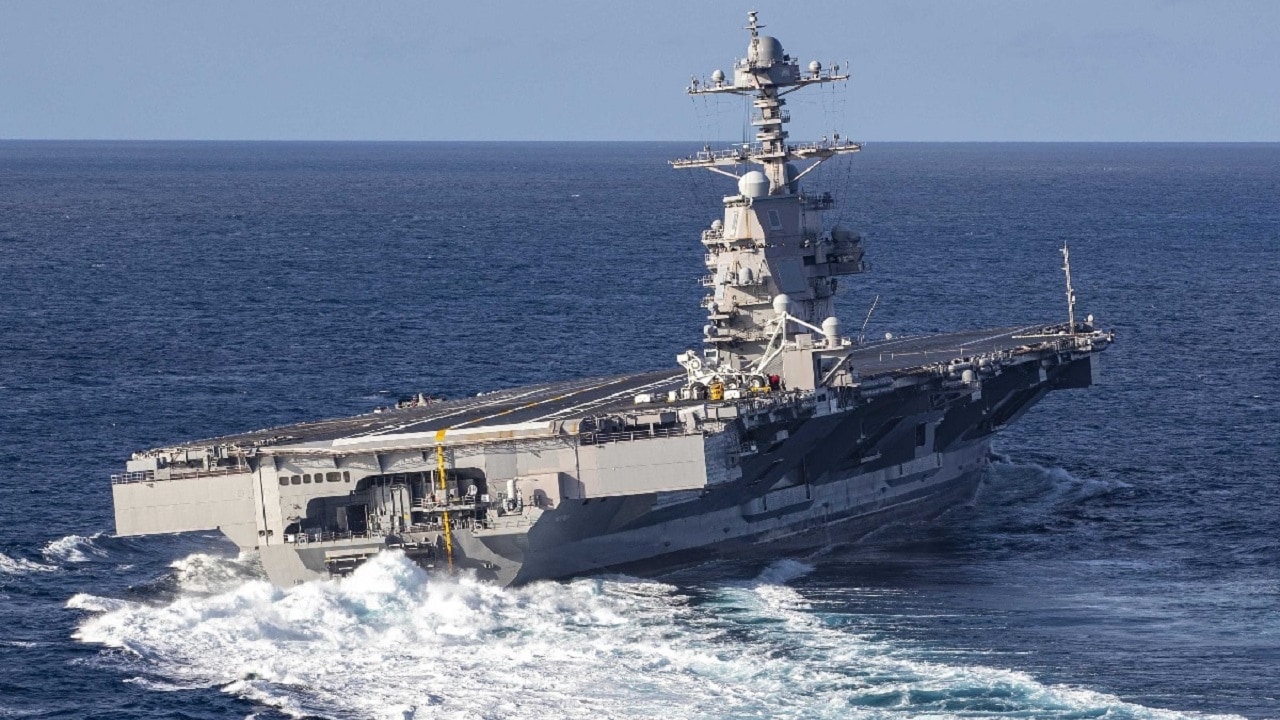
Key Points and Summary – The USS John F. Kennedy (CVN-79) has been delayed again, now to March 2027, just as the Navy plans to retire USS Nimitz in 2026—creating a real risk of a temporary carrier shortfall.
-Officially, the slip is blamed on finishing and certifying the Ford-class’ Advanced Arresting Gear and Advanced Weapons Elevators, but the deeper problem is an overstressed industrial base.
-Supply-chain fragility, sole-source vendors at risk of going “cold,” workforce gaps, and aging shipyard infrastructure are all converging.
-Unless Congress stabilizes carrier procurement and invests heavily in shipyards, America’s ability to sustain naval dominance against China will erode.
Ford-Class: Can the U.S. Navy Fix Its Aircraft Carrier Industrial Base Before China Pulls Ahead?
The USS John F. Kennedy (CVN-79), the second in the Gerald R. Ford-class of nuclear aircraft carriers, has been postponed yet again – this time to March 2027, according to the Navy’s Fiscal Year 2026 budget justification.
The news isn’t truly new – we’ve known this for months now – but there have been some newer reports revealing additional details about the causes behind the delays. And it’s clearer than ever that the U.S. Navy is facing a carrier fleet shortfall as a result of ongoing supply chain and workforce constraints.
The delays revealed earlier this year come as the service prepares to retire the aging USS Nimitz (CVN-68) in mid-2026, triggering what is expected to be a temporary but serious gap in American carrier fleet capability.
The deep, systemic challenges in the Navy’s shipbuilding enterprise should be of concern to the whole country; from technical integration of next-generation systems to supply-chain bottlenecks and even industrial-base strain, it seems as though little is going right.
These delays and constraints will have ripple effects that will inevitably stretch well beyond the CVN-79, threatening broader naval readiness at a time of intensifying global maritime competition.
Technical Troubles and Supply-Chain Headaches
Here’s what we know at present: budget documents supporting the FY 2026 request show that the Kennedy’s delivery date was moved from the originally planned July 2025 date to March 2028.
The official reason?
The need to complete certification of the new Advanced Arresting Gear (AAG) and to finish work on the Advanced Weapons Elevator (AWE).
And those systems need to be perfected because they’re pivotal to the Ford-class design.
The AAG allows modern aircraft to land safely on the carrier’s deck, and the AWE is essential for rapidly moving ordnance through the ship – both critical for the carrier’s combat readiness. Delays here are unfortunate but can’t be avoided. If the work needs to be done, it needs to be done.
So far, integrating those cutting-edge systems has proven far more difficult than originally anticipated. Even the first ship of the class, USS Gerald R. Ford, experienced delays stemming in part from problems with its elevators and related systems.
For Kennedy, the shipbuilder Huntington Ingalls Industries (HII) has acknowledged that lessons learned from CVN-78 came too late in the process to be fully applied.
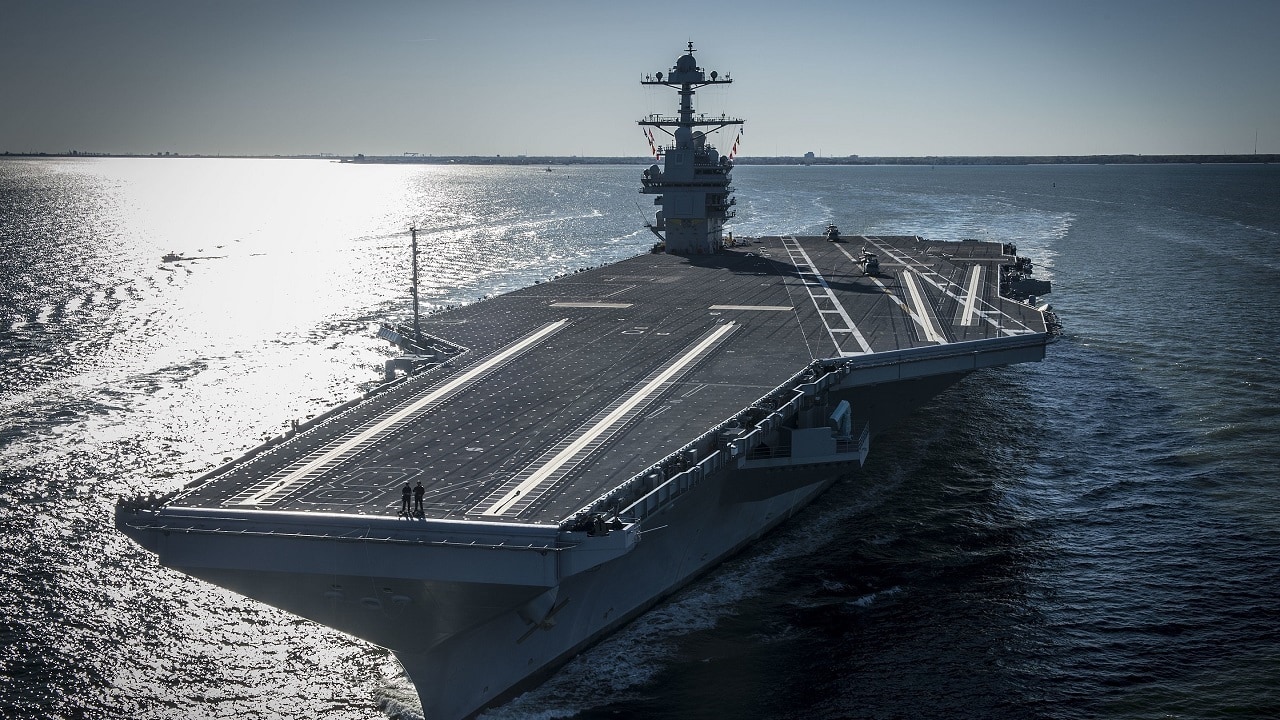
The U.S. Navy aircraft carrier USS Gerald R. Ford (CVN-78) underway on its own power for the first time. The first-of-class ship — the first new U.S. aircraft carrier design in 40 years — spent several days conducting builder’s sea trials, a comprehensive test of many of the ship’s key systems and technologies.
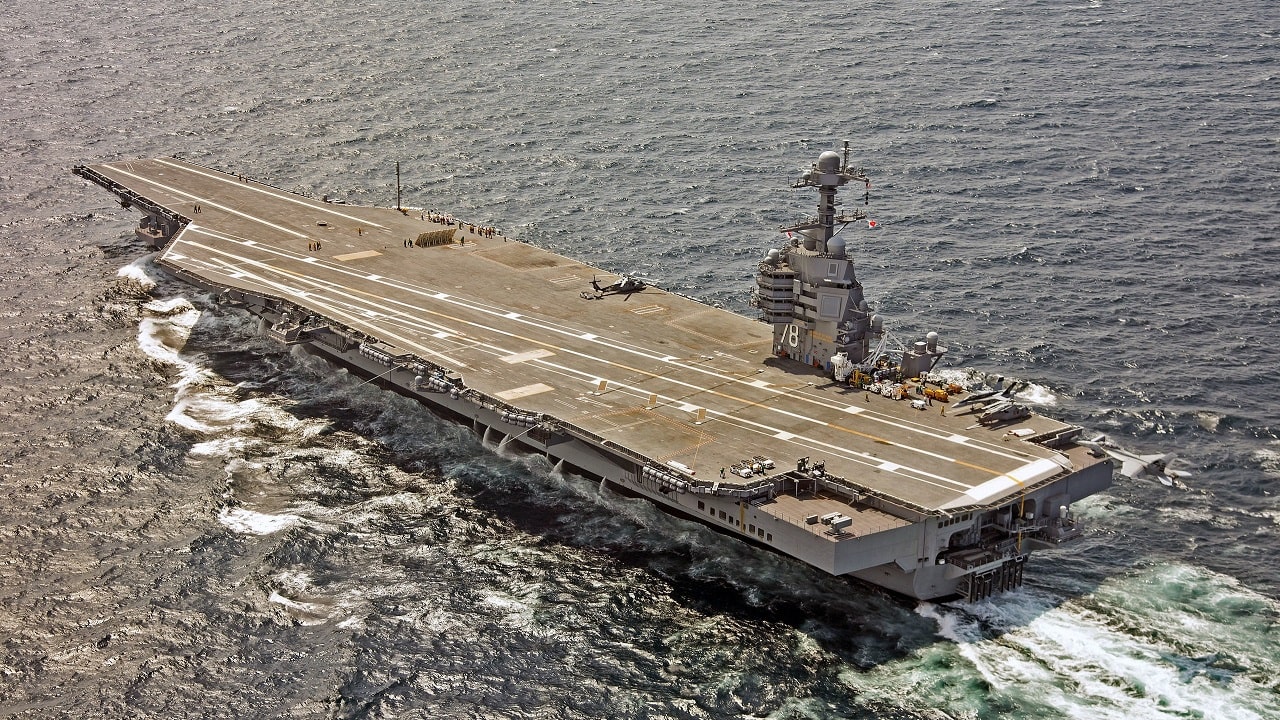
An F/A-18F Super Hornet assigned to Air Test and Evaluation Squadron (VX) 23 approaches the aircraft carrier USS Gerald R. Ford (CVN 78) for an arrested landing. The aircraft carrier is underway conducting test and evaluation operations.
Beyond technical difficulties, though, there are supply-chain constraints and shortages of critical materials that continue to compound the problem. According to recent reports on the delays, material availability and industry-wide performance issues are the primary drivers here.
According to a 2025 report by analysts at the Aircraft Carrier Industrial Base Coalition (ACIBC), which represents thousands of suppliers and workers linked to U.S. carrier construction, the delays reflect systemic strain across the entire shipbuilding enterprise.
Speaking to Business Insider, ACIBC Chair Lisa Papini described how advanced procurement funding had become necessary to allow suppliers to keep their ship production lines running and, in turn, maintain their workforces even before the keel laying.
Papini referenced a delay in the procurement of USS William J. Clinton (CVN 82) to fiscal year 2030, noting that the delays had become a “real inflection point.”
The coalition warned that without stable procurement and consistent demand, dozens of single-source suppliers for niche parts could “go cold” with some shutting down production lines altogether by 2027.
The result would be a disaster: rather than just delays, ships would lose access to vital parts. And the problem only keeps snowballing. ACIBC also warned that by the end of this year, 73% of sole-source suppliers were at risk of halting operations – and that the figure rises to 96% by 2027.
But beyond material supply problems, American shipyards are facing chronic workforce shortfalls, a shrunken industrial base, and aging infrastructure that make large warships harder to build than in the past.
For the Ford-class program specifically, the challenge has been magnified by the simultaneous integration of 20 new technologies at once – something that may have been about achievable once upon a time, but is no longer possible.
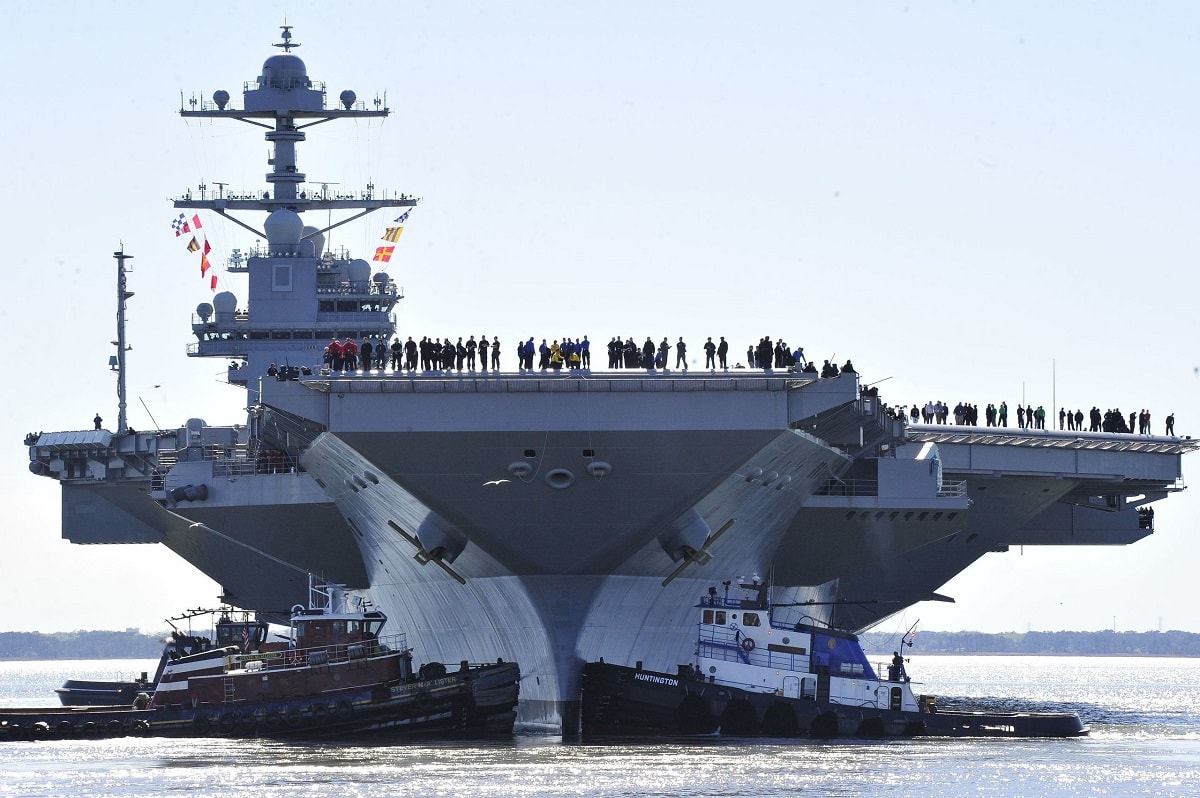
USS Gerald R. Ford. Image: Creative Commons.
All of these new technologies demand precise manufacturing, specialized components, and rigorous testing – and combined with supply chain and industry bottlenecks, it’s not hard to see why the delays are getting worse.
Fixing the Ford-Class?
So, what next? Well, if these material shortfalls and workforce problems persist unchecked – as the ACIBC has warned – the U.S. risks more than just delayed warships: the very industrial backbone underpinning American naval dominance could crumble.
When that happens, the United States faces a real problem: a growing Chinese naval force and a capability gap that makes responding to threats in the Indo-Pacific substantially harder.
Without immediate change – meaning a solution to procurement, funding, and structural investments – decades of American maritime dominance risk coming to an end.
About the Author:
Jack Buckby is a British author, counter-extremism researcher, and journalist based in New York who writes frequently for National Security Journal. Reporting on the U.K., Europe, and the U.S., he analyzes and understands left-wing and right-wing radicalization and reports on Western governments’ approaches to the pressing issues of today. His books and research papers explore these themes and propose pragmatic solutions to our increasingly polarized society. His latest book is The Truth Teller: RFK Jr. and the Case for a Post-Partisan Presidency.