
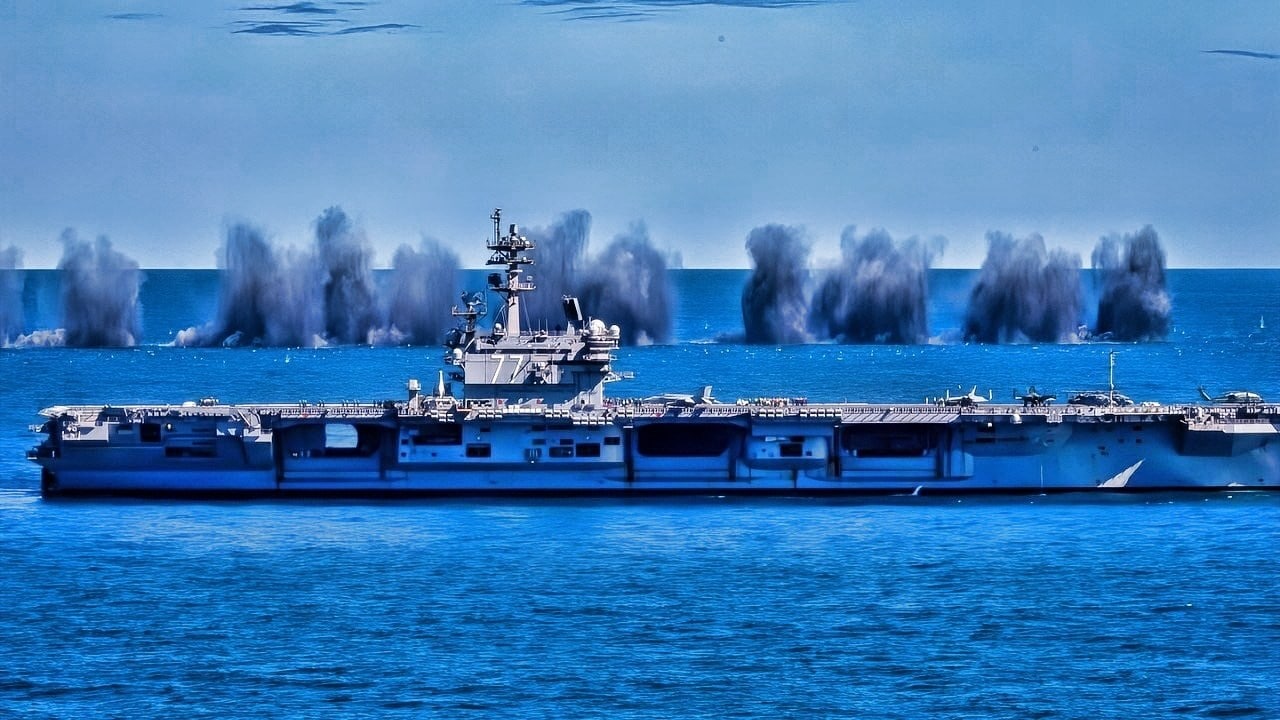
Synopsis: The USS Abraham Lincoln’s rapid move from San Diego to Guam and now in the Philippine Sea places another U.S. supercarrier in the Western Pacific alongside the forward-deployed USS George Washington in Japan—creating a two-carrier presence near China even if one is at home port.
-Combined with the forward deployment of the USS Tripoli amphibious assault ship in the East China Sea, the posture signals deterrence amid rising regional tension.
-The piece argues the U.S. is projecting strength to complicate Chinese planning as Beijing expands its fleet, fields high-end surface combatants and carriers, and builds anti-ship ballistic missiles designed to threaten carriers and bases as far back as Guam.
Two U.S. Supercarriers Near China: The Message Washington Is Sending
In late November 2025, the Nimitz-class carrier USS Abraham Lincoln (CVN-72) departed from San Diego and arrived at Guam just a couple of weeks later. The aircraft carrier is now in the Philippine Sea.
This marks the second American supercarrier to be deployed to the region near China.
The USS George Washington (CVN-73) is currently based in Yokosuka, Japan, and is at its home base after its previous deployment in the region.
It is likely no coincidence that two carrier strike groups are in the region as tensions with China continue to increase. Their presence is likely designed to project a position of strength in the region as China seeks to challenge the U.S. Navy.
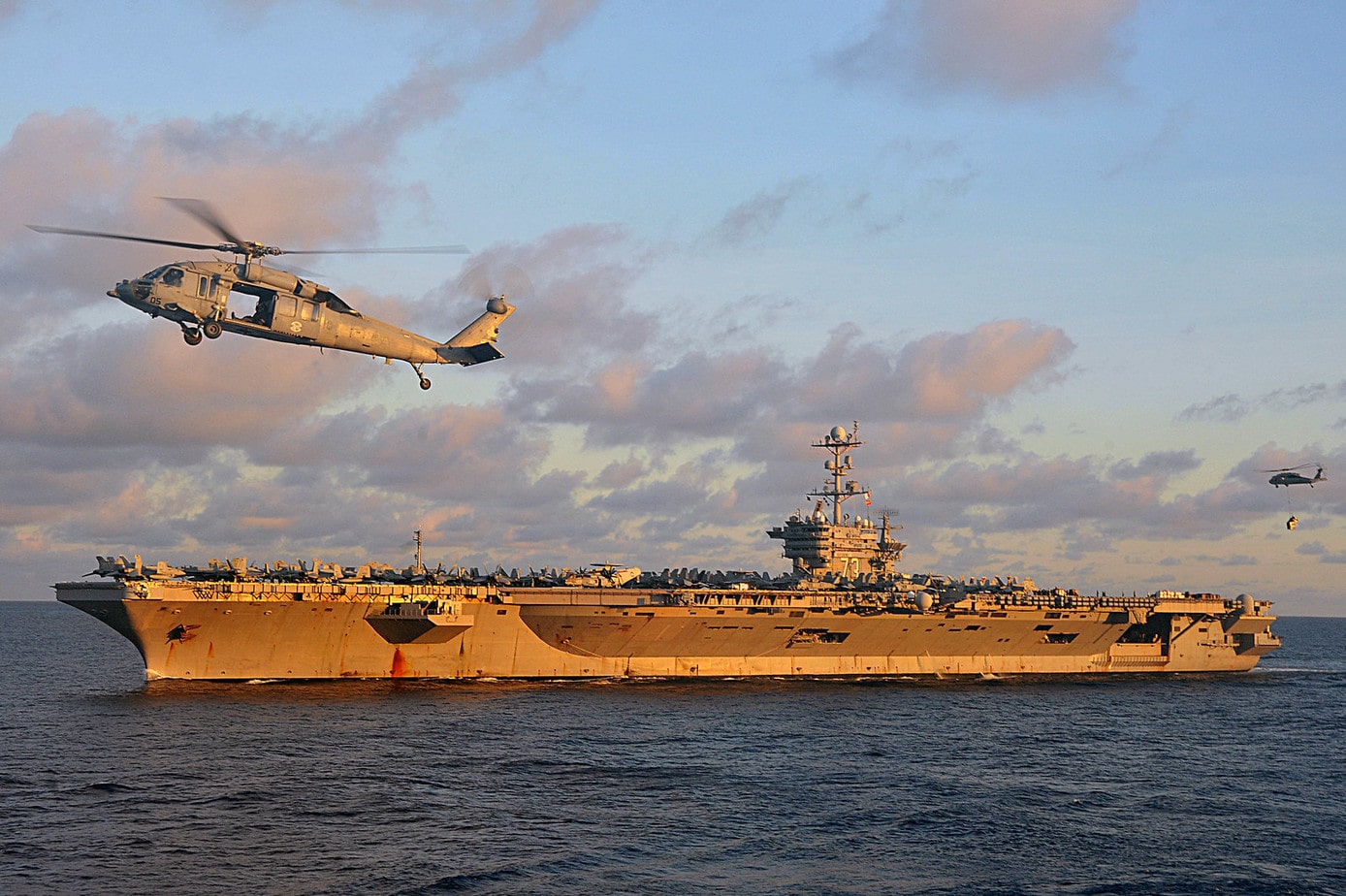
SOUTH CHINA SEA (July 8, 2012) The Nimitz-class aircraft carrier USS George Washington (CVN 73) conducts a vertical replenishment at sea in the U.S. 7th Fleet area of responsibility. George Washington and its embarked air wing, Carrier Air Wing 5, are underway for a routine summer patrol in the western Pacific Ocean. (U.S. Navy photo by Mass Communication Specialist Seaman Declan Barnes/Released)
Two U.S. Navy Aircraft Carriers Near China
George Washington has been forward-deployed to Japan ever since its long and troubled Refueling and Complex Overhaul. She replaced the USS Ronald Reagan (CVN-76) in Yokosuka and has been there ever since.
Washington recently completed her patrol in the region, during which she docked at the South Korean city of Busan (which invoked the anger of North Korea). She returned to her home port earlier in December, though she remains ready to be called up should anything happen.
Meanwhile, Abraham Lincoln departed from San Diego with unusually little fanfare. She was sent to replace the USS Nimitz (CVN-68), which had just completed her patrol in the region. Nimitz’s recent patrol made headlines after she lost an F/A-18 Super Hornet and an MH-60R helicopter from her flight deck in late October while in the South China Sea.
This required mobilizing many naval assets to the region to find and recover the lost aircraft before China could. Seeing the naval buildup near its own shores, however, China responded by mobilizing its own forces in a tense standoff. Luckily, both aircraft were eventually recovered, and both sides de-escalated without any issues.
Sending a Strong Message
While George Washington is technically inactive right now, the presence of Abraham Lincoln puts two U.S. supercarriers in the East Asia region near China.
In addition to the two carrier strike groups, an America-class amphibious assault ship, USS Tripoli (LHA-7), was also forward-deployed to the East China Sea.
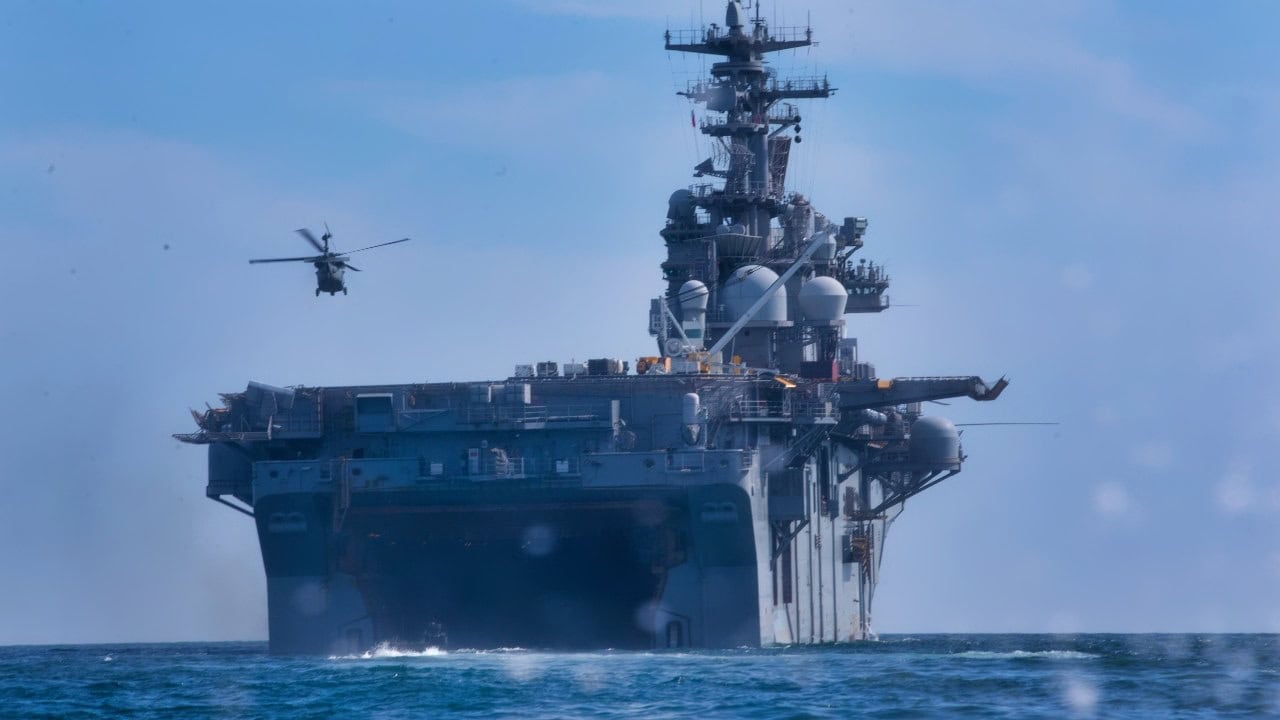
U.S. Marines with Bravo Company, 2d Assault Amphibious Battalion, 2d Marine Division approach the USS Wasp (LHD 1) in assault amphibious vehicles off of Onslow Beach during a three-day ship-to-shore exercise on Camp Lejeune, N.C., June 27, 2020. During the exercise, the Marines conducted amphibious maneuvers and dynamic ship-to-shore operations with the USS Wasp (LHD 1). (U.S. Marine Corps photo by Lance Cpl. Jacqueline Parsons)
While not as large as a traditional aircraft carrier, the amphibious assault ship can deploy Marine Expeditionary Units (MEUs) with up to 2,200 troops while serving as the flagship of an expeditionary strike group or an amphibious ready group. Tripoli arrived in Japan earlier this year after leaving her home port in San Diego in May.
The U.S. currently has many assets in the INDOPACOM theater. The reason for this is apparent: deter any potential aggression from China.
Traditionally, the U.S. has at least one carrier in the region for routine patrols, and with George Washington at her home port, this is still technically true.
However, given the CSGs and Tripoli’s presence, it is highly likely that the U.S. is sending a warning message to China.
Both CSGs are capable of launching F-35C stealth fighters as well as F/A-18 Super Hornet fighters. The presence of both George Washington and Abraham Lincoln gives the U.S. the capability to respond to any crisis in the region.
China is Biding Its Time
China, on the other hand, has been testing the waters in the region and preparing itself for large-scale combat with the U.S. Navy for some time.
It possesses the largest navy in the world by pure tonnage, with 750 total assets ranging from destroyers and submarines to smaller patrol vessels and mine warfare boats. Its industrial capacity is nothing short of impressive.
China can produce warships at a much faster rate than any other country, including the U.S. Additionally, it is modernizing its navy just as quickly.
This is evident in the recent commissioning of advanced vessels like the Type-003 Fujian carrier, which rivals American supercarriers in size and also features advanced technologies such as Electromagnetic Aircraft Launch Systems (EMALS).
China has also been manufacturing newer vessels, such as the Type 055 destroyer, which is currently one of its most advanced surface vessels.
In addition to building up its own navy, China has also been investing significantly in long-range ballistic missiles designed to target American aircraft carriers.
These “carrier killers,” as they are often called, include hypersonic missiles like the DF-21 and DF-26. These missiles have long ranges of up to 1,000–4,000 km and can threaten assets based as far back as Guam and pose a considerable threat to large carriers in the region.
All of these assets are included as part of China’s broader A2/AD strategy, which relies on land-based, sea-based, and airborne assets.
Make no mistake: China has been preparing for a war with the U.S. for a long time and has been preparing contingency after contingency for such an occasion. If China does go to war with the U.S., it is more than ready.
At the moment, it is still too soon for any conflict to occur. The U.S. still enjoys a qualitative edge over China.
The presence of two CSGs in the region is more than enough to deter the Chinese for now. The offensive capabilities of both groups are currently too risky for China to mess with, and a broader conflict between the U.S. and China is not in either side’s interest.
In the future, however, if China decides to go to war, it will take much more than two CSGs to deter it.
About the Author: Isaac Seitz
Isaac Seitz, a Defense Columnist, graduated from Patrick Henry College’s Strategic Intelligence and National Security program. He has also studied Russian at Middlebury Language Schools and has worked as an intelligence Analyst in the private sector.