
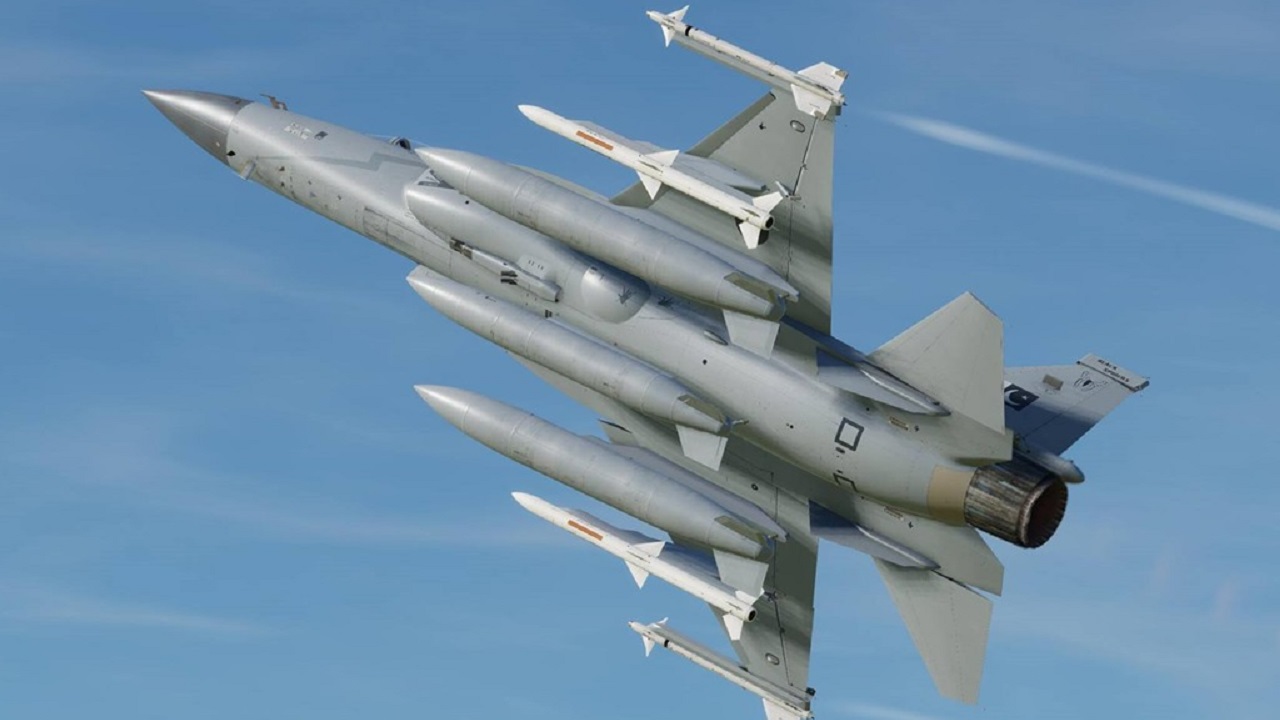
Key Points and Summary – The JF-17 Thunder is Pakistan’s answer to aging legacy jets and a partial stand-in for the coveted F-16. Co-developed with China’s Chengdu Aircraft Corporation, the single-engine fighter is meant to replace multiple older types in Pakistani service and give the Pakistan Air Force a low-cost, exportable multirole jet.
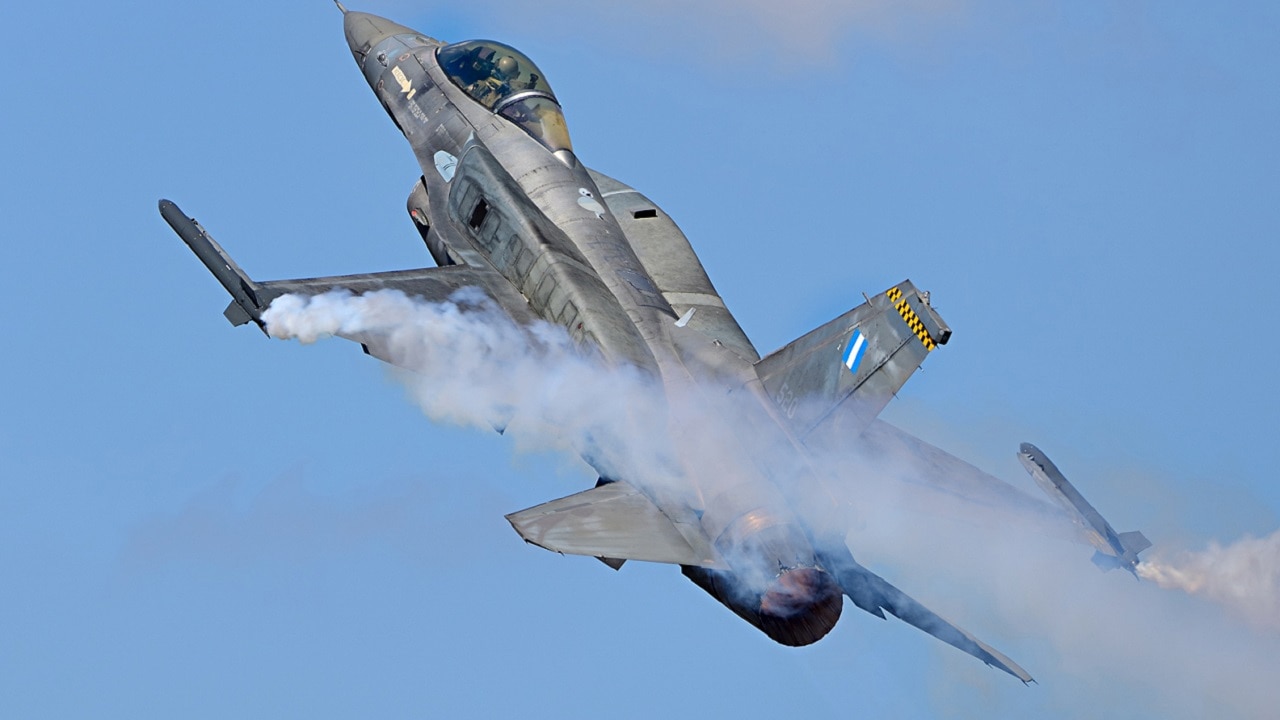
Image Credit: Hellenic Air Force.
-While clearly inspired by the F-16, the JF-17 is lighter, slower, and less sophisticated, but cheaper to buy and operate.
-It has seen real combat in counterterrorism strikes, border skirmishes, and cross-border raids, and is steadily building an export footprint, even as Pakistan continues to fly – and politically navigate – its limited fleet of true F-16s.
Is this JF-17 Fighter Merely a Chinese Copycat of the F-16?
“Imitation is the sincerest form of flattery,” the saying goes. By that rationale, the People’s Republic of China’s (PRC’s) People’s Liberation Army Air Force (PLAAF) and People’s Liberation Army Naval Air Force (PLANAF) are the ultimate flatterers of the United States Air Force and US Naval Aviation.
However, the aviators and designers for the latter country’s services undoubtedly don’t feel so flattered, viewing their PLAAF and PLANAF counterparts as sheer copycats and ripoff artists. At least when Beijing copied Soviet-designed warplanes, such as the H-6K Zhanshen (“War God”) via Tupolev Tu-16 “Badger” bomber, they were license-built via proper official channels.
Chinese knockoffs of American warbirds range from the H-20 (B-2 Spirit) to the Chengdu J-20 (F-22) to the J-16D (E/A-18G Growler) to the J-31/FC-31/J-35A (F-35). And there’s not just one, but two F-16 Fighting Falcon (AKA “Viper”) knockoffs, the J-10 and today’s subject at hand, the JF-17 Thunder.
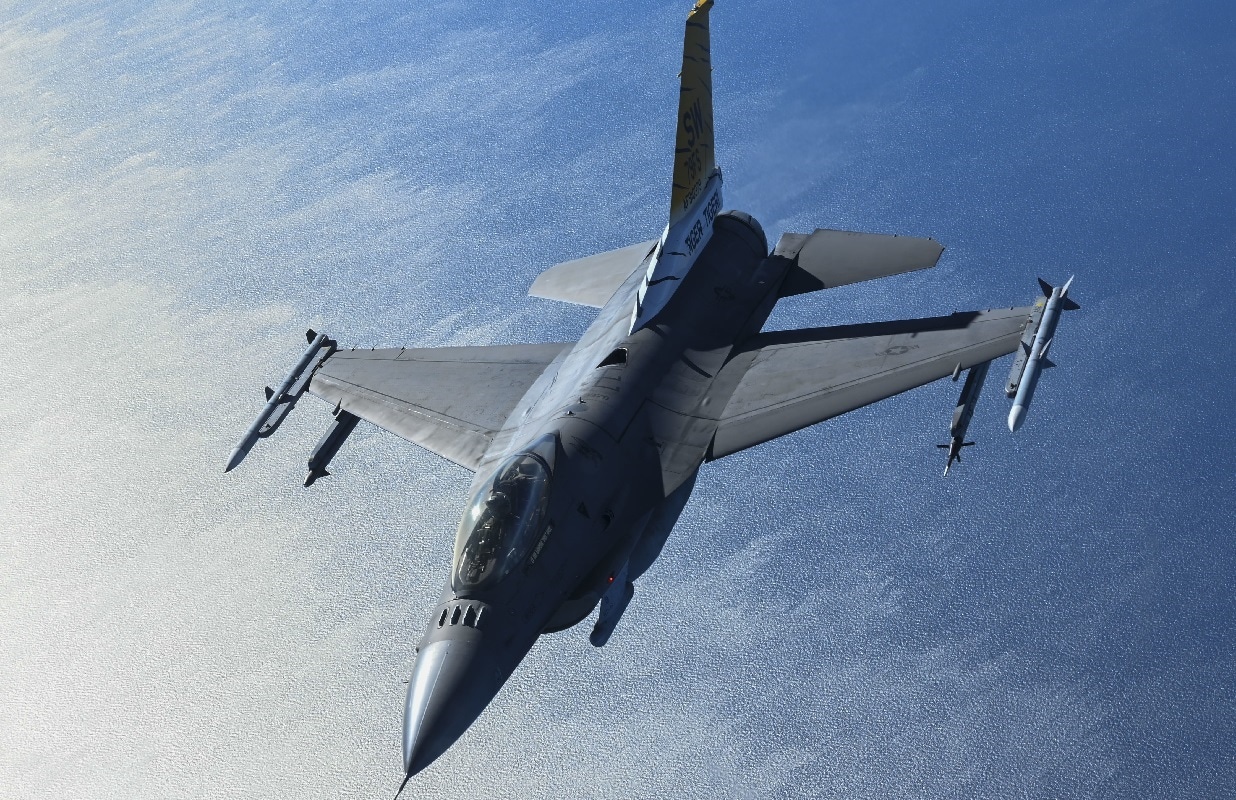
A U.S. Air Force F-16 Fighting Falcon with the 79th Fighter Squadron, Shaw Air Force Base, South Carolina, flies over the Gulf of Mexico, Nov. 8, 2021. Personnel and aircraft from the 79th FS traveled to Florida to participate in Checkered Flag 22-1, a large-force aerial exercise held at Tyndall Air Force Base, Florida, which fosters readiness and interoperability through the incorporation of fourth- and fifth-generation aircraft during air-to-air combat training. The 22-1 iteration of the exercise was held November 8-19, 2021. (U.S. Air Force photo by Staff Sgt. Betty R. Chevalier)
At least in the case of the JF-17, China can share the copycat credit with its ally Pakistan… which is more than a tad ironic when you consider that Pakistan is also a US ally and a longtime foreign military sales (FMS) customer of the actual F-16!
Semantic Side Note
JF-17 Thunder is the official Pakistani designation for this fighter, whilst the Chinese refer to it as the FC-1 Xiaolong (“Fierce Dragon”).
(For whatever reason, the JF-17 hasn’t been officially assigned a NATO reporting name yet.)
The “JF” stands for “Joint Fighter,” the “FC” stands for “Fighter China.” Quoth Juliet to Romeo, “A rose by any other name would smell as sweet,” and along those same lines, the warbird in question here is every bit as deadly whether you call it “Thunder,” ‘Fierce Dragon,” or just plain “Viper Ripoff.”
PAF-PLAAF Project Pairing: JF-17 Thunder Early History
The JF-17 is a joint venture between Chengdu Aircraft Corporation (CAC)—the same company that builds the J-20 mentioned above—and Pakistan Aeronautical Complex (PAC).
The “-17” segment of the alphanumeric designation denotes that the Pakistani Air Force (PAF) considers the plane to be its direct successor to the F-16 (in addition to being the imitator).
But there’s a bit more to it than that: it’s intended to replace the PAF’s ageing A-5C “Fantan,” F-7P/PG, Mirage III, and Mirage V fighter-bombers.
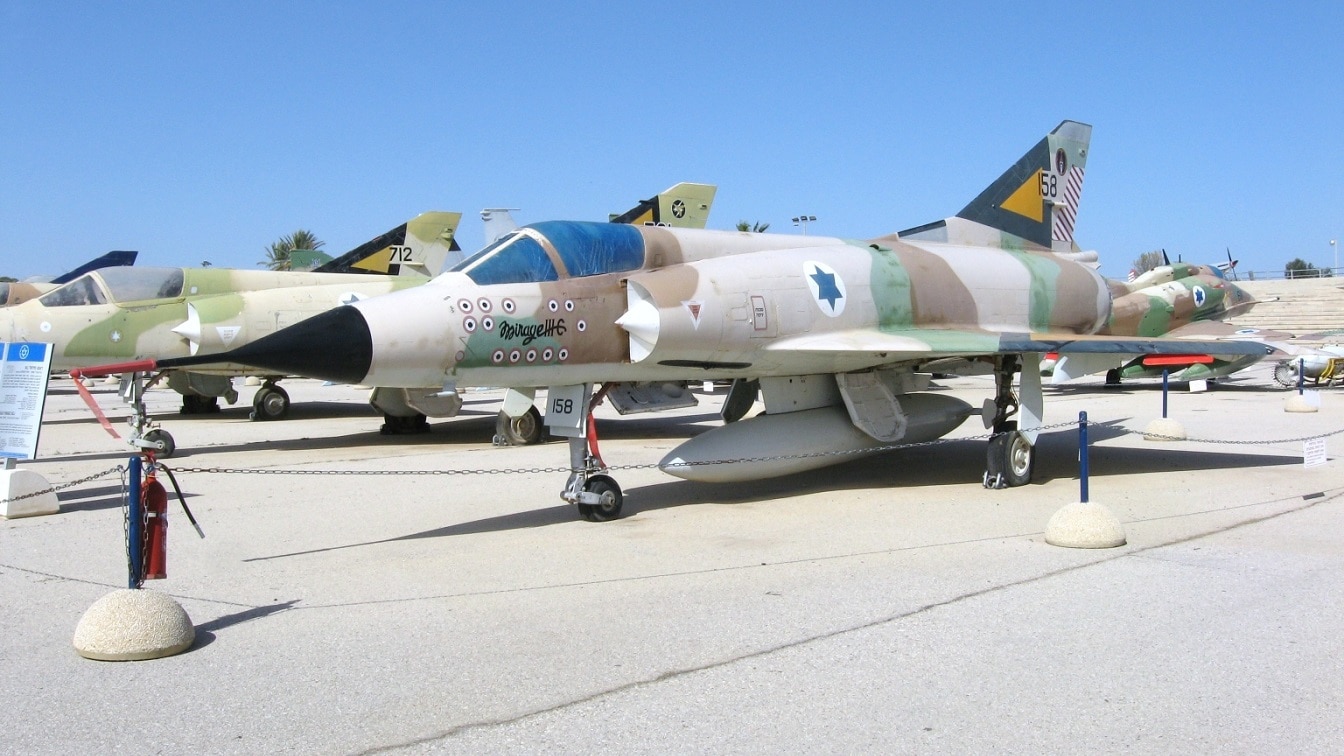
Israeli Air Force Mirage IIICJ 158 at the Israeli Air Force Museum in Hatzerim. Bears 13 kills markings and the colours of 101 Squadron.
The Thunder made its maiden flight on August 25, 2003, and was officially introduced into PAF service on March 12, 2007.192 airframes have reportedly been built thus far; according to the World Directory of Modern Military Aircraft (WDMMA), the Pakistanis have 161 of them, with an additional 27 on order.
Additional users of the Xiaolong include the Azerbaijani Air Force, the Nigerian Air Force, and the Myanmar Air Force.
Meanwhile, WDMMA reports that PAF also has 85 F-16s.
JF-17 Tech Specs and Vital Stats
-Crew: 1 (single-seater JF-17) or 2 (dual-seater JF-17B)
-Fuselage Length: 47 feet
-Height: 15 feet
-Wingspan: 31 feet
-Empty Weight: 17,559 lb.
–Max Takeoff Weight (MTOW): 29,762 lb.
-Powerplant: 1 × Klimov RD-93MA afterburning turbofan, generating 91.2 kN (20,500 lbf) of thrust
-Max Airspeed: Mach 1.6
-Service Ceiling: 55,000 feet
-Ferry Range: 1,180 nautical miles
-Combat Range: 940 nautical miles
-Armament:
8 hardpoints capable of carrying a variety of air-to-air missiles, air-to-surface missiles, or 3,400 kg (7,495 lbs.) worth of bombs
GSh-23-2 23mm double-barrel cannon
Operational History/Combat Performance
Though not as battle-proven as the F-16, the JF-17 has certainly been “blooded” in combat, including the following PAF operations:
–Air strikes against terrorist positions in North Waziristan near the Pakistan-Afghanistan border ( the Federally Administered Tribal Areas [FATA]) during anti-terror operations in 2014 and 2017
–Shooting down an intruding Iranian military UAV near the Pakistan-Iran Border in Baluchistan in 2017
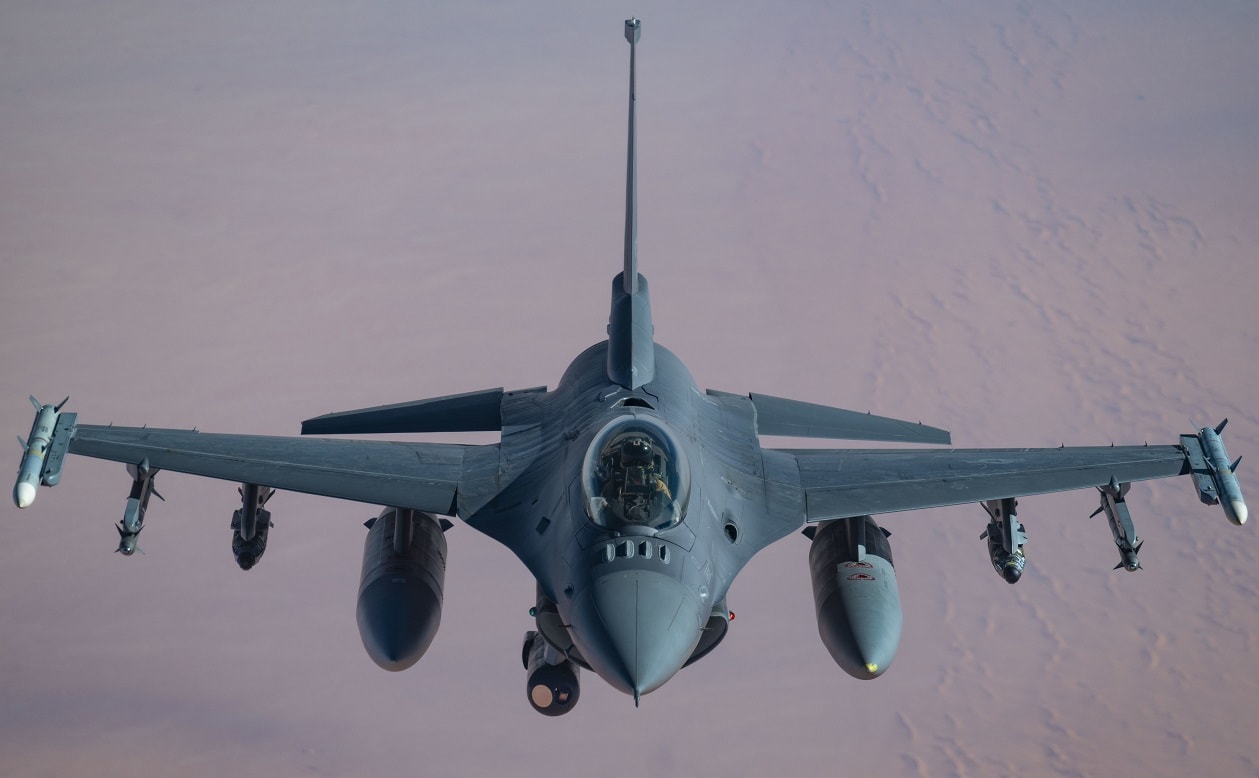
A U.S. Air Force F-16 Fighting Falcon receives fuel from a U.S. Air Force KC-135 Stratotanker, deployed to Al Udeid Air Base, Qatar, above the U.S. Central Command area of responsibility, Dec. 2, 2021. The F-16 Fighting Falcon is a compact, multi-role fighter aircraft that delivers war- winning airpower to the U.S. Central Command area of responsibility. (U.S. Air Force photo by Senior Airman Daniel Hernandez)
–Operation Marg Bar Sarmachar in 2024, wherein Pakistan launched a series of air and artillery strikes inside Iran’s Sistan and Baluchistan province targeting Baloch separatist groups
-Cross-border airstrikes against Pakistani Taliban hideouts inside Afghanistan in March and December 2024
-During the most recent conflict between Pakistan and its oldest nemesis, India, this past May (India officially dubbed it Operation Sindoor), the PAF deployed JF-17s in combat in both the air-to-air and air-to-ground roles.
However, all five air-to-air kills reportedly scored by the PAF fighter pilots against their Indian Air Force (IAF) adversaries were achieved by the aforementioned other Chinese-made F-16 knockoff, the J-10 “Vigorous Dragon” (by now, our dear readers have probably noticed that Beijing likes to name its fighters after dragons).
The Way Forward for the Thunder: PAF JF-17 vs. IAF F-16 (F-21)?
The Indian subcontinental intrigue (not to be confused with that other ISI) of the true F-16 and its knockoffs is taking another ironic twist: the F-21, a special version of the F-16 that Lockheed Martin is legitimately building for India.
The chances we will see an IAF F-21 vs. PAF F-16 clash in the case of yet another Indo-Pakistani War in the future are relatively small, by virtue of the fact that the US government placed very restrictive provisions on Pakistan’s use of the F-16, expressly forbidding it for use against conventional states such as India, which is certainly understandable given the fact that the US and India are partners in “the Quad” (along with Japan and Australia) as a bulwark against China.
By contrast, it’s unsurprising in the least that the PRC has placed no such restrictions on Pakistan’s use of the JF-17, which means that PAF Thunder drivers would conceivably be able to declare open season on their IAF Viper driver adversaries in future flare-ups.
About the Author: Christian D. Orr, Defense Expert
Christian D. Orr is a Senior Defense Editor. He is a former Air Force Security Forces officer, Federal law enforcement officer, and private military contractor (with assignments worked in Iraq, the United Arab Emirates, Kosovo, Japan, Germany, and the Pentagon). Chris holds a B.A. in International Relations from the University of Southern California (USC) and an M.A. in Intelligence Studies (concentration in Terrorism Studies) from American Military University (AMU). He is also the author of the newly published book “Five Decades of a Fabulous Firearm: Celebrating the 50th Anniversary of the Beretta 92 Pistol Series.”