
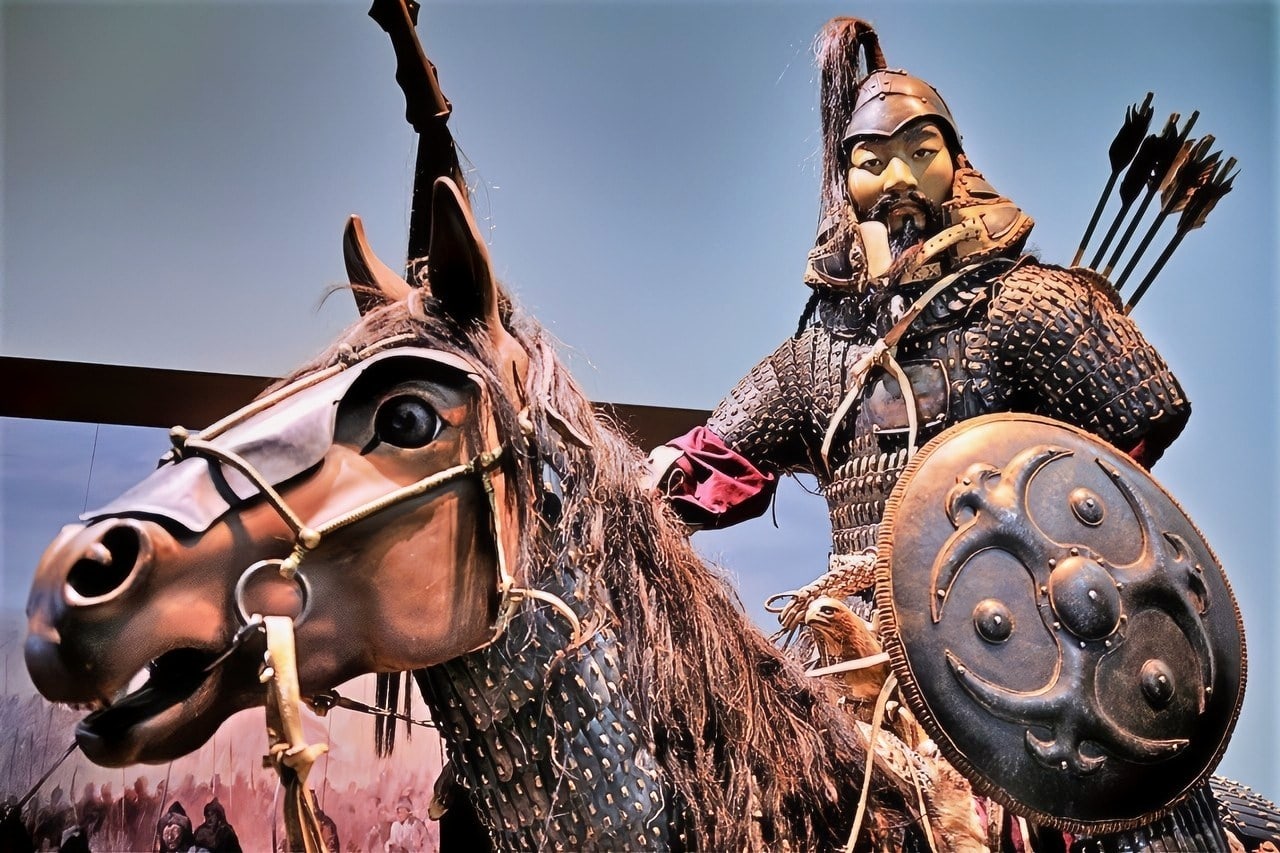
Summary and Key Points: Genghis Khan’s famous quote about the “greatest happiness”—vanquishing enemies and seizing their wealth—captures the brutal efficiency of Mongol warfare, in which terror served as a strategic deterrent to minimize future resistance.
-While likely paraphrased from later chroniclers like Rashid al-Din or popularized by modern media, the sentiment reflects the psychological warfare used at cities like Nishapur and Merv.
-However, the article argues that the empire’s longevity relied less on this violence and more on sophisticated innovations like the Yam relay network, the Pax Mongolica trade routes, and a policy of religious tolerance that stabilized its diverse subjects.
Did Genghis Khan Actually Say His Most Famous and Brutal Quote?
“The greatest happiness is to vanquish your enemies, to chase them before you, to rob them of their wealth, to see those dear to them bathed in tears.” – Genghis Khan
The above is arguably Genghis Khan’s most brutal quote, and while the exact phrasing may have been filtered through later chroniclers’ lenses, historians generally agree that it reflects t he strategic logic that underpinned the Mongol conquest: total victory, psychological warfare, and the permanent removal of resistance.
Genghis Khan’s rise from warlord to ruler of the largest land empire in history was built on his understanding that combining military might and mobility, discipline, and terror is a winning strategy – regardless of ethics.
Many accounts have described Mongol campaigns in which cities that resisted the Khan were destroyed, while those that surrendered early were often spared and incorporated into the empire. The quote’s focus on “vanquishing” and “chasing” reflected a war doctrine that treated conflict as unfinished until all opponents were unable – psychologically, physically, or politically – to recover.
Conquest As Deterrence
Historians have long argued that Mongol brutality was a form of deterrence strategy rather than straight savagery – although, the latter is also true.
Reports of massacres at cities like Nishapur and Merv long existed, spreading fear well beyond the immediate battlefield. That reputation rippled across the continent and allowed Mongol forces to secure surrender without sieges in some instances, reducing casualties and the logistical strain typical of regular campaigns.
The quote focuses on humiliation and dispossession. By stripping defeated elites of their wealth and status, the Mongols removed other centers of authority that could later form a resistance. The families of defeated leaders were often taken captive or moved away – a practice that further undermined any power structures based on clans that were common across Eurasia at the time.
The result was the systematic destruction of the enemy societies’ ability to rebuild leadership under pressure.
That strategy explains why Mongol violence was generally uneven rather than constant: when cities opened their gates, they were often left intact and rewarded with commercial rights and privileges. From a strategic perspective, the terror was designed to be memorable enough that it didn’t need to be repeated everywhere. The reference to “happiness” in the quote, then, is best understood as this: success means an enemy is so thoroughly broken that future conflict isn’t necessary. They were, in a sense, “happy.”
Power and Endurance
Coercion alone does not explain the durability of the Mongol role, however.
Genghis Khan and his successors invested heavily in administrative systems to maintain control over long periods, allowing a small ruling elite to govern vast areas of land.
One of the most important was the Yam relay network – a series of stations that provided horses, food, and lodging for imperial couriers.
That system enabled the rapid movement of orders and intelligence across thousands of miles, dramatically shortening response times to external threats or internal rebellions.
The Mongols also implemented their own standardized laws, census practices, and taxation systems that reduced dependence. The same empire that could destroy a resisting city could also ensure safe passage for merchants throughout Eurasia, encouraging trade under the Pax Mongolica.
It meant that the Mongol empire wasn’t built solely on violence.
Religious toleration, which has often been cited as a Mongol virtue, also played a part in the success of the empire. Scholars have long noted that the Mongols generally avoided imposing a new state religion, instead co-opting existing clerics and institutions from across Buddhism, Islam, and Christianity, and the result was that rule was stabilized despite the empire’s control over hugely diverse populations.
Why the Quote Still Resonates
The relevance of Genghis Khan’s words today comes mainly from their clarity: they describe power in straightforward and practical terms.
Khan defined success as breaking an enemy’s ability and willingness to fight again.
That logic does still appear in modern strategy, even if modern leaders avoid saying it so plainly. What has changed, however, is the cost: today, mass violence results in significant political backlash, economic sanctions, and global scrutiny that did not exist in the 13th century.
There’s no doubt that without that change, the tactics would still be used – albeit this time using drones, automation, and advanced military technology.
About the Author:
Jack Buckby is a British researcher and analyst specialising in defence and national security, based in New York. His work focuses on military capability, procurement, and strategic competition, producing and editing analysis for policy and defence audiences. He brings extensive editorial experience, with a career output spanning over 1,000 articles at 19FortyFive and National Security Journal, and has previously authored books and papers on extremism and deradicalisation.