
Summary and Key Points – Trump’s apparent enthusiasm for dramatic, made-for-television interventions risks dragging the United States back into the classic problem of military overstretch.
-The argument holds that the Maduro raid validated a preference for visible “wins,” encouraging talk of coercive action against targets like Greenland, Panama, or Cuba.
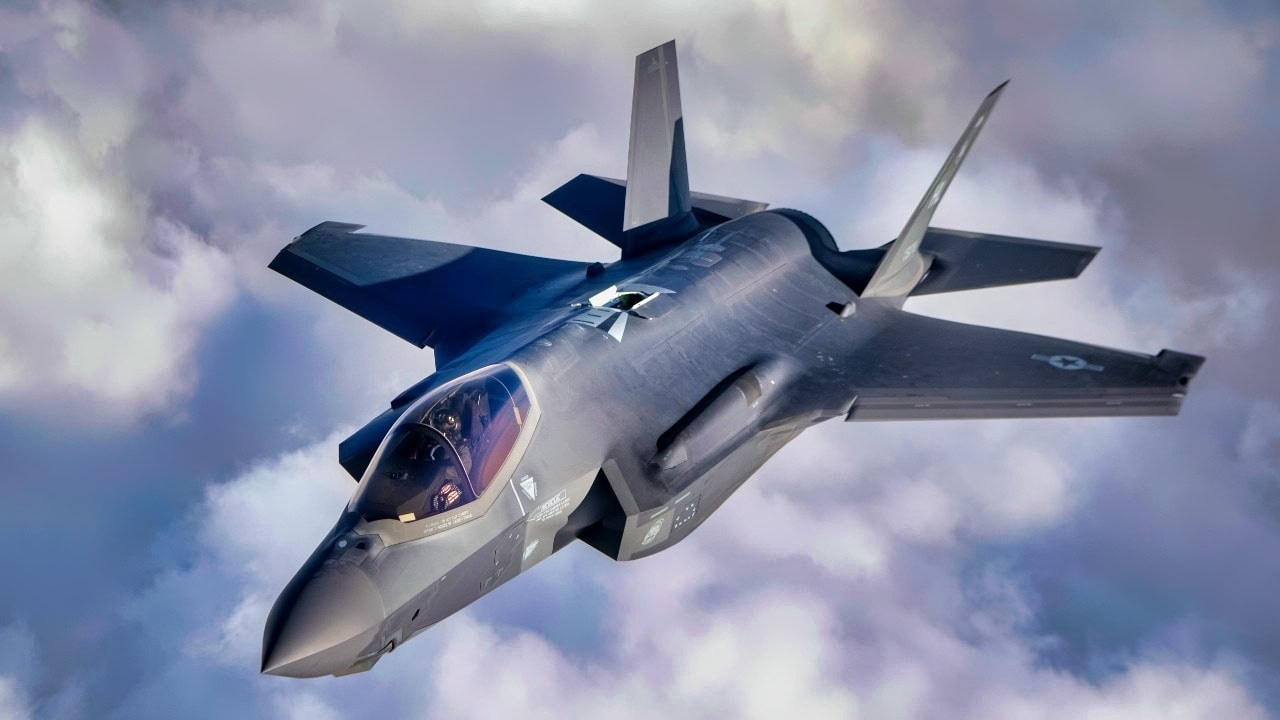
A U.S. Air Force F-35 Lightning II flies over the U.S. Central Command area of responsibility, July 15, 2020. The F-35 Lightning II is an agile, versatile, high-performance, multirole fighter that combines stealth, sensor fusion and unprecedented situational awareness. (U.S. Air Force photo by Airman 1st Class Duncan C. Bevan)
-But symbolic strikes and leader-capture operations do not solve underlying political resistance and can create pressure for deeper, longer deployments—or even Iraq-style insurgency dynamics if territory must be controlled.
-Even absent ground war, maintaining task forces for blockades and coercion would siphon scarce naval and air resources away from East Asia, where China is the primary strategic priority.
Trump’s Post-Venezuela Temptation: The Overstretch Trap for U.S. Power
US President Donald Trump recently declared an interest in intervention around the Western Hemisphere. The tactical success of the US raid to capture Venezuelan President Nicolas Maduro appears to have excited him. Trump has always sought very public displays of presidential success. He rarely shows much interest in policy detail, instead demanding ‘wins’ that will dominate the news cycle.
Foreign policy interventions are dramatic, make for gripping television, and illustrate presidential power. That nicely fits Trump’s personality, and in retrospect, it seems strange that Trump did not discover this before. But now that Venezuela went so smoothly, Trump appears to have grasped that the US military is a highly capable instrument. He may imminently use it against Greenland or Cuba.
But there are serious risks. Trump’s actions grossly violate the core foreign policy principle of his ‘Make America Great Again’ (MAGA) movement; they also threaten US overstretch.
MAGA’s Best Contribution to US Politics Has Been Restraint
Trump has been a hugely divisive figure in American politics. American academics routinely rate him among the worst presidents ever. His domestic policies have sharply divided the country, as seen in the current polarization over the behavior of the Immigration and Customs Enforcement (ICE) agency in US cities. But one area where most Americans have welcomed Trump is his deep aversion to US interventionism—particularly in the developing world.
Trump grew up during the Vietnam War. As an adult, he watched the Soviet Union overstretch itself in Afghanistan. As a potential political candidate, he saw the US lose its way in the Middle East. He seems deeply affected by these experiences. Perhaps because of his own ramshackle, up-and-down career over the decades, he seemed to grasp how difficult large, complex projects in forbidding environments are. Expounding this in the 2016 Republican primary famously helped him beat the Bush family and neoconservatives to take over the party.
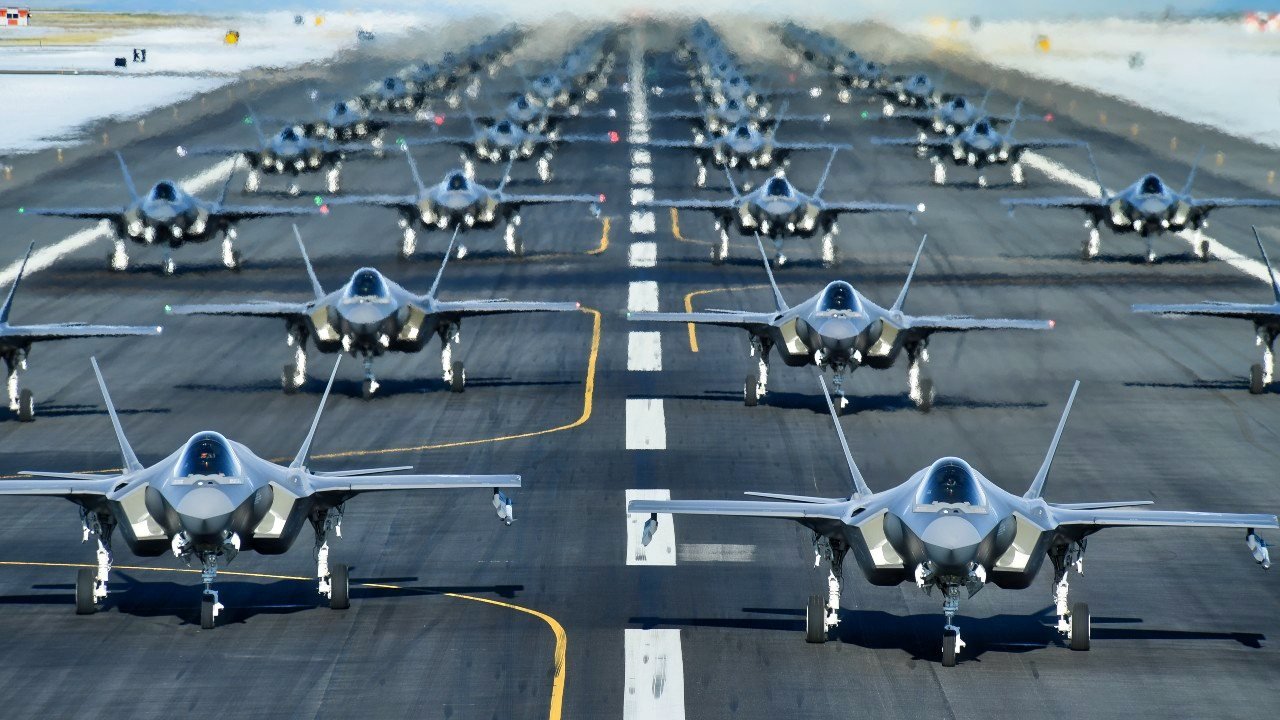
F-35 Elephant Walk. Image Credit: Creative Commons.
Keeping the US out of unnecessary wars has been the one unalloyed good of the Trump years. Pushing US allies to spend more and do more – part of the larger Trump restraint project – has also been good. The Europeans, for example, should carry most of the weight of the Ukraine war and re-arm to deal with Russia with far less US assistance.
All of these achievements—so badly needed after two decades of American overextension—are now in jeopardy. And their blatant, public violation should embarrass MAGA. That movement should turn on Trump for his massive betrayal of one of its defining beliefs. Sadly, it has not.
US Over-Extension, Again
The list of countries Trump has flirted with attacking has grown dramatically. While Trump is likely to restrict US action to airstrikes, the Maduro raid illustrates the limit of that approach. Maduro has been removed—and it surely made for great television—but the rest of his regime is intact and has even demanded that Maduro be returned. It is unclear how the US can push Venezuela into compliance with its wishes without ‘boots on the ground’ regime change.
Trump’s other targets would also require ground intervention to change the status quo meaningfully. Greenland, Panama, and Cuba could all be bombed, or their leaders extracted, but the underlying resistance to US intervention would remain. The US could not, for example, control the Panama Canal again without physically doing so. No Panamanian administration would voluntarily cede control of it.
Territorial interventions in all these places could easily spiral into Iraq-style insurgencies. Denmark, for example, has talked of forcefully resisting a US military incursion, and the local terrain would be punishing for US forces to operate in. Similarly, one would expect a nationalist insurgency in Panama over the canal, given the long history of US-Panamanian animosity over the issue. Resistance like this is probably why the US did invade Venezuela on the ground.
But even if the US could coerce these countries without actually invading them, the on-station naval and air forces to do so would eat up US resources for other missions. As Robert Farley notes, the logistics of keeping US task forces away from port for extended periods—for example, to quarantine Greenland from Europe or to block commercial traffic at the canal—would be punishing over time. And this would reduce America’s air and sea capabilities to deploy to East Asia to confront China, which is vastly more important to the US than 60,000 unhappy Greenlanders.
In short, Trump’s imperial visions in the Western Hemisphere would require a significant portion of US capabilities to be kept close to home indefinitely. The consequences in East Asia would be either American overstretch—a massive US defense buildup—or retrenchment from East Asia and acceptance of China’s rise to dominance there.
Author: Dr. Robert Kelly, Pusan National University
Dr. Robert E. Kelly is a professor of international relations in the Department of Political Science and Diplomacy at Pusan National University in South Korea. His research interests focus on Security in Northeast Asia, U.S. foreign policy, and international financial institutions. He has written for outlets including Foreign Affairs, the European Journal of International Relations, and the Economist, and he has spoken on television news services such as the BBC and CCTV. His personal website/blog is here; his Twitter page is here.