Summary and Key Points: Swarms of small attack boats, missile-armed drones, and helicopters compress a ship’s decision time and can burn through expensive interceptors fast.
-That’s the opening for shipboard lasers: precision at the speed of light, deep “magazine” depth, and a lower cost-per-shot than missiles like SM-3 or SM-6.

211214-M-HB658-1322 GULF OF ADEN (Dec. 14, 2021) Amphibious transport dock ship USS Portland (LPD 27) conducts a high-energy laser weapon system demonstration on a static surface training target, Dec. 14, while sailing in the Gulf of Aden. During the demonstration, the Solid State Laser – Technology Maturation Laser Weapons System Demonstrator Mark 2 MOD 0 aboard Portland successfully engaged the training target. The photograph was captured utilizing a short wave infrared lens and optical filter. (U.S. Marine Corps photo by Staff Sgt. Donald Holbert)

(May 21, 2020) The amphibious transport dock ship USS Portland (LPD 27) successfully tests a Solid State Laser – Technology Maturation Laser Weapon System Demonstrator (LWSD) Mark 2 MOD 0.The SSL-TM program builds upon the Office of Naval Research’s previous directed-energy developments, like the Laser Weapon System (LaWS), which was successfully tested at-sea aboard the Afloat Forward Staging Base (Interim) USS Ponce (ASB(I)) 15 in 2014. (U.S. Navy photo/Released)

211214-N-VQ947-1142 GULF OF ADEN (Dec. 14, 2021) — Amphibious transport dock ship USS Portland (LPD 27) conducts a high-energy laser weapon system demonstration on a static surface training target, Dec. 14, while sailing in the Gulf of Aden. During the demonstration, the Solid State Laser – Technology Maturation Laser Weapons System Demonstrator Mark 2 MOD 0 aboard Portland successfully engaged the training target. The photograph was captured utilizing a short wave infrared lens and optical filter. (U.S. Navy photo illustration by Mass Communication Specialist 2nd Class Devin Kates)
-The Navy is already fielding HELIOS on some Arleigh Burke destroyers, pairing hard-kill potential with surveillance and optical dazzling.
-Now, the Chief of Naval Operations is pointing toward megawatt-class lasers—power levels associated with defeating larger threats, including cruise missiles—potentially as a defining feature of future large combatants.
The Missile-Defense Cost Trap: Why Ship Lasers Are Suddenly a Big Deal
If swarms of enemy small-attack boats armed with guns and explosives approached a Navy ship—perhaps sailing alongside missile-armed drones and helicopters—the ship’s commanding officer would weigh defensive options including interceptor missiles, electronic warfare, deck-mounted guns, or the close-in weapon system.
But now, laser weapons are being added to the defensive options. The Navy is adjusting its defensive posture—and its attack options—to incorporate new high-powered ship-fired lasers.
The Navy continues to fast-track the development of laser weapons to add another layer to its complex array of ship defenses.
Developers may soon introduce lower-cost, precision lasers to bolster the defenses offered by deck-mounted guns, ship-fired interceptor missiles, and ship-launched aircraft such as Osprey helicopters or fighter jets.
Navy Sees MegaWatt Lasers
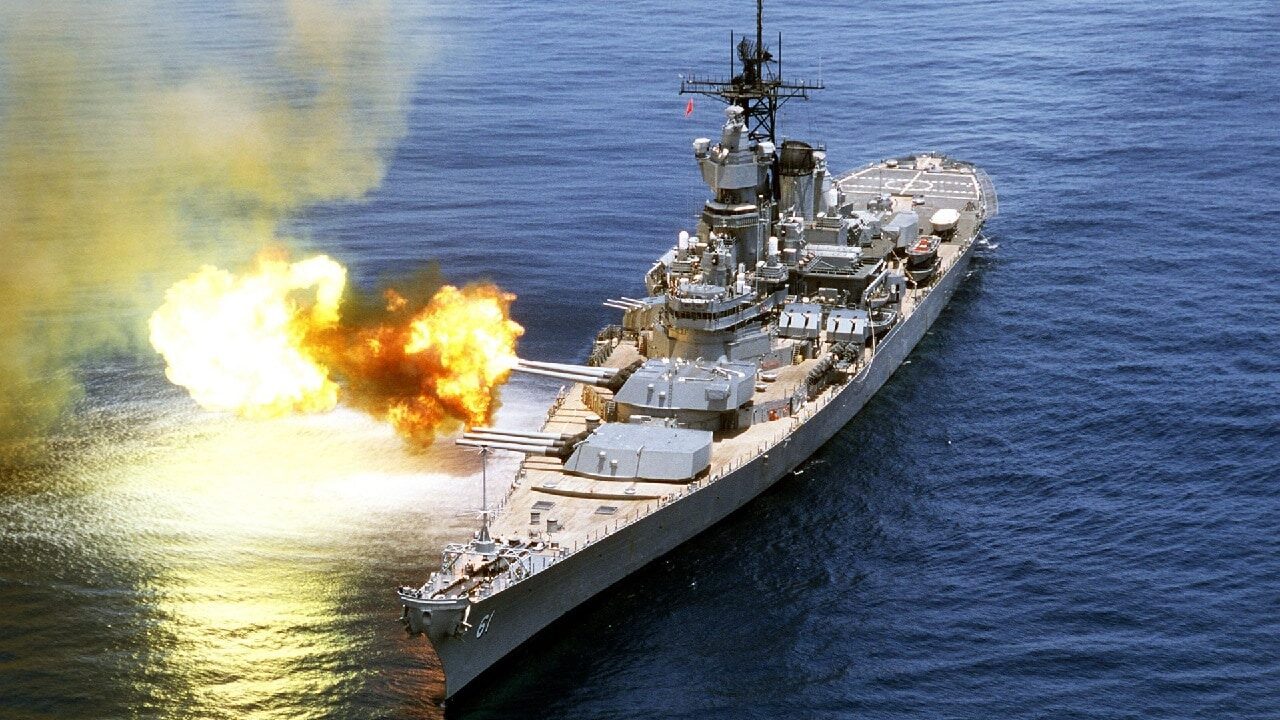
There have been numerous laser-weapons programs integrated into destroyers for many years. But Chief of Naval Operations Admiral Daryl Caudle says that even more powerful “megawatt-level” lasers may arm the future Trump-class Battleships.
“My thesis research at [the] Naval Post Graduate School was on directed energy and nuclear weapons,” Caudle said, TWZ reported. “This is my goal, if it’s in line of sight of a ship, that the first solution that we’re using is directed energy.”
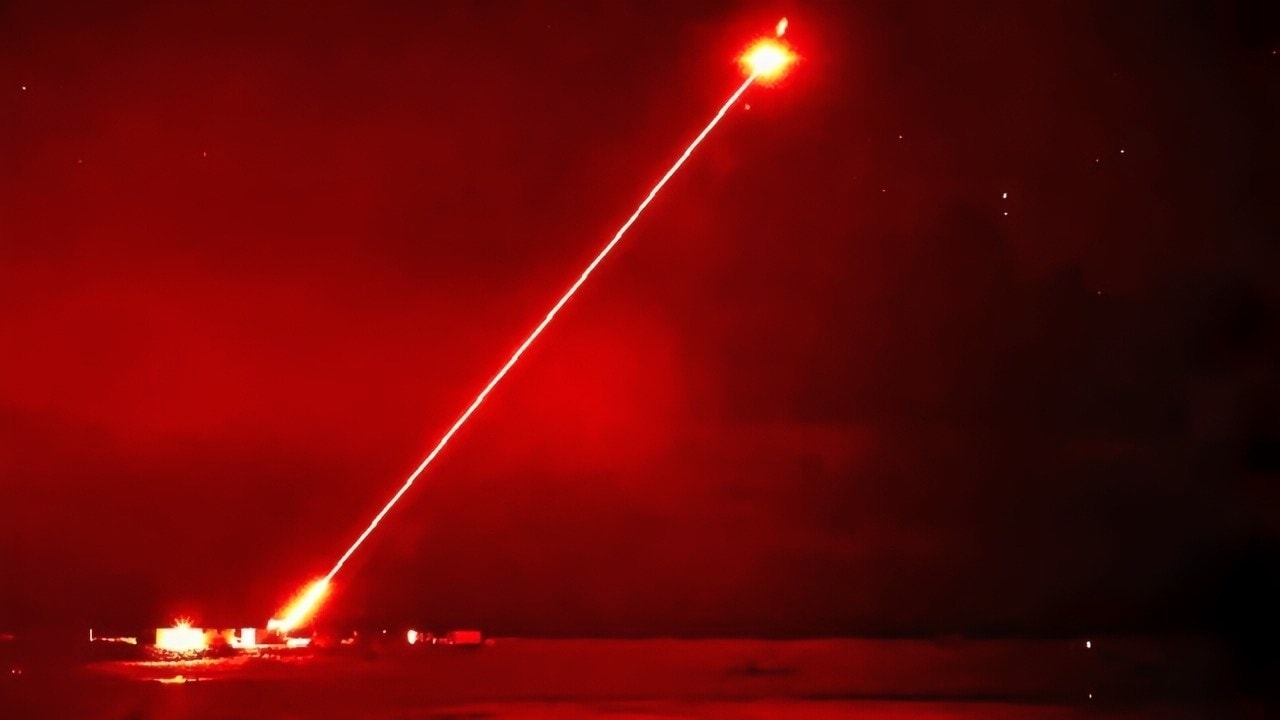
Dragonfire Laser System. Image Credit: Public Domain.
Laser weapons demonstrated an ability to destroy drones years ago. But Navy officials want more—they have been working to engineer lasers capable of destroying incoming cruise missiles and other large threats. Combined high-power laser beams could destroy multiple incoming attacks at one time. There are other mission possibilities for a laser weapon, such as to obscure adversaries’ optical sensors to throw incoming drones, helicopters, or anti-ship missiles off course.
Attacking at the Speed of Light
Lasers bring a wide range of previously impossible attack advantages. They can strike quietly at the “speed of light,” with essentially an endless magazine.
Laser weapons can thus help keep a force ahead of the cost curve against an adversary—they can be quickly regenerated with mobile sources of power.
Interceptor missiles such as the Standard Missile (SM)-3 or SM-6 can be costly, especially when expended in high volume, so a limitless, low-cost magazine brings tactical and financial advantages.
The Navy has made great gains miniaturizing sources of expeditionary power generation to sustain ship-board laser weapons. This is critical, as laser weapons require mobile sources of power to keep working.
HELIOS Arming Destroyers
The High-Energy Laser with Optical-dazzler and Surveillance (HELIOS) is now arming some DDG-51 destroyers. Lasers such as HELIOS also can act as a sensor to track targets and aid surveillance missions.
Lasers could also in some instances enable surface warships to close in more fully upon enemy positions, given that deck-mounted guns could be supplemented by laser weapons attacking at the speed of light and engineered to pinpoint narrow target areas with precision-guidance technology.
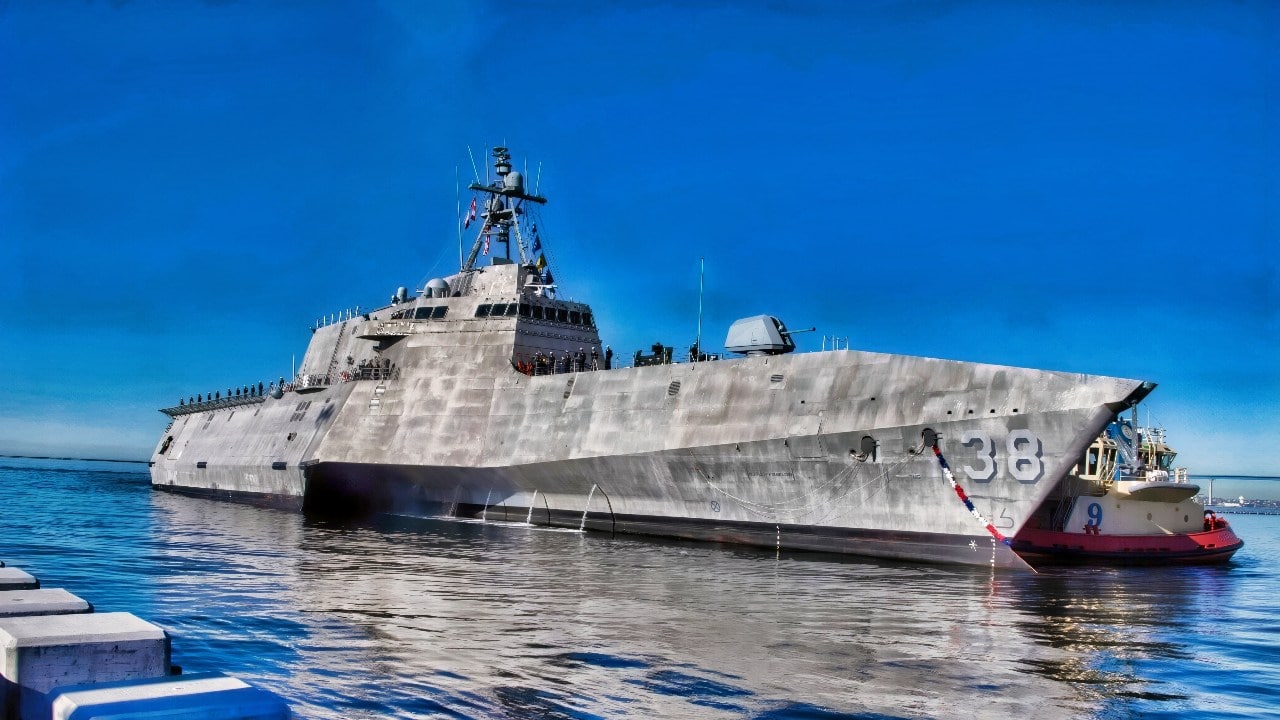
The Independence-Variant littoral combat ship USS Pierre (LCS 38) prepares to moor pier side during its arrival to its homeport of San Diego for the first time, Dec. 5, 2025. Pierre, the second U.S. Navy ship to bear this name, commissioned in Panama City, Fla. Nov. 15 as the final independence-variant LCS. Littoral combat ships are fast, optimally-manned, mission-tailored surface combatants that operate in near-shore and open-ocean environments, winning against 21st-century coastal threats.
Of course, lasers could also incinerate enemy targets—it all depends on specific mission needs.
For example, should an incoming enemy anti-ship missile be traveling over heavily trafficked ocean areas, a kinetic explosion dispersing fragments would be likely to cause civilian casualties.
A laser weapon, however, could simply incinerate the target.
About the Author: Kris Osborn
Kris Osborn is the Military Affairs Editor of 19FortyFive and President of Warrior Maven – Center for Military Modernization. Osborn previously served at the Pentagon as a Highly Qualified Expert with the Office of the Assistant Secretary of the Army—Acquisition, Logistics & Technology. Osborn has also worked as an anchor and on-air military specialist at national TV networks. He has appeared as a guest military expert on Fox News, MSNBC, The Military Channel, and The History Channel. He also has a Masters Degree in Comparative Literature from Columbia University.