
Summary and Key Points: Despite anxiety over the scheduled 2026 retirement of the USS Nimitz, Dr. Andrew Latham argues that decommissioning the 50-year-old carrier is a move toward strategic clarity rather than a surrender of capability.
-He contends that clinging to legacy platforms rests on outdated Cold War assumptions of uncontested air superiority, whereas modern maritime warfare is defined by dense surveillance and precision strikes that threaten large surface vessels.
-By retiring the Nimitz, the Navy can break the “gravitational pull” of the past, freeing resources to adapt to a new era dependent on survivability, dispersion, and integration rather than sheer mass and presence.
Retiring the USS Nimitz: Why “Letting Go” Is the Only Way to Win
The prospect of decommissioning USS Nimitz, now scheduled for retirement in 2026 after more than five decades of service, has stirred a familiar anxiety. For over 50 years, the carrier has embodied American naval dominance, anchoring major military operations and serving as a visible instrument of reassurance during repeated crises. To many observers, retiring Nimitz feels like a self-inflicted wound, an unnecessary surrender of capability at a moment of growing global tension. That reaction is understandable. It is also strategically misleading.
The real danger is not that the Navy might retire an aging carrier that has already given more than was ever asked of it. The danger lies in extending its life for the wrong reasons, using yesterday’s strategic successes to justify tomorrow’s force structure. The ship still functions. But the strategic environment that once made it decisive has given way to something radically new.
The Comfort of Familiar Power
Arguments for extending USS Nimitz often rest on an unspoken premise: aircraft carriers worked – and worked spectacularly. Therefore, they must continue to work in the same way. That logic imports a specific vision of naval war, shaped by the late Cold War and the long unipolar moment that followed.
In that world, American forces expected to gain air superiority early, while the adversary’s sensors remained limited in range and persistence. Anti-ship weapons existed, but their range and integration imposed fewer operational constraints, allowing logistics pipelines to function with relative security once the opening phase passed. Large platforms were therefore treated as efficient instruments of concentration rather than as sources of unacceptable risk.
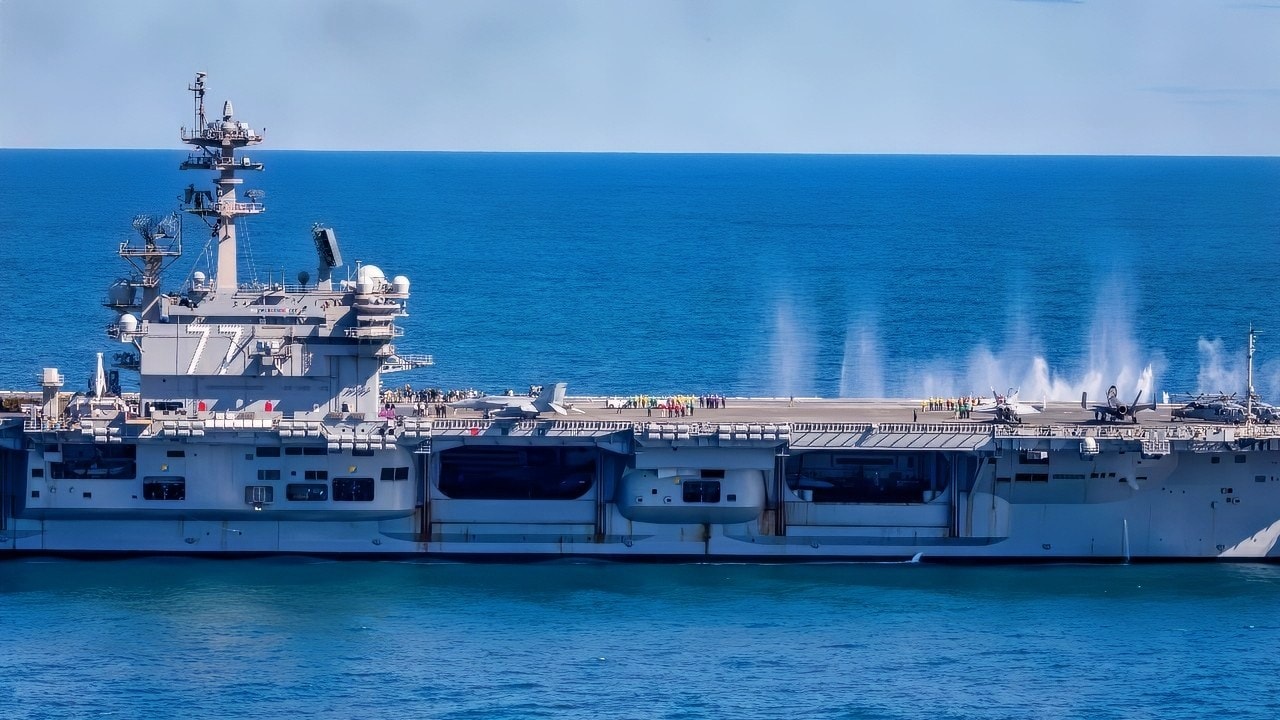
ATLANTIC OCEAN (Oct. 5, 2025) The Nimitz-class aircraft carrier USS George H.W. Bush (CVN 77) transits the Atlantic Ocean while an F/A-18E Super Hornet, attached to the “Pukin Dogs” of Strike Fighter Squadron (VFA) 143 fire rounds into ocean in support of the Titans of the Sea Presidential Review. The Titans of the Sea Presidential Review is one of many events taking place throughout the country to showcase maritime capabilities as part of the U.S Navy’s 250th birthday. America is a maritime nation. For 250 years, America’s Warfighting Navy has sailed the globe in defense of freedom. (U.S. Navy photo by Mass Communication Specialist 2nd Class Mitchell Mason)
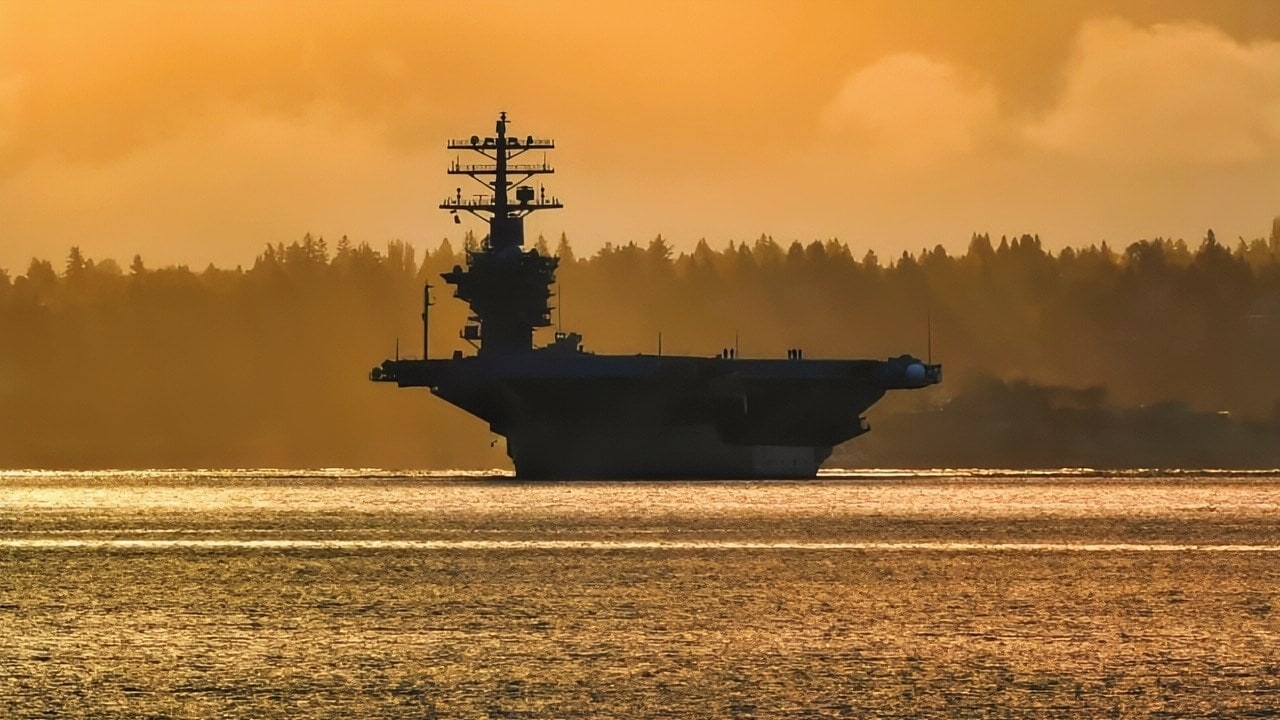
MANCHESTER, Wash. (April 28, 2017) USS Nimitz (CVN 68) transits Puget Sound, past the Seattle skyline enroute to its homeport, Naval Base Kitsap-Bremerton. The return to homeport marks the end of an underway along with its Carrier Strike Group 11, having successfully completed its final pre-deployment assessment, Composite Training Unit Exercise, April 21, and is now fully certified to deploy later this year. (U.S. Navy photo by Mass Communication Specialist 2nd Class Vaughan Dill/Released
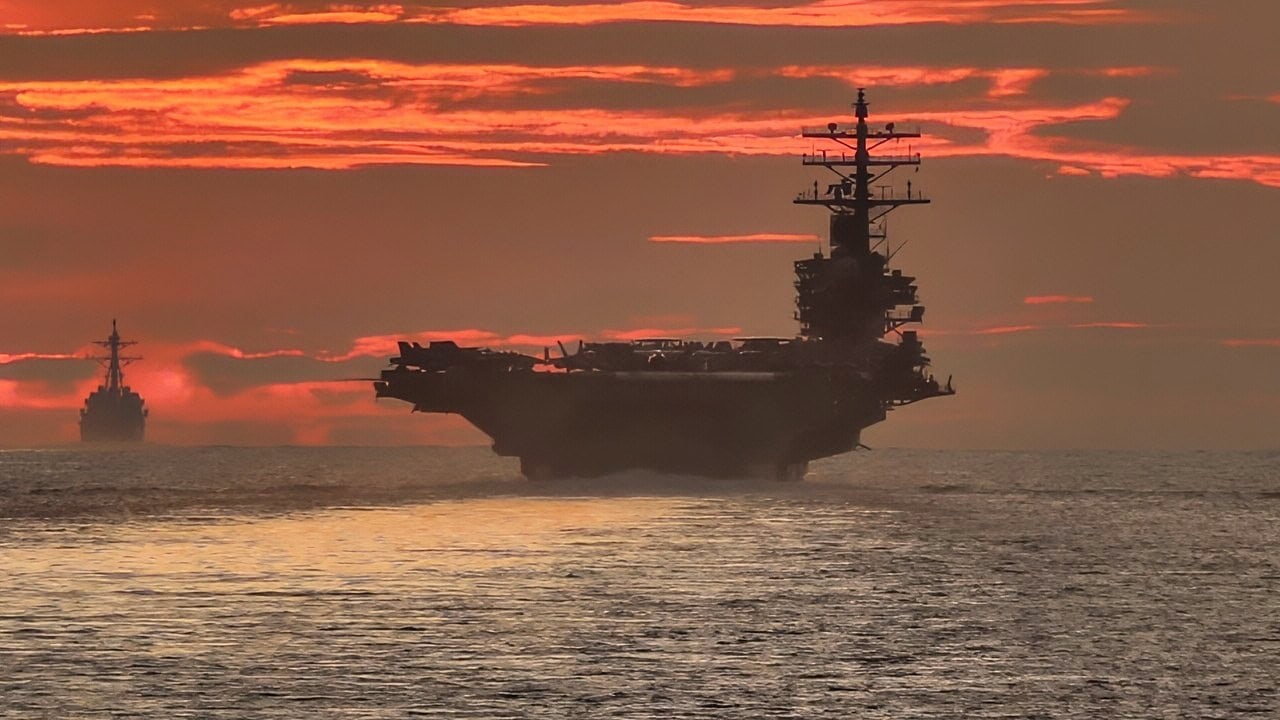
210618-N-JW440-2165 STRAIT OF MALACCA (June 18, 2021) As seen from the Ticonderoga-class guided-missile cruiser USS Shiloh (CG 67), the Navy’s only forward-deployed aircraft carrier USS Ronald Reagan (CVN 76) transits the South China Sea with the Arleigh Burke-class guided missile destroyer USS Halsey (DDG 97). The ships are part of Task Force 70/Carrier Strike Group 5, conducting underway operations in support of a free and open Indo-Pacific. (U.S. Navy Photo by Mass Communication Specialist 1st Class Rawad Madanat)
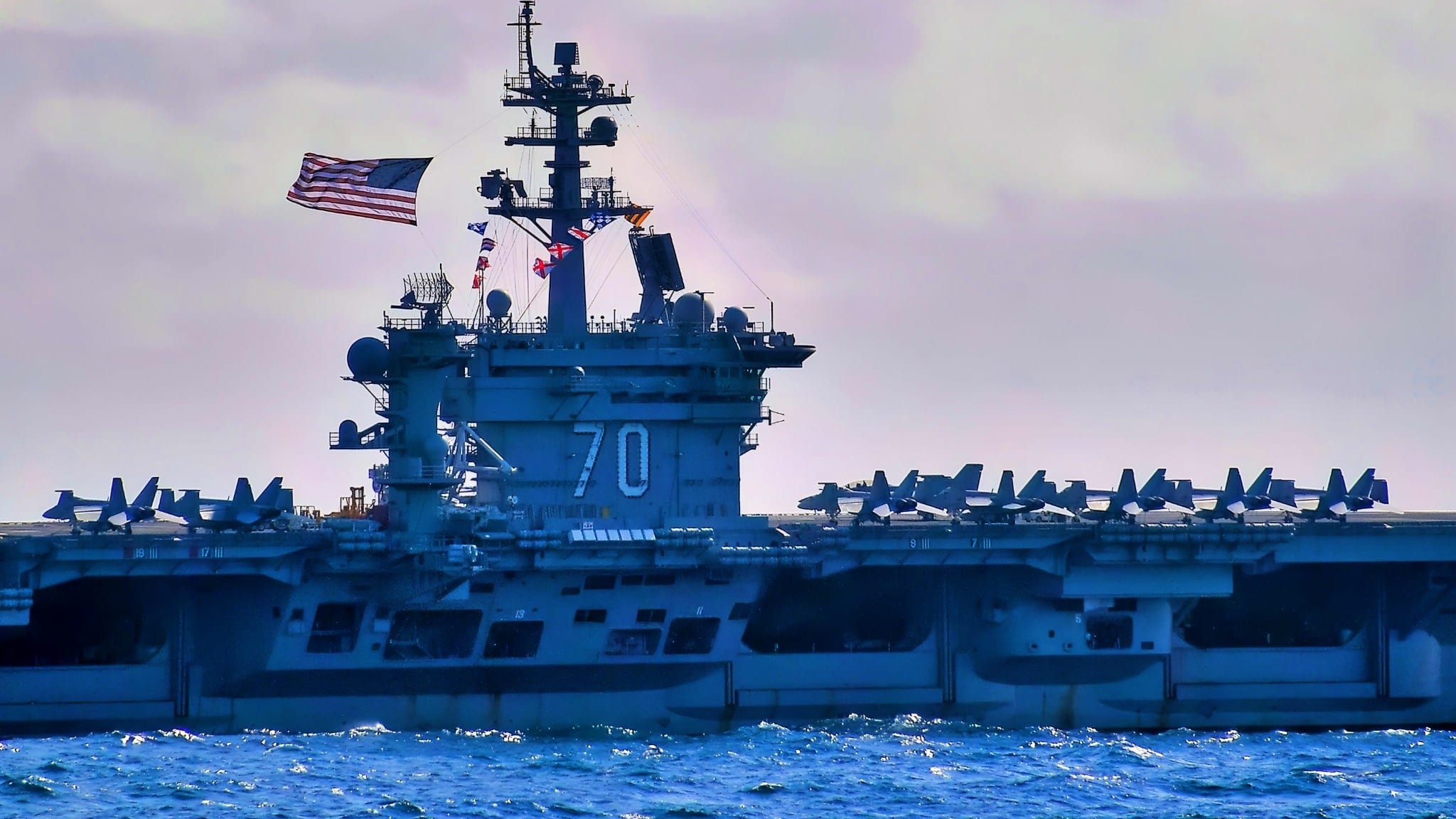
The Battle Ensign is flown aboard the Nimitz-class aircraft carrier USS Carl Vinson during an exercise with the Peru navy. Carl Vinson is supporting Southern Seas 2010, a U.S. Southern Command-directed operation that provides U.S. and international forces the opportunity to operate in a multi-national environment.
That mental map still exerts a powerful pull. It is reinforced by decades of success and by the institutional habits built around it. Extending Nimitz is prudent because it preserves a form of power the United States knows how to wield effectively. Yet strategy is not about preserving comfort. It is about aligning means with reality.
A Battlespace That No Longer Forgives Size
The maritime environment has changed in ways that cut directly against the assumptions that once protected large carriers. Surveillance is now dense and persistent. Sensors are fused across domains. Tracking is continuous rather than episodic. Precision strike reaches farther and arrives faster than it did even a generation ago.
In such an environment, concealment is harder to sustain, and predictability comes at a higher price. The value of a supercarrier makes it a priority target from the opening stages of high-end conflict, even as defensive systems remain formidable. Offensive capabilities have gained enough depth to change how strike campaigns unfold, with saturation now shaping operational logic more consistently than reliance on singular effects.
This does not render carriers irrelevant. It changes the terms under which they operate. They move from being default instruments of control to contested assets that demand careful protection and deliberate employment. Extending USS Nimitz risks treating this shift as incremental when it is structural.
When Continuity Becomes Strategy by Default
Life extension is often framed as a technical decision, a matter of hull life and reactor margins. In reality, it is a conceptual choice. Keeping an aging supercarrier in service signals continuity at a moment when adaptation should be the priority.
Legacy platforms exert a gravitational pull that extends beyond their immediate capabilities. They influence doctrine and training while quietly shaping investment decisions, reassuring political leaders that familiar tools remain available and delaying difficult conversations about tradeoffs that cannot be postponed forever.
Extending Nimitz absorbs attention and capacity that could otherwise accelerate adjustment. Maintenance demands rise. Workarounds multiply. Scarce expertise is tied to sustaining an old ship rather than scaling new operational concepts. The risk is not that the carrier fails in combat. The risk is that the Navy postpones the intellectual reckoning demanded by a less forgiving maritime environment.
Presence Is Not the Same as Preparedness
Defenders of extension are not wrong to emphasize presence. Carriers remain unmatched instruments of signaling and crisis management. They shape calculations short of war. They offer presidents visible options that can be surged or withdrawn.
Yet presence should not be confused with preparedness for sustained, high-end conflict. A force optimized for reassurance can drift away from the demands of survival under pressure. Retiring USS Nimitz does not eliminate the need for carriers. It forces clarity about what kind of carrier force is required and how it must evolve.
The United States retains newer carriers, additional hulls under construction, and a carrier industrial base that continues to function, albeit under strain and timing risk. The issue is not whether to abandon sea-based airpower. It is whether to allow the oldest exemplar of a past era to continue shaping present assumptions.
Learning Requires Letting Go
History suggests that militaries adapt poorly when legacy systems remain politically untouchable. Platforms that once enabled dominance can become constraints on imagination long after the conditions that favored them have eroded. The longer they are preserved, the harder it becomes to challenge the assumptions built around them.
Retiring USS Nimitz would not erase American naval power. It would acknowledge that power now depends more heavily on survivability, dispersion, and integration than on sheer concentration. Adaptation matters more than preserving familiar numbers.
Such decisions are never comfortable. They invite criticism and uncertainty. Yet strategic strength is measured less by what is retained than by what institutions are willing to change.
A Necessary Act of Strategic Honesty
USS Nimitz served magnificently in the world that produced it. That world rewarded scale and tolerated exposure. Today’s environment does neither. Extending the carrier’s life may feel reassuring, but reassurance is not a strategy.
Letting go is not a decline. It is recognition. Naval power remains central to American influence, but its future will not be secured by clinging to platforms designed for conditions that no longer prevail. The United States weakens itself not by retiring an old carrier, but by insisting that the logic which once justified it can still carry the burden of tomorrow’s wars.
About the Author: Dr. Andrew Latham
Andrew Latham is a non-resident fellow at Defense Priorities and a professor of international relations and political theory at Macalester College in Saint Paul, MN. You can follow him on X: @aakatham.