
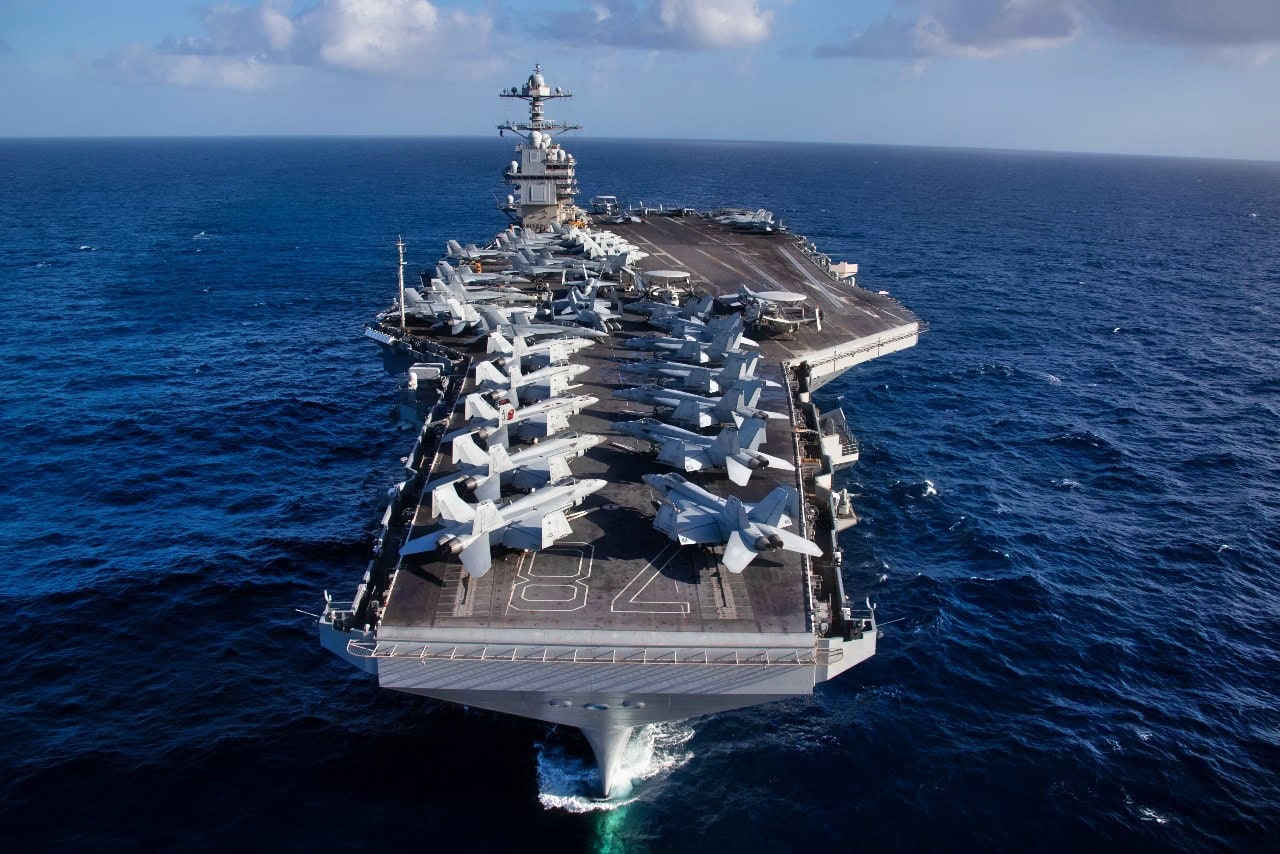
Synopsis: The U.S. Navy’s newest carrier, USS Gerald R. Ford, was redirected in late October 2025 from European operations into the Caribbean to support SOUTHCOM—an unusually large show of force tied to heightened U.S. pressure on Venezuela’s Maduro government and tougher sanctions enforcement.
-The carrier’s presence is reinforced by a broader regional posture that includes amphibious forces, advanced aircraft, and a sizable U.S. personnel footprint.
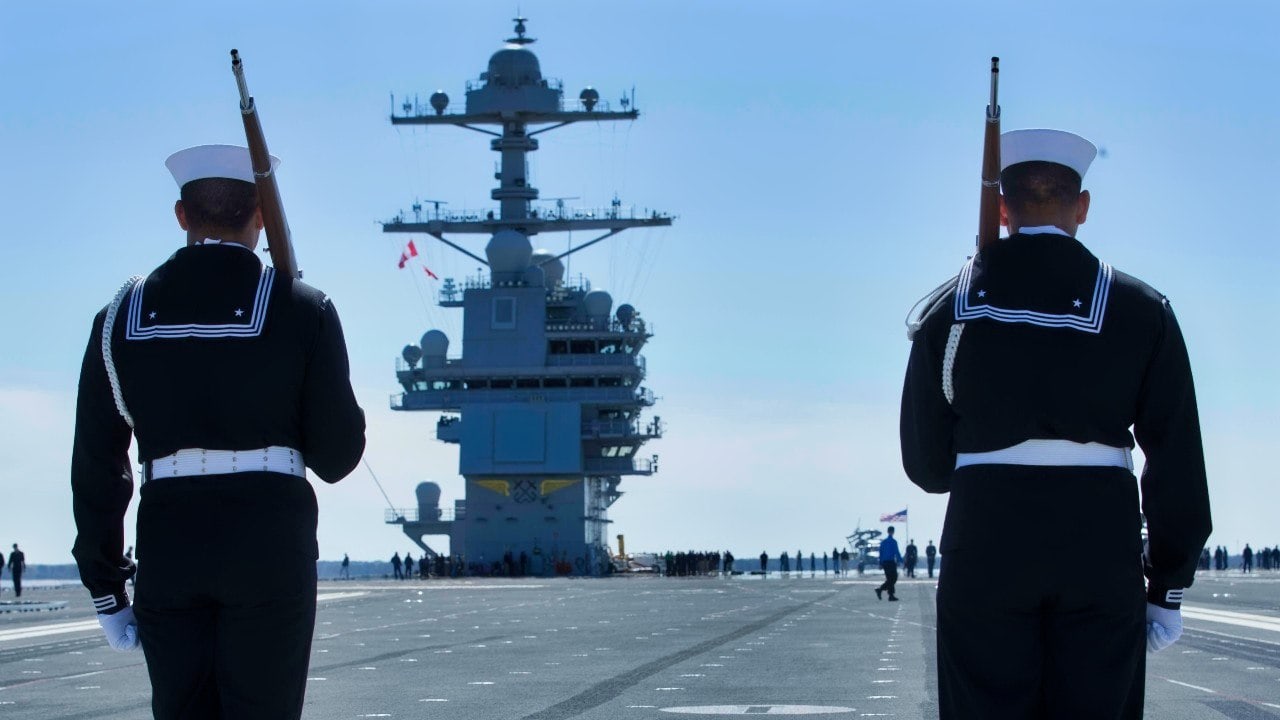
(April 8, 2017) — Logistics Specialist 3rd Class Miguel Monduy, from Miami, Florida, and Aviation Ordnanceman Airman Michael Valdez, from Pheonix, Arizona, assigned to Pre-Commissioning Unit Gerald R. Ford (CVN 78), stand on the flight deck for shifting colors. The future USS Gerald R. Ford (CVN 78) is underway on its own power for the first time. The first-of-class ship — the first new U.S. aircraft carrier design in 40 years — will spend several days conducting builder’s sea trials, a comprehensive test of many of the ship’s key systems and technologies. (U.S. Navy photo by Mass Communication Specialist Seaman Gitte Schirrmacher)
-The catch is sustainability: Ford is slated for major shipyard maintenance in early 2026, and the East Coast carrier bench is thin, making a prolonged carrier-led deployment difficult to maintain without trade-offs elsewhere.
Aircraft Carrier USS Gerald R. Ford Has a Message for Venezuela—and the Navy
In late October 2025, the U.S. Navy deployed its newest nuclear-powered aircraft carrier to the Caribbean, marking one of its most significant concentrations of American naval power in the region in decades. The USS Gerald R. Ford, after spending months in European waters, is now operating in support of U.S. Southern Command missions.
The deployment, while surprising, came amid escalating political pressure from Washington on Venezuela’s government and reflects a broader effort by the Trump administration to reassert American military dominance in the Western Hemisphere visibly.
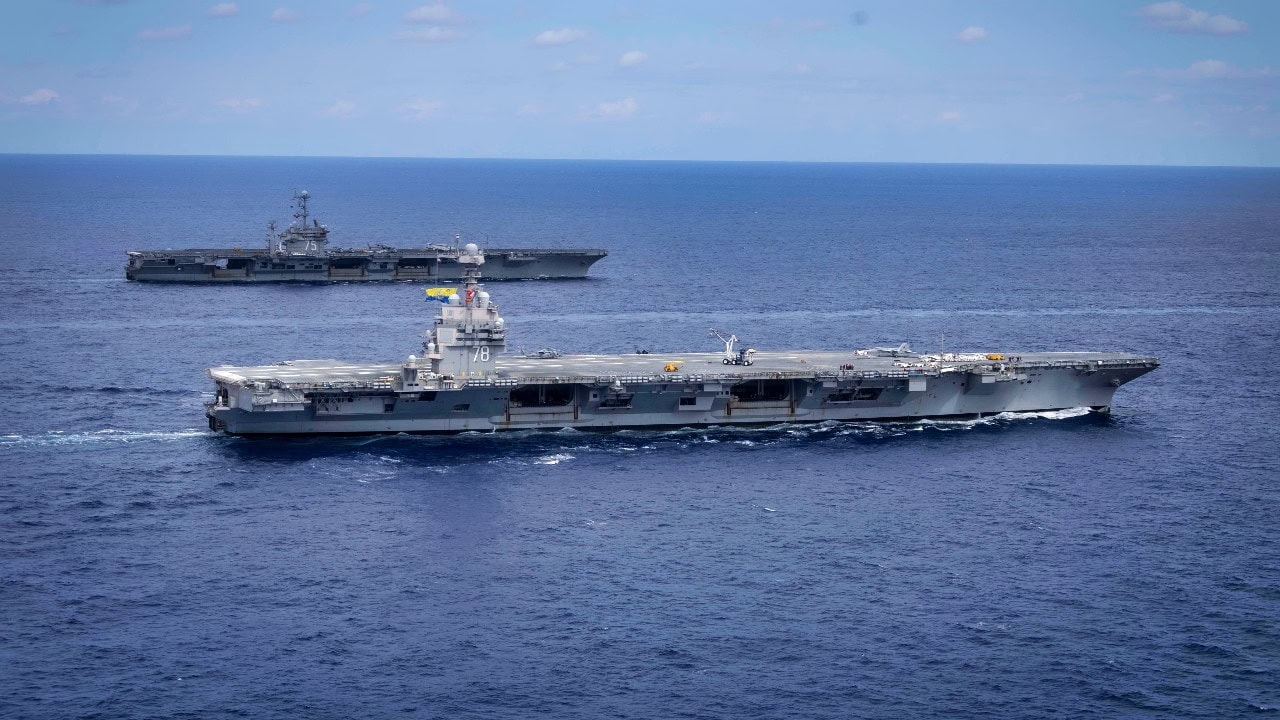
ATLANTIC OCEAN. (Aug. 24, 2024) The Nimitz-class aircraft carriers USS Harry S. Truman (CVN 75), back, and the world’s largest aircraft carrier, USS Gerald R. Ford (CVN 78), sail in formation in the Atlantic Ocean, Aug. 24, 2024. USS Gerald R. Ford is the flagship of the Gerald R. Ford Carrier Strike Group. The aircraft carrier is underway in the Atlantic Ocean to further develop core unit capabilities and skills such as fuels certification and ammunition on-load during its basic phase of the optimized fleet response plan. (U.S. Navy photo by Mass Communication Specialist 2nd Class Maxwell Orlosky).
While the Caribbean has long hosted rotational naval patrols, the presence of an entire carrier strike group, backed by strategic bombers, amphibious forces, and advanced fighters, constitutes a dramatic shift from routine security operations to sustained deterrence and even coercive signaling.
Yet as imposing as the current force posture appears, its presence raises a question: how long can the Navy realistically maintain a carrier-led deployment in the Caribbean without straining its already limited fleet?
How the Deployment Began – and Why It Escalated
The current deployment to the Caribbean grew out of what was initially a conventional carrier operating cycle. USS Gerald R. Ford departed Naval Station Norfolk in May 2025 for a deployment that began in European waters, following a pattern similar to its 2023-2024 route, which was repeatedly extended due to the Israel-Hamas war and regional instability in the Eastern Mediterranean.
That earlier deployment ultimately kept the carrier at sea for 239 days before it returned to Virginia in January 2024.
The escalation really began in late October 2025 when Defense Secretary Pete Hegseth ordered the carrier to leave Split, Croatia, and head south into the Caribbean, shifting its mission from European deterrence to operations supporting U.S. Southern Command.
The move also coincides with President Donald Trump’s decision to ramp up political pressure on Venezuelan President Nicolas Maduro, which included expanded sanctions enforcement.
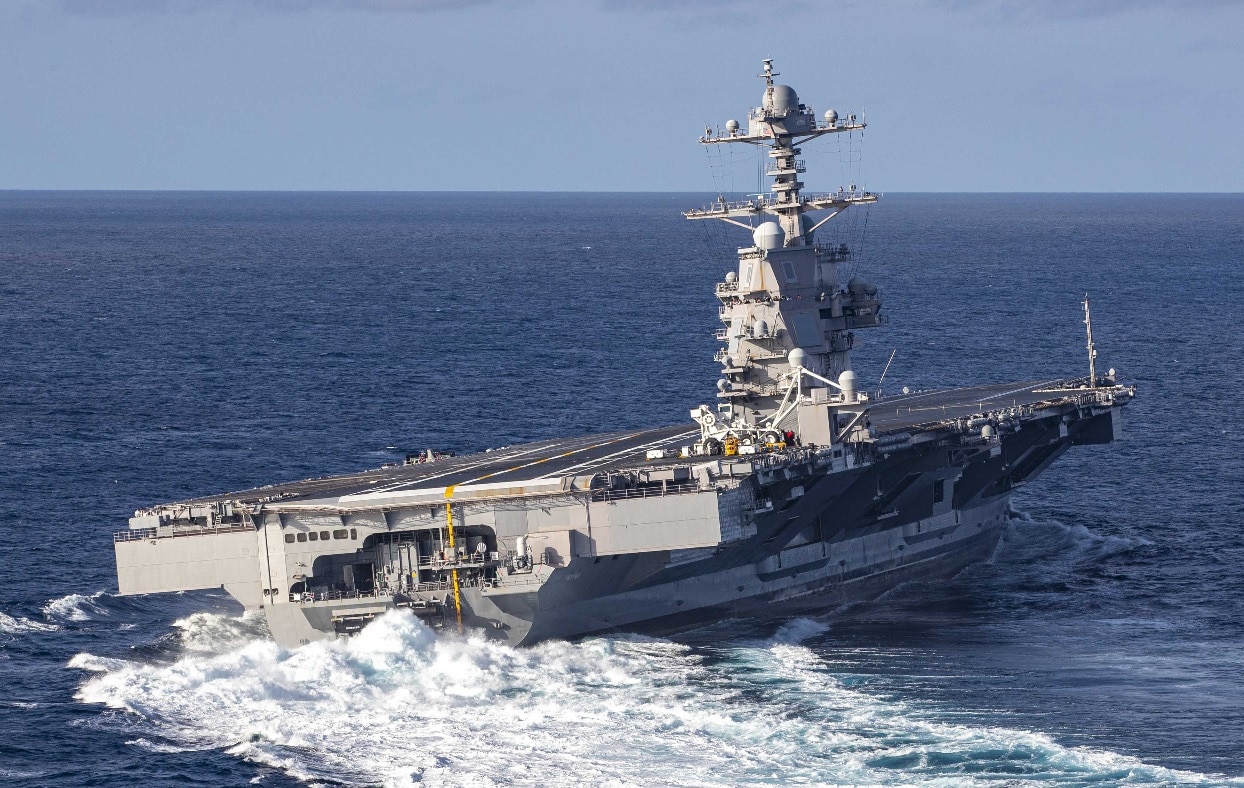
ATLANTIC OCEAN (Oct. 29, 2019) The aircraft carrier USS Gerald R. Ford (CVN 78) conducts high-speed turns in the Atlantic Ocean, Oct. 29, 2019. Gerald R. Ford is at sea conducting sea trials following the in port portion of its 15-month post-shakedown availability. (U.S. Navy photo by Mass Communication Specialist 3rd Class Connor Loessin/Released)191029-N-YW238-1322
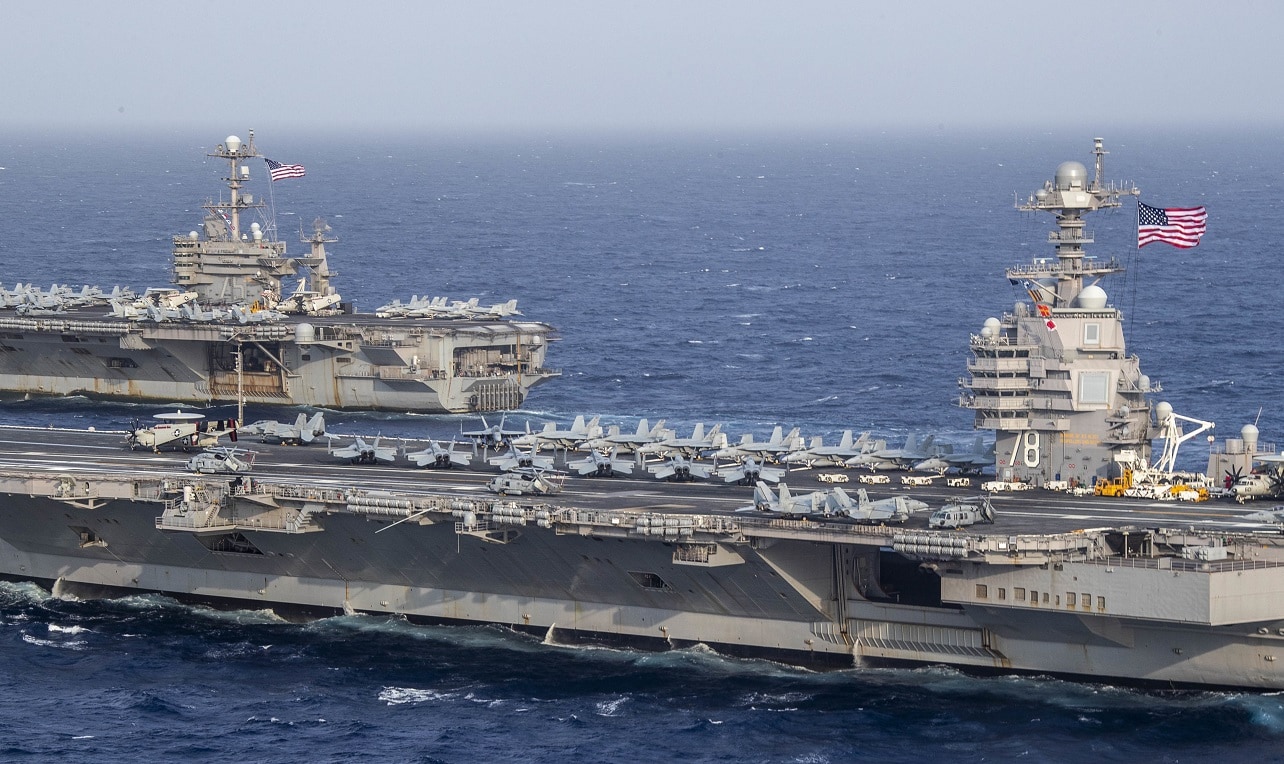
The Ford-class aircraft carrier USS Gerald R. Ford (CVN 78) and the Nimitz-class aircraft carrier USS Harry S. Truman (CVN 75) transit the Atlantic Ocean June 4, 2020, marking the first time a Ford-class and a Nimitz-class aircraft carrier operated together underway. Ford is underway conducting integrated air wing operations, and the Harry S. Truman Carrier Strike Group remains at sea in the Atlantic as a certified carrier strike group force ready for tasking in order to protect the crew from the risks posed by COVID-19, following their successful deployment to the U.S. 5th and 6th Fleet areas of operation. (U.S. Navy photo by Mass Communication Specialist Seaman Riley McDowell)
In a December analysis for Forbes, Peter Suciu argued that the carrier’s redirection was notable precisely because it broke from modern peacetime deployment norms, which typically cap carrier deployments at around six months absent major conflict.
While the U.S. Navy routinely surged carriers during the post-9/11 wars, it has spent the last decade or so attempting to restore more predictable deployment cycles to maintain fleet readiness.
The carrier’s arrival was not isolated. In late August and early September, the amphibious assault ship USS Iwo Jima deployed to the Caribbean as part of a U.S. Navy amphibious ready group conducting counter-narcotics operations and regional security missions, according to U.S. Navy and U.S. Southern Command reporting. The deployment included fifth-generation aircraft, with U.S. officials confirming that F-35 fighter jets were operating from U.S. positions in the region to support maritime surveillance.
By December, U.S. officials acknowledged that roughly 15,000 U.S. military personnel and an unusually large concentration of naval assets were operating in and around the Caribbean, marking one of the most significant sustained U.S. military presences in the region in recent years amid heightened concerns over regional security and drug trafficking activity.
Why Trump May Want the USS Ford Deployment To Continue – and Why It Probably Can’t
Politically, the incentives for President Trump to sustain a visible naval presence in the Caribbean are clear. A carrier operating near Venezuela’s coast offers a solid symbol of American military dominance in the region and reinforces the administration’s hard-line posture against Maduro, and allows the White House to frame the operation as both a national security mission and an extension of its expanded war on drug trafficking.
Operational constraints, however, limit how long that posture can be maintained – leaving many to wonder how long it will take for the president to order some kind of strike, or if he’ll order anything at all.
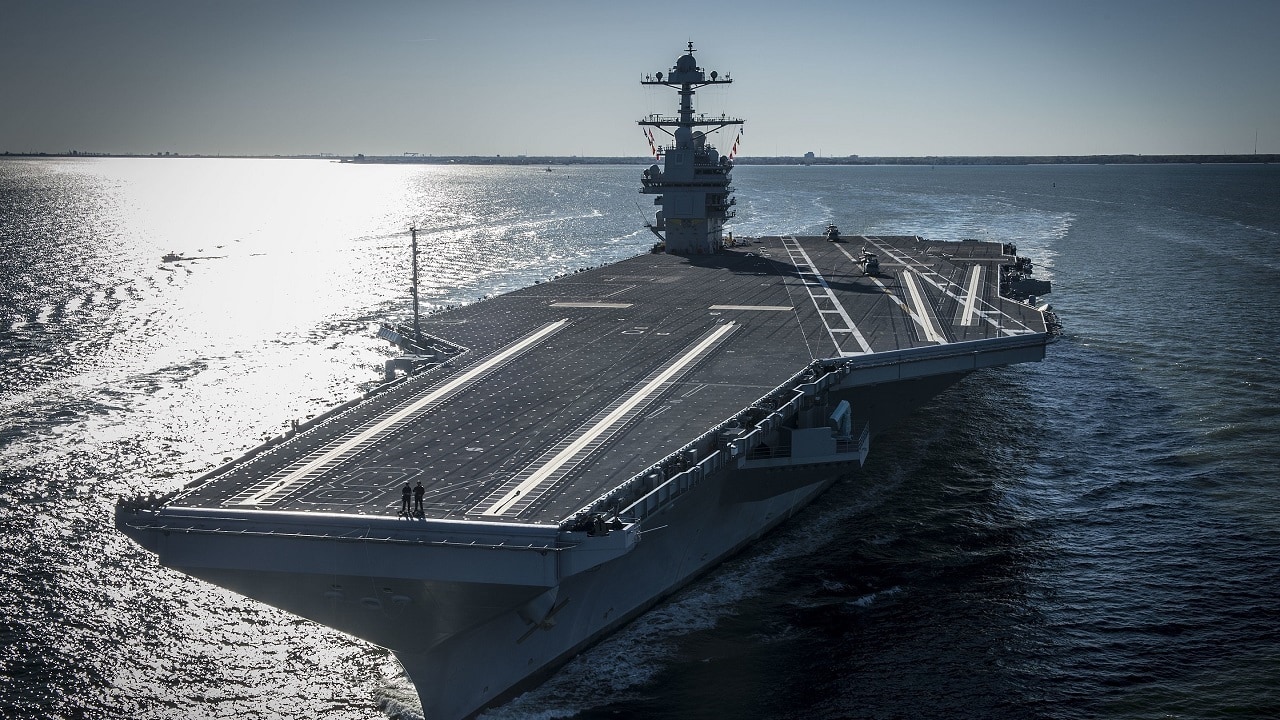
The U.S. Navy aircraft carrier USS Gerald R. Ford (CVN-78) underway on its own power for the first time. The first-of-class ship — the first new U.S. aircraft carrier design in 40 years — spent several days conducting builder’s sea trials, a comprehensive test of many of the ship’s key systems and technologies.
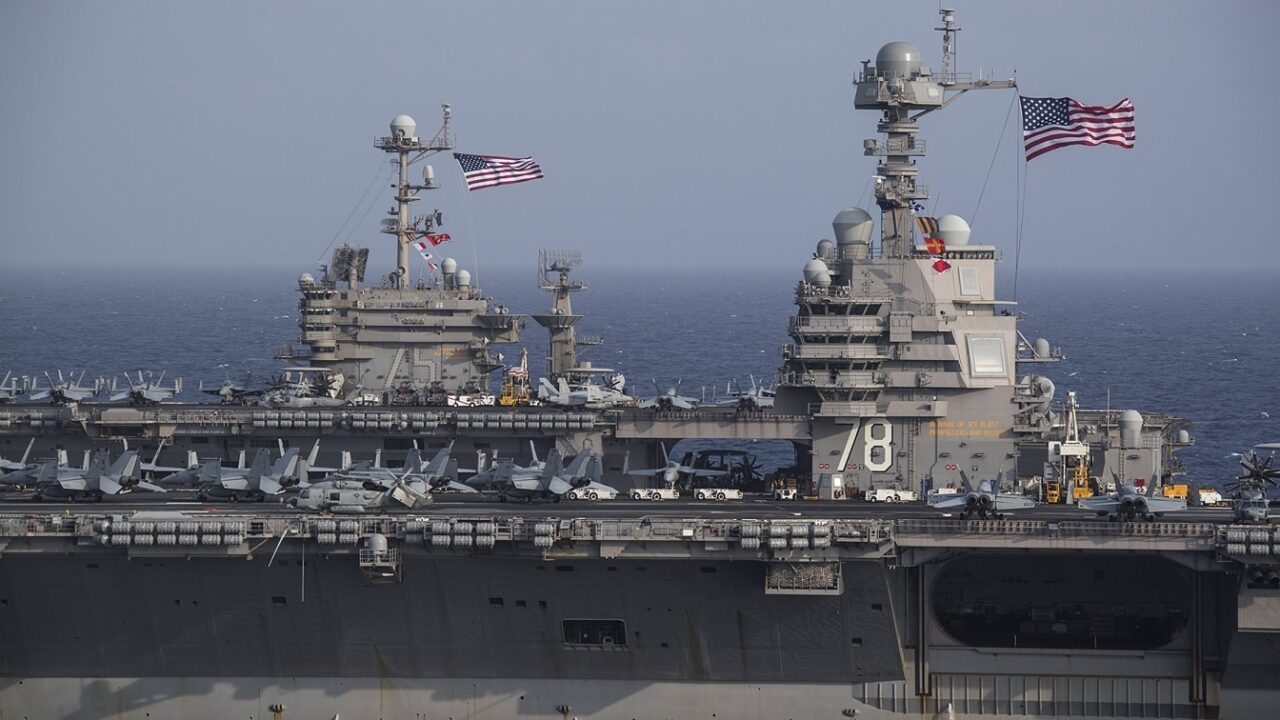
(June 4, 2020) The Ford-class aircraft carrier USS Gerald R. Ford (CVN 78) and the Nimitz-class aircraft carrier USS Harry S. Truman (CVN 75) transit the Atlantic Ocean, June 4, 2020, marking the first time a Ford-class and a Nimitz-class aircraft carrier have operated together underway. Gerald R. Ford is underway conducting integrated air wing operations and the Harry S. Truman Carrier Strike Group remains at sea in the Atlantic Ocean as a certified carrier strike group force ready for tasking in order to protect the crew from the risks posed by COVID-19, following their successful deployment to the U.S. 5th and 6th Fleet areas of operation. (U.S. Navy photo by Mass Communication Specialist 2nd Class Ruben Reed/Released
The most immediate issue here is maintenance. USS Gerald R. Ford is scheduled to enter a major maintenance and refit period at Newport News Shipyard in early 2026 – a process that will involve planned upgrades and system modifications that can only be performed in dry dock. Prolonging the deployment would delay those upgrades and cause several knock-on effects. In short, that maintenance cannot be skipped easily.
Replacement options are slim, too. Of the Navy’s four East Coast-based carriers, USS Harry S. Truman is entering its Refueling and Complex Overhaul, which is a multiyear process that will sideline the ship until the end of the decade. USS Dwight D. Eisenhower could, in theory, move to the Caribbean.
Still, that ship only recently completed an extended deployment supporting operations in the Red Sea and Middle East – and between crew fatigue and maintenance backlogs, that is a last-resort option.
Meanwhile, deploying a West Coast-based carrier would introduce other trade-offs. For example, it would require a lengthy transit around South America or require a carrier to be diverted from the Indo-Pacific, where U.S. naval presence is already stretched amid rising tensions with China.
If President Trump is planning something in Venezuela, expect something soon.
About the Author:
Jack Buckby is a British researcher and analyst specialising in defence and national security, based in New York. His work focuses on military capability, procurement, and strategic competition, producing and editing analysis for policy and defence audiences. He brings extensive editorial experience, with a career output spanning over 1,000 articles at 19FortyFive and National Security Journal, and has previously authored books and papers on extremism and deradicalisation.