Key Points and Summary – “Operation Absolute Resolve” was a strategically consequential U.S. raid that combined air, sea, and ground power to seize Nicolás Maduro—highlighting scale (over 150 aircraft), tight joint integration, and deep intelligence access to Maduro’s inner security architecture.
-The operation signals American reach and may trigger a regional “paradigm change,” with knock-on effects for Havana, Moscow, and Beijing.
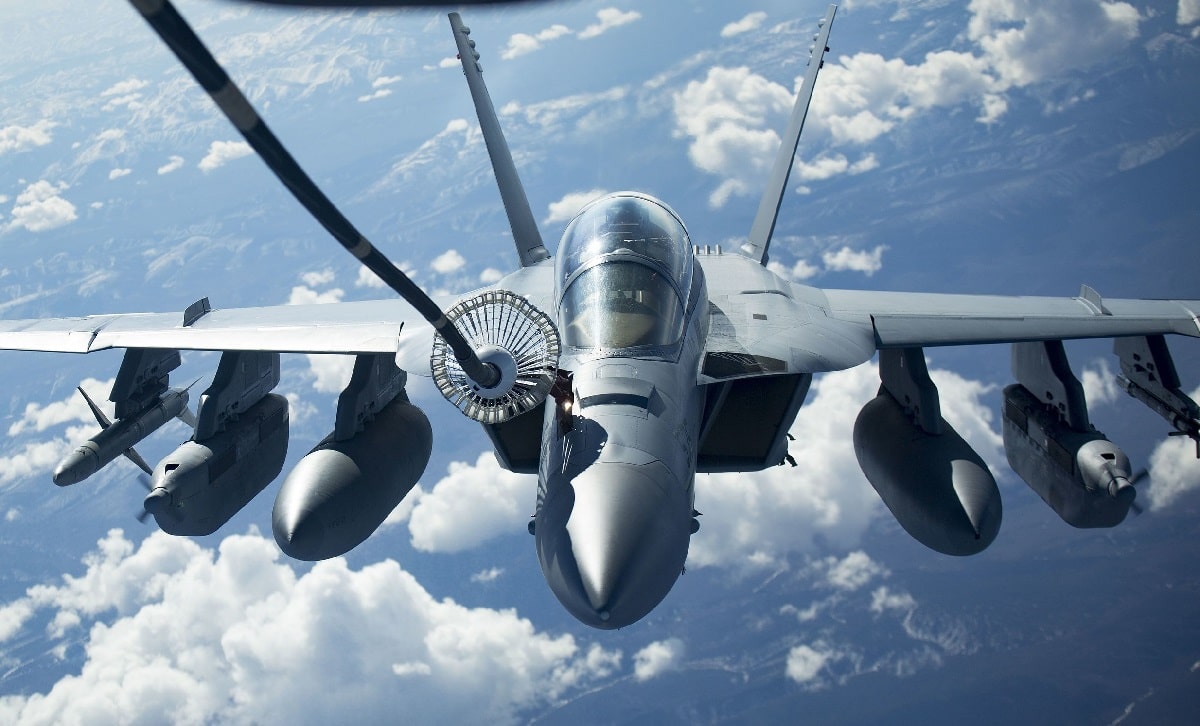
EA-18G Growler. Image Credit: Creative Commons.
Trump’s Venezuela Strike Has a Message: U.S. Power Can Still Decapitate a Regime
“We have opened the door to a paradigm change in the region.” This was the comment of former US Army Vice Chief of Staff (1999-2003) Gen. Jack Keane from the Washington, DC-based Institute for the Study of War when speaking on Fox News about last night’s strike on Venezuela by a US military air, sea, and land assault.
This and the extradition of its strongman leader, Nicolás Maduro Moros, is hopefully the first step in changing Latin America, said Gen. Keane.
He went on to say that this could be the moment where the trend of Latin nations succumbing to leftist and criminal regimes comes to an end.
The world will then witness a “return by South America to what it used to be – [a continent] ruled by democratic governments.”
Trump’s Venezuela Action: What We Know
There had been increasing indications that military action was coming.
For more than a month, the buildup of US forces in the Caribbean had risen from a presence of “just enough for a show of force” to a level of “more than enough to conduct a broad-scale military operation.”
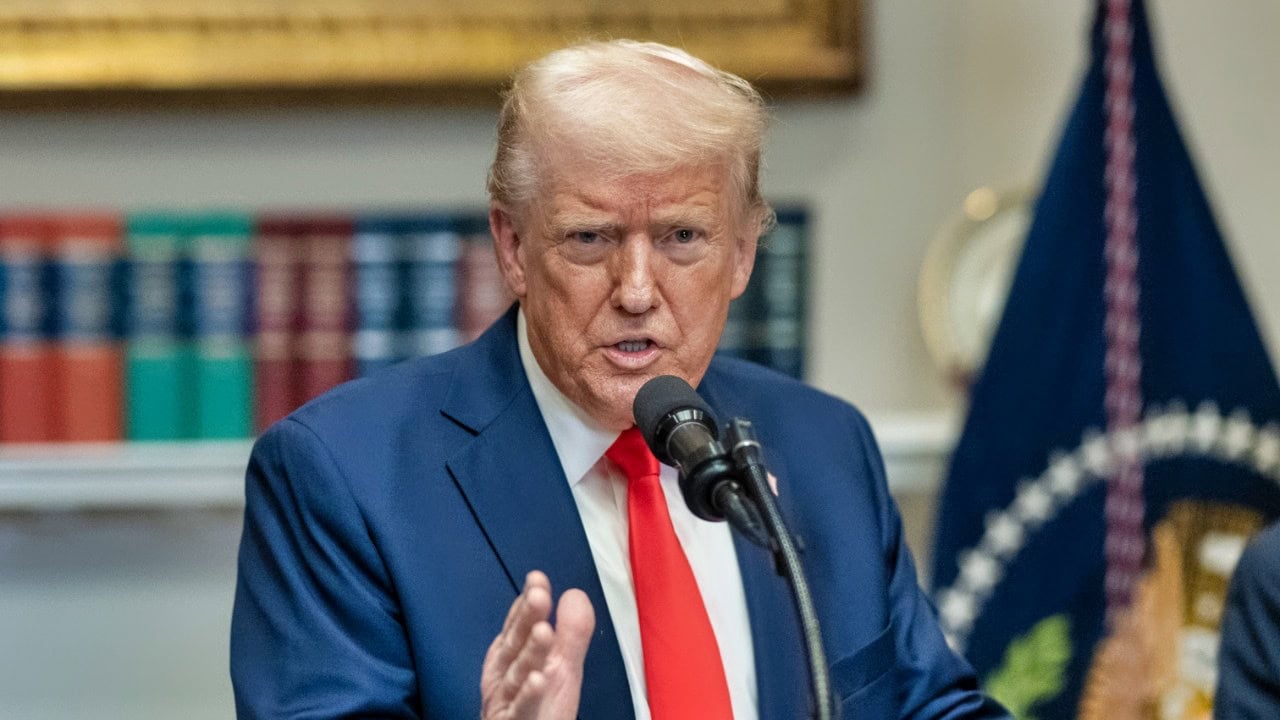
According to briefings this morning by US President Donald Trump, JCS Chairman USAF Gen. Dan Caine, and National Security Advisor Marco Rubio, there are several major takeaways from “Operation Absolute Resolve” with additional far-reaching implications.
Military Power and Intelligence Penetration
One of those is that the US military has premier capabilities to carry out an attack at almost any place on the globe – as demonstrated not only by the attack on Venezuela, but also this past June’s Operational Midnight Hammer raid against Iran’s nuclear weapons design centers.
The US nighttime military operation to take out critical military nodes and other assets and then extract Venezuelan President Nicolas Maduro in Caracas is one of the more complex in contemporary military history.
The effort required “months of planning and rehearsal,” and more than 150 US aircraft were used, General Caine told the media in this morning’s after-action briefing.
“The word integration does not explain the sheer complexity of such a mission, an extraction so precise — it involved more than 150 aircraft launching across the Western Hemisphere,” Caine told the joint press conference along with Trump and Rubio.
Caine added that Maduro and his wife, Cilia Flores, “both indicted, gave up and were taken into custody by the Department of Justice, assisted by our incredible US military with professionalism and precision, with no loss of US life.”
After a 4-day delay due to weather, the US began the operation at 2300 hours EDT on Friday, when at the “darkest hours” of the night, said Caine, aircraft launched from 20 different bases, on land and at sea, across the Western Hemisphere. Caine added that the raid included an effectively integrated mix of USAF F-35 and F-22 stealth fighter jets, B-1 Bombers, plus US Navy F/A-18 fighter jets, EA-18 Growlers electronic attack jets, and E-2 airborne early warning planes.
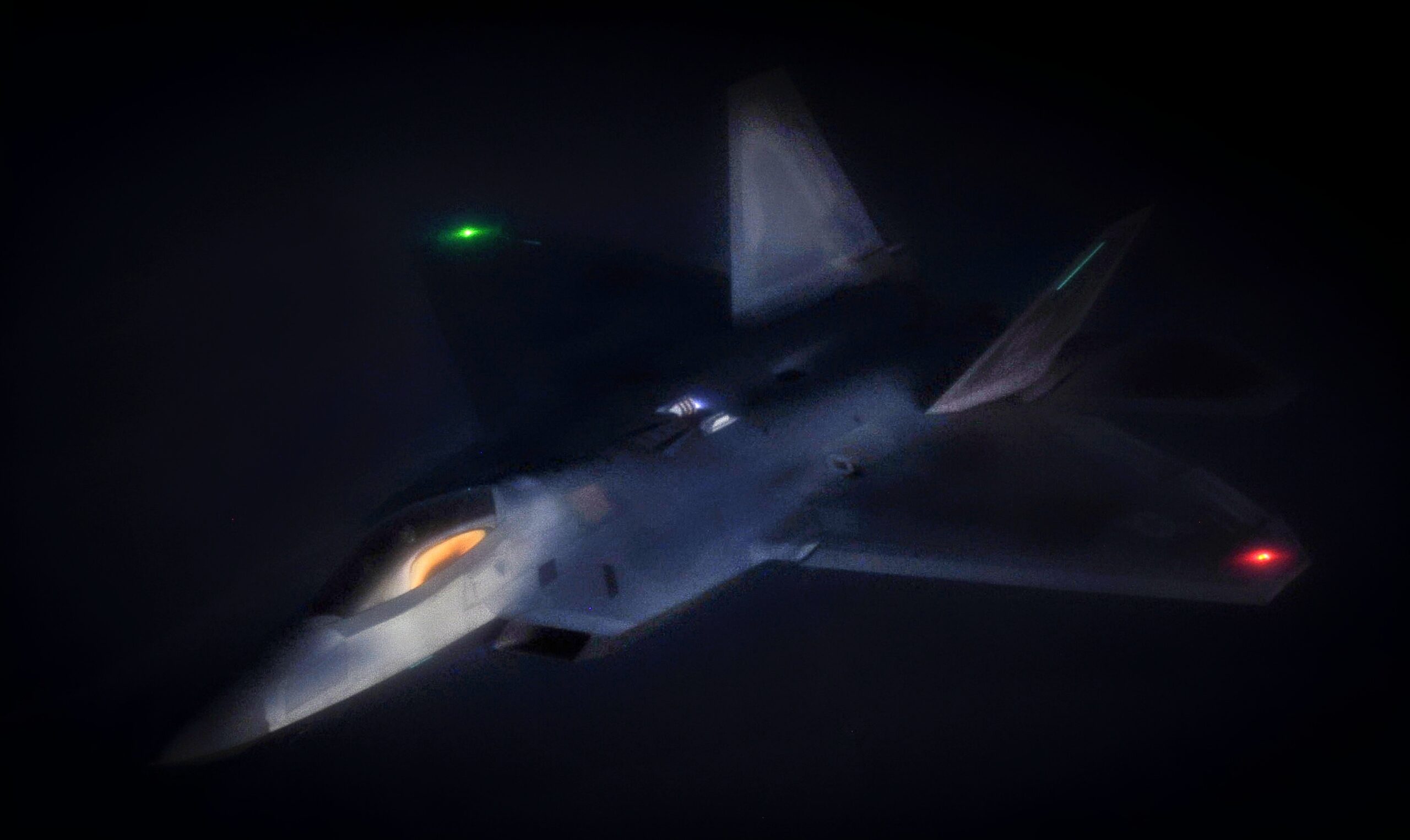
An F-22 Raptor fighter jet, assigned to the 433rd Weapons Squadron at Nellis Air Force Base, Nev., maneuvers after being refueled by a KC-135 Stratotanker during a Weapons School Integration mission over the Nevada Test and Training Range June 8, 2012. One of the most important planned aspects of this mission is holding it during the hours of darkness. (U.S. Air Force photo by Senior Airman Kevin Tanenbaum/Released)
Details of the outbriefs were that between the USAF Suppression of Air Defenses (SEAD) sorties and the US Navy employing the Growlers there was little chance for the Venezuelan forces on the ground to either “see what was coming or be able to put up any defensive fire even if they did,” said one former US military planner familiar with these joint operations who spoke to 19FortyFive.
The helicopters carrying the extraction team reached Maduro’s compound just after 0100 EDT, but took heavy fire from the presidential security forces in the process.
The special forces assigned to the mission then took the Venezuelan president and his wife into custody despite their attempts to enter into a steel safe room inside the residence.
The level of detail that the US forces had as to the location of Maduro, the design and layout of his compound, also demonstrates that the US intelligence must have had “eyes and ears in the room” for weeks, said a former CIA official. “It is a rather high level of penetration of Maduro’s security services,” he said.
So thorough a penetration that “elite US troops, including the Army’s Delta Force, created a replica of Maduro’s safe house and practiced how they would enter the strongly fortified residence,” before last night’s operation, according to several media reports.
The CIA had a small team on the ground beginning in August who learned enough details as to Maduro’s pattern of movements and daily routine that made his abduction “seamless,” according to anonymous intelligence sources who spoke to Reuters.
US Adversaries May Fight Back
Taking down Maduro and Venezuela, presumably becoming a partner of the U.S., would be bad news for the country’s previous line-up of allies.
The consequences will be particularly severe for Cuba, which had a significant, long-term commitment to Venezuela, so much so that indications are that they will fight back even after this US attack.
Last month, anti-Castro opposition figures in Miami told me that Havana “lives for the opportunity to poke Uncle Sam in the eye” and that encouraging Maduro to hold the line against the US had been “one of [the] most visible ways for them to do so.”
Cuba’s security and intelligence services were also a significant support structure for Maduro, for which Havana was well-paid. “The innermost circle of Maduro’s security detail that keeps him and those around him safe are all Cuban,” said another well-known expert, Dr. Sebastian Arcos, the Associate Director of the Cuban Research Institute at Florida International University.
Cuba was willing to take significant measures to keep Maduro from falling, explained Arcos. Not the least of which is because “[H]avana understands that Venezuela is the weak link” in the axis that also includes Havana’s other partners – Russia and the People’s Republic of China (PRC).
Arcos told 19FortyFive that what we now see is that “the people who have been running Venezuela are the people that Cuba has wanted to be running Venezuela – Maduro was not an all-powerful leader. He was a figurehead for the Cubans.”
He continued that Delcy Rodriguez, the Venezuelan Vice-President under Maduro, and who had been rumored to have fled to Moscow, Defense Minister Vladimir Padrino López, and
Diosdado Cabello Rondón, the Minister of Interior, Justice and Peace, has just given a press conference from Caracas late this afternoon. They have announced that they will continue to run the country. And do not forget that all of Maduro’s power structures are still in place, he said.
Cuba Has a Problem…and Russia…and China
For Cuba, this is now a struggle for survival as “Havana’s oil supplies will last only 45 days without Venezuela in the picture,” said Arcos. “And it looks like they are not out of the picture based on what we are seeing now. We need to see just exactly what is going to happen because right now it is very confusing.”
In the future, the Cuban regime may increasingly have to depend on Venezuela for manpower in its labour force. Due to waves of emigration and economic trends that have depressed the birthrate, “at present Cuba is a demographic catastrophe,” said Arcos. “Its population is today the oldest in all of Latin America.”
If that lifeline for Cuba – both in manpower and energy – is completely severed, “the reputation of Havana for being able to provide competent security and intelligence services for its allies may be significantly dented,” said a US special forces and security services contractor active in Latin America. But Cuba may not be the weakest link of all.
It was also not too long ago that Russian President Vladimir Putin had threatened to base a large number of his Oreshnik ballistic missiles in Venezuela to deter a US attack.
Both Russia and the PRC had pledged to support Maduro against any US action, but this had no effect on the American president’s determination.
For Moscow, Maduro is now the second major ally to be removed after Syria’s Bashar al-Assad, and in both cases, these leaders lost power without Russia’s influence having had any protective effect. “As a consequence, other allies of Russia are going to be asking if Putin’s ‘guarantees’ actually guarantee anything of any value anymore,” said the former CIA official.
“Too many people have too much to lose at this point, which is always a dangerous state of affairs.”
About the Author: Reuben F. Johnson
Reuben F. Johnson has thirty-six years of experience analyzing and reporting on foreign weapons systems, defense technologies, and international arms export policy. Johnson is the Director of Research at the Casimir Pulaski Foundation. He is also a survivor of the Russian invasion of Ukraine in February 2022. He worked for years in the American defense industry as a foreign technology analyst and later as a consultant for the U.S. Department of Defense, the Departments of the Navy and Air Force, and the governments of the United Kingdom and Australia. In 2022-2023, he won two awards in a row for his defense reporting. He holds a bachelor’s degree from DePauw University and a master’s degree from Miami University in Ohio, specializing in Soviet and Russian studies. He lives in Warsaw.