
Trump Should Not Make Iranians Pay for Their Own Regime Change
President Donald Trump sees foreign policy as transactional.
He is upfront that when the United States acts, it should profit from its actions. Trump initially linked support for Ukraine to a deal in which Ukraine would pay the United States back with proceeds or rights to more than $500 billion in minerals and metals, including rare earths.
Likewise, his quid pro quo with new Venezuelan President Delcy Rodríguez and her brothers involved her accepting President Nicolás Maduro’s removal in exchange for primacy in the sale and development of Venezuelan oil.
If Trump is serious about regime change in the Islamic Republic, he might expect a similar commercial advantage. While he might use revenue, should he seize the Kharg Oil terminal before regime change to fund opposition, medical funds, and strike funds, he should not demand any monopoly or impose any commercial contracts on post-Islamic Republic Iran.
Iran and a History Lesson
Trump may care little for history, but history provides a lens through which the experiences of other countries and people shape their interpretation and approach to world events.
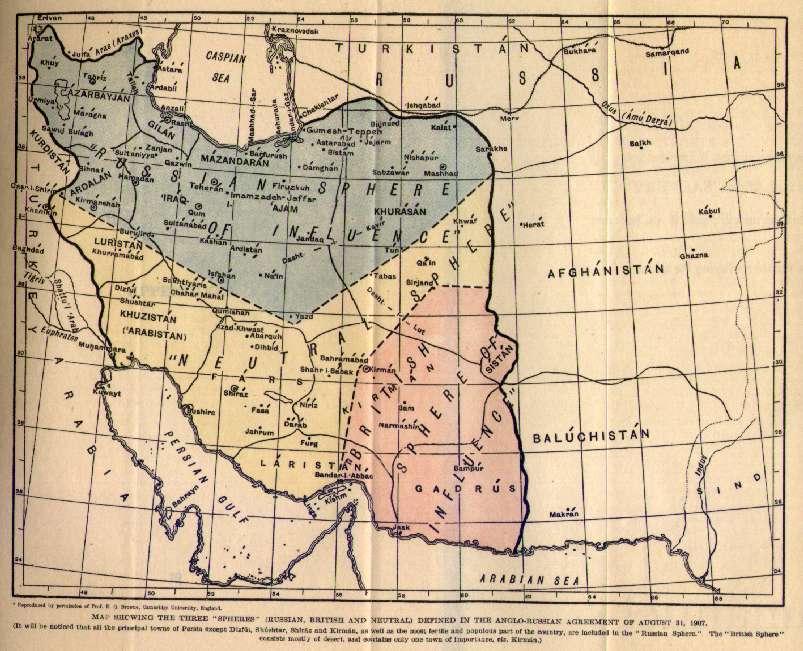
In the 19th century, Persia avoided colonialism in theory, but not in reality. The Russian and British Empires chipped away at their borders and, in the 1907 Anglo-Russian Convention, formally divided Persia into spheres of influence.
Within the Iranian national mind, however, among the era’s biggest grievances was the imposition of “concessions.” Nasir al-Din Shah visited Europe in 1873, 1878, and 1889. Not only were these months-long trips expensive given his lifestyle, profligate spending, and the sheer numbers of his courtiers, but the shah’s desire to replicate the technologies he saw—everything from electric streetlights to railroads—led to a shopping spree that brought Persia to the brink of bankruptcy.
Nasir al-Din Shah saw himself as “the pivot of the universe” and was not going to be denied. He was an absolute monarch who saw the state as his property to develop or sell as he saw fit. To raise money for his projects and purchases, he engaged the British, Germans, and Russians in a series of concessions, basically economic monopolies granted to the foreign powers in exchange for cash that he burned through quickly.
In 1872, for example, he granted Baron Julius de Reuter (of news agency fame), a German-born British national, rights to build railways, telegraph lines, mills, and factories, and mine all minerals except gold and silver. and a 60-year banking monopoly. The terms were so outrageous and one-sided that public pressure sparked widespread protests, prompting the shah to retract the concession. The tipping point was British recognition that the Reuter Concession was so exploitive as to be indefensible. Almost as a concession, Reuter received a second, pared down concession that gave him control over the Imperial Bank of Persia.
In 1890, the shah was at it again when the shah granted a 50-year tobacco monopoly to a British officer, essentially forcing Persian farmers to sell their crops to the British at a set price regardless of their own expenses.
The uproar was huge, the Tehran bazaar closed, and protests spread nationwide as the clergy moved to the forefront of political agitation for the first time, eventually forcing the shah to back down. The Russians, meanwhile, gained a monopoly over Caspian fisheries.
Perhaps the most famous concession was William Knox D’Arcy’s 1901 purchase of all rights to Persian oil. Prime Minister Mohammed Mosaddegh’s nationalization of the Anglo-Iranian Oil Company, which later became British Petroleum, sparked the upheaval of the early 1950s.
A Raw Nerve for Iran
The point is this: Concessions and demands for monopolies remain a raw nerve in Iranian society. Whoever demands them, let alone imposes them, will, in an instant, not only lose the hearts and minds of 95 percent of the Iranian public but will also delegitimize any Iranian leader or figurehead who emerges after Supreme Leader Ali Khamenei’s fall.
Indeed, while Iranians risk and sacrifice their lives to defy Khamenei, the best way to enable a clerical rebound would be to let Trump be Trump and treat Iran as another Ukraine or Venezuela.
About the Author: Dr. Michael Rubin
Michael Rubin is a senior fellow at the American Enterprise Institute and director of policy analysis at the Middle East Forum. The opinions and views expressed are his own. A former Pentagon official, Dr. Rubin has lived in post-revolution Iran, Yemen, and both pre- and postwar Iraq. He also spent time with the Taliban before 9/11. For more than a decade, he taught classes at sea on the Horn of Africa and the Middle East, covering conflicts, culture, and terrorism to deployed US Navy and Marine units. The views expressed are the author’s own.