
USS Nimitz Is Sailing Home To Die: The 51-Year Story Of The Carrier Class That Defined American Power
The oldest aircraft carrier on earth is on the last leg of her last voyage. USS Nimitz departed Kingston, Jamaica, at noon on June 5 after the final foreign port call of her fifty-one-year career — five days in which Jamaica’s prime minister came aboard, her sailors painted and repaired an elementary school and played flag football with locals, and her escort destroyer put on a live-fire gunnery demonstration as Dominican Republic officials toured the flight deck. She is now steaming for Naval Station Norfolk, closing out the Southern Seas 2026 deployment that took her out of Bremerton on March 7 for the final time, through the Strait of Magellan — her hull is too big for the Panama Canal — and around South America in joint maneuvers with more than a dozen partner nations, Chile and Argentina, and Brazil among them. Her destination is the same base where she was commissioned on May 3, 1975; she will end her career at the pier where it began.

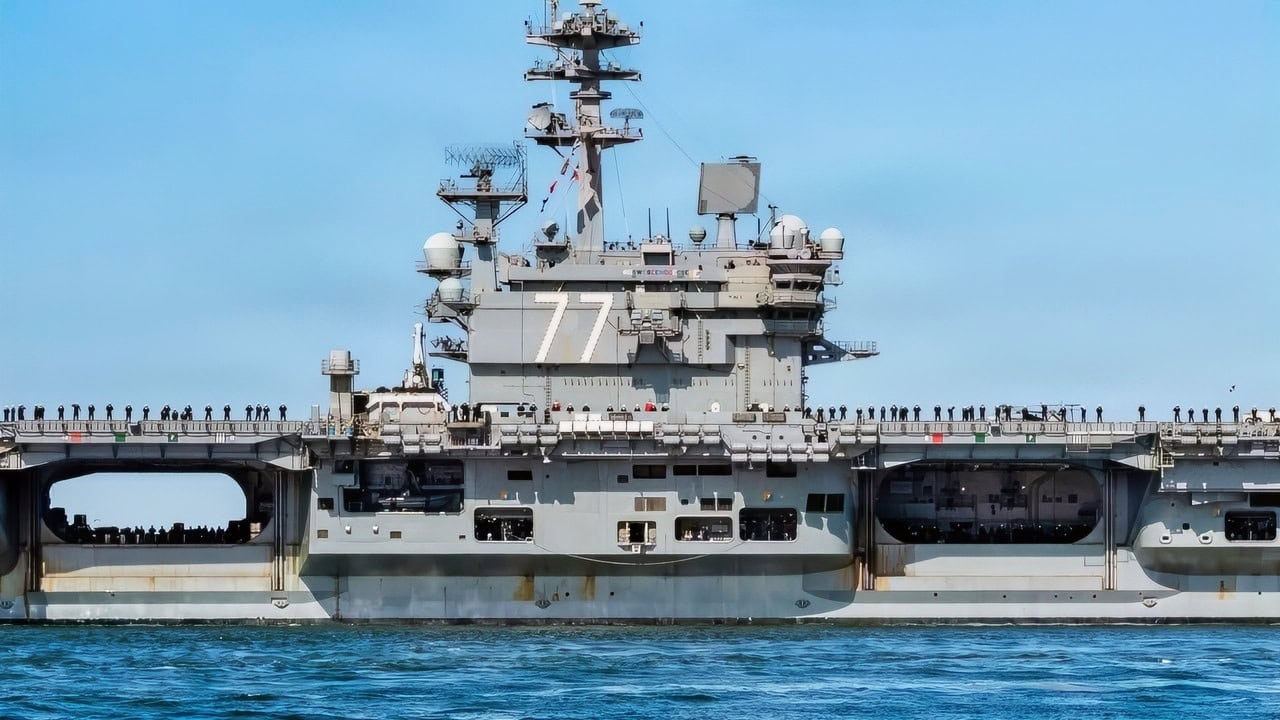
The Nimitz-class aircraft carrier USS George H.W. Bush (CVN 77) transits the Atlantic Ocean, Feb. 15, 2026. The George H.W. Bush Carrier Strike Group is at sea training as an integrated warfighting team. Composite Training Unit Exercise (COMPTUEX) is the Joint Force’s most complex integrated training event and prepares naval task forces for sustained high-end Joint and combined combat. Integrated naval training provides combatant commanders and America’s civilian leaders highly capable forces that deter adversaries, underpin American security and economic prosperity, and reassure Allies and partners. (U.S. Navy photo by Mass Communication Specialist 2nd Class Mitchell Mason)
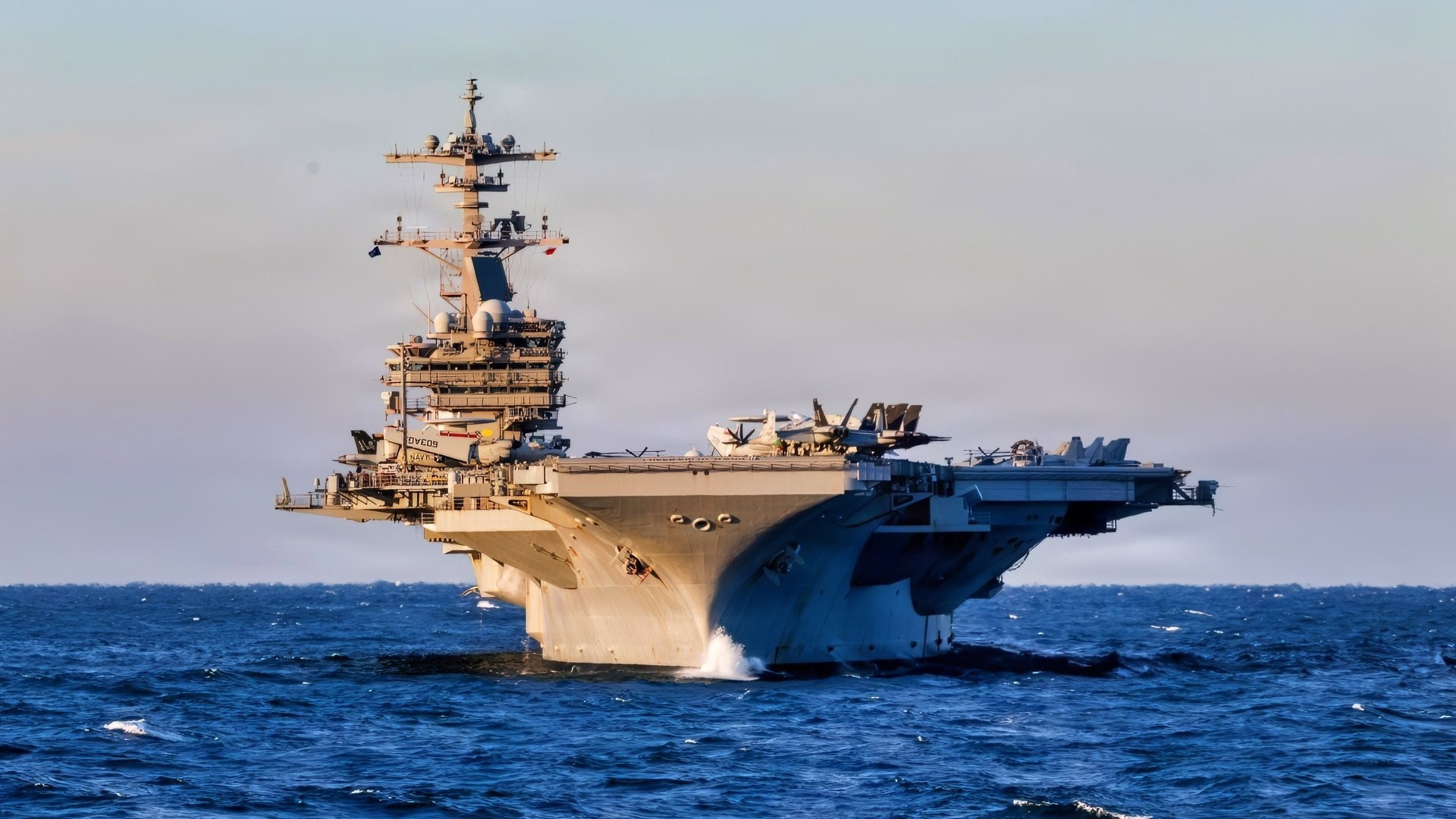
The Nimitz-class aircraft carrier USS George H.W. Bush (CVN 77) sails in the Atlantic Ocean, Feb. 6, 2026. The George H.W. Bush Carrier Strike Group is at sea as an integrated warfighting team. Composite Training Unit Exercise (COMPTUEX) is the Joint Force’s most complex integrated training event and prepares naval task forces for sustained high-end Joint and combined combat. Integrated naval training provides combatant commanders and America’s civilian leaders highly capable forces that deter adversaries, underpin American security and economic prosperity, and reassure Allies and partners. (U.S. Navy photo by Mass Communication Specialist 3rd Class John R. Farren)
The voyage closes the opening chapter of the most successful warship class since the Second World War, and with the lead ship coming home and the last ship of the class now widely regarded as the finest conventional carrier ever built, the full fifty-one-year arc deserves telling — including the parts the legend usually skips.
One scheduling note frames everything: the Navy extended her service life to March 2027 this spring, ten months past her planned retirement, to preserve the congressionally mandated floor of eleven carriers until her Ford-class replacement delivers.
Even her exit is a force-structure calculation, and a public debate runs alongside it — my old friend Gordon Chang argued in a recent op-ed that decommissioning her at all is a gift to China.
Her last combat deployment, a nine-month tour through three fleet areas that ended in December with strikes on ISIS targets in Somalia, made the case that even a fifty-year-old carrier earns her keep.
Why The Nimitz Was Needed: The Enterprise Lesson And Two Reactors Instead Of Eight
The class was born from a cost problem. By the mid-1960s, the Navy knew nuclear propulsion was the future of the carrier — USS Enterprise had proven the endurance, the speed, and the freedom from fuel logistics — and knew equally that Enterprise’s eight-reactor plant was an unaffordable way to get it. The price was steep enough that the next carrier ordered after her, the John F. Kennedy, reverted to conventional power.
The Nimitz design solved the problem with two large Westinghouse A4W reactors doing the work of Enterprise’s eight, occupying far less of the hull and freeing the volume for what carriers actually trade in: compared to the conventional Forrestal class, the design carried more aviation fuel and ordnance dramatically in a hull of similar size. Two reactors instead of eight turned the nuclear carrier from a one-off experiment into a production item, which is the entire reason ten of them exist.
The fleet’s need was equally concrete. The Midway-class veterans of 1945 and the first-generation supercarriers were aging through the Vietnam era, the Soviet navy was expanding, and the Navy required a carrier design it could build repeatedly for decades. The Nimitz was ordered in 1967 and laid down at Newport News in 1968 as exactly that — not a leap, but a template.
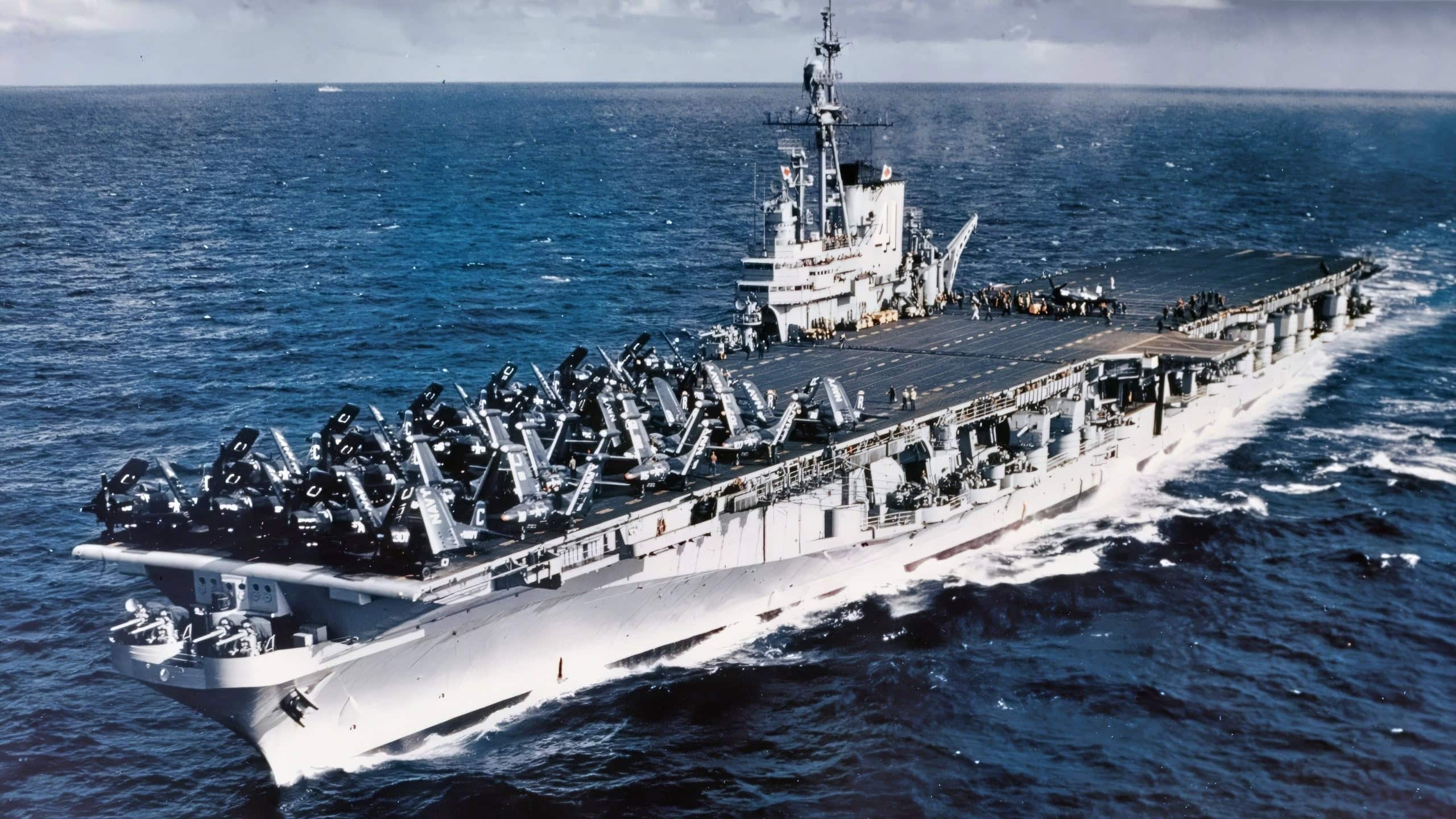
USS Midway Midway-Class Aircraft Carrier
A Rough Start: The Business and Industrial Challenge of Building the Nimitz-Class
The template arrived badly. Shipyard labor shortages and construction problems at Newport News pushed the Nimitz roughly two years past her planned delivery; her costs climbed accordingly, and she commissioned in May 1975 into a Washington that questioned whether any warship this expensive made sense. Congressional critics of the 1970s attacked her in nearly the same language that would later be aimed at the F-35 and the Ford.
Her early service years added tragedy to the criticism: the May 1981 night crash of an EA-6B Prowler on her flight deck killed fourteen sailors and injured dozens, one of the worst carrier deck accidents of the modern era, and the investigation’s findings helped drive the Navy’s drug-testing and flight-deck safety reforms that followed. The first years of the most celebrated carrier class in history, read honestly, included schedule failure, cost growth, political fire, and blood on the deck.
The record matters because of what came next. None of the early troubles predicted the ship’s career, and the pattern — a difficult lead ship maturing into a superb class — is the through-line of this story and the reason the Ford class’s first decade should be read with some humility about how these stories end.
How CVN-68 Set The Standard Every Carrier Is Still Measured Against
What the Nimitz established became the global definition of the aircraft carrier. A hundred thousand tons. An air wing of about ninety aircraft — a national air force on one hull. Catapult launch and arrested recovery as the price of flying a real combat radius with real payloads.
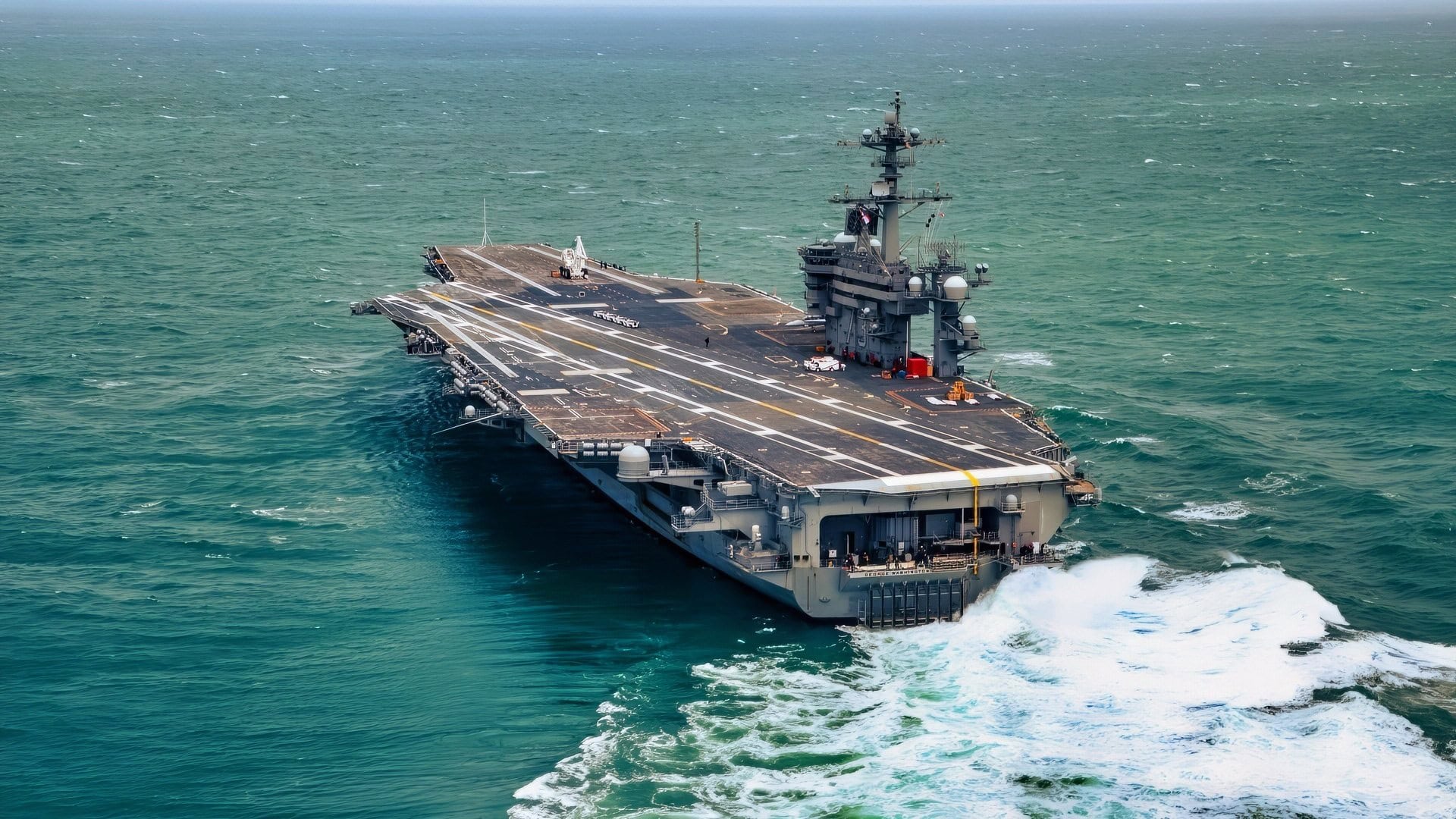
The Nimitz-class aircraft carrier USS George Washington (CVN 73) transits through the Atlantic Ocean May 25, 2023. George Washington was underway after completing its mid-life refueling and complex overhaul and sea trials, a comprehensive test of the ship’s system and technologies. (U.S. Navy photo by Mass Communication Specialist 3rd Class Nicholas A. Russell)
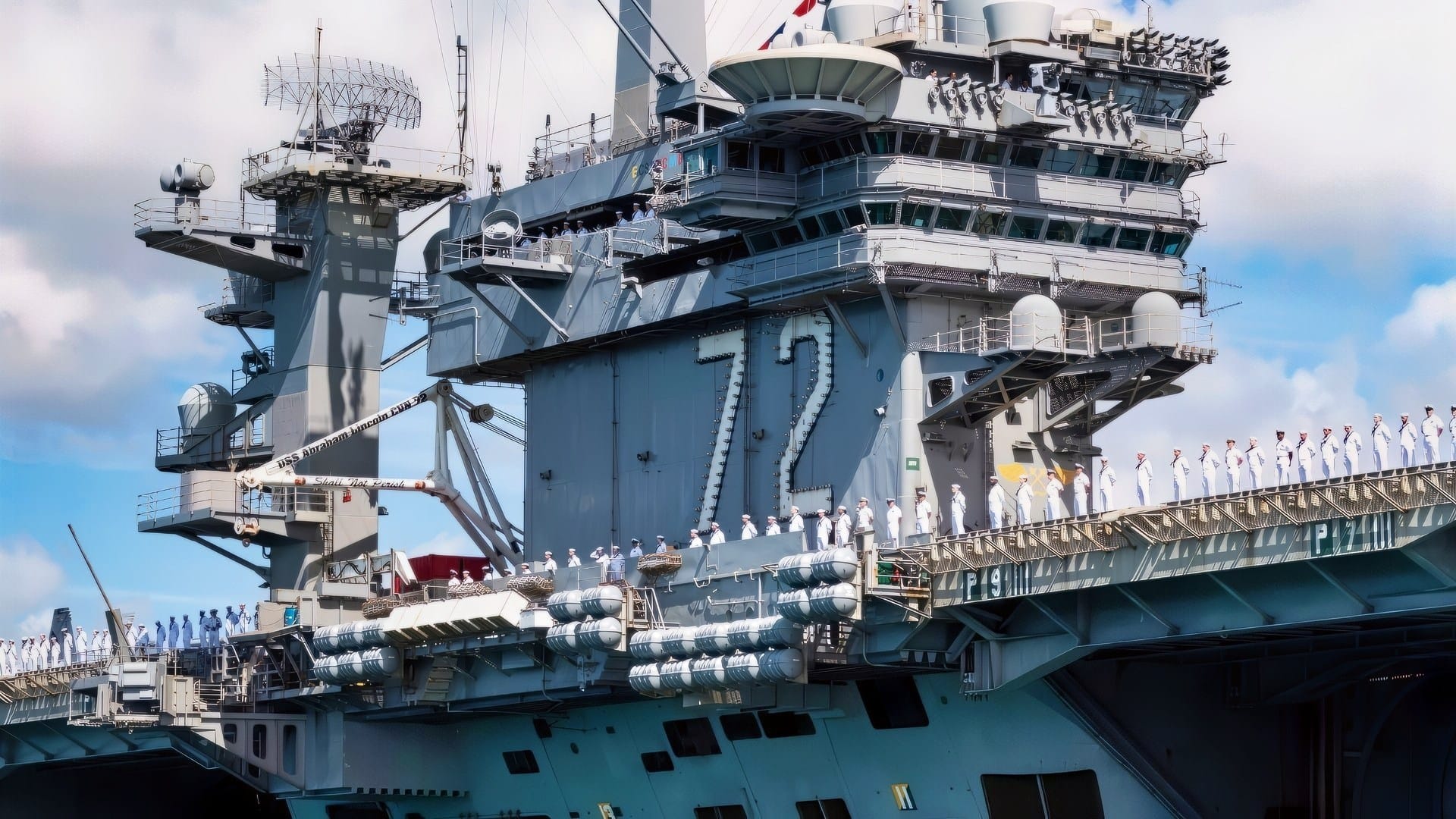
(June 28, 2022) – Nimitz-class aircraft carrier USS Abraham Lincoln (CVN 72) arrives at Joint Base Pearl Harbor-Hickam to participate in Rim of the Pacific (RIMPAC) 2022, June 28. Twenty-six nations, 38 ships, four submarines, more than 170 aircraft and 25,000 personnel are participating in RIMPAC from June 29 to Aug. 4 in and around the Hawaiian Islands and Southern California. The world’s largest international maritime exercise, RIMPAC provides a unique training opportunity while fostering and sustaining cooperative relationships among participants critical to ensuring the safety of sea lanes and security on the world’s oceans. RIMPAC 2022 is the 28th exercise in the series that began in 1971. (U.S. Navy photo by Mass Communication Specialist 1st Class Devin M. Langer)
Reactor cores that ran for decades, refueled once at mid-life, supporting a fifty-year service life, no other warship type attempts. Six thousand sailors operating a floating city that delivers four and a half acres of sovereign American territory to any coastline on earth. Every crisis of the past half century opened with the same presidential question — where are the carriers — and for fifty years the answer has been a Nimitz-class hull: off Iran in 1980, in the Gulf in 1991 and 2003, off Korea and Taiwan in every confrontation, in the Red Sea against the Houthis, and in the current war, where the class has anchored the largest naval combat operations since 1945.
Ten Ships, Thirty-Four Years Of Quiet Improvement
The class’s underappreciated genius was that it never stood still. Ten ships were commissioned across thirty-four years, 1975 to 2009, and the Navy treated each as a chance to fix, harden, and refine.
The Theodore Roosevelt, sixth in the class, marked the biggest internal break: improved magazine and ordnance protection, Kevlar armor over vital spaces, and modular construction techniques that changed how the remaining ships were built.
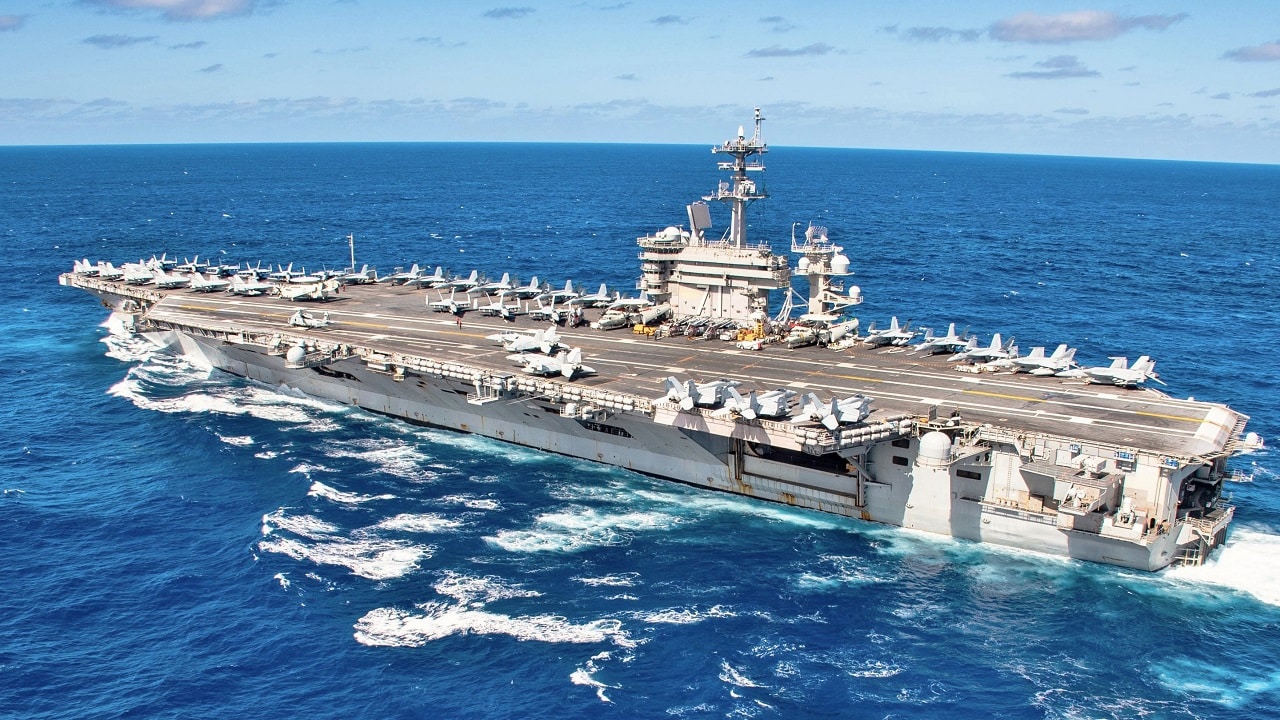
(Jan. 25, 2020) The aircraft carrier USS Theodore Roosevelt (CVN 71) transits the Pacific Ocean Jan. 25, 2020. The Theodore Roosevelt Carrier Strike Group is on a scheduled deployment to the Indo-Pacific. (U.S. Navy photo by Mass Communication Specialist Seaman Alexander Williams)
The George Washington added upgraded flight-deck ballistic protection; the John C. Stennis introduced high-strength low-alloy steel through the hull; the Ronald Reagan brought a redesigned island and a bulbous bow that improved seakeeping and efficiency.
None of the changes made headlines, which is the point. The class absorbed thirty years of operational lessons one hull at a time, every ship better than the one before, while the design’s fundamentals — the reactors, the deck layout, the air wing — proved sound enough to leave alone.
USS George H.W. Bush: The Masterpiece At The End Of The Line
The tenth ship gathered every refinement into one hull, and the result is the carrier sailors and analysts routinely name the best of the conventional era. The George H.W. Bush, commissioned in 2009, was deliberately built as the bridge to whatever came next: a new enclosed radar tower, upgraded navigation and communications, armored windows, improved launch and recovery equipment, and a redesigned aviation fuel system, joined by a bulbous bow refined from the Reagan’s, curved deck edges trimming radar signature, new propellers, and a modernized island that previewed Ford-class thinking throughout.
She was the Nimitz design with thirty-four years of corrections applied — the version the 1975 critics could not have imagined growing out of the late, over-budget lead ship.
She is also still working hard. The Bush completed a ten-month modernization at Norfolk in late 2024 — networks, data links, launch and recovery systems — and returned to sea just as the Navy surged carriers toward the Middle East crisis that became this war. The last Nimitz has decades remaining; the class does not retire with its namesake, it merely begins the long handoff, one hull leaving each few years into the 2050s.
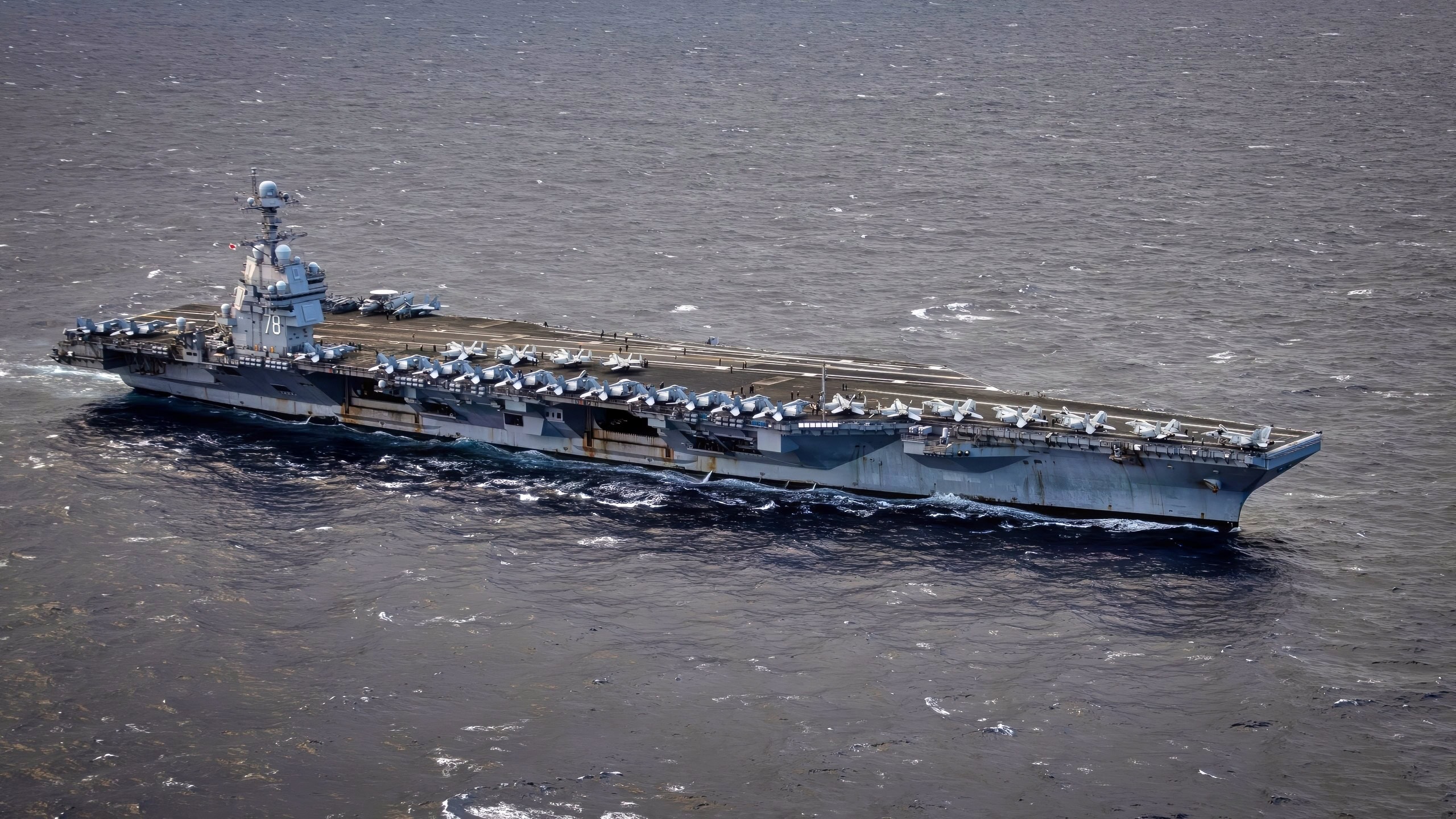
The world’s largest aircraft carrier, USS Gerald R. Ford (CVN 78), transits the Eastern Mediterranean Sea, March 22, 2026. Gerald R. Ford is on a scheduled deployment in the U.S. 6th Fleet area of operations to support the warfighting effectiveness, lethality and readiness of U.S. Naval Forces Europe Africa, and defend U.S., Allied and partner interests in the region. (U.S. Navy photo by Mass Communication Specialist 2nd Class Tajh Payne)
The Ford-Class Inherits The Method
The handoff’s first exchange happens within a single calendar year, and the symmetry is exact. The Nimitz inactivates in 2027; the John F. Kennedy, second of the Ford class, delivers in March 2027, arriving with the modifications for full F-35C operations that the Ford herself lacked — the new class already practicing the old class’s habit of fixing each ship against the lessons of the last.
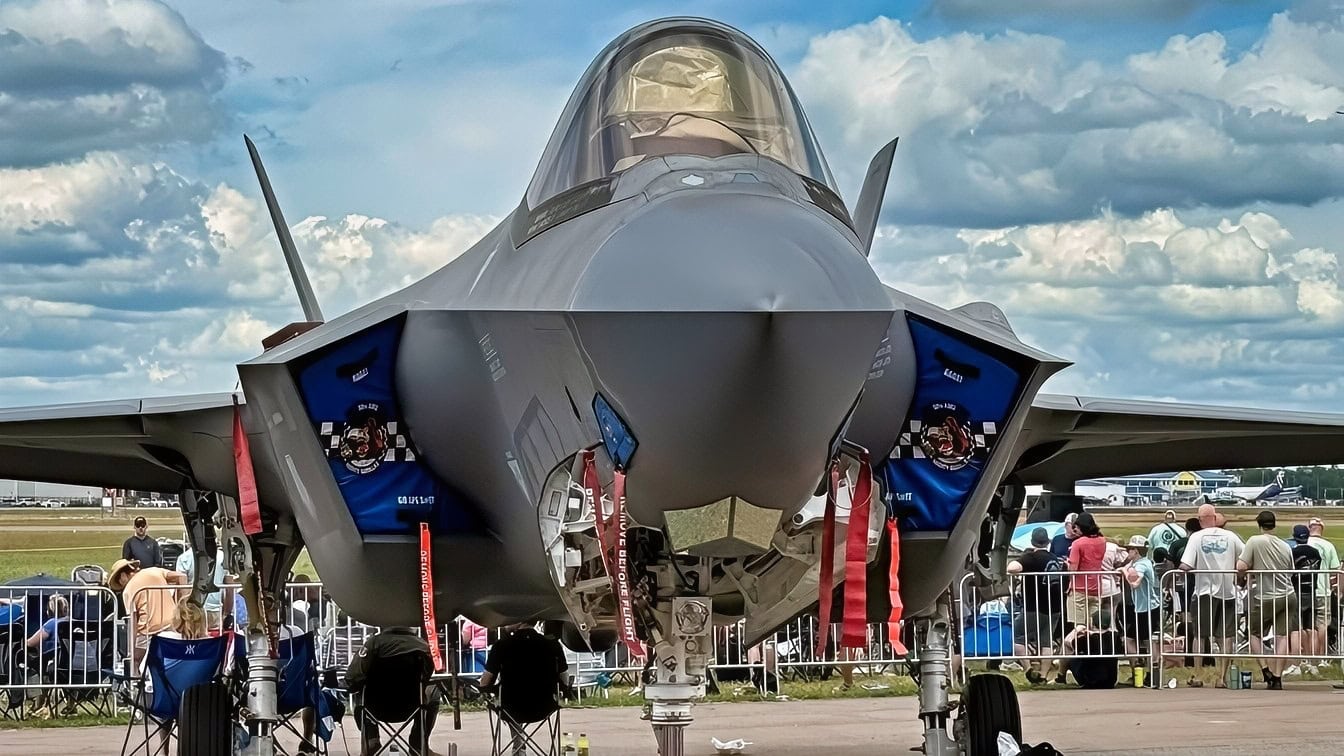
F-35C Lakeland Airshow Photo 19FortyFive Image Taken on 4/19/2026.
The Ford’s own story tracks the Nimitz’s opening chapter closely: a lead ship years late and billions over, carrying first-of-kind technologies through public ridicule, followed by a second ship built on the paid-for lessons and accelerated on the strength of the lead ship’s combat debut. The Nimitz class’s deepest legacy is not the tonnage or the sortie counts; it is the method — build the sound template, then improve it relentlessly for ten ships and fifty years — and the Ford class was designed by a Navy that learned the method on these hulls.
The fair accounting of CVN-68 herself runs from a troubled birth to a half-century at the center of American power: late and over budget in 1975, mocked by the budget hawks of her day, bloodied early, and then present at essentially every American crisis from the Iranian hostage rescue attempt to the strikes she flew against ISIS this past autumn, in her fifty-first year, weeks before turning for home.
The critics of 1975 were right about the schedule and the cost and wrong about everything that mattered, which is worth remembering as her successor class absorbs the same criticism today.
The Nimitz is steaming north through the Caribbean this week toward the pier in Norfolk where President Ford commissioned her, and somewhere in a Newport News dry dock, the ships that will repeat her fifty years are taking shape on the pattern she set.
MORE – France’s Only Nuclear Aircraft Carrier Problem: The Propeller Fell Off
MORE – The Royal Navy Can’t Deploy a Single Nuclear-Attack Submarine
MORE – The SR-71 Blackbird Beat the U.S. Navy
About the Author: Harry J. Kazianis
Harry J. Kazianis (@Grecianformula) was the former Senior Director of National Security Affairs at the Center for the National Interest (CFTNI), a foreign policy think tank founded by Richard Nixon based in Washington, DC. Harry has over a decade of experience in think tanks and national security publishing. His ideas have been published in the NY Times, The Washington Post, The Wall Street Journal, CNN, and many other outlets worldwide. He has held positions at CSIS, the Heritage Foundation, the University of Nottingham, and several other institutions related to national security research and studies. He is the former Executive Editor of the National Interest and the Diplomat. He holds a Master’s degree focusing on international affairs from Harvard University.

