
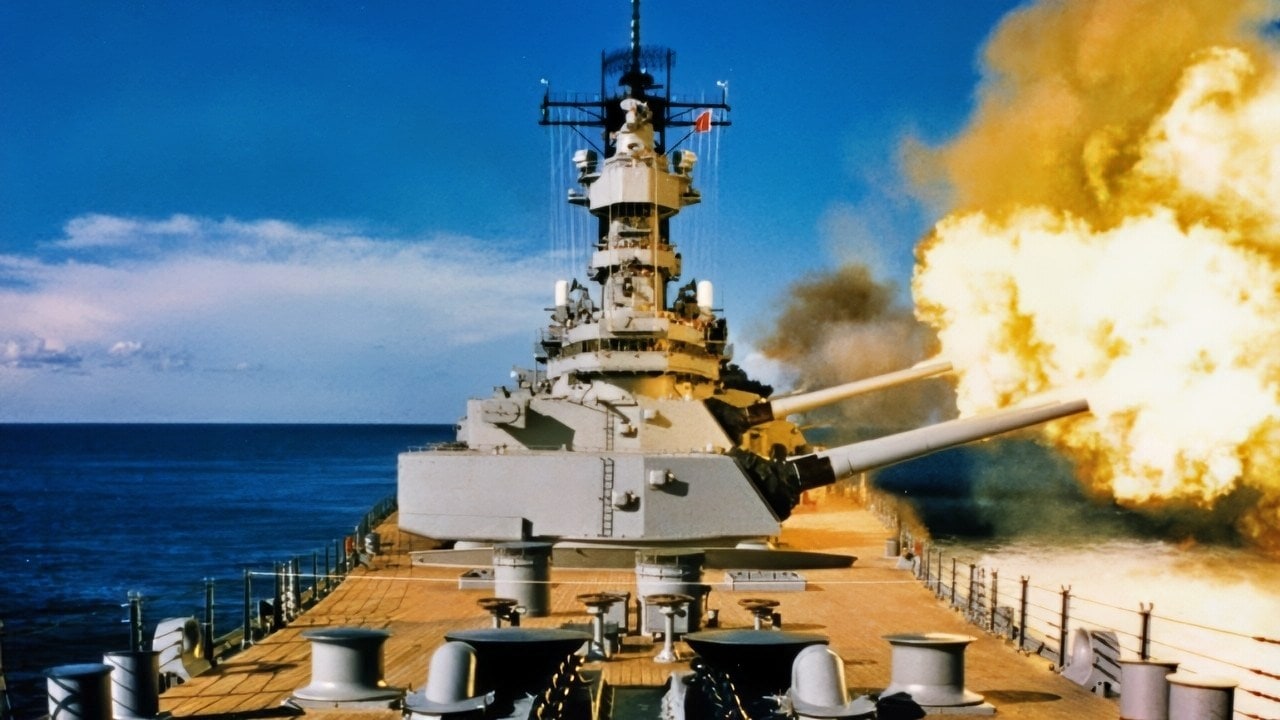
Summary and Key Points: Dr. Andrew Latham challenges the view that canceling the Trump-class battleship program after a single hull would be a procurement failure.
-Instead, he argues that the USS Defiant represents a critical strategic pivot away from the Navy’s “fragile” carrier-centric model toward a fleet built for networked, distributed warfare.
-Unlike supercarriers, which risk irrelevance in contested zones, a missile-heavy surface combatant like the Defiant can sustain combat power in a “denial-dominated” environment.
Why Building Just One “Trump-Class” Battleship Could Save the Navy
If the U.S. Navy were to commission a single Defiant-class battleship – informally known as the Trump-class – and then terminate the program after a single hull, the episode would be easy to misread.
It would look like another procurement debacle, a brief flirtation with a nostalgic icon before a retreat to familiar ground. That reading would be comfortable. It would also be wrong. The real consequence would not be the loss of one ship. It would be the abandonment of the Navy’s only serious effort to move beyond a carrier-centric fleet at a moment when carriers fit the maritime warfighting ecosystem less well than they once did.
The Trump-class was never about nostalgia. It was conceived as a next-generation surface combatant designed for a networked battlespace shaped by long-range missiles, persistent sensing, and contested airspace. Ending that effort after one hull would not settle a debate.
It would freeze it, locking the Navy into a legacy model and foreclosing a path that had only just begun to take form.
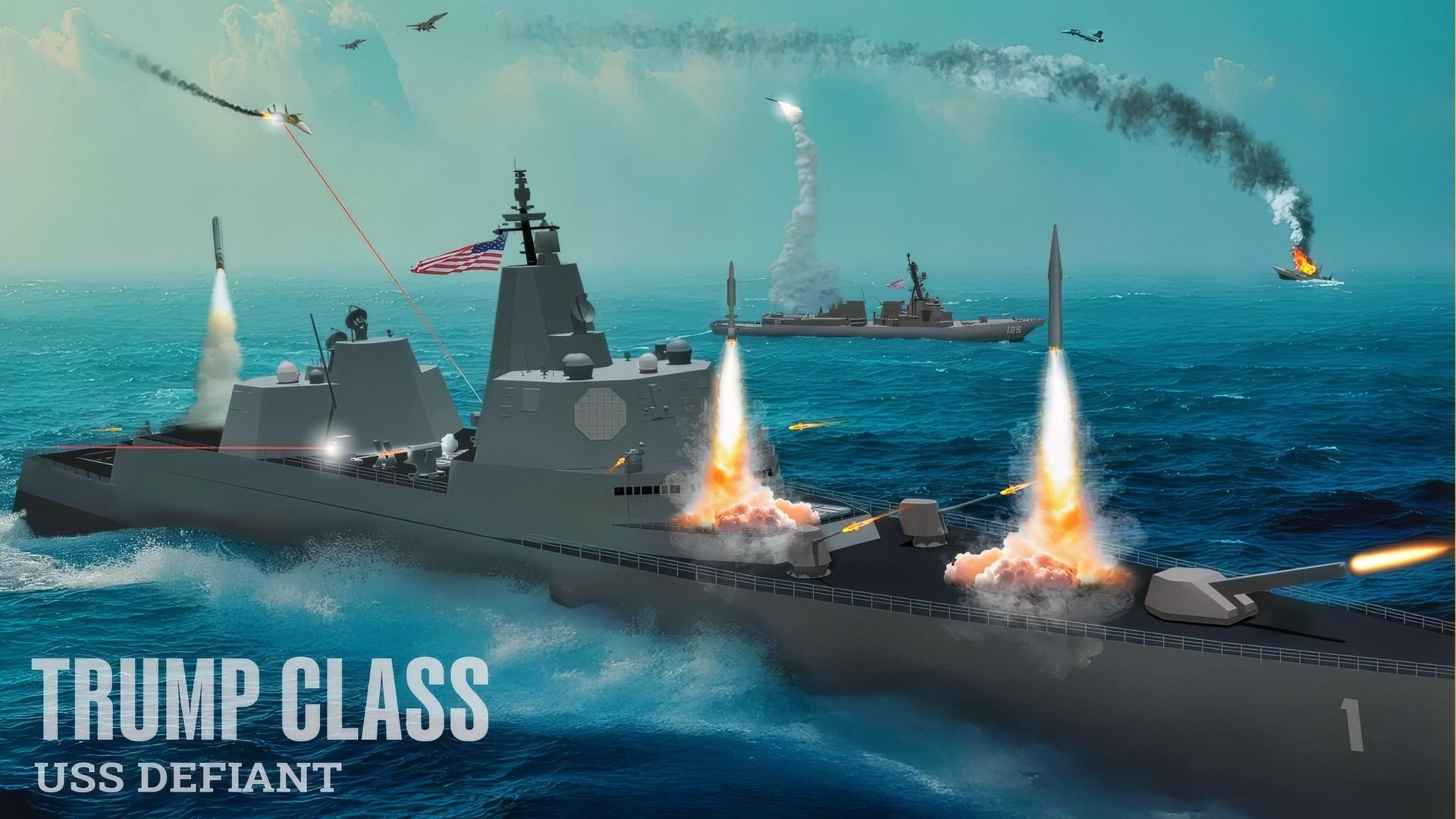
Trump-Class Battleship USS Defiant. Image Credit: Creative Commons.
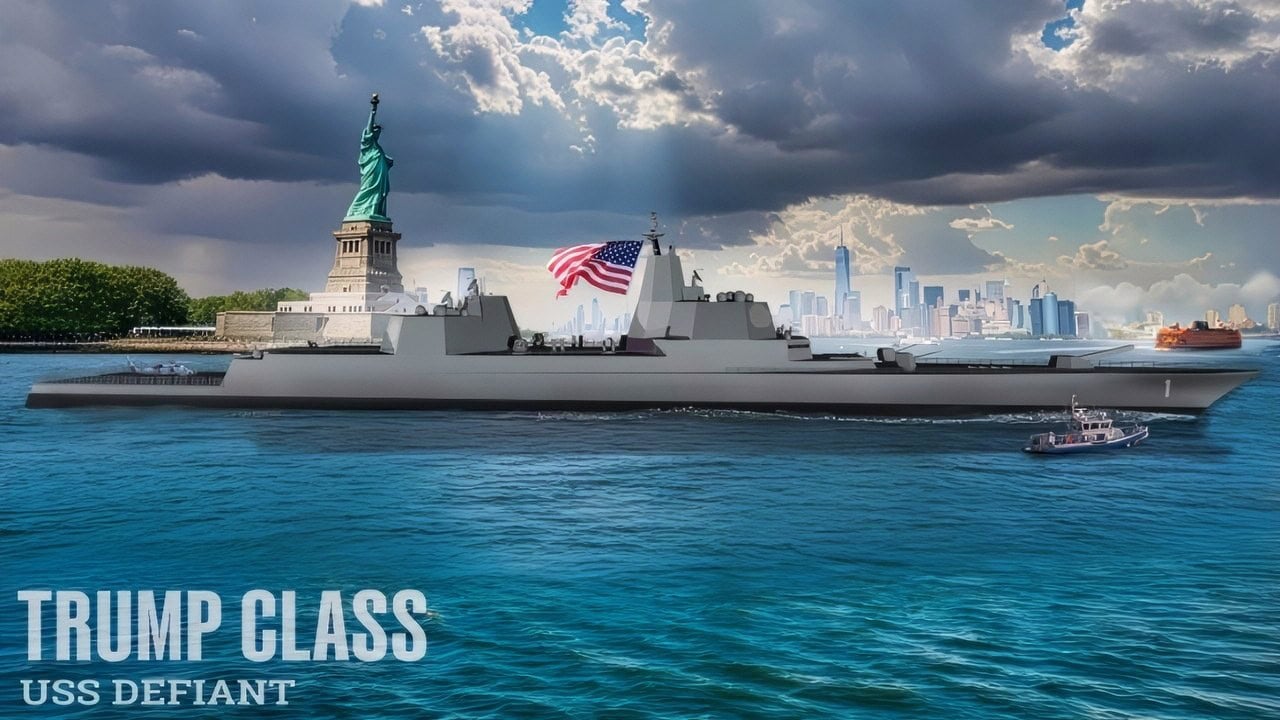
Trump-Class Battleship. Image Credit: Creative Commons/White House.
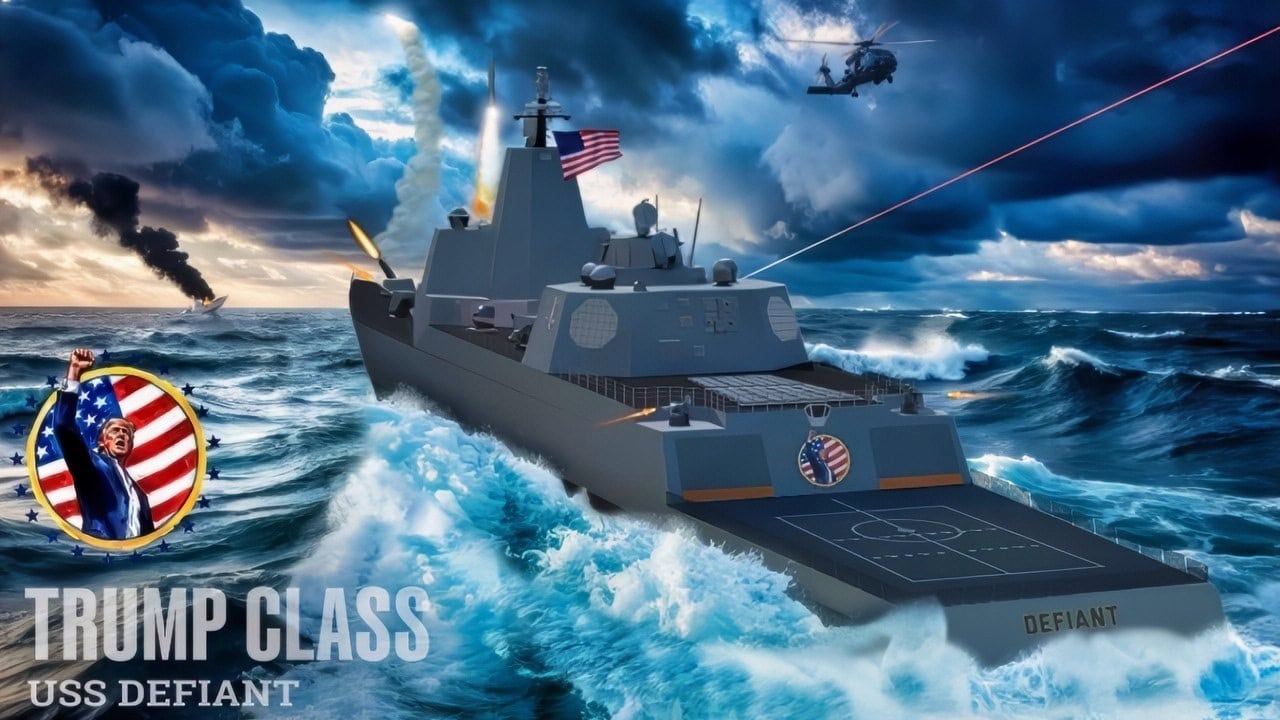
Trump-Class Battleship. Image Credit: Creative Commons/White House Photo.
A Fight That No Longer Favors Old Assumptions
Modern maritime combat is defined by reach, precision, and saturation. Strike now travels hundreds of miles. Sensors persist and share data across domains. Missiles arrive in salvos rather than singles. In this environment, the decisive question in the opening phase of a major conflict is not which platform performs best under permissive conditions. It is which platform remains combat-relevant when access is contested from the outset?
The supercarrier earned its place in a different era. Its air wing offered reach and adaptability when airspace could be exploited with relative confidence. That advantage has become conditional. Sortie generation depends on enablers that are increasingly exposed. A carrier may remain afloat while its ability to shape the fight erodes. Survivability of the hull is no longer a reliable proxy for survivability of combat power.
This does not render carriers obsolete. It does mean they are less dependable as the organizing center of high-end maritime combat in the most dangerous phase of war.
What the Trump-Class Was Built to Do
The Trump-class is not a traditional gun platform searching for a role in today’s maritime warfighting environment. It is a concept built around missiles, sensors, and integration. Its purpose is to operate as a resilient node inside a distributed fires network rather than as a floating airbase. The familiar label obscured the novelty. This is intended to be a surface combatant optimized for conditions in which aviation struggles most.
In a dense missile environment, a platform that contributes directly to long-range strike has an advantage over one that enables strike indirectly through aviation. A missile-centric surface combatant remains lethal even when air operations are constrained. Its primary function does not collapse if tankers are pushed back or airspace is denied. Combat relevance persists under pressure.
That is the narrow sense in which the Trump-class might prove superior. The claim is contextual and phase-specific. In the opening phase of a high-end fight, when denial dominates, a networked surface combatant offers more reliable combat power than a carrier whose strengths depend on access.
Answering the Carrier Defense
Carrier advocates are right about the carrier’s central virtue. An air wing allows the Navy to concentrate combat power in a way no surface combatant can replicate. Aircraft can adapt as a fight unfolds and generate effects across a wide battlespace. When sustained flight operations are possible, that integration remains unmatched.
The problem is that this strength rests on an assumption that has become increasingly fragile. Carrier combat power is functionally tied to continuous aviation. That dependence creates a sharp cliff. A carrier does not need to be sunk to be neutralized. It only needs to be held at a sufficient distance, or its enabling systems placed at enough risk, for its defining contribution to fade. The ship can remain afloat while its combat relevance in the opening phase steadily declines.
A next-generation surface combatant degrades differently. It is no less vulnerable to detection or attack, but its contribution does not hinge on sustained air operations. As long as it remains connected to a targeting network and retains some magazine depth, it continues to matter.
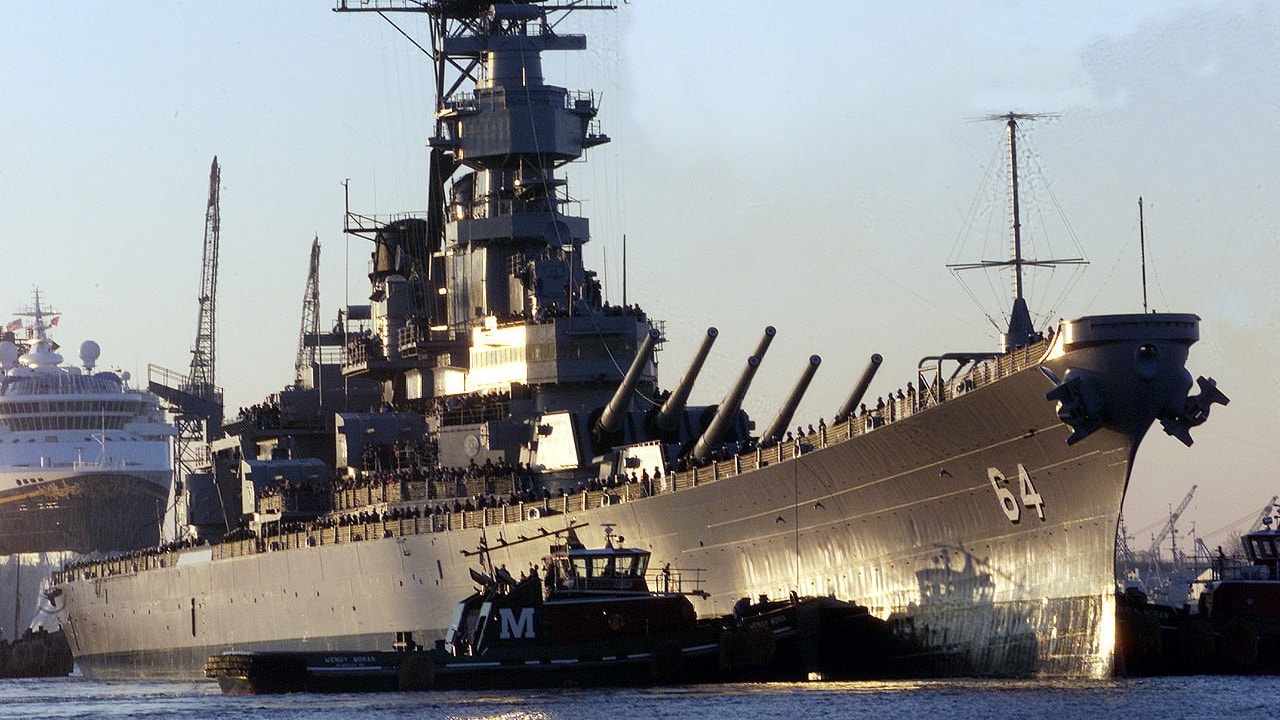
A tug boat nudges the bow of the battleship USS Wisconsin (BB 64) as the ship is pushed from the Norfolk Naval Shipyard to the Nauticus Museum in Norfolk, Va., on Dec. 7, 2000. The Wisconsin will be the centerpiece of a four-part exhibit on the battleship’s role in Naval history.
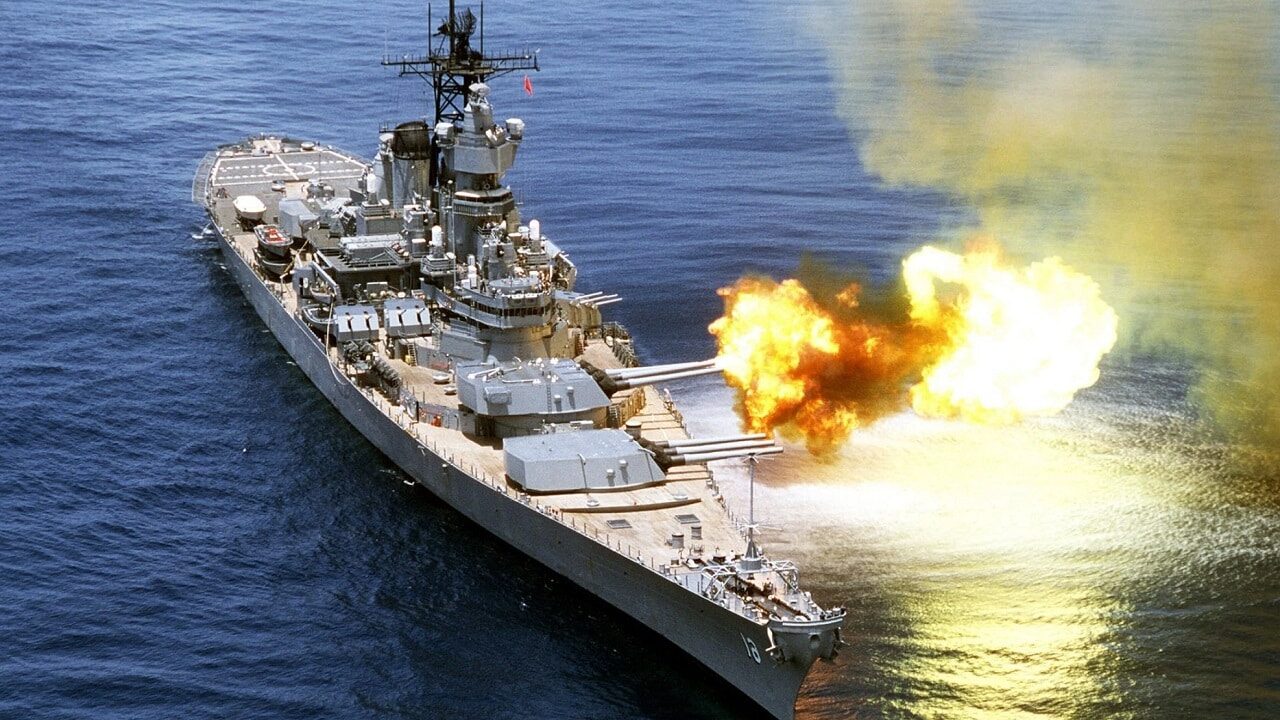
Iowa-Class USS Wisconsin Battleship. Image Credit: Creative Commons.
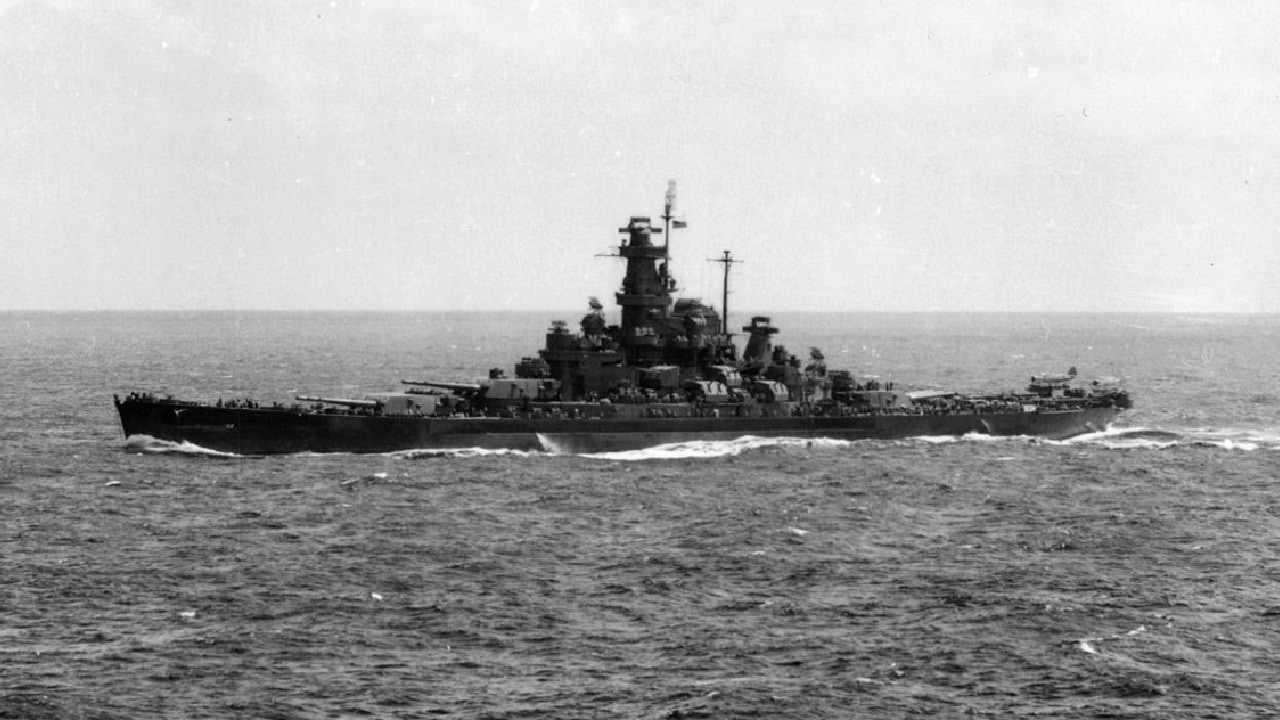
South Dakota-Class USS Alabama Battleship.
Damage constrains output rather than negating the role altogether. In a missile-dominated fight, where usable combat power under threat is decisive, that difference carries real weight.
This distinction also shapes behavior. The political and strategic consequences of serious carrier damage encourage distance and caution. A missile-centric surface combatant places less meaning in any single hull. Exposure does not automatically force withdrawal, and degradation does not collapse the mission at once. In a distributed fight, gradual loss is easier to absorb than sudden irrelevance.
Presence Without Automatic Escalation
Combat power is only part of the Navy’s burden. Visible presence remains politically indispensable. Ships reassure partners, signal commitment, and shape behavior short of war. Contrary to the conventional wisdom, the supercarrier performs poorly in this role. Its arrival signals escalation, whether intended or not. It narrows diplomatic space and raises the stakes by default. It is also too valuable to risk casually forward for routine signaling.
A Trump-class battleship would project presence in a different register. It would be visible without implying imminent air strikes, with all the escalatory incentives that entail in the minds of potential adversaries. It could loiter forward without collapsing, signaling, and escalating into a single gesture.
Presence and strike would no longer sit in the same hull.
Here again, the Trump-class is better suited to the demands of the moment, not because it would dominate, but because it would signal resolve without forcing a crisis up the escalation ladder.
A Path That Pointed Forward
Taken together, these functions pointed toward a different organizing logic for the fleet. The Trump-class was meant to separate long-range strike from aviation and visible presence from automatic escalation, while embedding surface combatants more deeply in a networked system of fires. It did not promise a complete solution. It offered a credible alternative path.
Terminating the program after a single hull would close that path. No other surface platform is positioned to assume the same role. Networked concepts would remain in circulation, but they would continue to revolve around the carrier as the default center of gravity. Presence missions would fall back onto the same platform that already carries excessive strategic and political weight. Risk would become more concentrated, not less, and fleet design would become easier for adversaries to anticipate.
That outcome would not reflect strategic balance. It would reflect institutional lock-in.
The Cost of Closing the Door
A carrier monopoly carries costs that are easy to ignore until they begin to shape behavior. Escalation becomes more difficult to manage because presence and strike remain fused within the same platform. Crisis response is heavier than necessary, and adversaries face a force whose structure is increasingly legible.
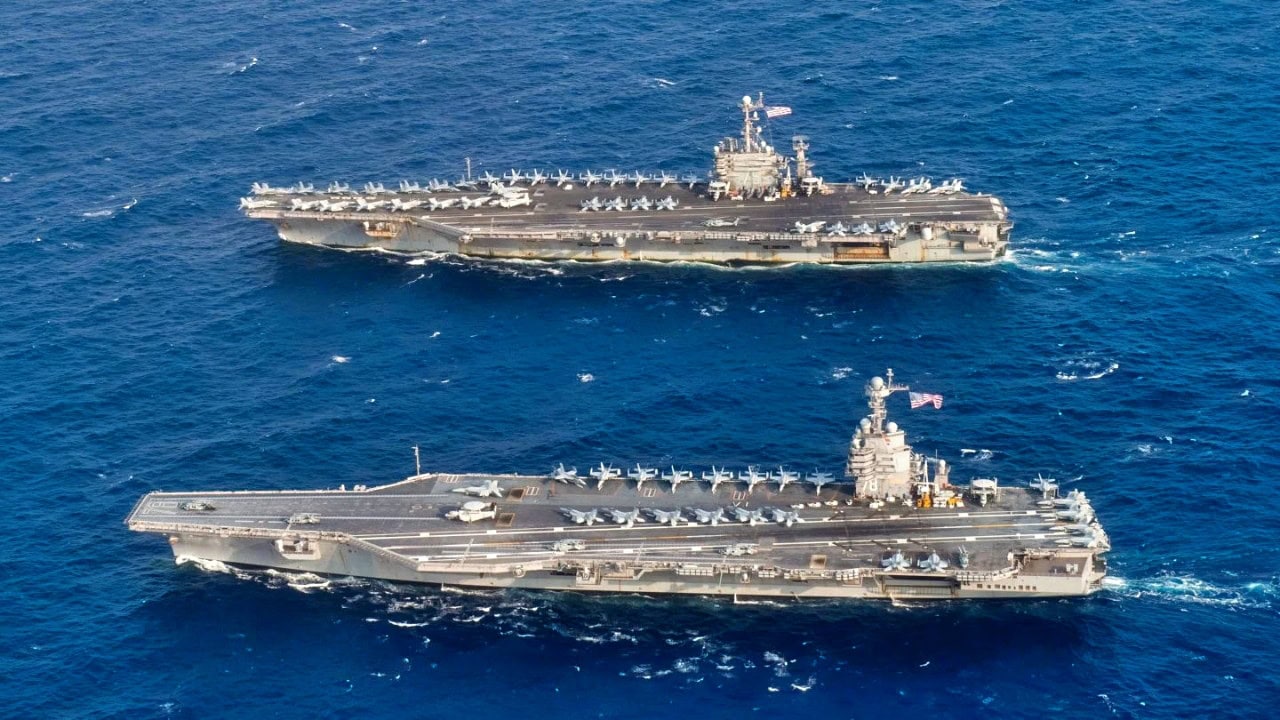
Ford-Class Aircraft Carrier U.S. Navy. Image Credit: Creative Commons.
Over time, the absence of credible alternatives slows innovation because the category itself has been closed rather than contested.
None of this depends on the Trump-class being flawless. It depends on recognizing what its cancellation would foreclose. Ending the program after a single hull would not correct a mistake. It would abandon the search for a surface combatant designed for a networked fight in which carriers no longer fit every role they are asked to play.
A one-off battleship would be easy to dismiss. Closing the path it opened would not.
About the Author: Dr. Andrew Latham
Andrew Latham is a non-resident fellow at Defense Priorities and a professor of international relations and political theory at Macalester College in Saint Paul, MN. You can follow him on X: @aakatham. Dr. Latham writes a daily column for 19FortyFive.com