
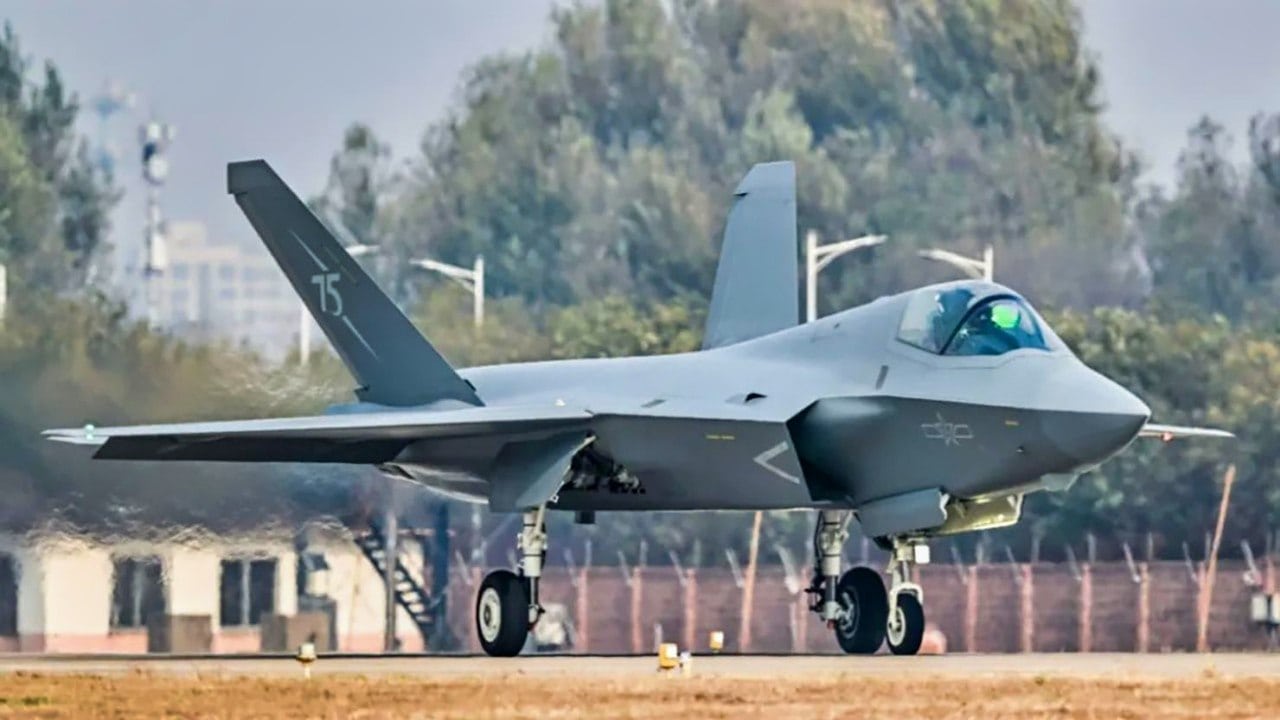
Synopsis: The J-35 is China’s latest fifth-generation stealth fighter, designed as a medium-weight, multi-role platform to complement the heavy J-20 and operate from the new Type 003 Fujian aircraft carrier.
-While visually similar to the U.S. F-35, the J-35 features a twin-engine configuration that may offer advantages in carrier-launch weight, though analysts believe it still lags Western jets in sensor fusion and stealth technology.
-With mass production ramping up, the J-35 marks a critical shift in Beijing’s ability to project “blue-water” power and challenge U.S. air dominance in the Indo-Pacific.
J-35 vs. F-35: Inside China’s Bid to End US Air Superiority
The J-35 is China’s most recent fifth-generation fighter. Originally intended for export only, the aircraft gained favor from both the PLAAN and the PLAAF, who have since adopted the fighter.
The J-35 is designed as a medium-weight, multi-role stealth fighter capable of operating from China’s future aircraft carriers, thereby expanding the CCP’s power-projection capabilities.
The aircraft is undoubtedly one of the most advanced fighters in China’s current inventory, but is it enough to challenge American air superiority in the Pacific?
China’s Newest Naval Fighter
The J-35 is often compared to the F-35 due to the external similarities, but the two fighters are quite different under the surface. The J-35’s twin-engine design, for example, offers advantages in flight performance and potentially greater launch weight from carrier decks.
Conversely, the F-35 retains the clear advantage in sensor fusion, network integration, and proven combat performance.
Most analysts agree that while the J-35 narrows the gap significantly, it still lags behind in electronics and stealth features. That being said, China’s rapid industrial development suggests that future iterations of the J-35 could gradually close some of these performance disparities.
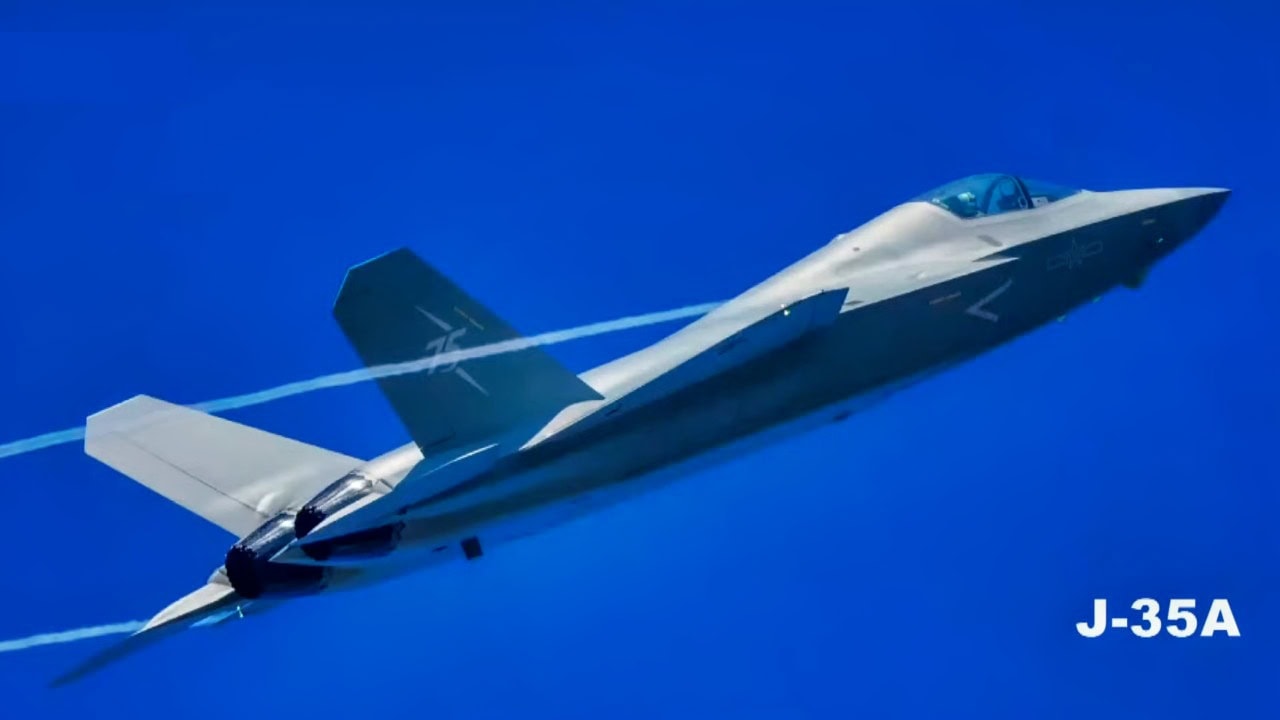
China J-35 Fighter. Image Credit: Creative Commons.
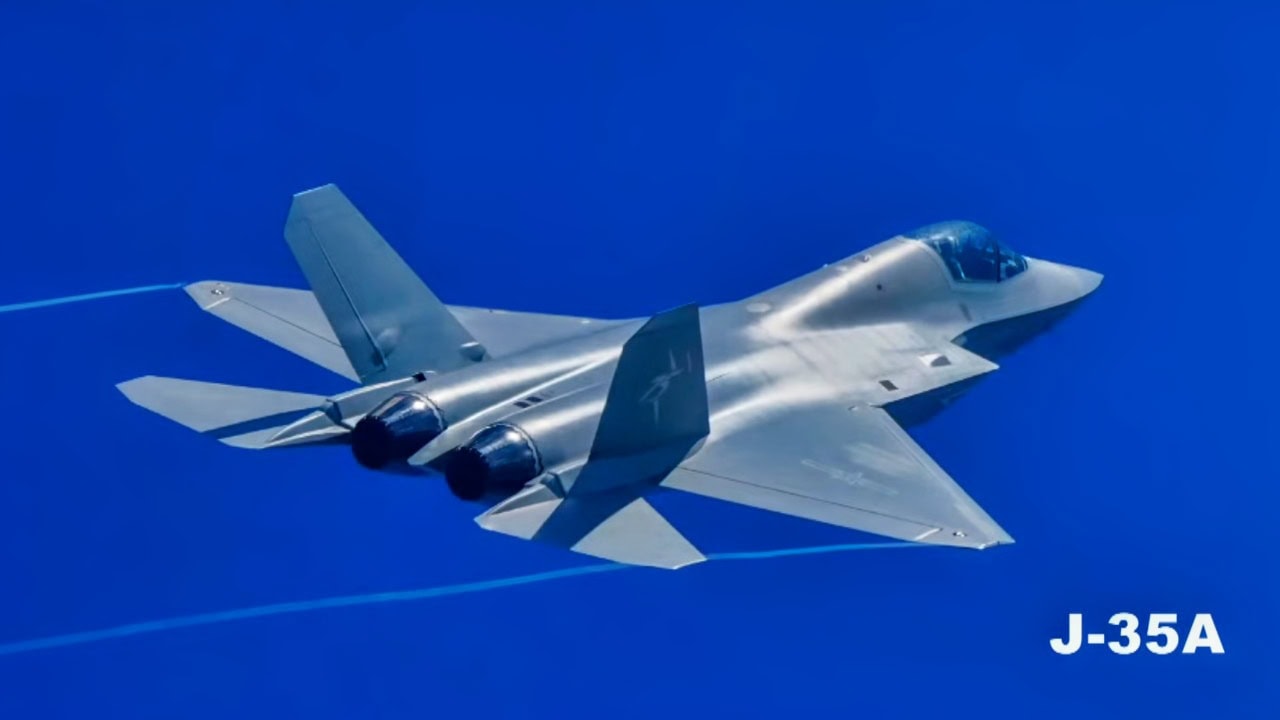
J-35 flying at Zhuhai Airshow 2024.
What’s more, the J-35 has undergone testing aboard the Type 003 Fujian aircraft carrier, according to Chinese sources. The Fujian, as China’s third aircraft carrier and first to field catapult launch technology, is expected to embark a complement of approximately 48 J-35 aircraft.
Early estimates also suggest that the Liaoning and Shandong carriers, which operate via ski-jump systems, may carry smaller numbers if modified or if the J-35 is adapted for STOBAR operations, though this remains speculative.
Beyond naval aviation, the PLAAF’s induction of the J-35A in October 2025 signals the establishment of a dual-stealth fighter strategy in which the J-20 performs long-range interception and air dominance missions, while the J-35A fulfills multirole and regional air superiority roles.
Will the J-35 Win the War Over Taiwan?
With its integration into a new generation of Chinese carriers, the J-35 enables the PLAN to conduct extended maritime operations with reduced detectability.
The shift from J-15 fighters derived from the Russian Su-33 airframe to an indigenous stealth platform marks a generational leap in China’s naval aviation capabilities.
This transition lays the foundation for a blue-water navy capable of projecting power across the Indo-Pacific and potentially farther afield. For the U.S., this adds a new and complicated dimension to any strategic planning in the Pacific. While the U.S. once enjoyed a monopoly on stealth fighters, now the U.S. Navy will have to contend with Chinese carriers fielding their own stealth fighters.
Is the J-35 the key to winning a war in Taiwan? Perhaps, but the definitive answer lies in production. The aircraft is currently in low-rate initial production and is expected to transition to full-scale production in the near future.
China has been working on expanding its production facilities to facilitate the rapid production of the J-35. If the J-17 and J-20 are indicative, production of the J-35 will likely increase substantially once the production facilities are ready.
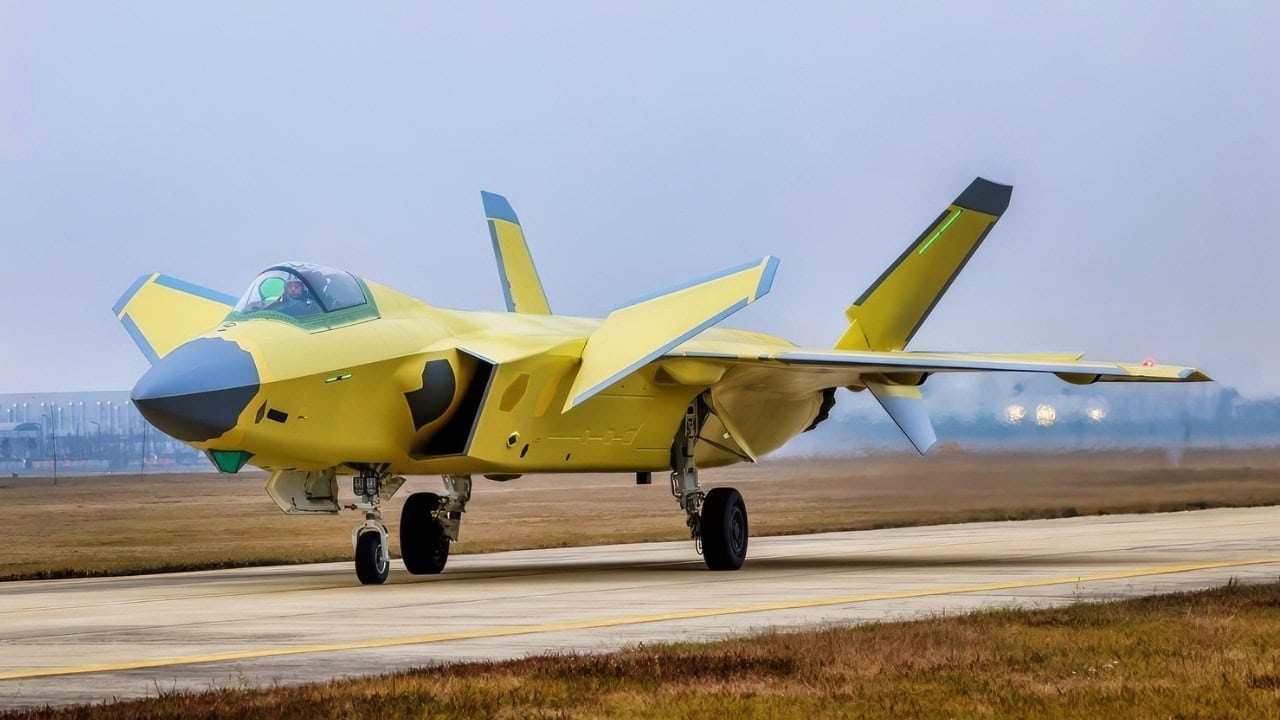
J-20 Fighter from China X Screenshot. Image Credit: Creative Commons.
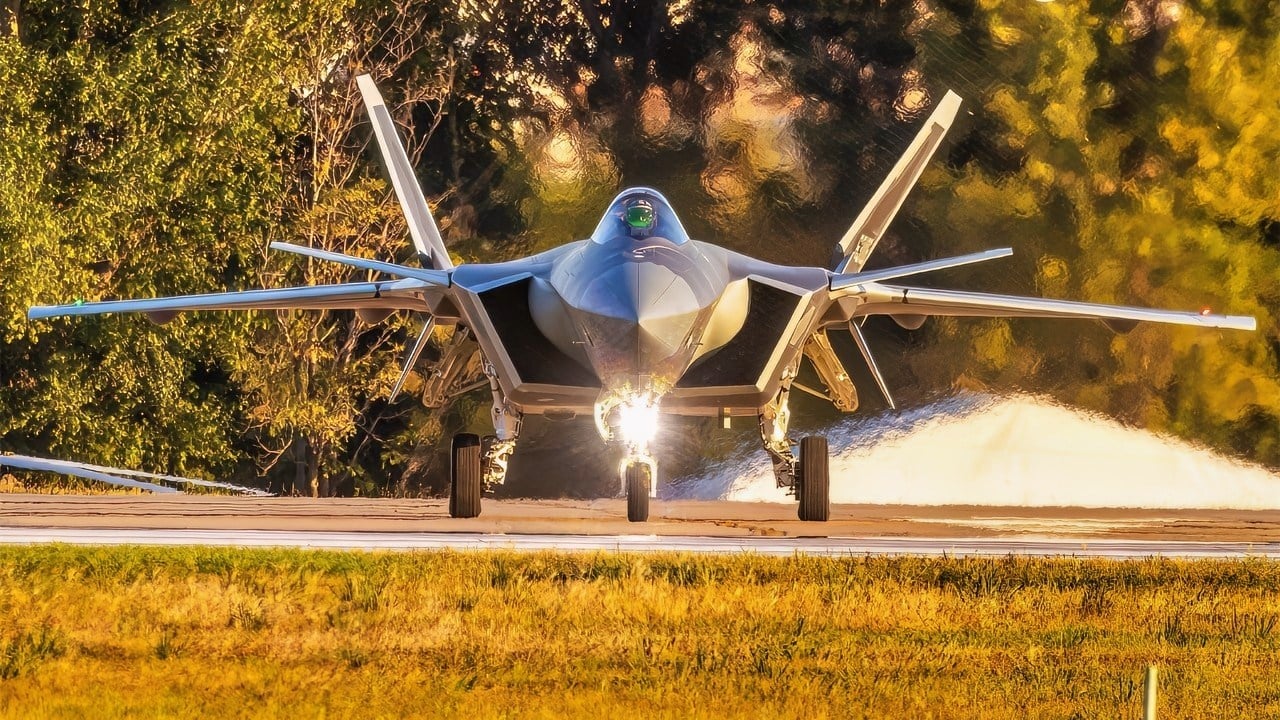
J-20 2026 New Image. Image Credit: PLAAF/Chinese Military.
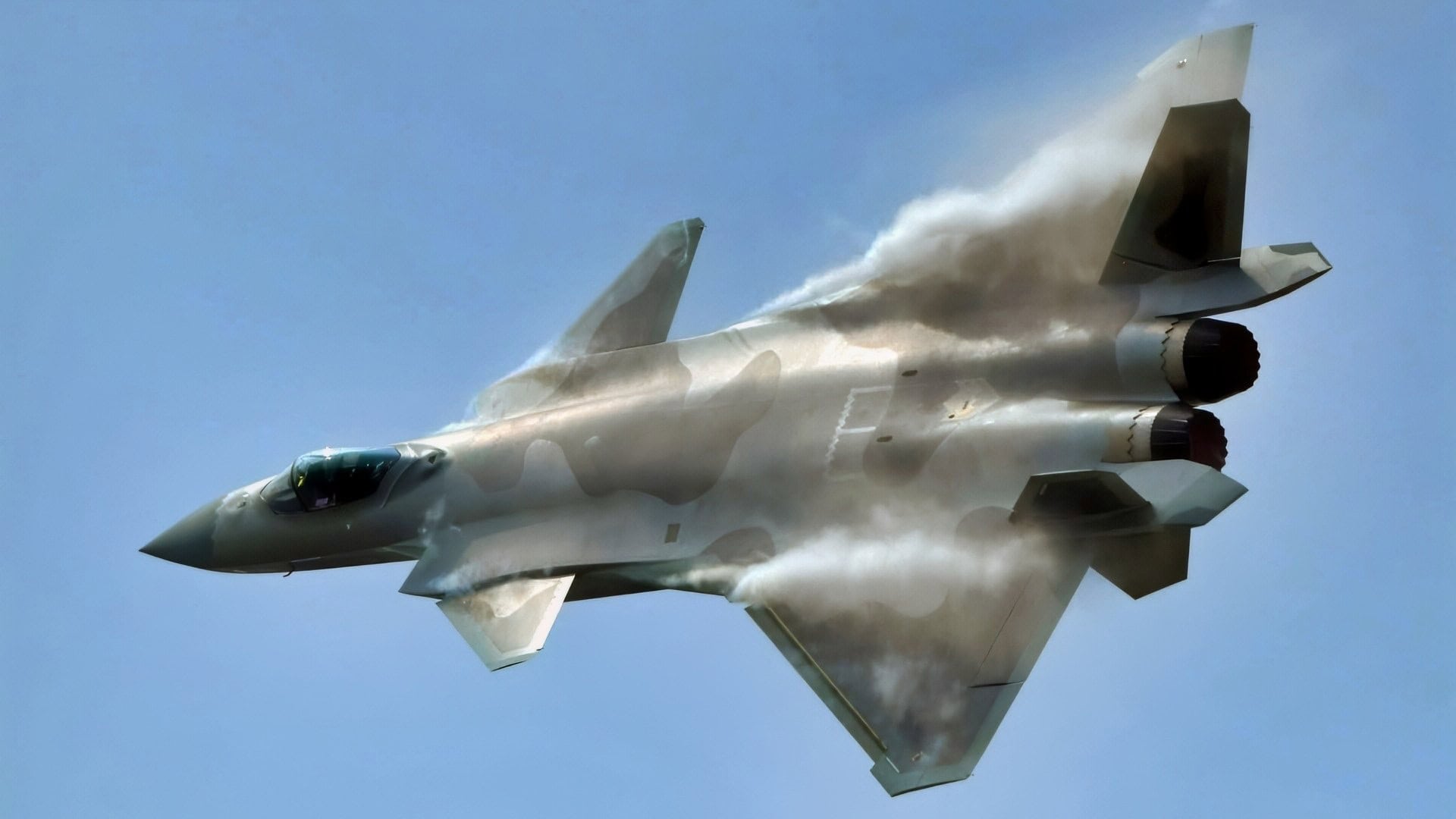
China J-20A Fighter. Image Credit: PLAAF.
It is estimated that China has approximately 300 operational J-20 aircraft, with its inventory increasing annually.
It will likely be some years before the J-35 reaches these numbers, although China’s ability to mass-produce stealth aircraft is nothing short of impressive, even if the fighters themselves do not match their Western counterparts.
Design and Capabilities of the J-35
The J-35’s overall design places it in the medium-weight stealth fighter category. It is a single-seat, twin-engine, multirole platform built for both air superiority and precision strike missions.
The airframe incorporates numerous low-observable features, including blended fuselage contours, serrated edges along access panels, diverterless supersonic intakes (DSI), canted tailplanes, and internal weapons bays.
The J-35’s aerodynamic shaping and surface alignment indicate clear efforts to achieve low radar cross-section performance comparable to that of Western fighters.
Furthermore, the J-35A’s design includes a revised tail structure, a raised cockpit section for improved visibility, folding wings (including the land-based version), and structural improvements that distinguish it from the original FC-31 demonstrator on which it is based.
The naval version of the aircraft required significant modifications to operate from China’s newest aircraft carrier. To meet the demands of carrier operations, the J-35 was equipped with reinforced landing gear, a strengthened nose assembly with an integrated catapult launch bar, a robust tailhook for arrested recovery, and enlarged folding wings to improve deck storage compatibility. These changes enable the aircraft to function seamlessly aboard the Type 003 Fujian, China’s first carrier equipped with electromagnetic aircraft launch systems (EMALS).
Closing the Gap Between the East and the West
The aircraft’s avionics suite is believed to include a nose-mounted active electronically scanned array (AESA) radar, an infrared search and track (IRST) system, an electro-optical targeting system (EOTS), and possibly a distributed aperture system (DAS) that provides 360-degree situational awareness.
Although Chinese advancements in sensor technology have been rapid, analysts generally assess that the J-35 still trails the American F-35 in areas such as sensor fusion, onboard processing power, and datalink sophistication.
Nonetheless, the presence of an integrated stealth sensor package and modern cockpit architecture underscores China’s increasing technological self-reliance.
The internal weapons bay is believed to accommodate up to six air-to-air missiles, typically the PL-15 long-range missile and the PL-10 short-range infrared missile, with an additional payload capacity of around 8,000 kilograms available through external hardpoints if stealth is not required.
About the Author: Isaac Seitz
Isaac Seitz, a Defense Columnist, graduated from Patrick Henry College’s Strategic Intelligence and National Security program. He has also studied Russian at Middlebury Language Schools and has worked as an intelligence Analyst in the private sector.