

Summary and Key Points: Benjamin Franklin’s early life was a masterclass in social mobility through industry and intellect.
-Born in 1706 and largely self-taught, he fled a harsh apprenticeship in Boston to become Philadelphia’s premier printer and civic architect.
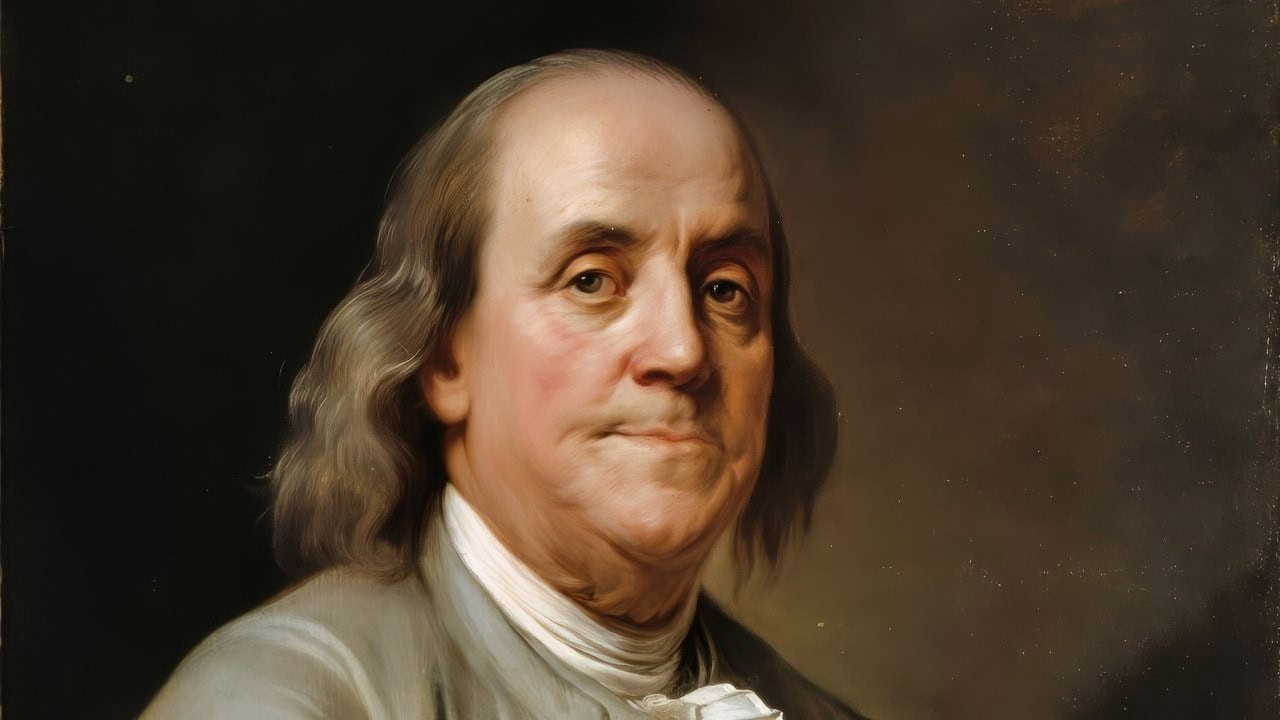
Benjamin Franklin. Image Credit: Creative Commons.
-Before the Revolution, Franklin was a “loyal Briton,” founding America’s first lending library, fire department, and hospital, while gaining global fame for his electrical experiments.
-However, years of navigating British imperial politics and a public humiliation before the Privy Council in 1774 shattered his faith in the Crown, turning a gifted diplomat into a resolute revolutionary ready to lead the colonies.
The Runaway Who Built America: Benjamin Franklin’s Untold Pre-Revolutionary Life
“Don’t throw stones at your neighbors, if your own windows are glass.” – Benjamin Franklin
This sentiment is several hundred years old, but it was reiterated by Benjamin Franklin in Poor Richard’s Almanac. The quote warns against hypocrisy and the danger that hypocritical judgments will often come back to bite you.
Benjamin Franklin was full of such wisdom. Before the Revolutionary War began, Franklin was a loyal English colonial who sought to improve the social fabric in the American colonies. He was a gifted writer as well as an avid scientist, poet, mathematician, and eventual revolutionary.
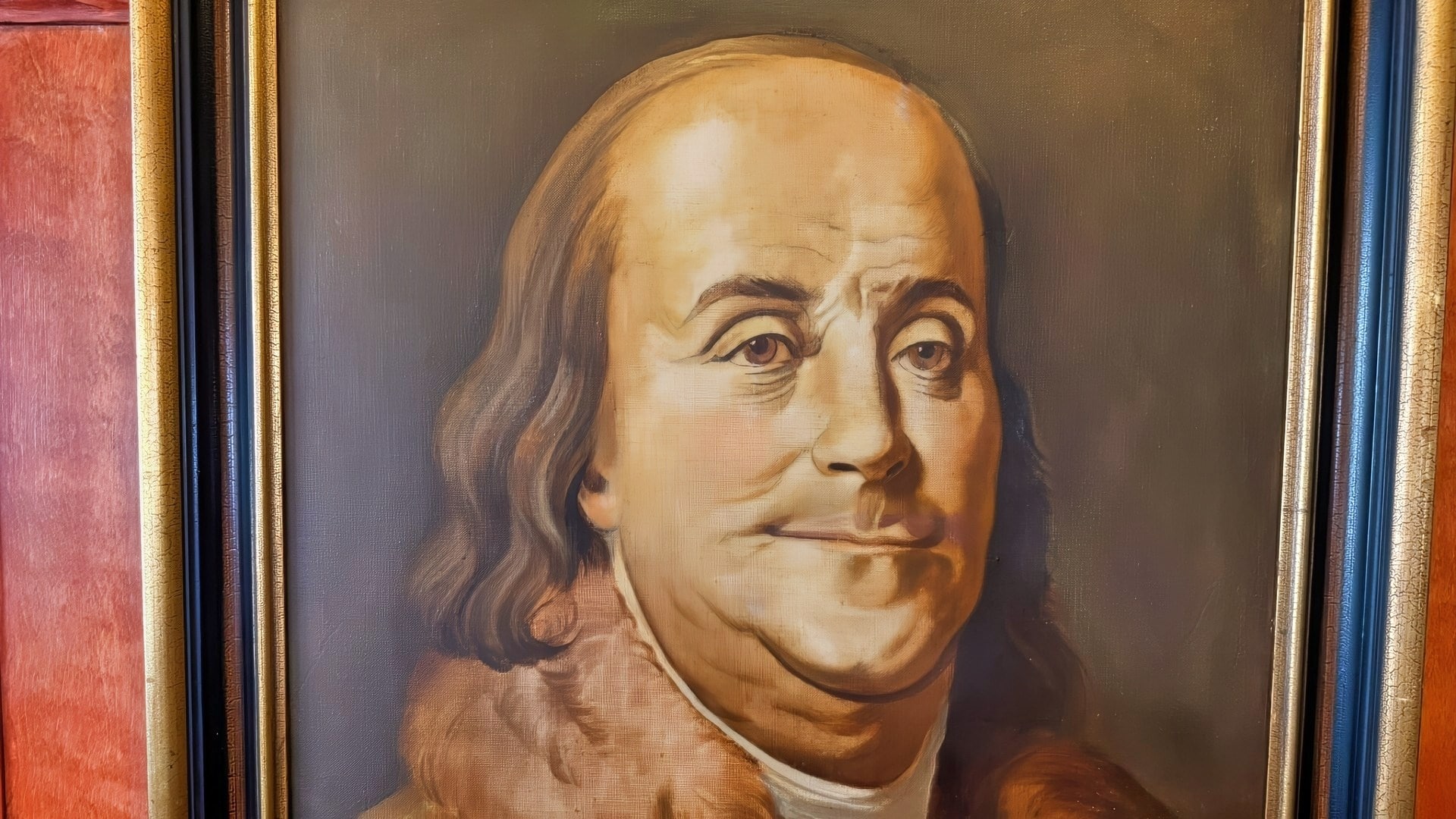
Benjamin Franklin 19FortyFive Image. Taken by Harry J. Kazianis at the Hall of Presidents at Walt Disney World, Florida.
Early Life and Family Background
Benjamin Franklin was born on January 17, 1706—January 6 under the Old Style calendar—in Boston, Massachusetts Bay, a thriving but socially stratified Puritan town in the British Empire. He was the fifteenth child and tenth son of Josiah Franklin, a candle and soap maker who had emigrated from England in the late 17th century, and Abiah Folger, a woman from a respected New England family. With 17 children to support, the Franklin household had little money but emphasized industry, frugality, and moral seriousness, which would deeply influence Benjamin’s character.
Franklin’s formal education was brief. He attended Boston Latin School for about a year. He showed promise but was withdrawn due to the cost of schooling. He later studied under a private teacher for another year, but by age ten his formal education had ended. Nevertheless, Franklin developed an intense love of reading and self-improvement. He borrowed books wherever he could find them and taught himself to write by closely studying admired authors. This habit of disciplined self-education became a defining feature of his life and thought.
Apprenticeship and the Birth of a Writer
At age 12, Franklin was apprenticed to his older brother James, a printer in Boston. Printing was a demanding trade, but it placed Franklin at the center of the world of ideas, politics, and public debate. In 1721, James founded The New-England Courant, one of the colonies’ earliest newspapers to publish opinion and satire rather than merely reprinting foreign news. Franklin secretly contributed a series of witty and insightful essays under the pseudonym “Silence Dogood,” posing as a middle-aged widow commenting on religion, education, and social customs.
The “Silence Dogood” essays brought Franklin local fame, but they also intensified tensions with his brother. James was frequently in trouble with colonial authorities for criticizing the government and clergy, and he could be harsh and abusive toward Benjamin. When James was briefly jailed, Franklin ran the paper in his absence, gaining practical experience in journalism and censorship. Ultimately, the strained relationship drove Franklin to make a daring decision: In 1723, at age 17, he ran away from his apprenticeship and left Boston for good.
Civic Leadership and Social Improvement
Franklin believed that knowledge and cooperation could improve society. In Philadelphia, he became a leading civic organizer. In 1727 he founded the Junto, a club of artisans and tradesmen who met to discuss philosophy, politics, and community improvement. From the Junto emerged some of the most important institutions in colonial America: a lending library (the Library Company of Philadelphia), a volunteer fire company, a hospital, and an academy that would later become the University of Pennsylvania.
These projects reflected Franklin’s belief that ordinary citizens could, through voluntary association, solve public problems without relying solely on government or inherited privilege. This practical republican spirit, cultivating usefulness, merit, and cooperation, would later inform revolutionary ideology, even though Franklin himself still saw these efforts as fully compatible with British imperial rule.
Scientific Fame and International Recognition
During the 1740s and 1750s, Franklin turned increasingly to scientific inquiry—in particular, the study of electricity. His experiments with electrical charge, including the famous kite experiment, led to important discoveries about positive and negative electricity and the conservation of charge. He invented practical devices such as the lightning rod, which protected buildings from fire, and published his findings in a clear, accessible style.
Franklin’s scientific achievements brought him international fame. He was elected to learned societies in Britain and Europe and received honorary degrees from prestigious universities. This recognition elevated his social standing and gave him credibility far beyond the colonies. It also strengthened his emotional and intellectual ties to Britain, reinforcing his early belief that Americans could be equal partners within the empire rather than rebels against it.
Political Career and Imperial Service
Franklin’s public reputation led naturally to political office. He served in the Pennsylvania Assembly and became deeply involved in colonial governance. In 1754, he proposed the Albany Plan of Union, an ambitious but unsuccessful effort to unite the colonies for mutual defense and administration under the British Crown. Although rejected, the plan revealed Franklin’s early thinking about colonial cooperation and collective identity.
From 1757 onward, Franklin spent much of his time in London as an agent representing Pennsylvania and other colonies. His task was to negotiate disputes with colonial proprietors and imperial officials. In Britain, Franklin moved easily in intellectual and political circles, defending colonial interests while affirming loyalty to the Crown. He argued that Americans were entitled to the same rights as Britons and that imperial harmony depended on mutual respect.
From Loyal Briton to Disillusioned Colonist
By the 1760s and early 1770s, Franklin’s faith in the British imperial system began to erode. Parliamentary measures such as the Stamp Act and the Townshend Duties convinced him that colonial rights were increasingly misunderstood or ignored. The decisive blow came in 1774, when Franklin was publicly humiliated before the Privy Council during the Hutchinson Letters affair. Branded as disloyal and untrustworthy, he returned to Philadelphia deeply changed.

Cannon Firing. Image Credit: Creative Commons.
Although the American Revolution had not yet begun, Franklin’s pre-revolutionary life had prepared him for it. His experiences as a printer, scientist, civic leader, and imperial diplomat had taught him how ideas spread, how institutions function, and how power could be challenged with reason and organization. By the time he arrived home in 1775, Franklin was no longer merely a loyal subject seeking reform, but a seasoned thinker ready to help lead a revolution.
About the Author: Isaac Seitz
Isaac Seitz, a Defense Columnist, graduated from Patrick Henry College’s Strategic Intelligence and National Security program. He has also studied Russian at Middlebury Language Schools and has worked as an intelligence Analyst in the private sector.