
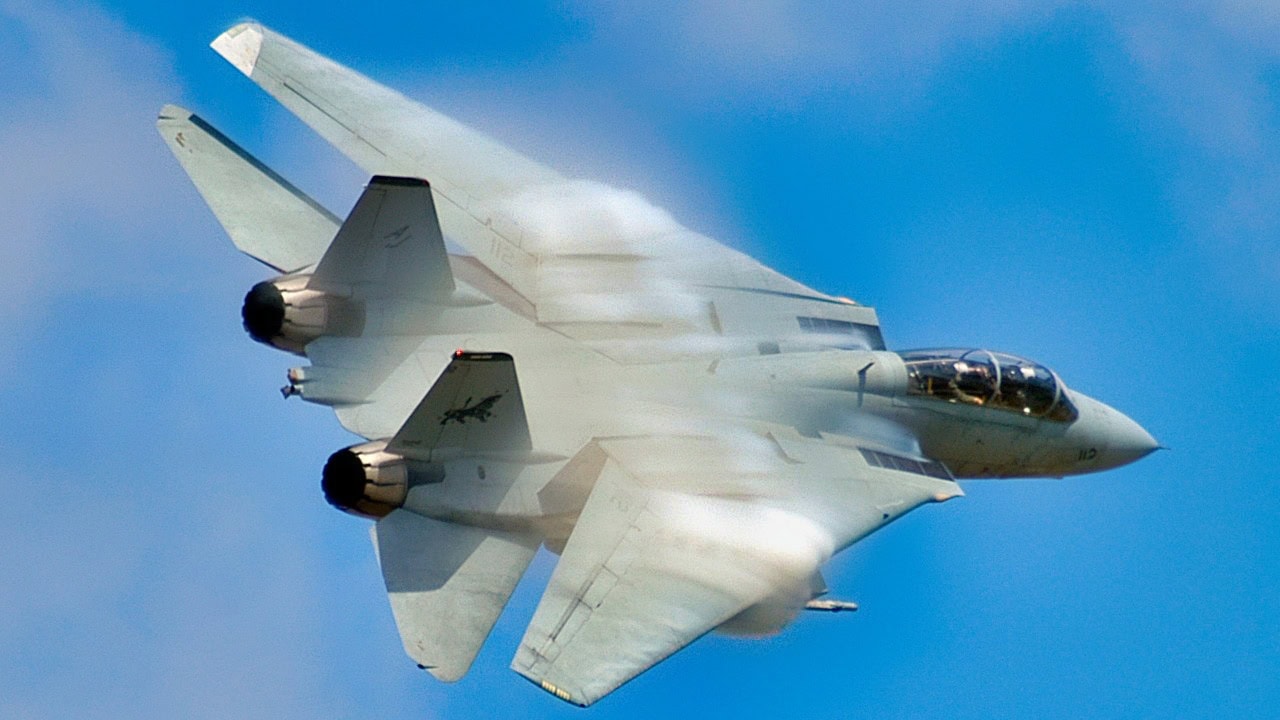
Summary and Key Points: Israeli strikes reportedly hit Iranian F-14 Tomcats at Tehran’s Mehrabad Airport in June 2025, sharpening the question of how many Tomcats Iran can still field in a crisis.
-Iran inherited roughly 80 F-14s from the Shah era, but decades of sanctions hollowed out the supply chain that made the aircraft viable.

F-14 Tomcat Fighter In a Museum Hanger
-To keep a small number operating, Tehran has relied on cannibalization, reverse-engineering, and hard-to-source components—while the United States moved aggressively to prevent parts leakage from retired American stocks.
-Even if some jets can still launch, doubts persist about radar, missiles, and real combat utility, with estimates ranging from a handful to roughly 25.
Iran Bought 80 F-14 Tomcats—Now the “Flyable” Number May Be Near Zero
In June 2025, imagery and reporting indicated Israeli strikes hit Iranian F-14 Tomcats at Mehrabad Airport in Tehran. In the aftermath, it is worth wondering how many flightworthy Tomcats Iran still has.
Iran is the only country that still claims to operate the F-14, a Cold War-era U.S. Navy interceptor made famous by the movie Top Gun and defined by long-range radar and missile systems.
But having Tomcats is different from being able to use them in a war. The Tomcat was complex to operate, even with U.S. Navy logistics powering it—and Iran has been under varying degrees of sanctions and embargoes since the 1979 Islamic Revolution. It has had to cannibalize aircraft it already owned to keep a smaller number flying. It has also had to engage in reverse-engineering and illicit procurement tactics.
What the F-14 Was Built To Do, and Why It Was Special
The U.S. Navy developed the F-14 as a carrier-based, long-range fleet-defense fighter meant to detect and destroy threats—especially bombers and anti-ship missiles—before they could reach carrier strike groups.
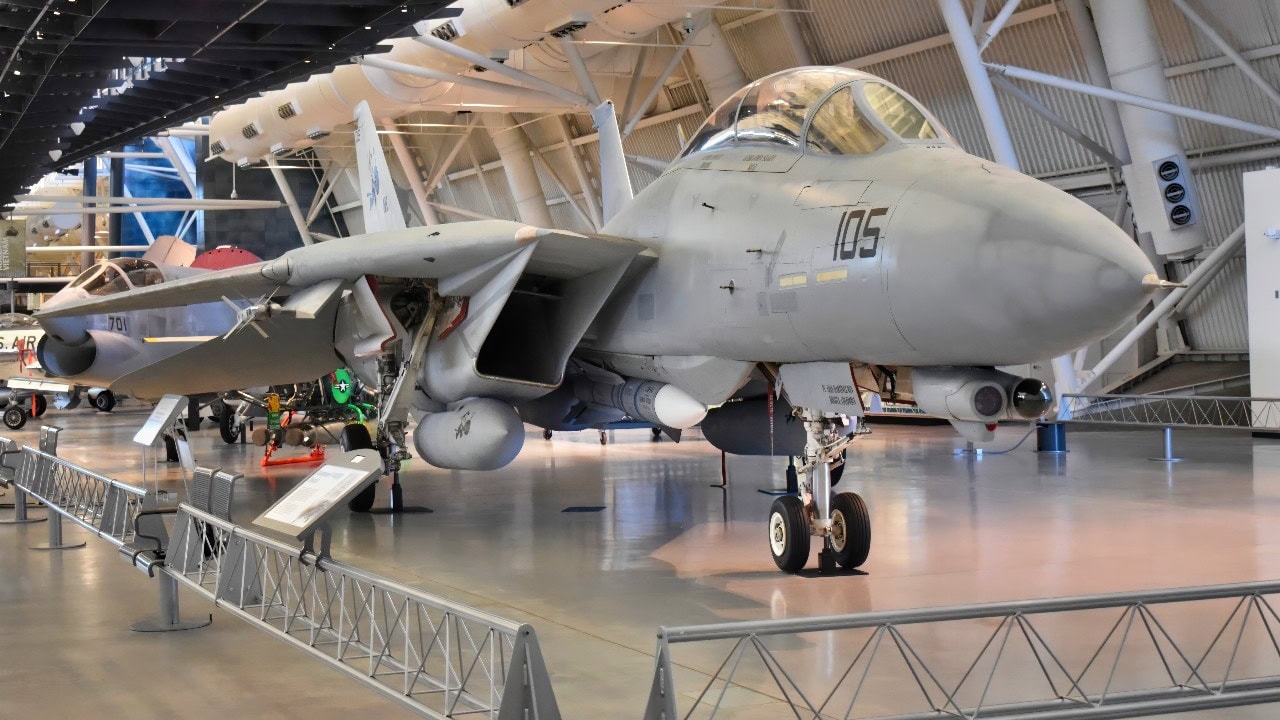
F-14 Tomcat. Image by 19FortyFive.com
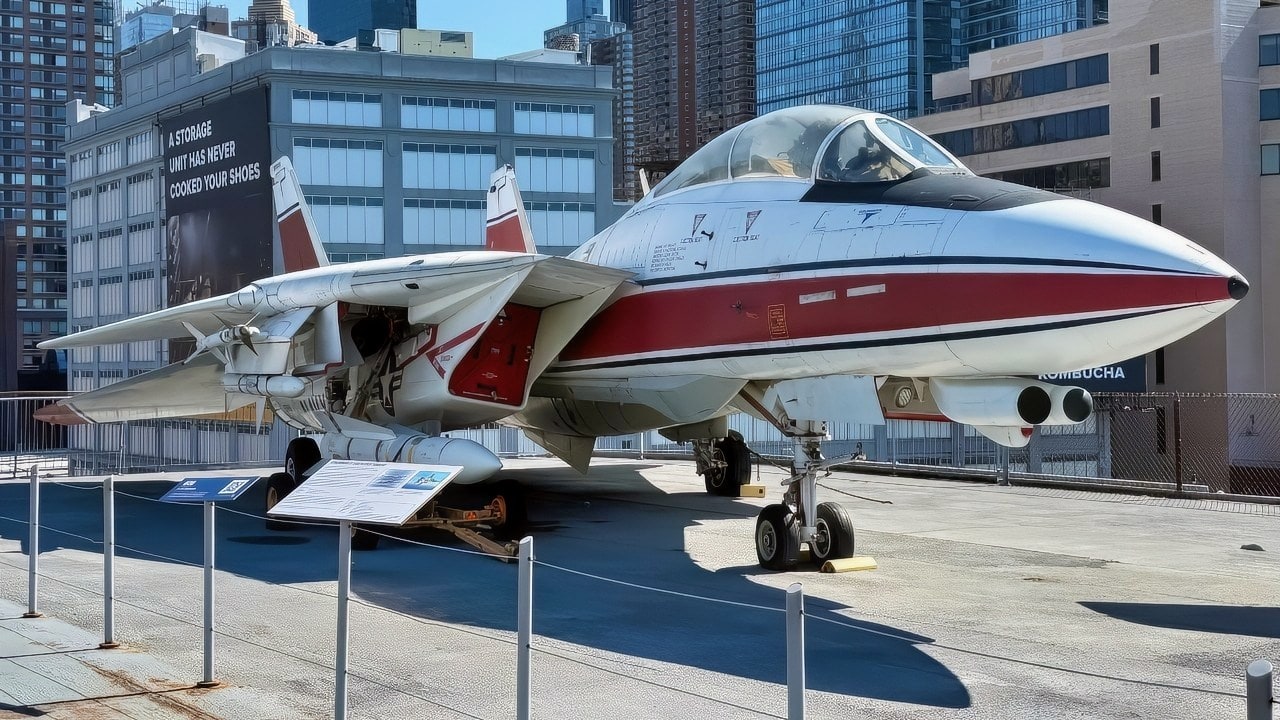
F-14 Tomcat Fighter in USS Intrepid Deck. Image taken late on 2025 by Jack Buckby for 19FortyFive. All Rights Reserved.
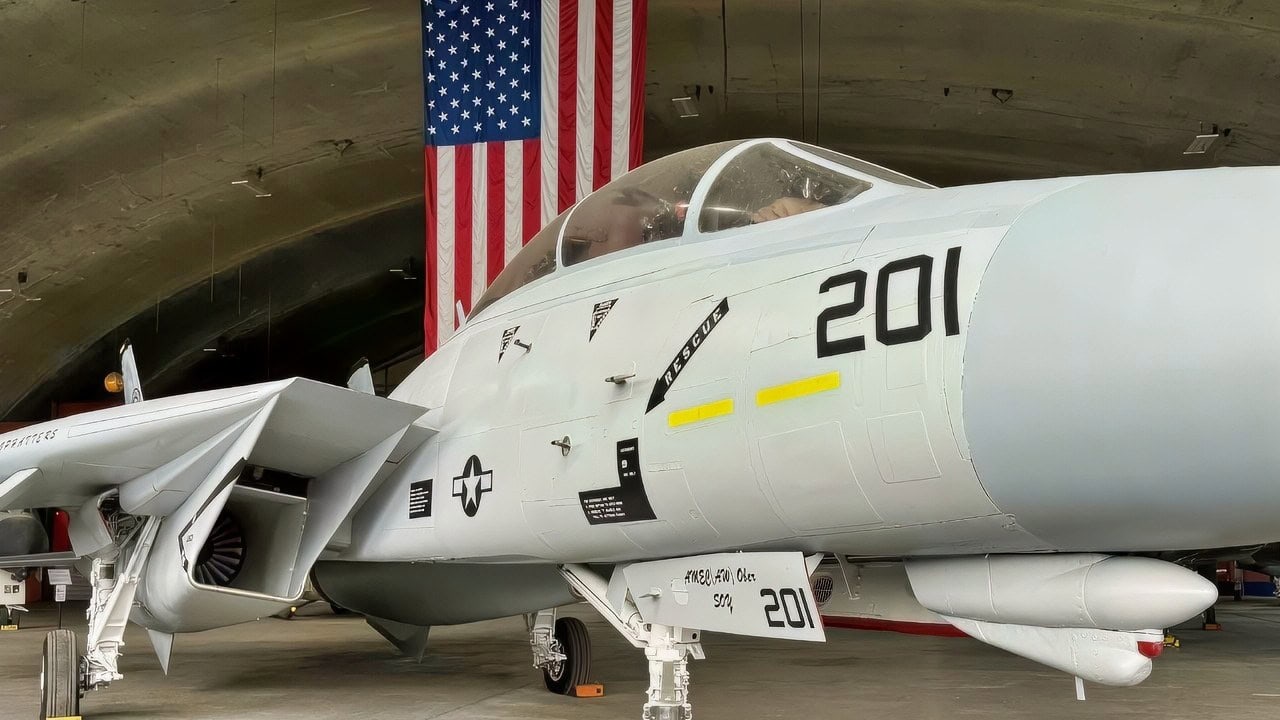
F-14 Tomcat Fighter U.S. Navy. 19FortyFive Field Research Image.

F-14 Tomcat in Museum. Image was taken by Jack Buckby for 19FortyFive.com. All rights reserved.
The aircraft’s defining advantage was its pairing of a powerful radar (the AN/AWG-9) with the AIM-54 Phoenix missile. This combination gave the Tomcat stand-off range and the ability to engage with multiple targets.
It was an exceptional combination for the 1970s, and the Tomcat is generally considered to have had the greatest stand-off engagement capability of any fighter of its era, with a range of more than 100 miles according to U.S. Navy documents. That allowed a Tomcat crew to treat air defense like a radar problem first: See farther, decide earlier, and shoot earlier—especially against aircraft approaching over water at high speed, collapsing reaction time.
Even for the Navy, that capability came with a cost: The F-14 was maintenance-heavy and manpower-intensive, and its most valuable components were tied to specialized supply chains. Now imagine how difficult it would be for a country slapped with some of the most wide-reaching sanctions in history to keep its Tomcats in the fight.
Why the Shah Bought the Tomcat
Iran purchased the F-14 under Shah Mohammad Reza Pahlavi, at a time when Tehran was one of Washington’s key regional partners and was aggressively modernizing its armed forces with U.S. equipment.
Iran ordered about 80 aircraft in the mid-1970s, along with a package that included Phoenix missiles and long-term support measures. According to most sources, it was a roughly $2 billion deal.
The most commonly cited strategic reason for the purchase was that Iran needed an answer to high-altitude and high-speed reconnaissance threats, especially the Soviets’ MiG-25 “Foxbat.”. What’s more, Iran was looking to dominate regional airspace using top-end U.S. technology.
Whatever the reason, Iran’s selection of the Tomcat made clear what it was prioritizing: long-range radar coverage, long-range interception, and an ability to hold enemy aircraft at risk well beyond visual range.
By the late 1970s, Iran had received most of the Tomcats it would ever get—79 in total before the revolution, while one remained undelivered.
1979 Changed Everything
After the 1979 Islamic Revolution and the collapse of U.S.-Iran defense ties, the logistical foundations required to operate an advanced aircraft like the F-14 evaporated. Spare parts access and contractor support suddenly narrowed—or disappeared entirely.
Iran’s solution to this problem over the decades has been to develop its own domestic maintenance capability and use foreign or illicit components to keep the aircraft airworthy, according to the U.S. Defense Intelligence Agency.
The U.S. government’s posture toward Iranian Tomcats also became unusually aggressive after the U.S. Navy retired the aircraft, specifically because Iran was the only remaining operator, and the easiest source for spare parts would be surplus U.S. inventory. For that reason, the United States took extreme measures to ensure its own inventories and supplies could not be accessed by Iran, directly or indirectly.
In 2007-2008, the Pentagon destroyed retired F-14 airframes and tightened controls after investigations and reports showed gaps in surplus-sales security that could have allowed parts to be delivered to Iran. The Pentagon even paid a contractor at least $900,000 to destroy the old jets.
This matters because the F-14’s value comes from internal systems that are hard to replace, especially without a support ecosystem. These include radar components and avionics modules, engines, missile integration systems, and more. Over time, a fleet may still technically exist on paper—or indeed, as real-life aircraft—but will become operationally useless because of a lack of spare parts and skilled maintenance teams, and an inability to manufacture these parts through domestic industry.
The Iran-Iraq War
When Iraq invaded Iran in 1980, Iran’s air force—disrupted by revolution and the isolation that followed—still had a handful of high-end assets that were inherited from the Shah era; these included the Tomcat.
A report by CSIS described Iran’s occasional use of F-14s at that time as an effort to deploy a kind of “mini-Airborne Warning and Control System (AWACS).” The aircraft’s radar could contribute to a larger air-defense effort, even if missile stocks or sortie generation were constrained.
“The F-14As could, however, still operate their AN/AWG-9 radar. This radar has a range of well over 100 nautical miles, and which can track 24 targets with sufficient look-down capability to act as a ‘mini-AWACs.’ They also could still fire Aim-7 and Aim-9 missiles. This allowed Iran to achieve a kill against an Iraqi Mirage fighter using the Aim-9 as late as the spring of 1988,” the 2003 report explains.
The “mini-AWACS” concept is still relevant today, too and possibly explains why Iran would value even a few functional Tomcats. The aircraft will not win any dogfights, but they can extend detection abilities and complicate attackers’ planning.
Why the Tomcats May Not Be Flying Now
There are three overlapping reasons that Iran’s F-14 force is likely unusable today: airframe age and fatigue, spare parts scarcity and ongoing cannibalization, and the obsolescence of the aircraft’s missiles and sensors. Even if some jets can take off, they are likely not particularly useful for Iran today.
Given the age of Iran’s F-14As (and other Shah-era aircraft such as the F-4), replacement would be the logical course. Iff Iran were operating under normal procurement conditions, replacing the aircraft it currently possesses would be one of the first items on its modernization agenda.
Iran simply couldn’t access anything it needed to restore the aircraft—certainly not at scale. Over time, parts scarcity forced Iran to engage in cannibalization, whereby a small number of jets were kept flying by taking parts from others. That’s one reason the June 2025 strikes were particularly impactful for Iran: Even if the destroyed F-14s were not flyable, they could have provided spare parts. But not anymore.
Regarding weapons and sensors, a Tomcat without a credible beyond-visual-range missile inventory and working radar is no longer useful to Iran at all.
Not only is Iran running short of working aircraft, it’s unclear just how many can still be used for “mini-AWACS” missions.
All this uncertainty is why estimates vary so widely about how many Tomcats are still in Iran. Estimates based on open-source intelligence suggest that anywhere between a “small handful” of aircraft and around 25 could be flyable today. That is a broad range, but whether it’s closer to 25 or 0, the fact remains that these aircraft don’t give Iran any practical advantage at all.
Iran’s dwindling Tomcat force is one part of a larger problem for Iran: its aging combat-air fleet—old, mixed in origin, and constrained by decades of sanctions.
Tehran’s air defense rests far more on its missiles and drones than these 1970s interceptors—and if the June 2025 strikes removed even the Tomcats’ spare parts reserve, the era of Iran’s Persian Tomcat may now be closing for good.
About the Author: Jack Buckby
Jack Buckby is a British researcher and analyst specialising in defence and national security, based in New York. His work focuses on military capability, procurement, and strategic competition, producing and editing analysis for policy and defence audiences. He brings extensive editorial experience, with a career output spanning over 1,000 articles at 19FortyFive and National Security Journal, and has previously authored books and papers on extremism and deradicalisation.