
Summary and Key Points: Thomas Jefferson’s “little rebellion” line comes from a January 30, 1787, letter to James Madison, written from Paris.
-He argues that periodic unrest can check government overreach and urges mild punishment so legitimate grievances aren’t crushed.

Monticello Thomas Jefferson Original Image. Image by Christian D. Orr/19FortyFive

Thomas Jefferson Burial. Image provided by Author.
-The piece then situates the quote inside Jefferson’s broader legacy—authoring the Declaration of Independence, his years in France, and his later presidency—while acknowledging the contradictions of life at Monticello.
-Finally, it tracks how the line is repeatedly repurposed in modern politics, from the Tea Party movement to post-United States Capitol commentary, including a critique in The Week by Bonnie Kristian.
Quote of the Day: Thomas Jefferson’s “A Little Rebellion” Line Still Hits Hard
Quote of the day: “I hold it that a little rebellion now and then is a good thing, and as necessary in the political world as storms in the physical.”- Thomas Jefferson
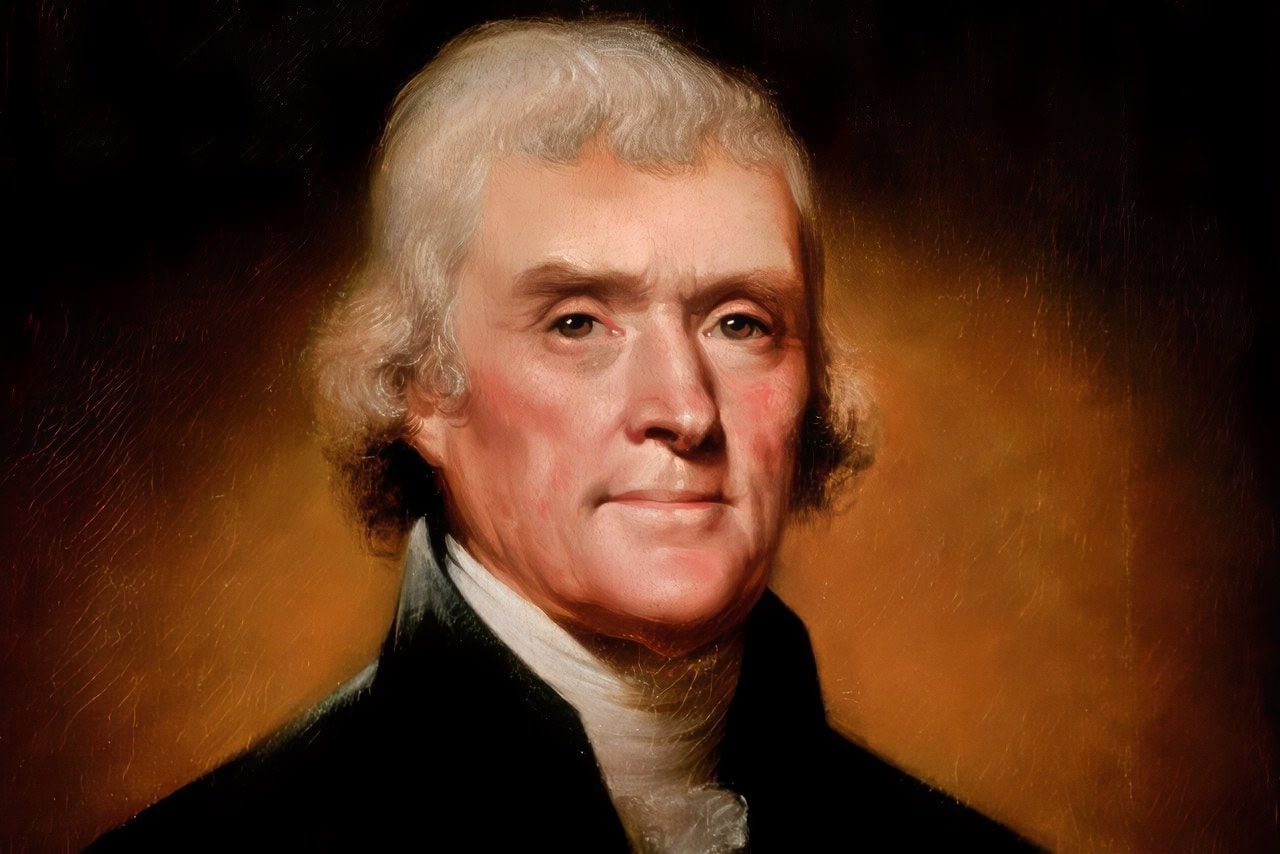
Thomas Jefferson was a key figure in the American Revolution, the primary author of the Declaration of Independence, the third president of the United States, and the first Secretary of State.
“I hold it that a little rebellion now and then is a good thing, and as necessary in the political world as storms in the physical,” Jefferson wrote to his fellow Virginian James Madison, in a letter dated January 30, 1787, per its copy published by the National Archives. The letter was sent from Paris, while Jefferson was serving as ambassador to France.
“Unsuccessful rebellions indeed generally establish the incroachments on the rights of the people which have produced them,” Jefferson continued. “An observation of this truth should render honest republican governors so mild in their punishment of rebellions as not to discourage them too much. It is a medicine necessary for the sound health of government.”
Jefferson was in France from 1784 to 1789. He remained in Paris during the early days of the French Revolution, but departed France in September of that year. Having “pretty much missed the late ‘80s,” as described in the Hamilton musical, Jefferson headed home to serve as the nation’s first secretary of state.
All About Jefferson
Thomas Jefferson was born on April 13, 1743.
According to the official Jefferson biography on the Monticello website, Jefferson’s father was “a successful planter and surveyor,” and his mother came from a prominent family. His father died when he was 14 years old.
“As young boy Jefferson studied mathematics, history, Latin, Greek, and French,” the Monticello biography says. “In 1760, he entered College of William and Mary in Williamsburg, Virginia. In 1762, he began to study law with prominent Virginia jurist, George Wythe, and recorded his first legal case in 1767. Two years later, he was elected to Virginia’s House of Burgesses (the legislature in colonial Virginia).”
Jefferson built Monticello atop the mountain overlooking his hometown of Shadwell. Jefferson’s wife, Martha, died ten years into their marriage.
As Monticello now acknowledges, Jefferson inherited slaves from his father, and bought and sold more, usually owning about 200 at any given time. Jefferson fathered at least six children by one of those slaves, Sally Hemings.
One of Jefferson’s most notable contributions was his authorship of the Declaration of Independence.
“The Declaration has been regarded as a charter of American and universal liberties. The document proclaims that all men are equal in rights, regardless of birth, wealth, or status; that those rights are inherent in each human, a gift of the creator, not a gift of government, and that government is the servant and not the master of the people,” the Monticello biography says.
Jefferson was governor of Virginia from 1779 to 1781. In 1784, he headed to France.
“In 1784, Jefferson entered public service again, in France, first as a trade commissioner and then as the successor to Benjamin Franklin as minister to France,” the Monticello biography says. “During this period, he avidly studied European culture, sending home to Monticello, books, seeds and plants, architectural drawings, artwork, furniture, scientific instruments, and information.”
Jefferson returned to the United States under the new Constitution and President George Washington. He was the nation’s second vice president for four years, serving under John Adams. In 1800, he was elected the nation’s third president, serving for eight years.
“Perhaps the most notable achievements of President Jefferson’s first term were the purchase of the Louisiana Territory in 1803 and his support of the Lewis and Clark expedition,” The Monticello bio says.
“His second term, a time when he encountered more difficulties on both the domestic and foreign fronts, is most remembered for his efforts to maintain neutrality in the midst of the conflict between Britain and France. Unfortunately, his efforts did not avert a war with Britain in 1812 after he had left office and his friend and colleague, James Madison, had assumed the presidency in 1809.”
After the end of his presidency, Jefferson returned to Monticello and remained there for, essentially the rest of his days.
“During this period, he sold his collection of books (almost 6500 volumes) to the government to form the nucleus of the Library of Congress before promptly beginning to purchase more volumes for his final library,” the Monticello biography says.
Jefferson famously died on July 4, 1826, which happened to have been both the 50th anniversary of the Declaration of Independence and the same day that his rival-turned-friend, John Adams, also died.
Other Little Rebellions
The Jefferson quote that “a little rebellion now and then is a good thing” has inspired many others in subsequent centuries.
It was sometimes used by the Tea Party movement during Barack Obama’s presidency, as was a different Jefferson quote from Revolutionary times, “the tree of liberty must be refreshed from time to time with the blood of patriots and tyrants. It is its [sic] natural manure.”
An op-ed piece, published in 2021 in The Week by Bonnie Kristian, arrived weeks after the January 6 riot and looked at “How the Founding Fathers encouraged political violence.”
“The tree may be figurative; the blood is not. Jefferson really wanted the populace to rise in armed rebellion from time to time, even against a government he helped create,” Kristian wrote. “I don’t think he would have supported the storming of the Capitol on behalf of Trump’s election fraud lie — but only because he would have rejected the reason for the protest. Supply a better cause and I suspect Jefferson would be all for overrunning the legislature.”
About the Author: Stephen Silver
Stephen Silver is an award-winning journalist, essayist, and film critic, and contributor to the Philadelphia Inquirer, the Jewish Telegraphic Agency, Broad Street Review, and Splice Today. The co-founder of the Philadelphia Film Critics Circle, Stephen lives in suburban Philadelphia with his wife and two sons. For over a decade, Stephen has authored thousands of articles that focus on politics, national security, technology, and the economy. Follow him on X (formerly Twitter) at @StephenSilver, and subscribe to his Substack newsletter.