
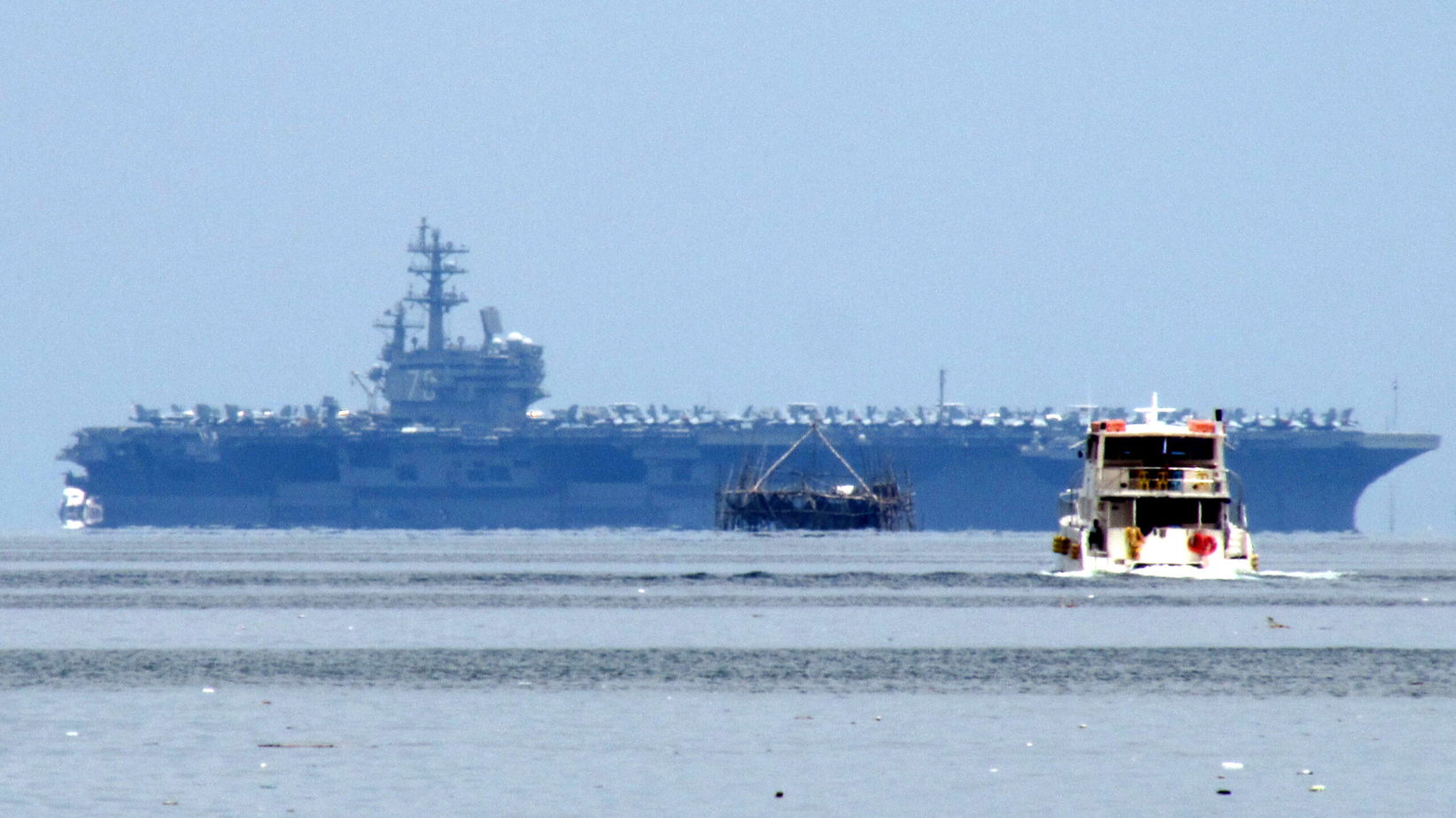
Summary and Key Points: President Trump has signaled the deployment of a second aircraft carrier strike group toward Iran as a “deal or strike” deadline looms.
-With the USS Abraham Lincoln already in the Arabian Sea, the USS George H.W. Bush (CVN-77) is the primary candidate to reinforce the “armada,” potentially arriving within a week.
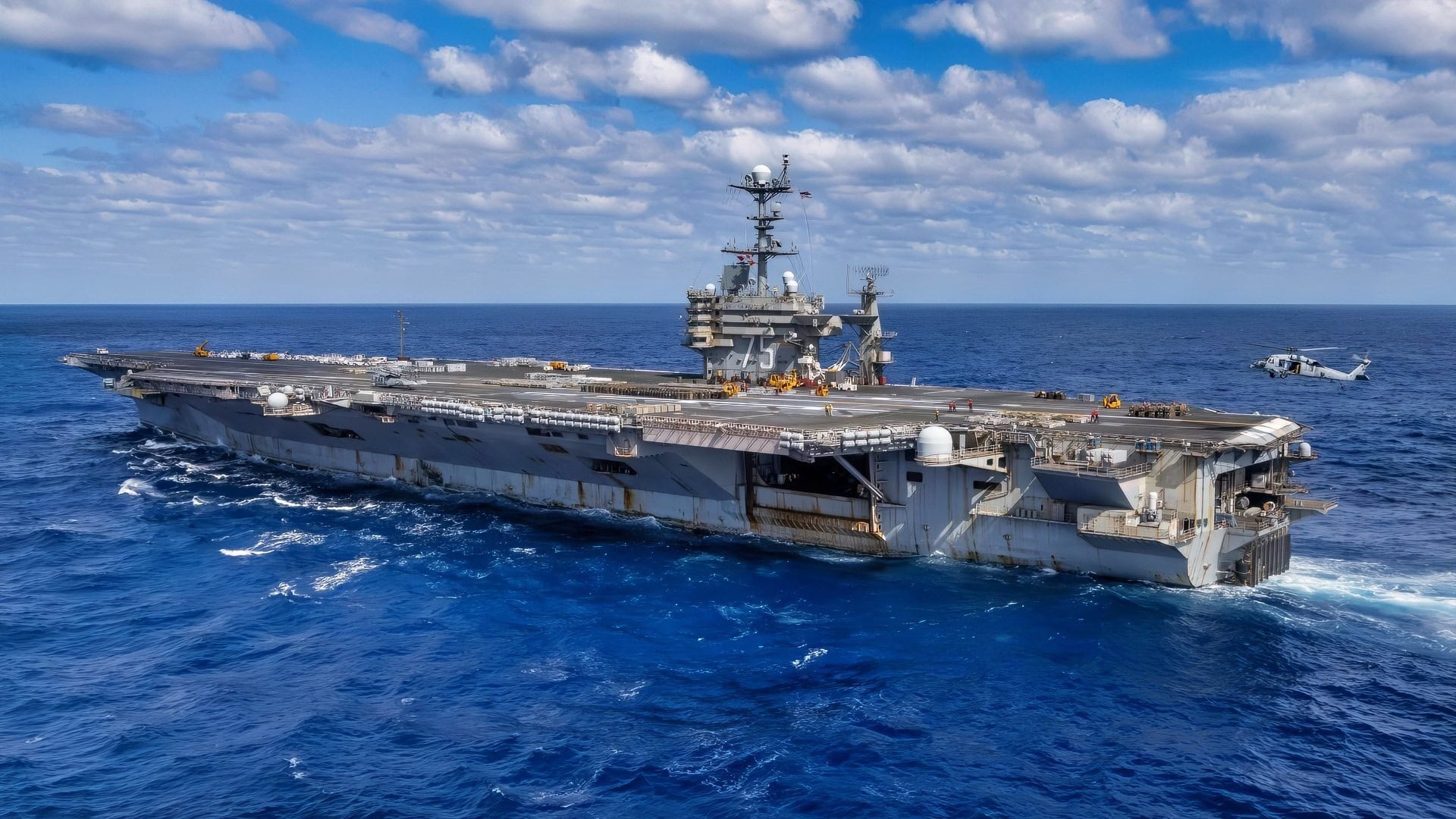
Aug. 4, 2025) An MH-60S Sea Hawk helicopter, attached to the “Dragonslayers” of Helicopter Sea Combat Squadron (HSC) 11, prepare to recieve ordnance from the flight deck of the Nimitz-class aircraft carrier USS Harry S. Truman (CVN 75) to transfer to the Lewis and Clark-class supply ship USNS Robert E. Peary (T-AKE 5) during an ammunition offload. Truman is currently underway in the Atlantic Ocean. (Photo by Mass Communication Specialist 2nd Class Mike Shen)
-While Iran demands sanctions relief and refuses to negotiate on ballistic missiles, the U.S. remains wary of stalling tactics.
The U.S. Navy Is Getting Ready to Send Another Supercarrier Near Iran
President Trump hinted during an interview with Axios that he may send a second aircraft carrier strike group off the coast of Iran to prepare for military strikes if negotiations with Iran fail.
The US Navy’s USS Abraham Lincoln (CVN-72) carrier strike group is currently operating in the Arabian Sea, south of Iran, in the Fifth Fleet’s area of operations.
President Trump, however, is confident that negotiations with Iran, the first since the June airstrikes that destroyed Iran’s nuclear weapons facilities, will go much better this time. He has a meeting scheduled with Israeli Prime Minister Benjamin Netanyahu in Washington on Wednesday. Netanyahu is much less confident of any meaningful deal.
“I will present Trump with principles for negotiations with Iran that are important not only to Israel but to everyone who wants peace and security,” Netanyahu said as he boarded an aircraft bound for the US.
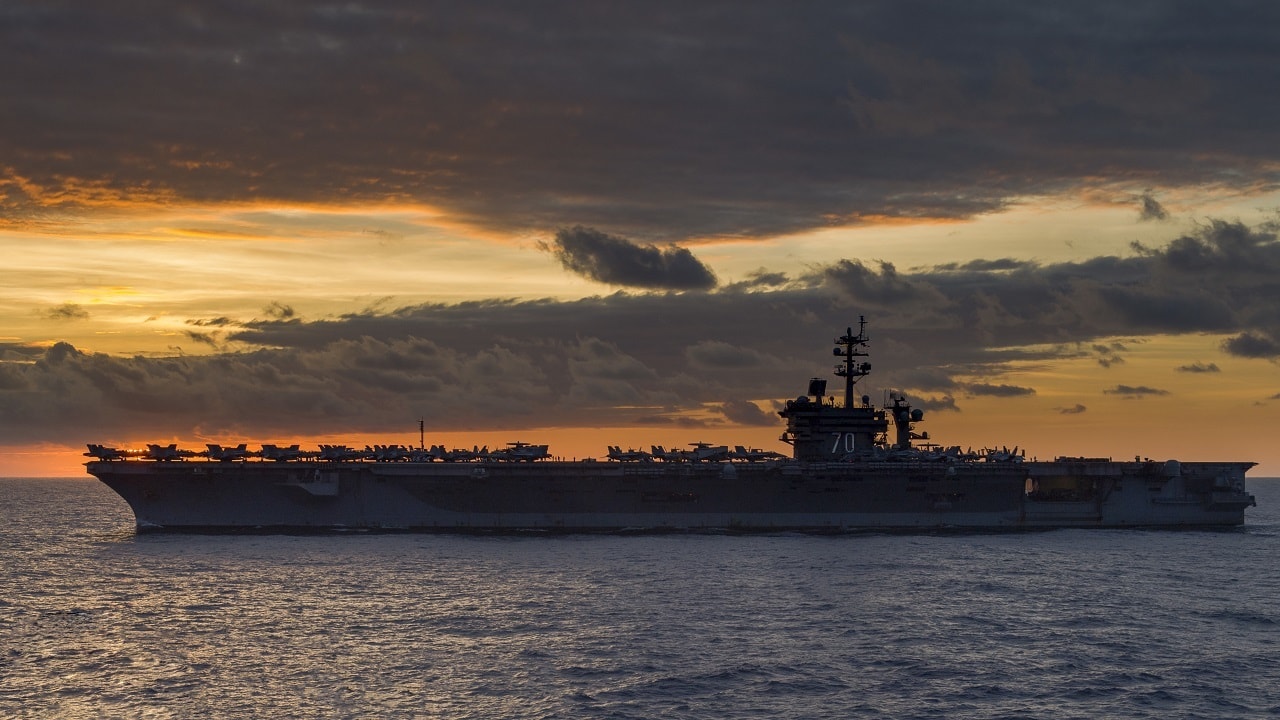
(Feb. 10, 2018) The Nimitz-class aircraft carrier USS Carl Vinson (CVN 70) transits the South Chna Sea. The Carl Vinson Strike Group is currently operating in the Western Pacific as part of a regularly schedule deployment. (U.S. Navy photo by Mass Communication Specialist Third Class Jasen Morenogarcia/Released)
“In my opinion, these are important principles for everyone who wants peace and security in the Middle East,” he added.
Does Iran Want A Deal, Or Stalling For Time?
The president said that Iran “wants to make a deal very badly” and is engaging much more seriously than during previous talks due to the military threat.
“Last time they didn’t believe I would do it,” Trump said, hinting at his decision to strike Iran’s nuclear facilities in June. “They overplayed their hand.”
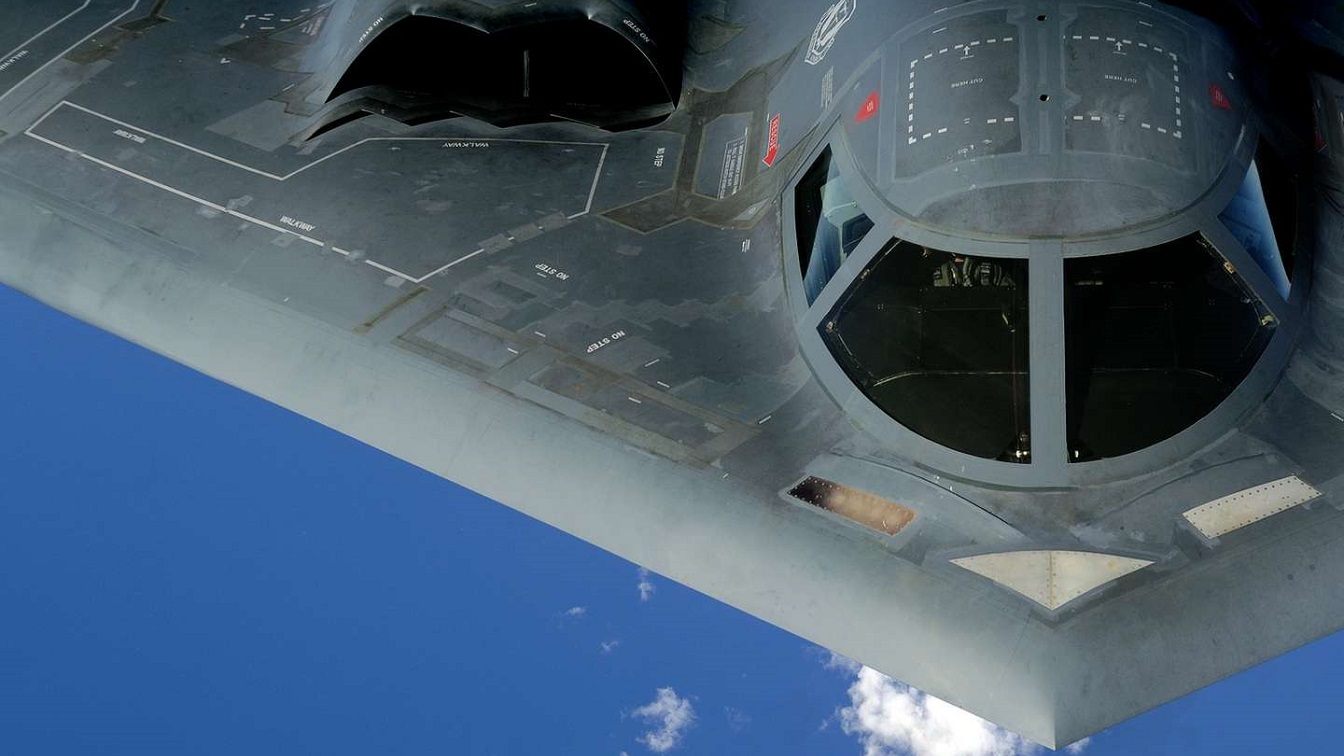
Image of B-2 Spirit stealth bomber. Image Credit: Creative Commons.
This time the talks are “very different,” he added.
However, President Trump is among the minority in believing that, as Iran has once again taken the tactic of stalling for time, while agreeing to nothing.
Iran insists on limiting discussions strictly to the nuclear program and is demanding the lifting of all sanctions, while the U.S. is pushing for a broader agreement that includes limiting ballistic missile development and ending support for regional proxy groups.
Iran has directly rejected U.S. demands to negotiate on its ballistic missile program, a key pillar of U.S. security concerns.
Analysts point to a familiar “playbook” where Iran agrees to talk to forestall military action while continuing to advance its nuclear capabilities, such as maintaining 60 percent uranium enrichment.
The talks are happening against a backdrop of military buildup in the region, with the U.S. increasing its naval presence and Iran engaging in provocative actions, including harassing U.S. vessels.
Iran is navigating a severe economic crisis and internal unrest, which some analysts believe makes it more likely that it is stalling to buy time rather than seeking a quick compromise.
“Either we will make a deal, or we will have to do something very tough like last time,” Trump said to Axios during the interview, warning that the US has ” an armada that is heading there and another one might be going.”
A Second Supercarrier Strike Group, But Which One?
During Israel’s Gaza offensive against Hamas, the US maintained one and often two carrier strike groups in the region.
The Lincoln carrier strike group was operating in the South China Sea in January before being ordered to the Arabian Sea. And while the US Navy has 10 active carrier strike groups, only half are at sea at any given time. The rest are going through maintenance and refit operations in port.
The USS Nimitz is being retired and will soon be undergoing decommissioning and recycling. There has been talk of extending the carrier’s contract for another decade, but that probably won’t happen.
The USS George Washington (CVN-73) completed its latest deployment in December and won’t be put to sea for several months. It is the only forward-deployed carrier. It is based in Yokosuka, Japan.
USS John Stennis (CVN-74) is in port, going through maintenance and upgrades, and won’t be ready for sea until 2027. The USS Harry S. Truman (CVN-75) is going through its midlife Refueling and Complex Overhaul (RCOH) and will be sidelined for a minimum of 48 months.
The Eisenhower, Reagan, and Vinson will also be unavailable for at least several months. The USS Theodore Roosevelt may be deployed, but not until later this spring. Another carrier strike group belonging to the USS George H. W. Bush (CVN-77) could also be tasked.

U.S. Navy sailors view the Nimitz-Class aircraft carrier USS Carl Vinson (CVN-70) from the hangar bay of the aircraft carrier USS Theodore Roosevelt (CVN-71). Theodore Roosevelt was deployed in the U.S. 5th Fleet area of responsibility supporting Operation Inherent Resolve, strike operations in Iraq and Syria as directed, maritime security operations and theater security cooperation efforts in the region.
CVN-77 remains an option due to its availability and positioning, which could allow Washington to reinforce its naval presence quickly if tensions escalate or negotiations fail. It would take about a week to position itself there.
During Operation Inherent Resolve from 2014 and 2017, it carried out strikes in Syria and Iraq, against ISIS, expending 907 tons of ordnance, the highest by a carrier air wing since Desert Storm.
So, what does the Navy turn to if there isn’t a supercarrier strike group available? Amphibious assault ships seem the likely answer.
About the Author: Stephen Balestrieri
Steve Balestrieri is a National Security Columnist. He served as a US Arry Special Forces NCO and Warrant Officer. In addition to writing on defense, he covers the NFL for PatsFans.com and is a member of the Pro Football Writers of America (PFWA). His work was regularly featured in many military publications.