
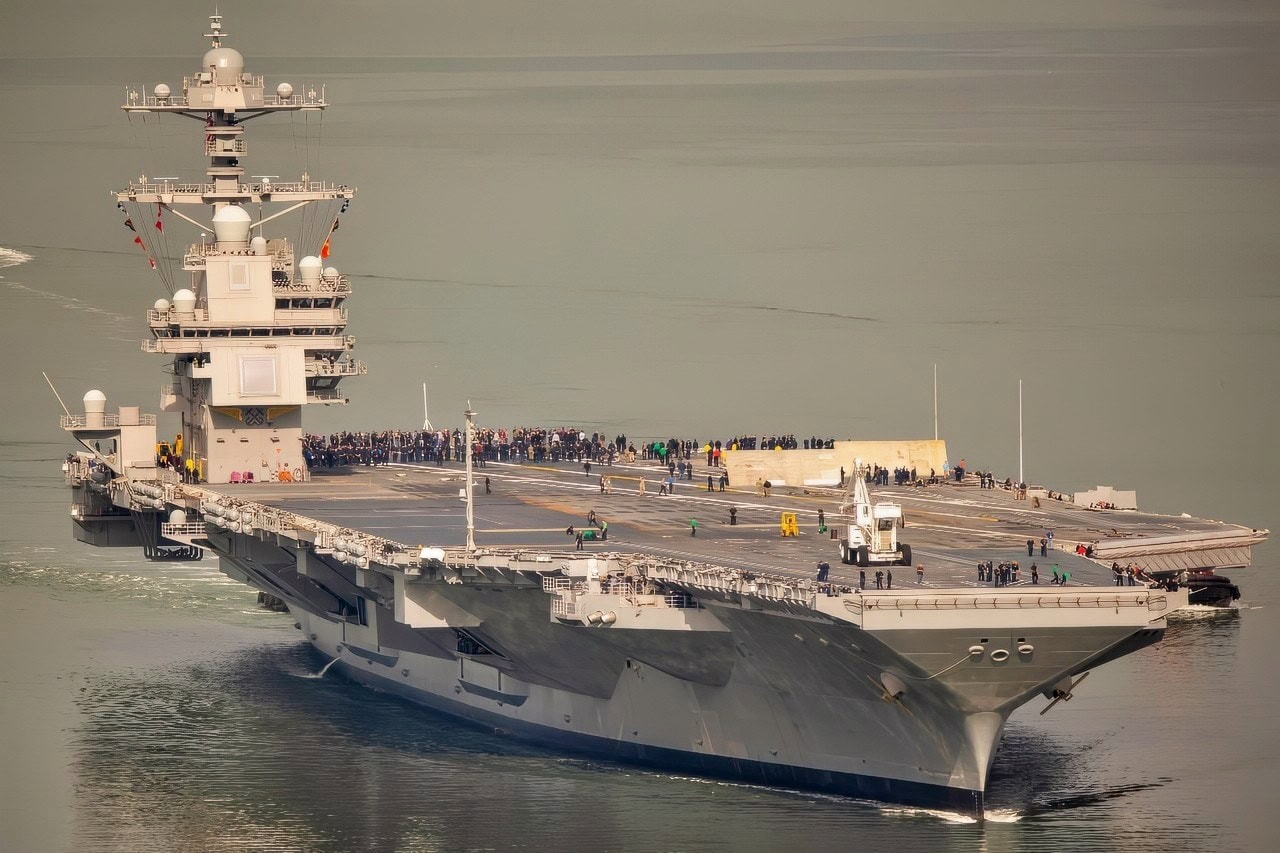
Summary and Key Points: Harrison Kass, a national security analyst and former US Air Force pilot selectee, evaluates the USS Gerald R. Ford (CVN-78) aircraft carrier and its transition from a troubled prototype to a cornerstone of US Navy strategy.
-This 19FortyFive report scrutinizes the “top five” hurdles of the Ford-class: EMALS reliability, Advanced Arresting Gear (AAG) setbacks, the $13 billion unit cost, and the certification of Advanced Weapons Elevators (AWE).
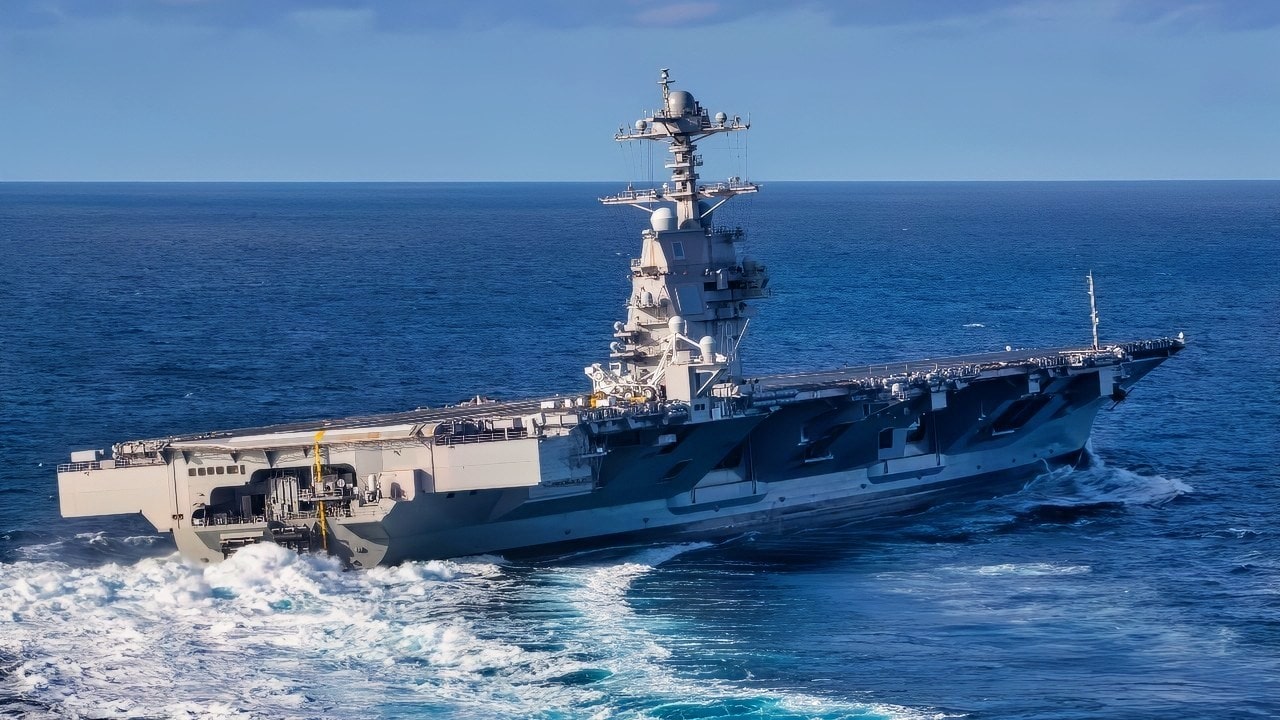
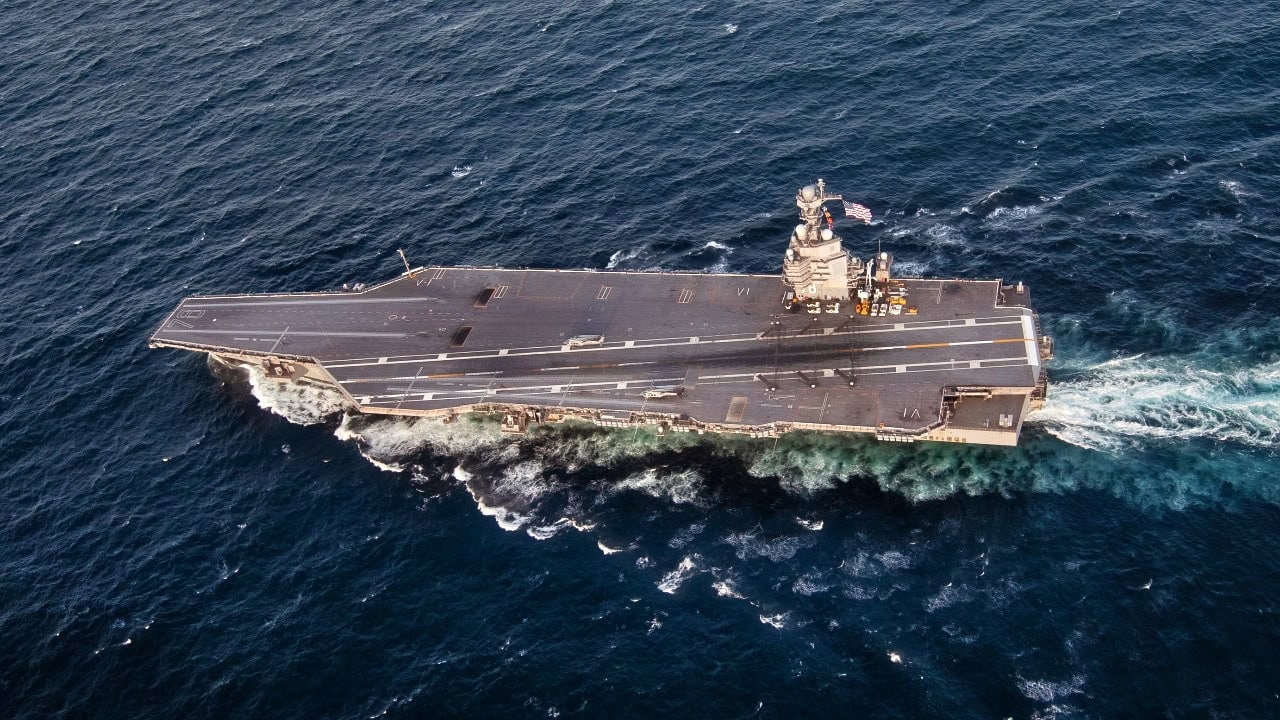
ATLANTIC OCEAN (Oct. 29, 2019) USS Gerald R. Ford (CVN 78) conducts high-speed turns in the Atlantic Ocean. Ford is at sea conducting sea trials following the in port portion of its 15 month post-shakedown availability. (U.S. Navy photo by Mass Communication Specialist 3rd Class Connor Loessin)
-The analysis weighs these “growing pains” against the carrier’s 50-year service life, exploring how its electrical growth margin prepares the fleet for directed-energy weapons in a contested A2/AD environment.
The $13 Billion U.S. Navy Aircraft Carrier Learning Curve: The Top 5 Challenges Facing the USS Gerald R. Ford
The Gerald R. Ford-class, CVN-78, is the first new US carrier design since the Nimitz-class, which debuted in the 1970s. Intended to replace the Nimitz-class one-for-one, the Ford is a 100,000-plus-ton nuclear-powered carrier designed for a higher sortie rate and reduced crew size, with lower lifetime operating cost and electrical growth margin for future weapons. Strategically, the Ford is meant to serve as a floating sovereign airbase, the deterrence backbone of the Indo-Pacific, capable of power projection without foreign basing.
The Ford, with a price tag of $13 billion per unit, is as much a political symbol as a military asset, designed not as an incremental upgrade but a generational leap ahead.
Accordingly, the Ford bundles multiple new technologies simultaneously—always a risk—with an intended 50-year service life and supposed compatibility with future technologies.
But, naturally, cramming so many untested technologies into one platform has proven difficult. The cost ballooned. Production delayed.
And growing pains have plagued operations. Still, the Ford is not a failure, but an ambitious program, with innovations stacked upon innovations, and the resultant risk concentrated in a single hull. Here are the top five problems with the Ford-class.
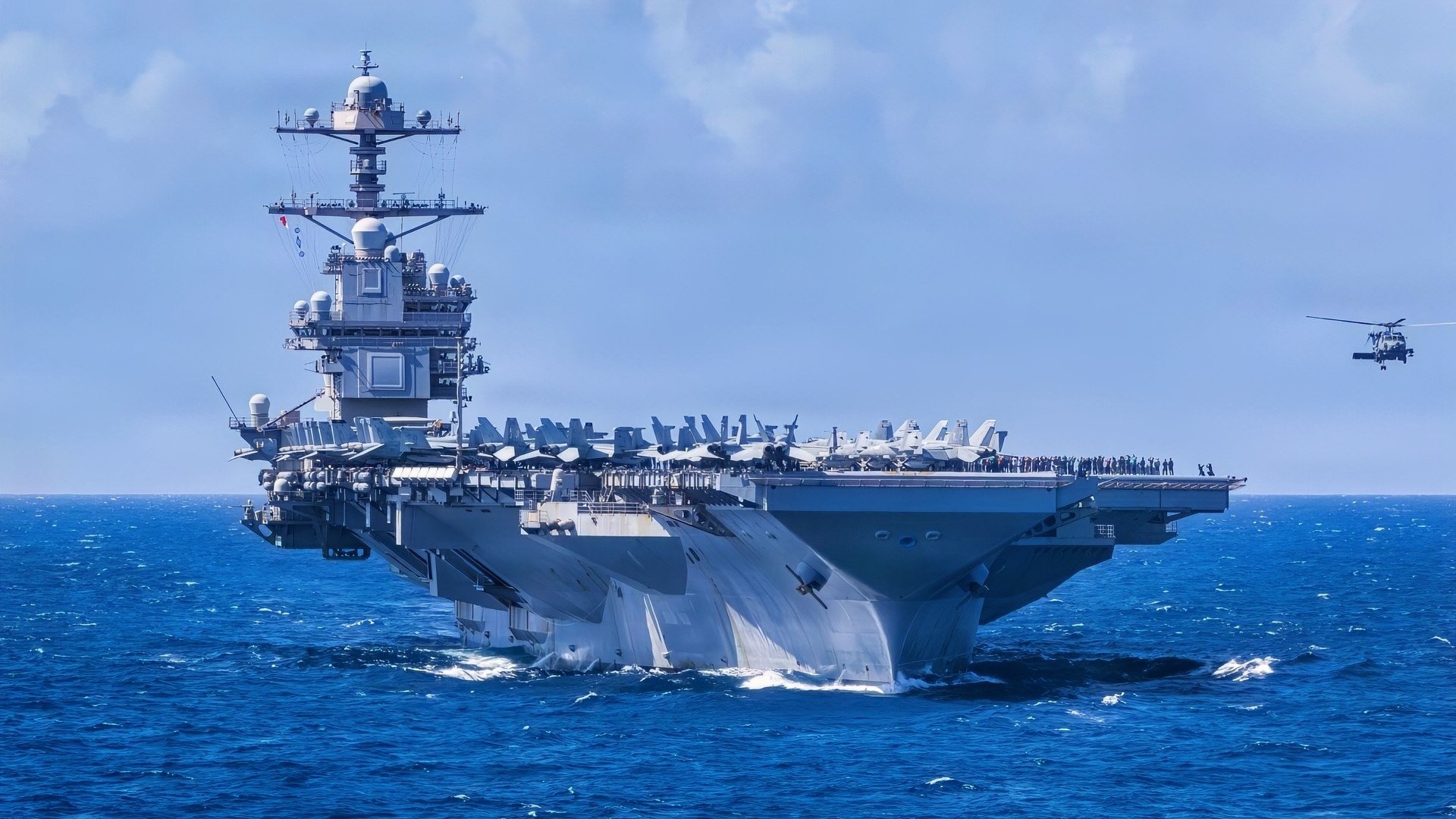
U.S. Navy Carrier Air Wing 8 aircraft fly in formation over the world’s largest aircraft carrier, Ford-class aircraft carrier USS Gerald R. Ford (CVN 78), during Carrier Air Wing 8’s aerial change of command ceremony while underway in the Caribbean Sea, Jan. 19, 2026. U.S. military forces are deployed to the Caribbean in support of the U.S. Southern Command mission, Department of War-directed operations, and the president’s priorities to disrupt illicit drug trafficking and protect the homeland. (U.S. Navy photo)
One: Cost
The Ford’s original estimate was $10 billion per unit. But the lead ship cost $13 billion—just for the ship. When you consider research and development costs, the program costs far more. As more hulls are commissioned, the R&D costs will be distributed across more hulls, lowering the cost per unit. But that still requires investing billions more and completing more super carriers, just to distribute costs. And follow-on hulls will still cost $12 billion or so. In short, the program is very expensive.
Why so expensive? The clean-sheet design features a nuclear plant redesign, EMALS launching system, AAG arresting system, advanced weapons elevators, a new radar suite, automated systems—these are generational innovations all packed into one hull, and that’s not cheap. Costs also expanded because the ship was designed while being built, meaning systems were often fixed post-delivery.
Strategically, the cost of the program likely means the Navy will procure fewer hulls than originally intended. And the increased fiscal cost also ups the opportunity cost of investing in the Ford, drawing from other assets like submarines and destroyers.
Political tension regarding the program is higher than anticipated, drawing attention and pressure to the military budget as great power competition ramps up. And the vulnerabilities of the carrier concept in the age of hypersonic missiles and drone swarms raise questions about the wisdom of investing so much in a single hull.
Two: EMALS
The Electromagnetic Aircraft Launch System, or EMALS, uses a linear induction motor and replaces the steam catapult system found on Nimitz.
Launching aircraft via electromagnetic force, EMALS is purported to offer smoother acceleration and adjustable launch energy per specific aircraft needs, which places less stress on aircraft and enables compatibility with lighter UAVs and heavier aircraft. EMALS implementation has had problems, though. Reliability was inconsistent early on, with power-conversion issues and energy-storage stress; the mean number of cycles to failure was initially below spec.

Aircraft Carrier USS Gerald R. Ford Diagram. Image Credit: Creative Commons.
Still, EMALS was seen as the smart play relative to steam catapults; steam was proven but manpower heavy. EMALS was future-oriented but immature. In the long term, EMALS is expected to improve sortie generation rates, but in the short term, if EMALS is down, the sortie tempo suffers. Fortunately, the technology has steadily improved, suggesting the growing pains will have been worthwhile.
Three: AAG
The Advanced Arresting Gear, or AAG, replaces the legacy hydraulic arresting system found on Nimitz. Designed for wider aircraft weight envelopes, future UAV compatibility, and a reduced maintenance burden, AAG suffered early development failures, including water twister energy absorber problems, control software immaturity, and testing setbacks.
And in carrier operations, where aircraft launch and recovery are the entire reason for existence, any weakness creates an operational bottleneck. The introduction of AAG, paired with EMALS, created a dual risk to the most critical flight deck functions. AAG is operational now, but the development pains were significant, causing schedule delays and reputational harm.
Four: Advanced Weapons Elevators (AWE)
The Advanced Weapons Elevators, or AWE, are supposed to use electromagnetic motors to replace cable-driven elevators for faster weapon movement (which supports high sortie generation). In reality, AWE suffered from persistent certification delays, elevator alignment, and software issues; the first Ford was delivered without full elevator functionality.
Problems relating to AWE are important because ordnance flow is critical to sustained carrier ops; sortie generation is tied to logistical efficiency. So AWE problems hamper the entire operation. The Ford was designed to have a 33 percent higher sortie rate than Nimitz—and the elevators are central to that promise.
Symbolically, having something as basic as the elevators unfinished at ship delivery creates bad optics and lowered confidence in the program at large.
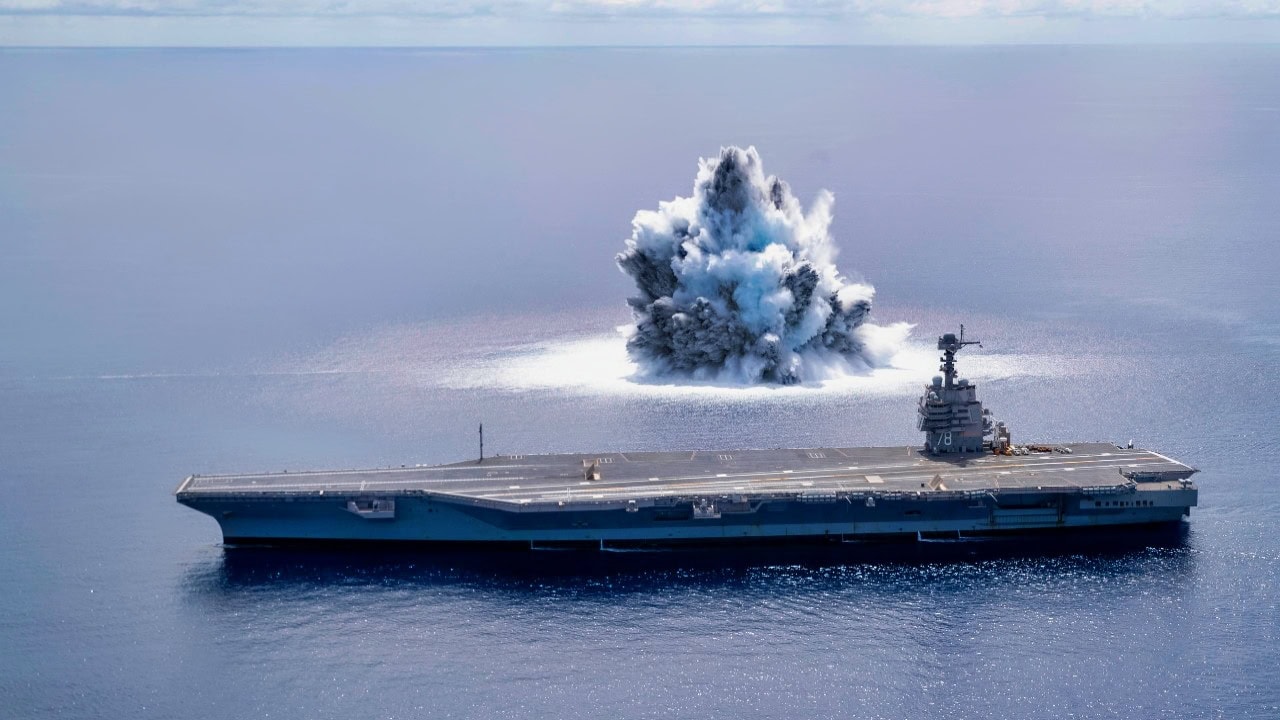
The aircraft carrier USS Gerald R. Ford (CVN 78) completes the first scheduled explosive event of Full Ship Shock Trials while underway in the Atlantic Ocean, June 18, 2021. The U.S. Navy conducts shock trials of new ship designs using live explosives to confirm that our warships can continue to meet demanding mission requirements under harsh conditions they might encounter in battle. (U.S. Navy photo by Mass Communication Specialist 3rd Class Riley B. McDowell)
The Ford-class aircraft carrier USS Gerald R. Ford (CVN 78) and the Italian aircraft carrier ITS Cavour (CVH 550) transit the Atlantic Ocean March 20, 2021, marking the first time a Ford-class and Italian carrier have operated together underway. As part of the Italian Navy’s Ready for Operations (RFO) campaign for its flagship, Cavour is conducting sea trials in coordination with the F-35 Lightning II Joint Program Office’s Patuxent River Integrated Test Force to obtain official certification to safely operate the F-35B. Gerald R. Ford is conducting integrated carrier strike group operations during independent steaming event 17 as part of her post-delivery test and trials phase of operations.
Five: Concurrency and Over-Ambition
Generally, the Ford jammed several innovations into one platform. The ambition level was admirable if overzealous. Ford features a new radar suite, new nuclear reactors, a new power architecture, and a variety of automation that have significantly reduced crew size. The problem here is risk stacking—too many first-of-class systems, with no incremental path and no fallback to legacy systems, just about promises cost overruns and scheduling delays, and threatens, at worst, fleet capacity downgrades. Even under the best of circumstances, the learning curve, with so many new technologies, was always going to be steep. Post-delivery fixes were guaranteed, with extended testing.
The Navy learned hard lessons from revolutionary weapons development; incrementalism would have made for a smoother transition, but the value of Ford is said to lie in cost savings and sortie rates over its 50-year life cycle.
The lead ship has already absorbed a lot of the growing pains; the follow-ons should be smoother, but still costly and still prone to transition difficulties.
Broader Criticism of the Ford-Class and Aircraft Carriers Overall
Critics have suggested that the age of the aircraft carrier is over. That criticism seems premature—but the threat environment has certainly become more complicated. Anti-ship ballistic missiles, like China’s DF-21D and DF-26, and the emergence of hypersonic weapons, could theoretically sink a carrier.
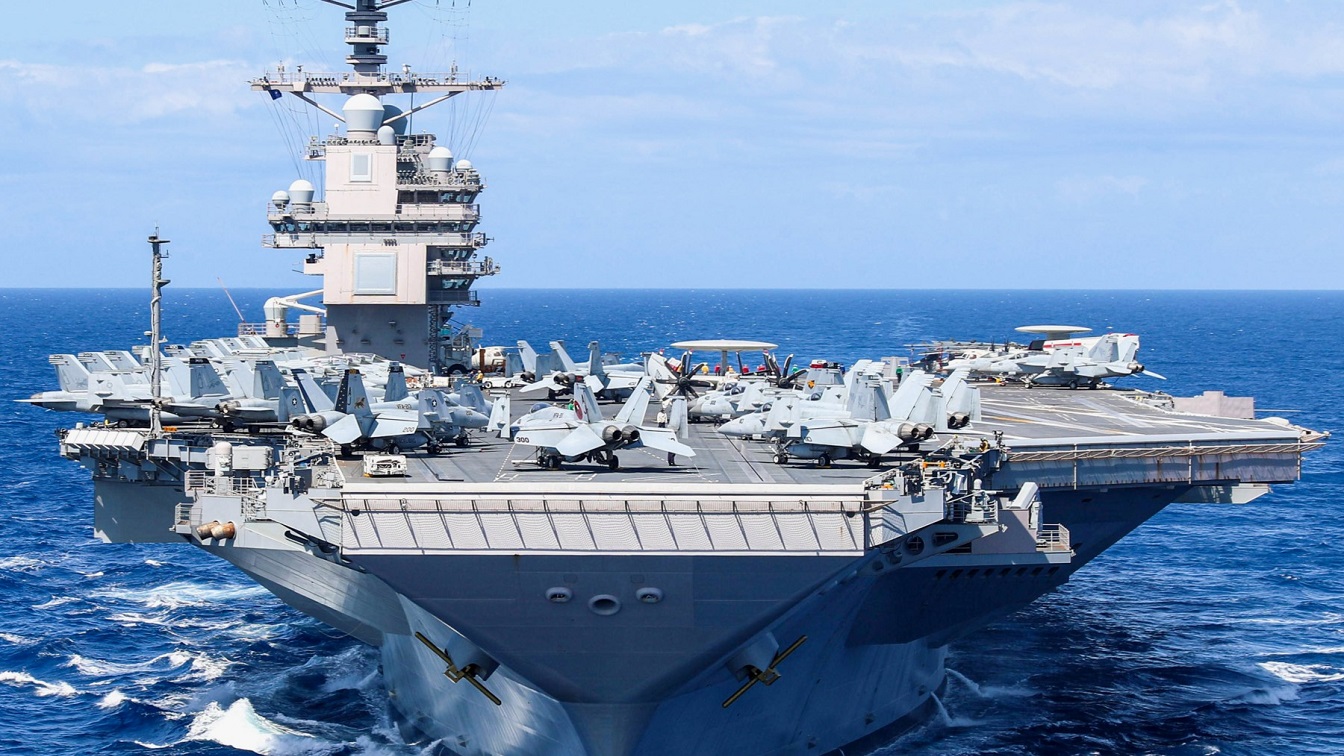
Ford-Class. Ford-Class Aircraft Carrier USS Ford.
China’s A2/AD environment will likely push carriers “back,” perhaps reducing the effectiveness of their air wing. And carriers, with dozens of aircraft, thousands of sailors, billions of dollars invested, and years of shipbuilding, represent arguably the “biggest” and most attractive target of any military asset on Earth.
But carriers aren’t just sitting ducks—they operate behind layered defenses, and they’re mobile. Identifying, tracking, and striking a carrier is much easier said than done.
But the cost of losing just one carrier would be a national catastrophe, which, in a heightened threat environment, would breed debate over whether the investment is still worthwhile.
What Ford Gets Right
While Ford’s problems are pronounced, the type gets certain things right, too, including increased electrical generation capacity, future compatibility with directed-energy weapons, reduced manpower over its lifecycle, improved sortie potential, and a long service life. Basically, the Ford was future-looking, designed for warfare in 2050, rather than 2020. So, the Ford may well prove to be worthwhile, just too far ahead of its time to be fully appreciated.
And strategically, the timing makes sense. The Nimitz is aging out, and a replacement will become necessary. No alternative platform matches Ford’s air wing flexibility, sustained power projection, and independent basing.
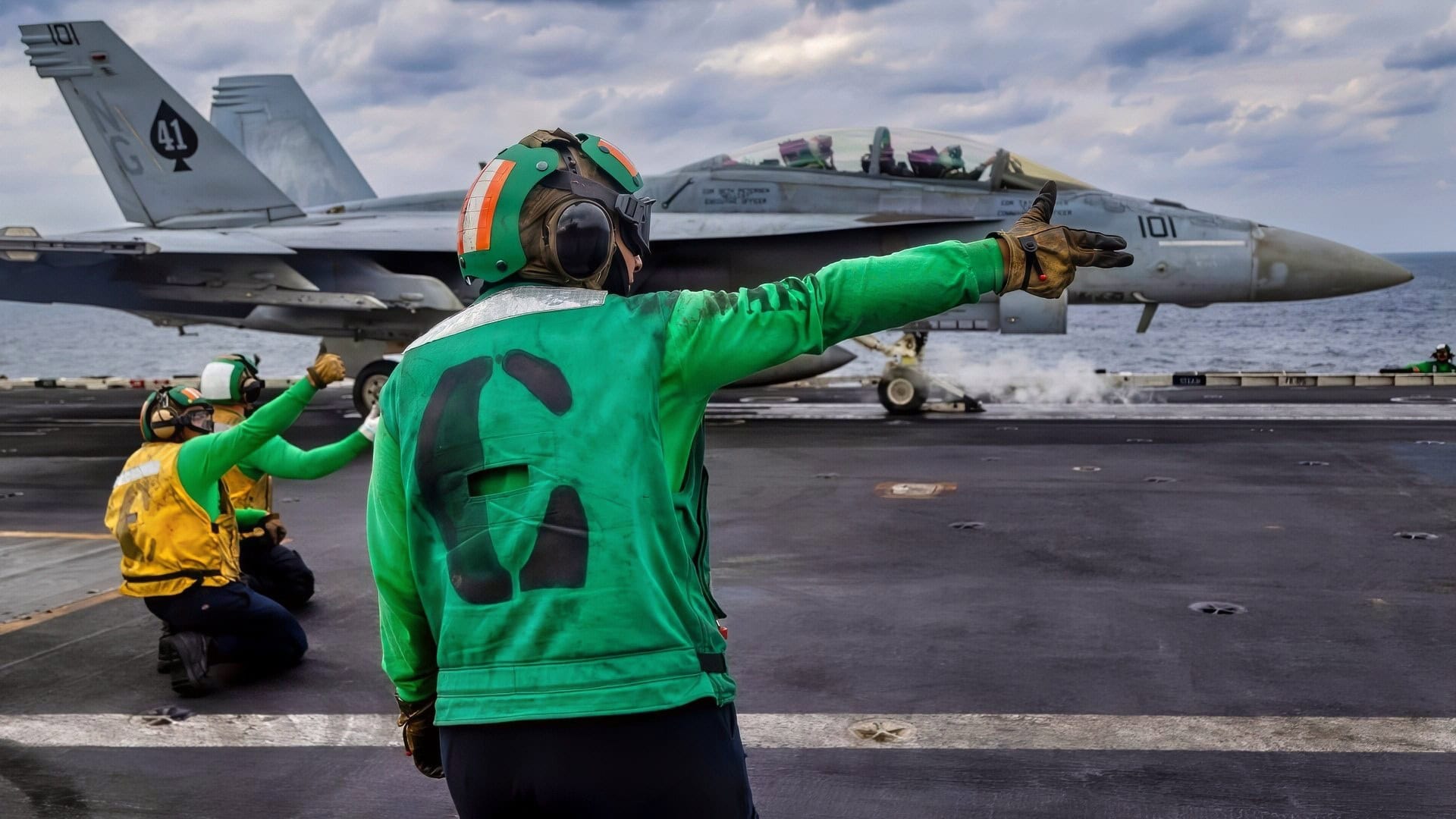
ARABIAN SEA (Jan. 28, 2026) An F/A-18F Super Hornet, attached to Strike Fighter Squadron (VFA) 41, prepares to launch from the flight deck of Nimitz-class aircraft carrier USS Abraham Lincoln (CVN 72) in the Arabian Sea, Jan. 28. Abraham Lincoln is deployed to the U.S. 5th Fleet area of operations to support maritime security and stability in the CENTCOM area of responsibility. (U.S. Navy photo by Mass Communication Specialist Seaman Zoe Simpson)
The question will remain whether the bundling of innovations was wise. But the Navy went big, and the growing pains have been real, but they could still prove worthwhile.
Either way, the Ford-class was not a disaster—it’s just that the rollout hasn’t been flawless.
And whenever one hundred billion dollars are invested in a program, you want it to be flawless.
About the Author: Harrison Kass
Harrison Kass is an attorney and journalist covering national security, technology, and politics. Previously, he was a political staffer and candidate, and a US Air Force pilot selectee. He holds a JD from the University of Oregon and a master’s in global journalism and international relations from NYU.