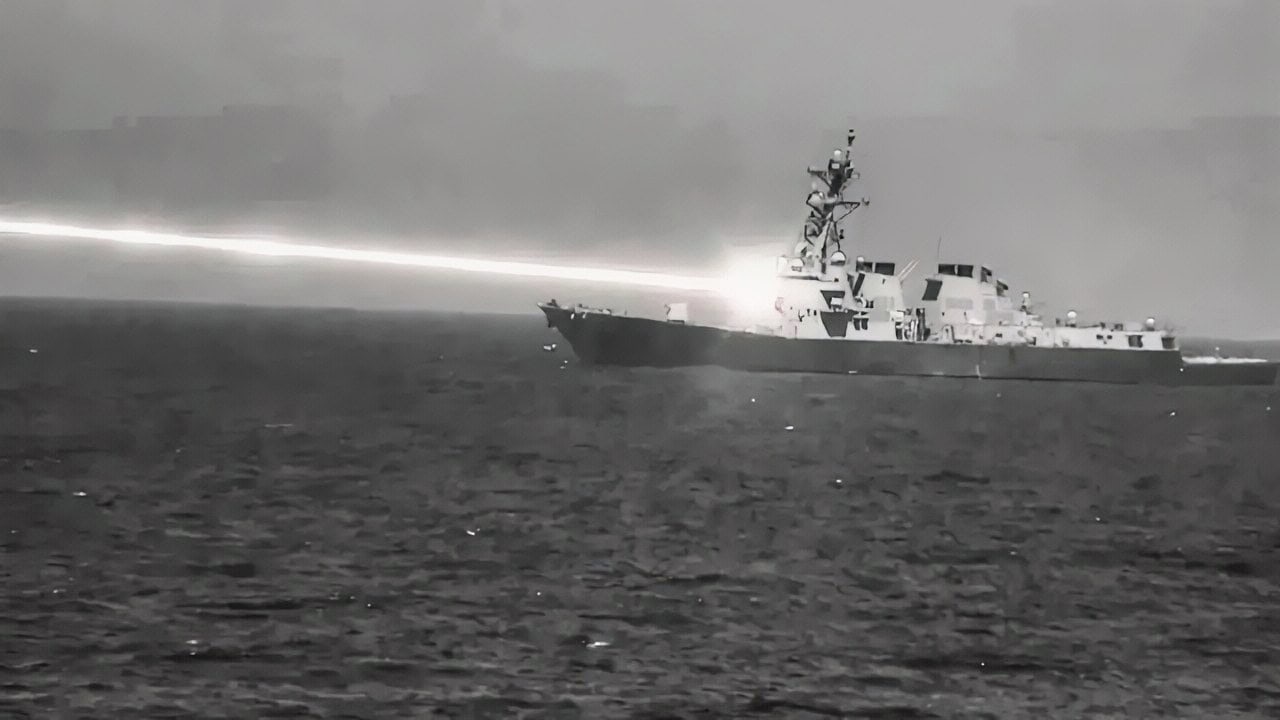
Summary and Key Points: The USS Preble has demonstrated a new layer of close-in defense by using the HELIOS shipboard laser to neutralize four uncrewed aerial vehicles during an at-sea counter-UAS exercise.
-Integrated into the Aegis Combat System, the 60-kilowatt-class HELIOS offers a way to conserve finite, expensive interceptors while adding an “effectively unlimited” magazine constrained mainly by ship power and cooling.
-The test is a proof point—but not a silver bullet: lasers remain single-target at a time, range-limited, and weather-sensitive. Even so, multi-target success signals directed energy is maturing into a practical supplement to missiles and guns.
US Navy’s ‘Amazing’ HELIOS Lasers Down 4 Drones
The U.S. Navy’s ship-mounted laser weapons program is moving full steam ahead, with the destroyer USS Preble having now neutralized four uncrewed aerial vehicles during an at-sea demonstration.
The test took place last year and has now been publicly disclosed by defense manufacturer Lockheed Martin.
The test involved the Arleigh Burke-class destroyer using its High-Energy Laser with Integrated Optical Dazzler and Surveillance (HELIOS) weapon during a counter-UAS exercise.
This was the first confirmed multi-target engagement using the system.

(May 21, 2020) The amphibious transport dock ship USS Portland (LPD 27) successfully tests a Solid State Laser – Technology Maturation Laser Weapon System Demonstrator (LWSD) Mark 2 MOD 0.The SSL-TM program builds upon the Office of Naval Research’s previous directed-energy developments, like the Laser Weapon System (LaWS), which was successfully tested at-sea aboard the Afloat Forward Staging Base (Interim) USS Ponce (ASB(I)) 15 in 2014. (U.S. Navy photo/Released)

211214-M-HB658-1322 GULF OF ADEN (Dec. 14, 2021) Amphibious transport dock ship USS Portland (LPD 27) conducts a high-energy laser weapon system demonstration on a static surface training target, Dec. 14, while sailing in the Gulf of Aden. During the demonstration, the Solid State Laser – Technology Maturation Laser Weapons System Demonstrator Mark 2 MOD 0 aboard Portland successfully engaged the training target. The photograph was captured utilizing a short wave infrared lens and optical filter. (U.S. Marine Corps photo by Staff Sgt. Donald Holbert)

211214-N-VQ947-1142 GULF OF ADEN (Dec. 14, 2021) — Amphibious transport dock ship USS Portland (LPD 27) conducts a high-energy laser weapon system demonstration on a static surface training target, Dec. 14, while sailing in the Gulf of Aden. During the demonstration, the Solid State Laser – Technology Maturation Laser Weapons System Demonstrator Mark 2 MOD 0 aboard Portland successfully engaged the training target. The photograph was captured utilizing a short wave infrared lens and optical filter. (U.S. Navy photo illustration by Mass Communication Specialist 2nd Class Devin Kates)
Per The War Zone, Lockheed Martin chief executive Jim Taiclet said the test made clear that the “amazing technology” of these lasers was able to assist ships in “successfully neutralizing” minor aerial threats, mitigating any need to use less plentiful (and more expensive) interceptor missiles.
HELIOS, designated Mk 5 Mod 0, is a 60-kilowatt-class laser that operates within the Aegis combat system.
The system has been installed on the Preble since 2022 and is among the most powerful lasers actively deployed on a U.S. Navy surface combatant. Other destroyers carry the lower-powered ODIN system, which is geared toward disrupting or blinding enemy sensors rather than physically obliterating them.
Missile-based point defence remains highly effective but expensive and finite. A single RIM-116 Rolling Airframe Missile costs a whopping $1 million, while systems such as the Phalanx Close-In Weapon System carry only seconds’ worth of ammunition at full rate of fire.
In prolonged or repeated engagements, those limits matter.
Lasers, by contrast, offer what Navy leaders increasingly describe as an effectively unlimited magazine, constrained mainly by power generation and cooling.
Chief of Naval Operations Adm. Daryl Caudle has gone further, arguing that directed energy should become the default solution for close-in defense. He has also spoken publicly about future ambitions, including megawatt-class lasers for next-generation surface combatants such as the planned Trump-class warships. Even before his confirmation, he stressed that laser technology was his “priority.”
But this hardly means there are no limitations; lasers must always be paired with other weapons.
The limitations are as follows: lasers can engage only one target at a time, and their effectiveness diminishes with distance.
They can also easily be compromised by weather conditions. While this recent HELIOS test is a big step forward, it is important to note that the Navy has not provided details on the system’s engagement ranges or speed.
For now, USS Preble remains a testbed rather than a template for future successes. But the successful engagement of multiple drones suggests that laser weapons are beginning to be used more often and more effectively, not as substitutes for missiles, but as an increasingly critical extra layer in naval air defence.
About the Author: Georgia Gilholy
Georgia Gilholy is a journalist based in the United Kingdom who has been published in Newsweek, The Times of Israel, and the Spectator. Gilholy writes about international politics, culture, and education. You can follow her on X: @llggeorgia.