
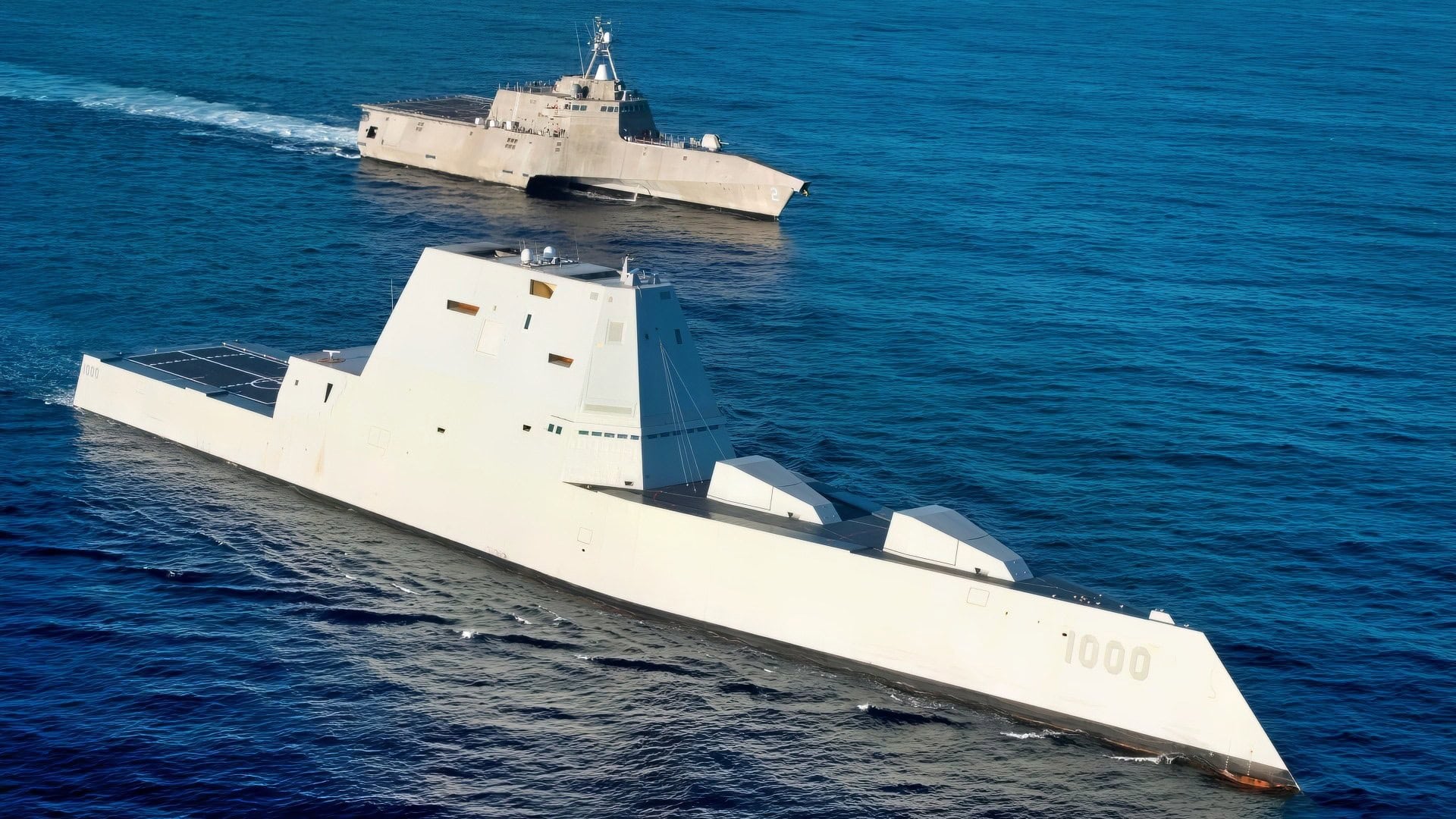
Summary and Key Points: At the Surface Navy Association symposium in January 2026, Daryl Caudle argued that future warships tied to Donald Trump’s “Golden Fleet” Trump-class battleship concept could field megawatt-class lasers and, potentially, high-power microwave systems.
-The logic is straightforward: point defense against drone swarms and saturation attacks cannot rely forever on expensive interceptors with finite magazines.
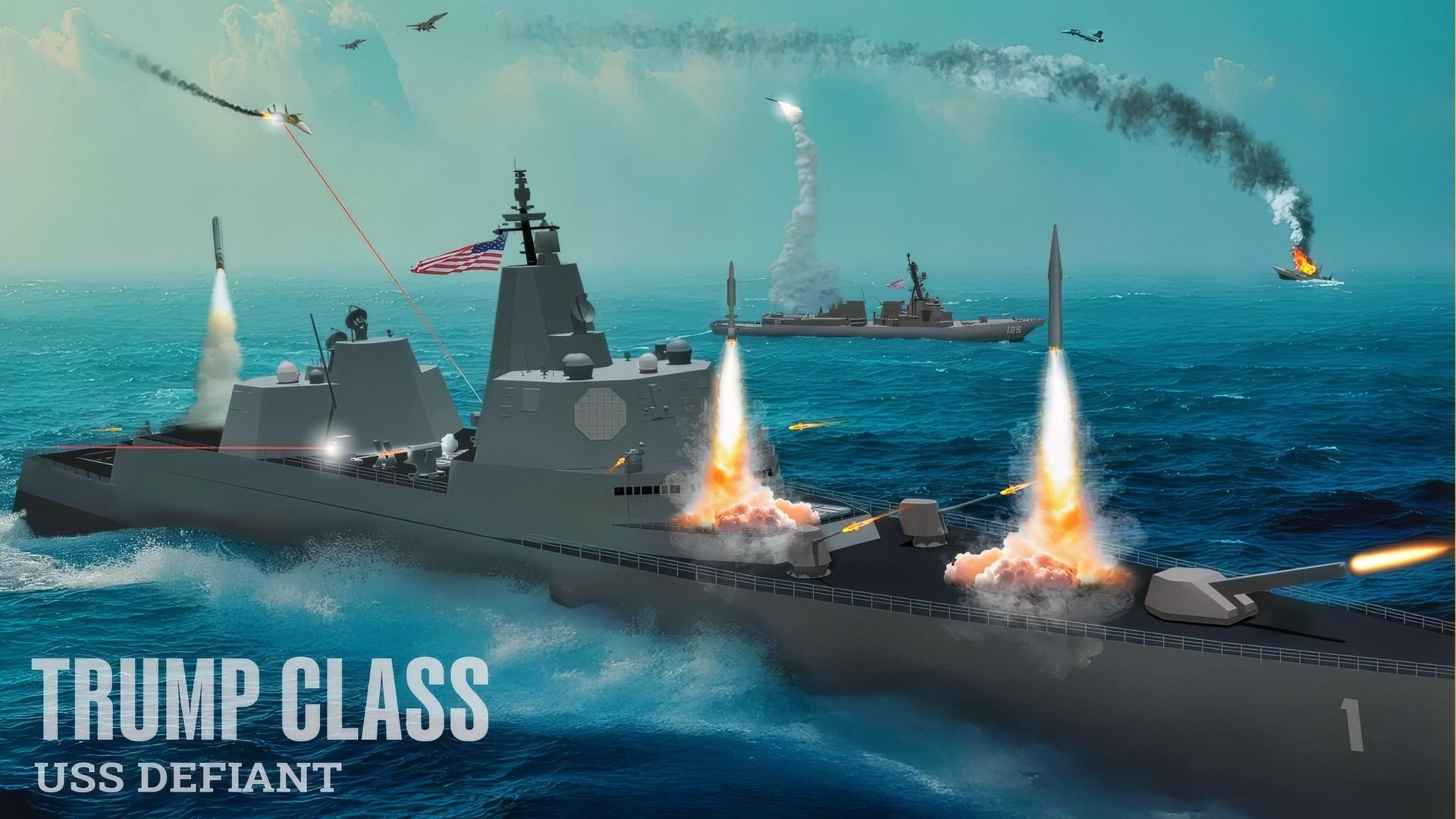
Trump-Class Battleship USS Defiant. Image Credit: Creative Commons.
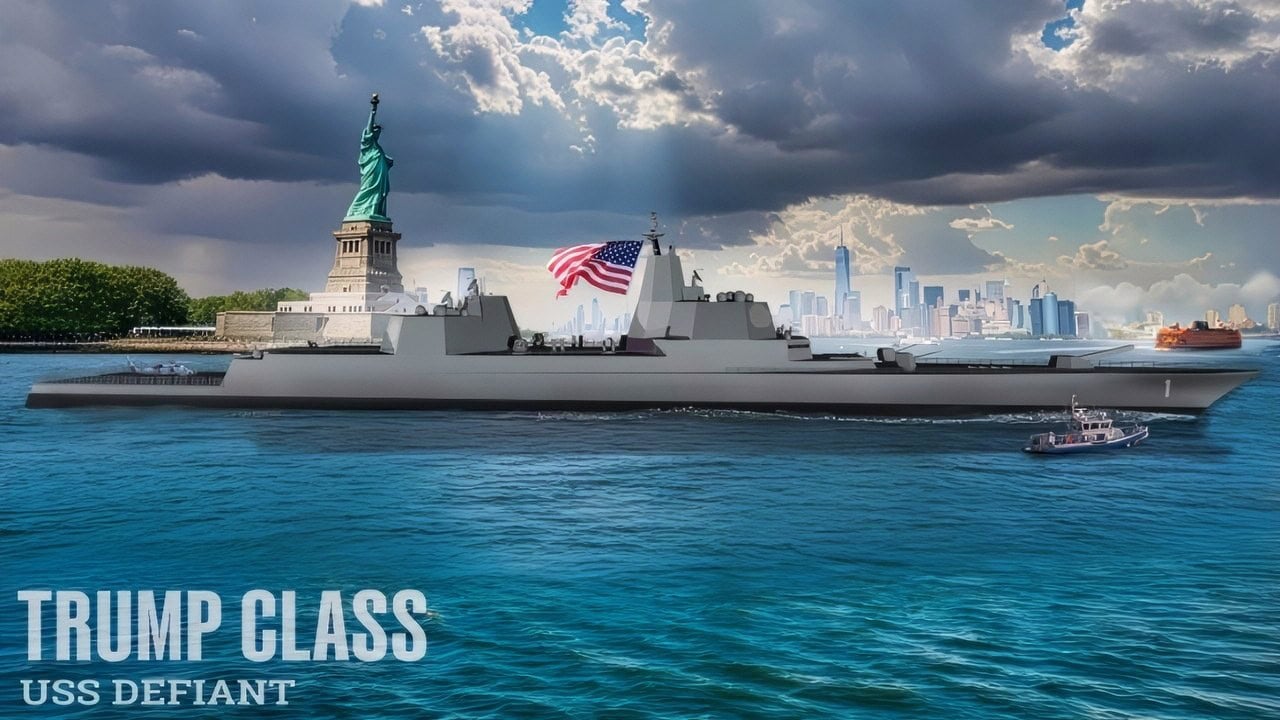
Trump-Class Battleship. Image Credit: Creative Commons/White House.
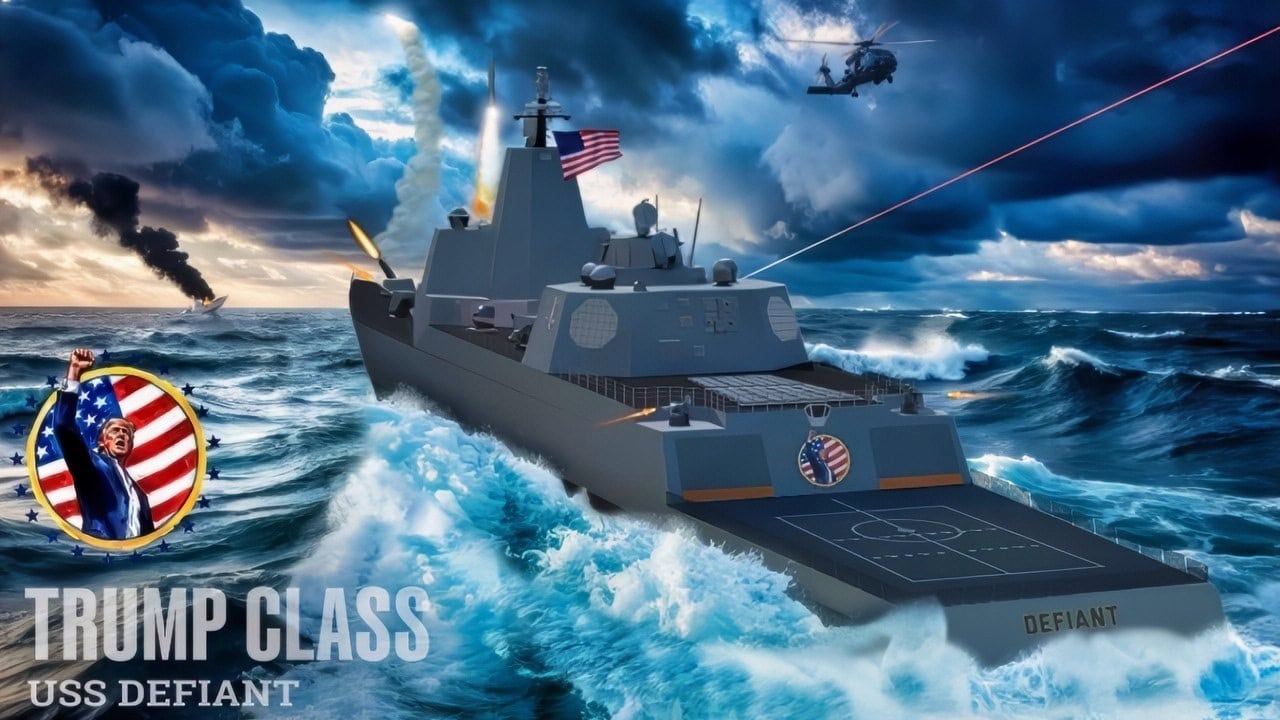
Trump-Class Battleship. Image Credit: Creative Commons/White House Photo.
-Directed energy offers precision engagement and an “infinite magazine” constrained mainly by shipboard power and cooling.
-But sea-based lasers face hard challenges—weather, salt spray, beam stability, and integration tradeoffs—making near-term feasibility the central question.
Trump-Class Battleships Could Get Lasers and High-Power Microwaves, Navy Chief Signals
Chief of Naval Operations Adm. Daryl Caudle has confirmed that directed energy weapons could be coming to Trump’s proposed “Golden Fleet” of Trump-class battleships.
Speaking during a roundtable at the Surface Navy Association’s (SNA) annual symposium in January 2026, Caudle argued that megawatt-class lasers could be included in future Trump-class warships, and revealed that the U.S. military is actively working on new systems that are designed to utilize high-power microwave.
The public comments come as the Navy continues to field early directed energy systems at sea while working to overcome several longstanding technical and environmental challenges.
If implemented, it would represent a dramatic doctrinal shift and equip the Trump-class vessels with the defense systems required to counter modern and emerging threats.
The vessels, which are expected to be equipped with hypersonic missiles and other traditional missile and gun systems, would also be able to counter high-end missiles and swarms of drones using laser systems that do not expend expensive interceptors.
These technologies are still in development, however, and everything from engineering realities to industrial capacity constraints means there are still many questions to be answered. But that being said, China is making progress on similar technologies, and other adversaries are leaning into new tactics that involve the rapid development of cheap drones – so sooner or later, the Trump-class ships, should they be realized, will need directed-energy weapons to stay relevant.
What Caudle Said
Speaking at the Symposium, Caudle explicitly stated that it is his “goal” to ensure that directed-energy weapons are included in the new class of ships.
“My thesis research at [the] Naval Post Graduate School was on directed energy and nuclear weapons,” Caudle told reporters. “This is my goal, if it’s in line of sight of a ship, that the first solution that we’re using is directed energy.”
Caudle also said that directed-energy systems are inevitable, arguing that “point defense needs to shift to directed energy” because it has an “infinite magazine.”
A move to directed-energy systems would not only make it easier to counter cheap drones designed to saturate air defenses and force adversaries to expend expensive interceptors, but also make it cheaper and easier to counter high-end threats.
Currently, U.S. surface combatants rely on kinetic warfare to defend themselves, using a combination of Mk 15 Phalanx close-in weapons systems and missiles such as the Rolling Airframe Missile (RAM).

The Iowa-class battleship USS New Jersey fires at positions near Beirut on 9 January 1984 during the Lebanese Civil War.
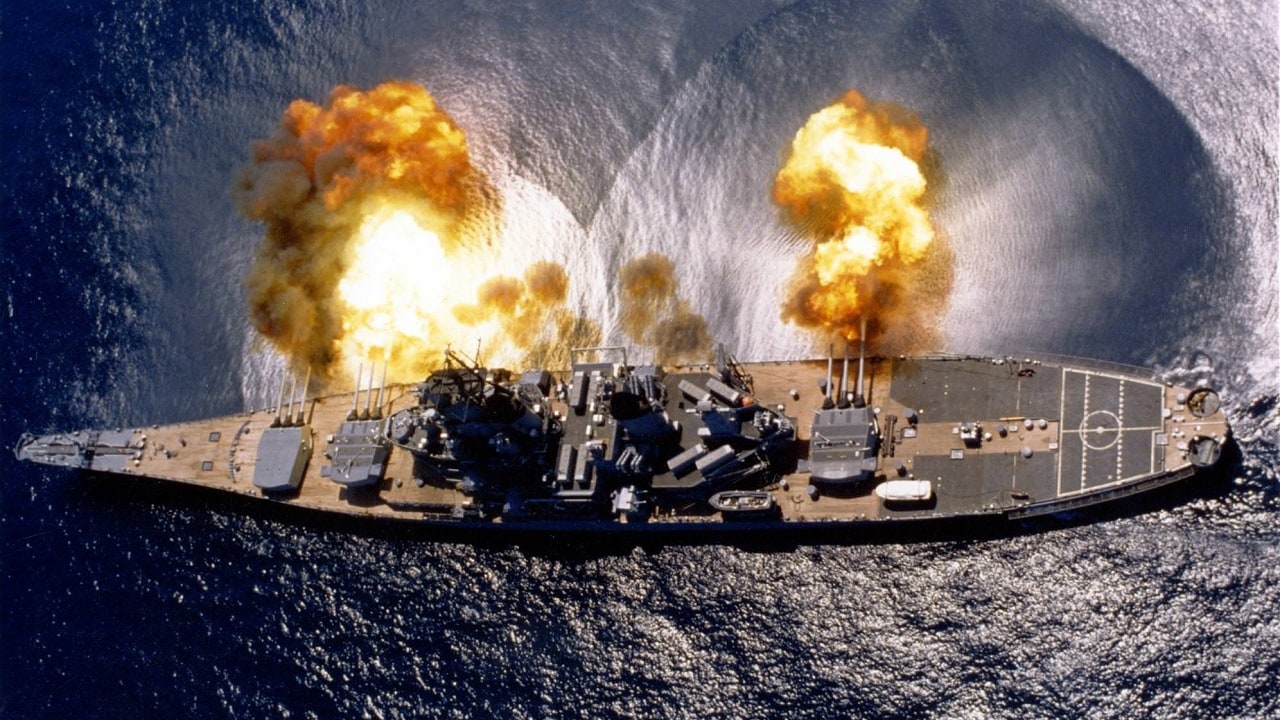
Iowa-class battleship firing a broadside. Image Credit: Creative Commons.
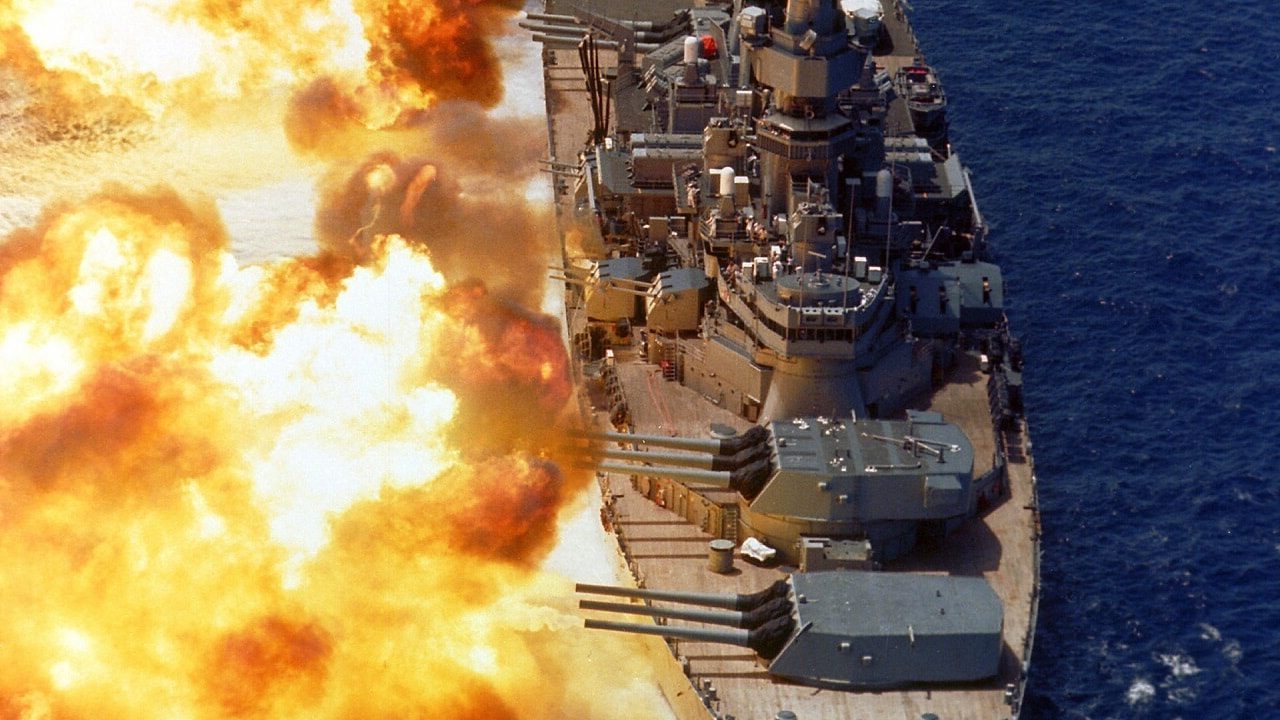
Iowa-class battleship firing off a broadside.
Directed energy, by contrast, does not require vessels to store large quantities of a finite resource like missiles, meaning future ships might only need to worry about ensuring their onboard power systems can generate the energy needed to fire them.
The Navy already fields two types of shipboard lasers: the High Energy Laser with Integrated Optical Dazzler and Surveillance (HELIOS) and the Optical Dazzling Interdictor (ODIN) on Arleigh Burke-class destroyers.
Scaling Up: What Lasers Can and Can’t Do at Sea
Directed-energy weapons appear to be an obvious solution for modern maritime combat, but they have limitations. Hard physics and engineering constraints are the primary reasons those weapons have not already been fielded at scale.
First, lasers require huge quantities of electrical power and cooling capacity to sustain engagements. Firing one shot is one thing, but doing so repeatedly and for extended periods requires significant energy, coordination, and cooling capacity. While future Trump-class ships – which Navy documents have indicated will be large enough to host nuclear propulsion systems – might be able to cope with the power demands, integrating the systems will still be a challenge.
And then there are the environmental issues: water vapor, salt spray, distance, and atmospheric turbulence all make it difficult to fire a beam directly at a moving target. To remain effective, the beam’s intensity needs to be preserved so that it can cause damage when it reaches a target. Consider the fact that ships are always moving, too, and it’s clear why lasers pose more of a risk than anything when not combined with advanced systems designed to keep the beam steady.
We are closer than ever to fielding this technology, but it will still be a challenge. Long-range and anti-missile laser weapons have been part of the Pentagon’s vision for maritime warfare for decades – since the 1980s, in fact – but only now are we seeing the kind of technological progress required to ensure that the lasers (which have long been technically possible to generate) are usable at scale.
What Adversaries Are Doing
The U.S. is not alone in pursuing these kinds of weapons. China has publicly unveiled its efforts, including the Liaoyuan-1 (LY-1) high-energy laser weapon,at the People’s Liberation Army’s 2025 Victory Day parade. The weapon is said to be capable of countering drones and missiles.
Meanwhile, Japan has also installed a 100-kilowatt laser weapon on a destroyer, designed to engage drones and small threats.
The U.S. is not the only country seeking to use these technologies, and the Trump-class battleships are arguably the best chance to field them in the near future. If the Navy cannot make directed-energy weapons work at sea within the next decade, another force will – and large surface combatants like the Trump-class will quickly look outdated.
About the Author:
Jack Buckby is a British researcher and analyst specialising in defence and national security, based in New York. His work focuses on military capability, procurement, and strategic competition, producing and editing analysis for policy and defence audiences. He brings extensive editorial experience, with a career output spanning over 1,000 articles at 19FortyFive and National Security Journal, and has previously authored books and papers on extremism and deradicalisation.