
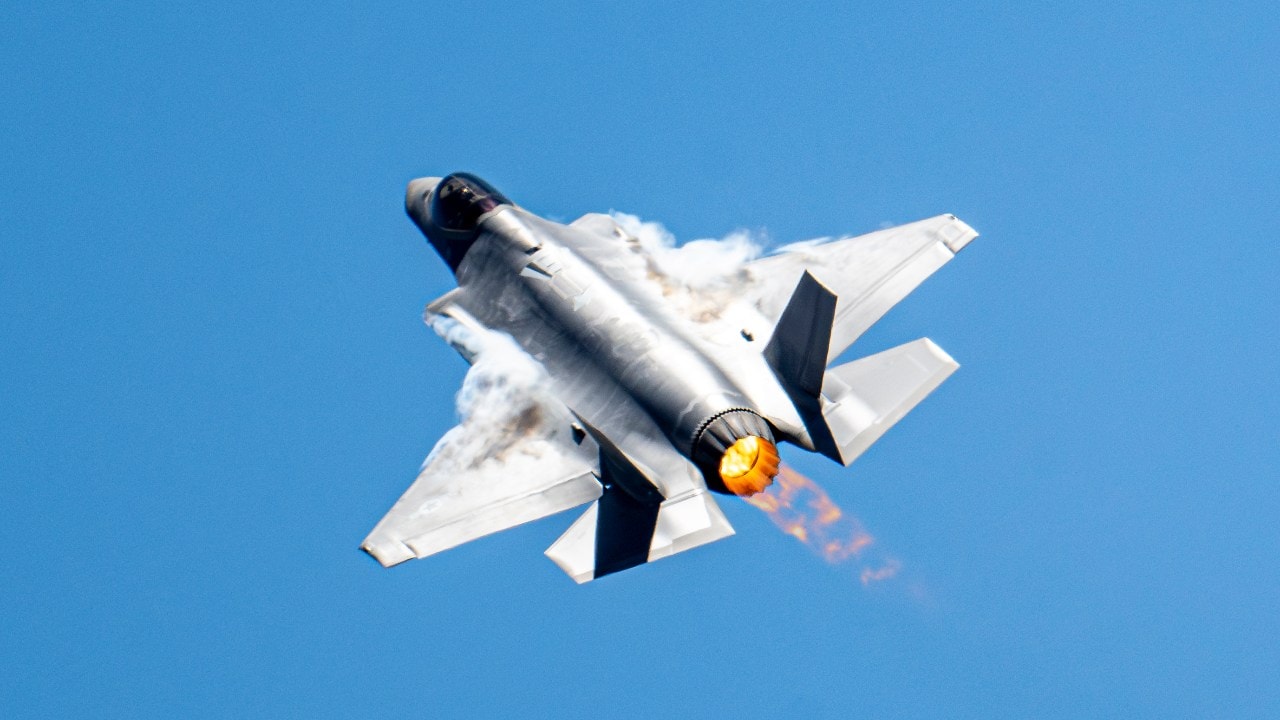
Summary and Key Points: The F-35 program has entered a high-stakes “radar gap” as Lot 17 aircraft are delivered to the U.S. military without their primary sensors.
-Due to technical delays with the next-generation AN/APG-85 GaN radar and physical incompatibility with the older APG-81 mounts, these jets are currently flying with ballast plates to maintain balance.
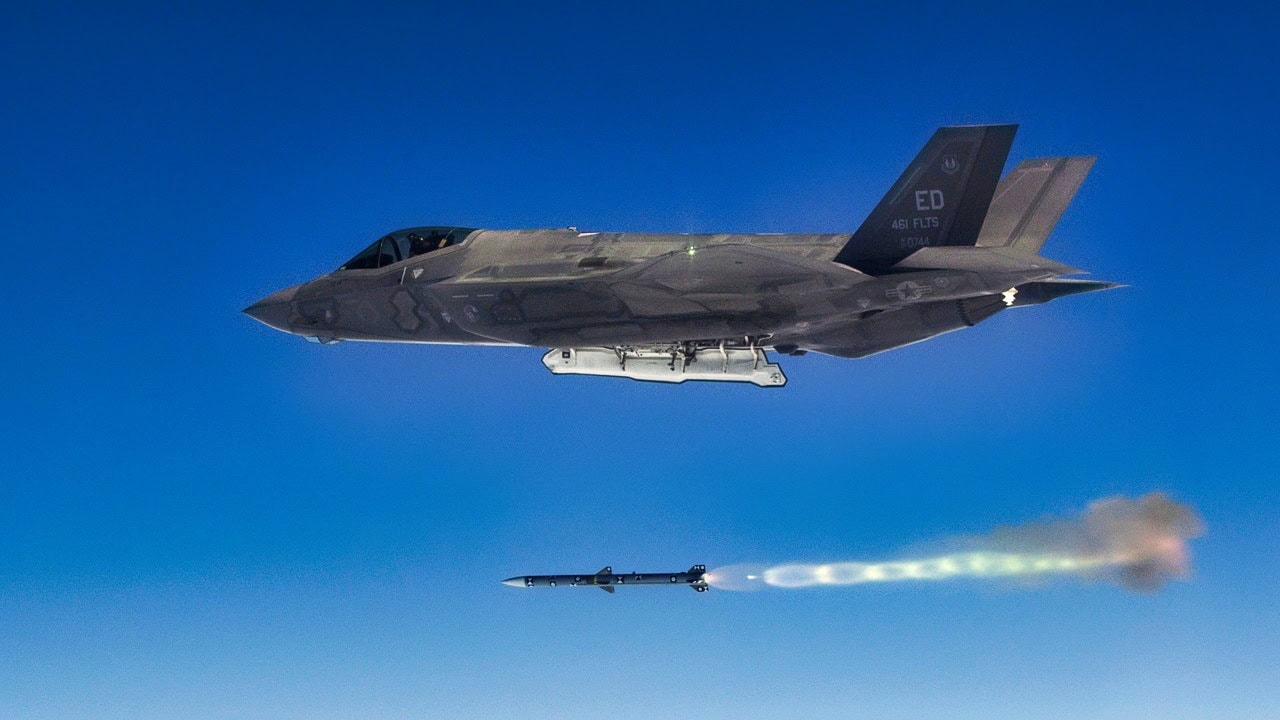
An Edwards AFB F-35A Lightning II fires an AIM-120 Advanced Medium-Range Air-to-Air Missile as part of Weapons Delivery Accuracy testing. The 461st Flight Test Squadron and F-35 Integrated Test Force completed WDA testing in early December, which concludes a large and important part of F-35 developmental test and evaluation. (Courtesy photo by Chad Bellay/Lockheed Martin)
-While the Air Force is mitigating this by networking “radarless” jets with fully equipped ones, experts warn that this reliance on data-linking is a risky stopgap.
-A permanent fix—a universal forward fuselage redesign—is not expected to reach the fleet until Lot 20 in 2027.
F-35s Being Delivered Without Radars? Say It Ain’t So
The United States may have been delivering F-35 Lightning II aircraft without their intended AN/APG-85 radar systems due to persisting issues in the upgrade program.
Defense Daily first reported in June of 2025 that F-35s were being delivered without radar. Instead, ballast is being installed in the nose cones.
TWZ reported that foreign customers purchasing F-35s with the AN/APG-81 radar have not been affected by this latest development.
“F-35 Lightning II aircraft are being built to accommodate the F-35 advanced radar (APG-85) for the U.S. Air Force, Navy, and Marine Corps,” a spokesperson for the F-35 Joint Program Office (JPO) told TWZ.
“Initial fielding for some F-35 aircraft is planned for Lot 17, which began delivery in 2025 and continues through September 2026.”
“Due to program security reasons, we are protecting any additional information with enhanced security measures.”
The issue stems from the components’ physical incompatibility. The latest production batches of F-35s (starting with Lot 17) are structurally prepared for the AN/APG-85 gallium nitride (GaN) radar. The issues with the AN/APG-85 radars are due to cooling and power consumption challenges.
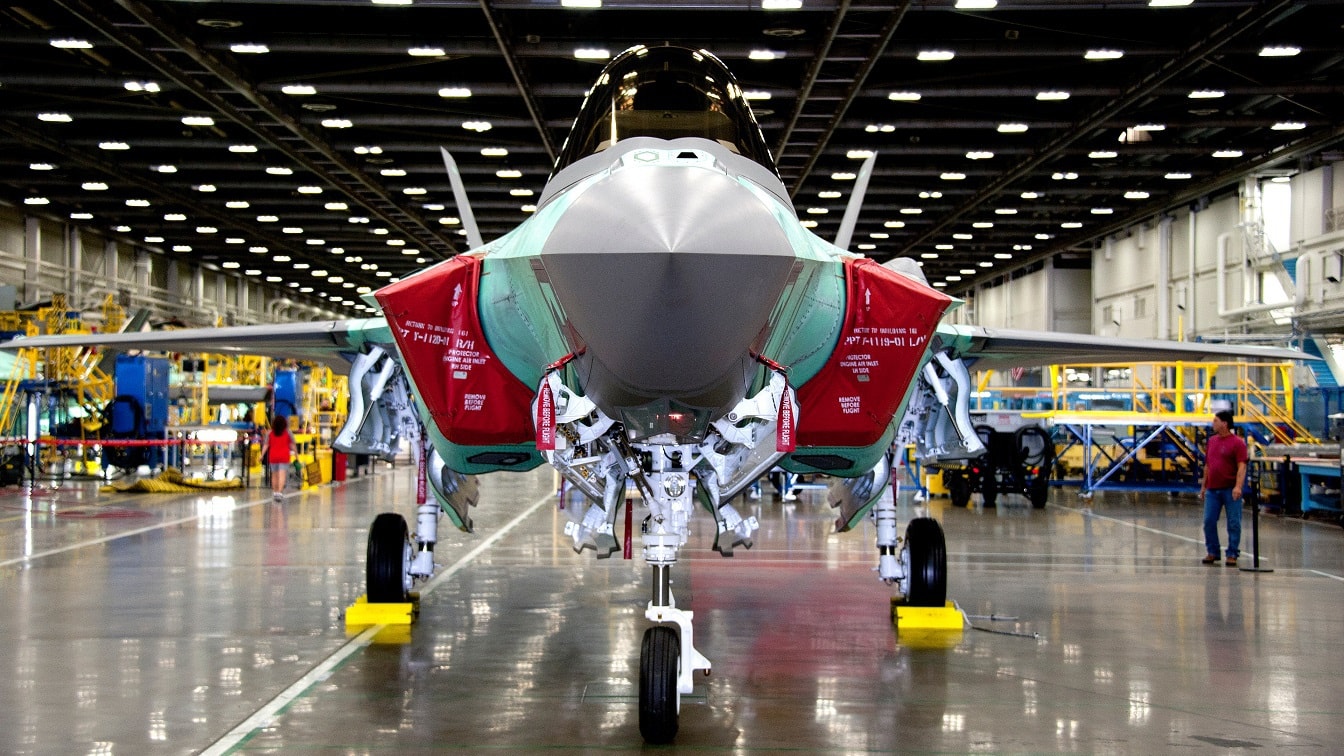
F-35A Joint Strike Fighter. Image Credit: Lockheed Martin.
Without the radar installed, the aircraft are not aerodynamically balanced, so ballast, in the form of weight plates, is being installed.
A Two-Year Wait Is Impending
This issue reportedly will not be resolved until Lot 20 of the F-35 is delivered in two years.
“The APG-81 is different than the APG-85, and therefore delivering the aircraft, as currently configured, with an APG-85 radar versus an APG-81 radar is challenging,” Rep. Rob Wittman (R-VA), one of the House’s overseers of the program, said in an interview on February 3.
“The bulkhead configuration is key because for both of the radars, they are very different,” he said. “Remember, the bulkhead configuration allows the placement of the radar towards the attitude of the array, and the attitude of the array makes all the difference in the world about how the radar operates.”
“I know all about it, but the delivery of the aircraft is classified,” Wittman added. “I can’t speak to the condition of the aircraft, so you’ll have to go to the Air Force, the customer, and ask them about that,” he said when asked if he knew that Lockheed Martin had been delivering unfinished F-35s since June.
Wittman, the chairman of the House Armed Services Committee’s Tactical Air and Land Forces panel, has been closely following the F-35 program and the contractor team since the fall of 2024 concerning the delays in the delivery of the APG-85, including what he said have been monthly phone calls since then with the head of the F-35 program executive office.
The APG-85 is designed to deny adversaries use of the electromagnetic spectrum and to enable improved weapons accuracy and targeting of adversary airborne and surface radars at greater ranges.

F-35A. Image Credit: Creative Commons.
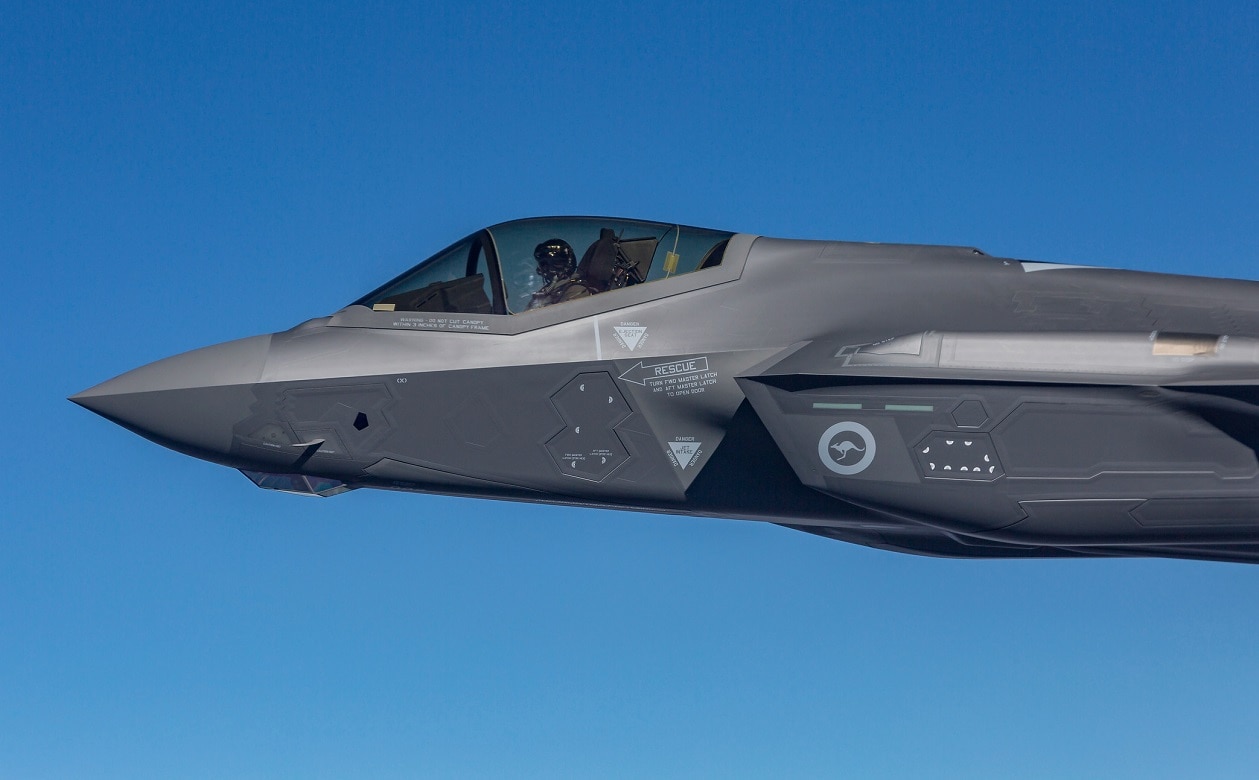
One of Australia’s first two F-35A aircraft commences its journey home from Luke Air Base Arizona, on 3 December, 2018.
“It’s an incredibly advanced radar,” Wittman added. “The arrays on it give it much more power, which is why we have to upgrade the engine. We need about 82 kilowatts of power versus what it’s producing right now. The APG-85 is key to Block 4, and it’s key to TR-3 software upgrade capabilities and integration with the imaging system, the Distributed Aperture System.”
AN/APG-85 Radar
The Northrop Grumman AN/APG-85 is a next-generation, Active Electronically Scanned Array (AESA) radar designed for all Lockheed Martin F-35 Lightning II variants, beginning with Lot 17 production.
Utilizing gallium nitride (GaN) for increased power and range, it offers advanced, high-resolution air-to-air and air-to-ground capabilities to combat modern, evolving threats. Due to development and technology delays, some F-35s are being delivered without it.
The AN/APG-85 is a new fire-control radar operating in the Ku band (IEEE designation) or the J band (NATO designation) for the F-35 Lightning stealth multi-role fighter aircraft.
The active phased-array antenna has a diameter of 73.5 cm and comprises more than 2,400 transmit/receive modules using gallium nitride (GaN) technology. This technology enables higher transmitter pulse power.
In air-to-air mode, the AN/APG-85 provides long-range detection and tracking of air targets, including aircraft, missiles, and unmanned aerial vehicles (UAVs). In air-to-ground mode, the radar provides high-resolution imaging of ground targets, including enemy installations, vehicles, and other targets of interest.
The high-resolution SAR imaging capabilities of the AN/APG-85 are particularly useful for reconnaissance missions, providing detailed images of targets for further analysis.
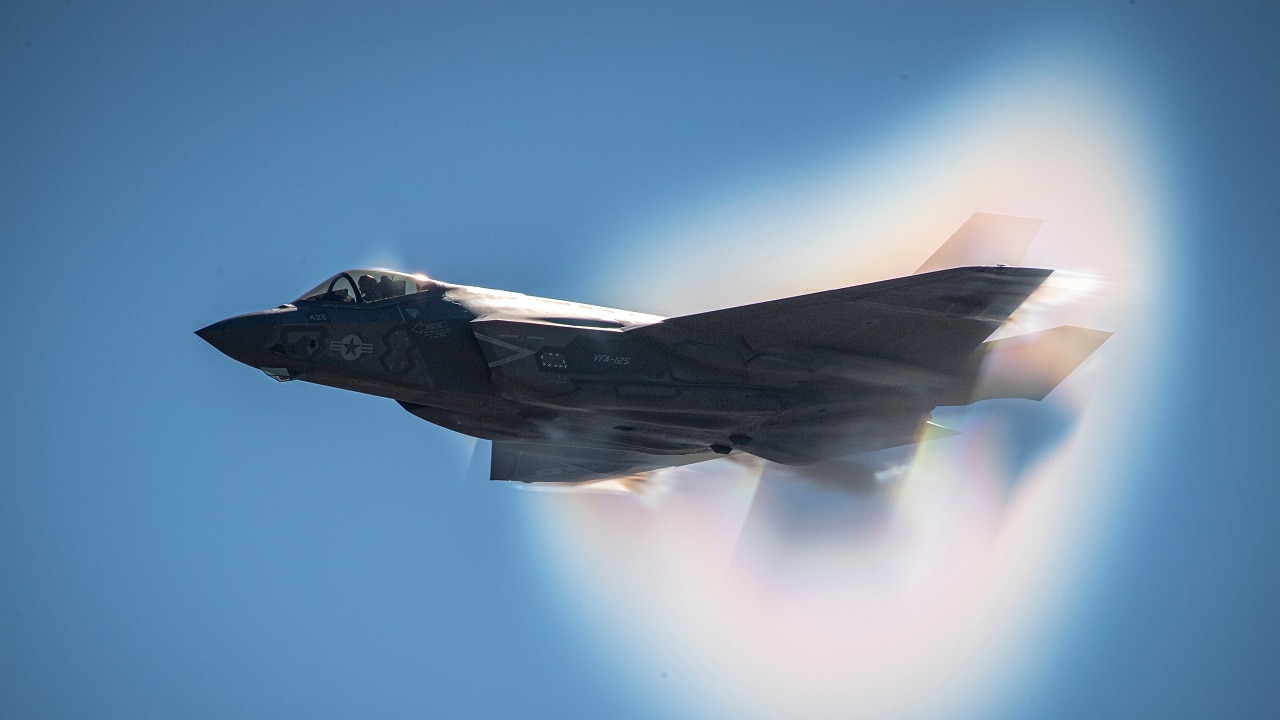
A U.S. Navy F-35C Lightning II fighter jet performs during the California International Air Show in Salinas, California, Oct. 29, 2021. The F-35C has a larger wingspan and internal fuel capacity as well as stronger landing gear than the F-35A and F-35B variants. (U.S. Air Force photo by Staff Sgt. Andrew D. Sarver)
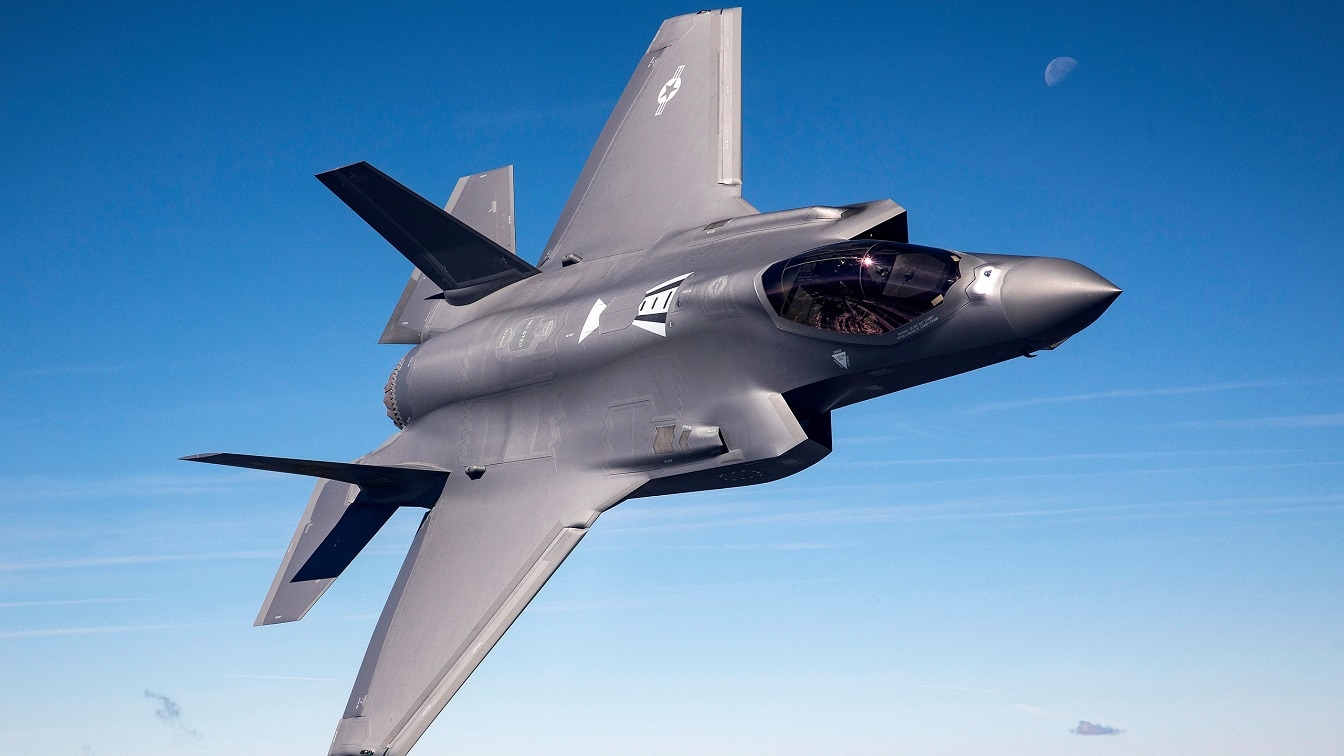
F-35A Joint Strike Fighter. Image Credit: Creative Commons.
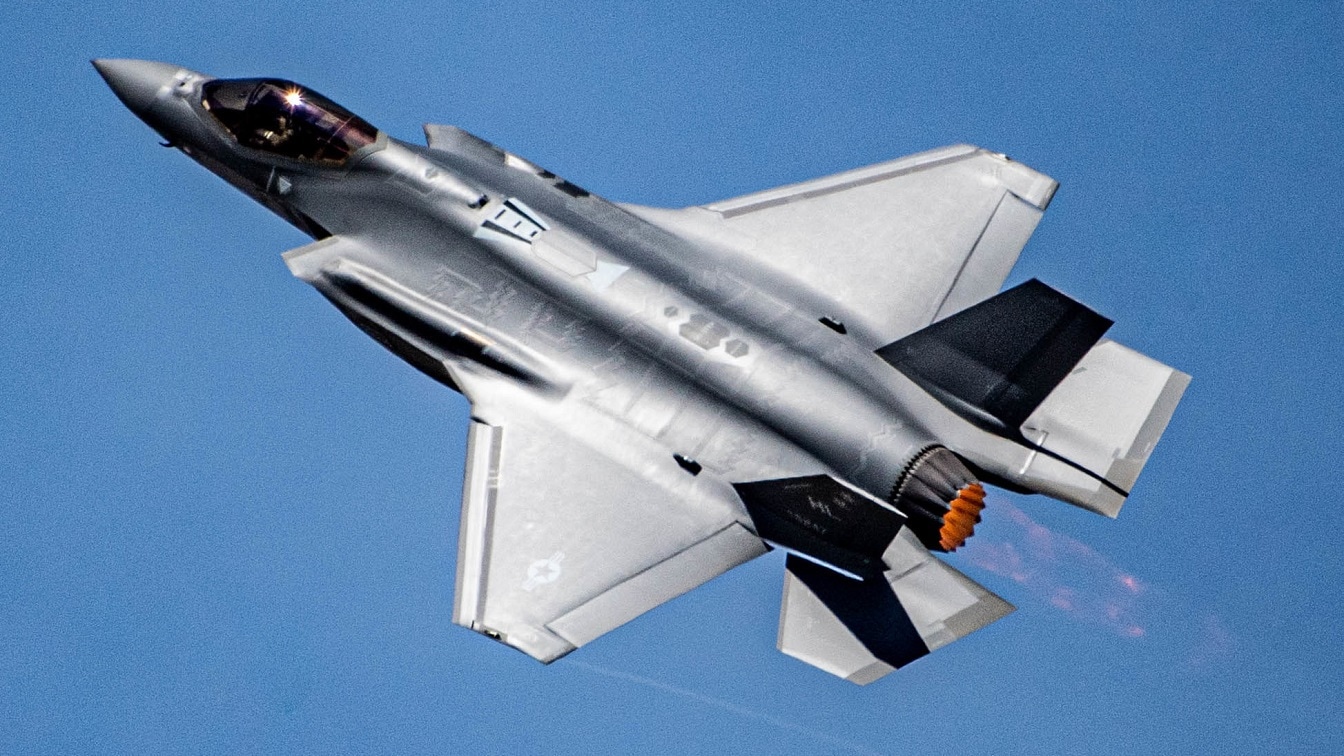
U.S. Air Force Maj. Kristin Wolfe performs a demonstration in the F-35A Lightning II during at the Reno Air Races in Reno, Nevada, September 19, 2021. The F-35 Lightning II Demonstration Team is based out of Hill Air Force Base, Utah. (U.S. Air Force photo by Tech. Sgt. Nicolas Myers)
The new radar offers a 50 percent improvement in range over its predecessor, the AN/APG-81, which is what current F-35 fighters are equipped with.
Northrop Grumman announced the first AN/APG-85 radar prototype in January 2023. The radar is designed to provide unprecedented situational awareness and could be operational by 2030.
However, this radar became too large for the F-35’s characteristic nose radome, so Lockheed must redesign the aircraft’s front fuselage to accommodate it.
F-35 Radar Drama Explained
The F-35 aircraft produced from 2025 onward were expected to be equipped with the state-of-the-art AN/APG-85 radar according to the Air Force and Lockheed Martin’s plans.
However, persistent technical delays and supply chain issues have pushed the radar’s availability from Lot 17 to at least Lot 20, with Lot 20 now expected to be delivered in 2027.
According to industry reporting, the legacy AN/APG-81 radar—still used on export aircraft—requires a fundamentally different mounting system and cannot be easily installed on airframes prepared for the newer radar. As a result, US Air Force jets delivered since June 2025 have arrived without any radar installed.
Radarless F-35 Fighters are Reality for the U.S. Air Force
The Clash Report reported that the Air Force is employing radarless F-35s alongside fully functional ones equipped with the AN/APG-81 radar, relying on the aircraft’s advanced data-sharing and network-centric capabilities to receive targeting and situational awareness information from other aircraft.
While this practice is a less-than-ideal solution in peacetime, if the US were to enter a high-intensity conflict with one of its enemies, it could have catastrophic consequences.
The survivability and combat effectiveness of a radarless Lightning II would be significantly degraded.
Lockheed Martin has already proposed developing a new fuselage that could accommodate both new and old radars. While this has its advantages, implementing such a project, re-certification, and production launch would take time. And, no doubt, that project would inevitably face delays.
Lockheed Martin CEO Jim Taiclet, back on March 21, 2025, warned of “risks” to the APG-85 schedule and declared, “We are taking proactive steps to create viable options for Lot 20 aircraft if necessary,” signaling a forward fuselage redesign effort intended to standardize a “common long-lead structure” to mitigate future bottlenecks.
About the Author: Steve Balestrieri
Steve Balestrieri is a National Security Columnist. He served as a US Army Special Forces NCO and Warrant Officer. In addition to writing on defense, he covers the NFL for PatsFans.com and is a member of the Pro Football Writers of America (PFWA). His work was regularly featured in many military publications.