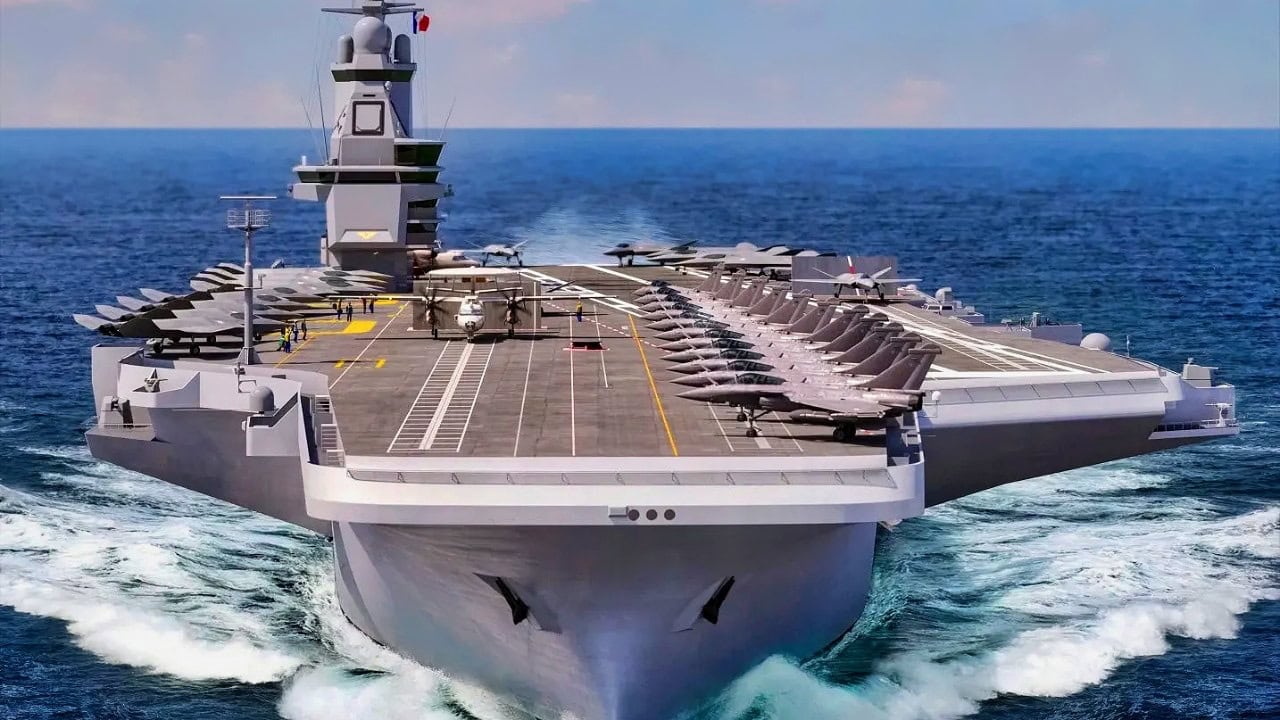
Summary and Key Points: National security editor Brandon J. Weichert evaluates France’s $12 billion Porte-Avions de Nouvelle Génération (PANG) program, recently christened France Libre. Slated for 2038, this 78,000-ton nuclear-powered supercarrier is designed to replace the aging Charles de Gaulle and secure French strategic autonomy in an “era of predators.”
-However, Weichert dismisses the project as a “boondoggle” and an “illusion of grandeur.”
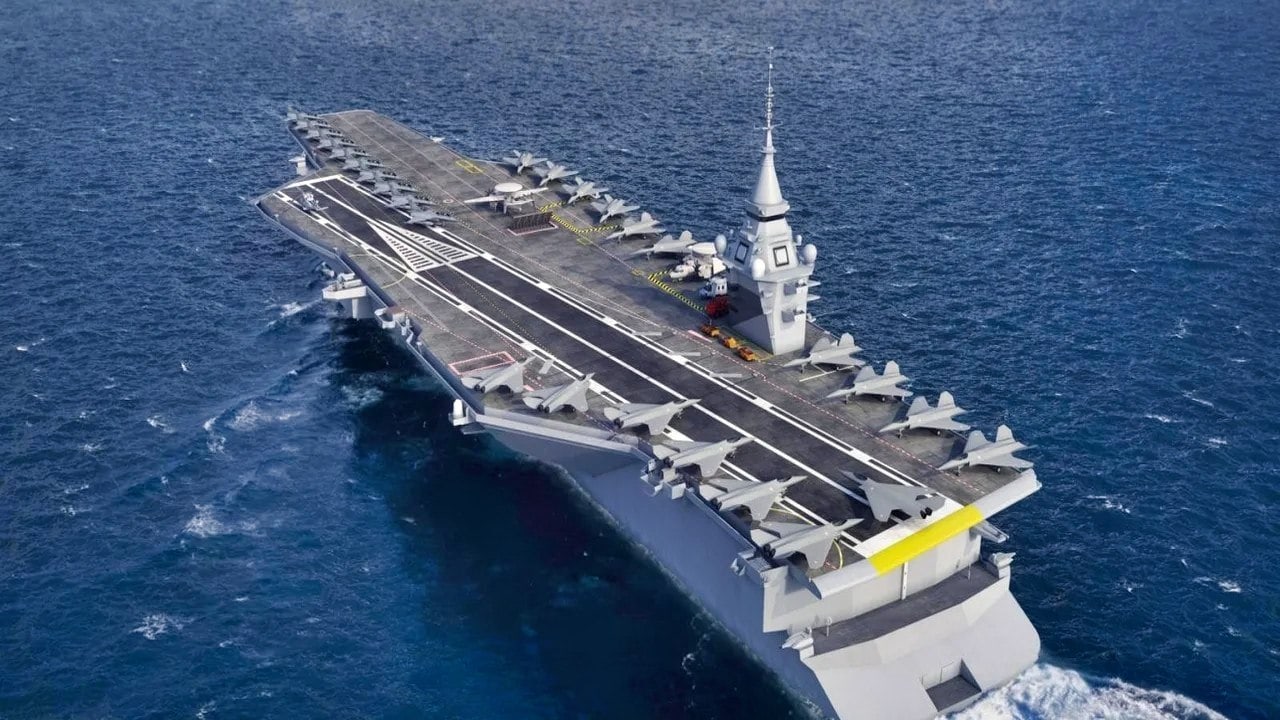
PANG Aircraft Carrier from France. Image Credit: French Navy.
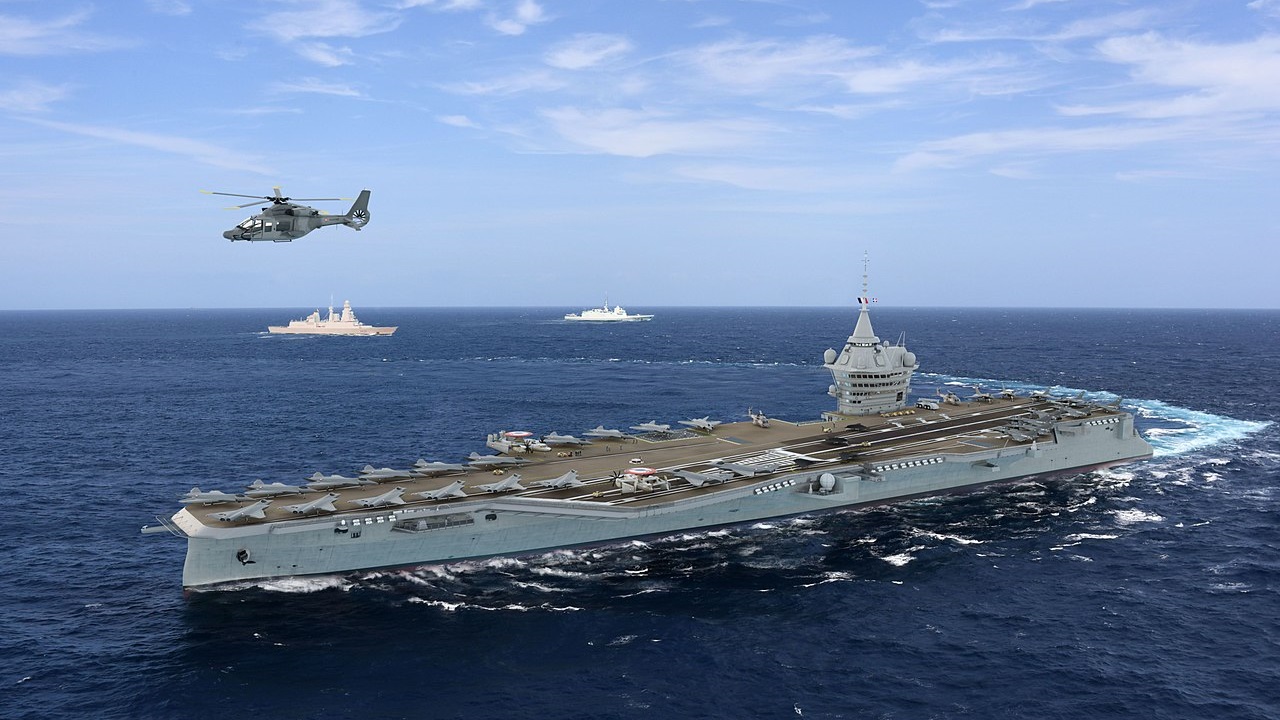
PANG Aircraft Carrier. Image Credit: Creative Commons.
-He argues that the massive expenditure overburdens France’s $74.8 billion defense budget, diverting critical funds from drones and missiles needed for modern Ukraine-style attrition warfare.
-Ultimately, the PANG represents an outdated 1990s power-projection strategy.
The $12 Billion Illusion: Why Critics Call France’s PANG New Supercarrier a “Boondoggle”
France continues to believe it is a great power on the world stage.
As an outgrowth of this misconception, Paris is spending $12 billion to build a new 78,000-ton aircraft carrier. The Porte-Avions Nouvelle Génération (PANG) nuclear-powered carrier will bear the name France Libre (Free France).
It will be the largest warship ever built in Europe and is slated for deployment by 2038.
France’s $12 Billion Illusion of Grandeur
Since Donald Trump’s election as U.S. president, France and other countries have begun to reassess their commitment to the U.S.-led global alliance structure that has dominated the world since at least the end of the Cold War.
Paris no longer sees Washington as consistently aligned with its interests and is seeking strategic leverage of its own.
France has Europe’s most powerful continental military, so Paris is working to enhance that power and showcase France’s independence and unique military capabilities.
Why Paris No Longer Trusts the US Security Umbrella
Currently, France is the only nuclear power in the European Union. That capability is independent of NATO. Indeed, in the 1960s, Paris briefly separated its command structure from NATO’s, largely because France wanted to create its own nuclear weapons force.
The extravagant PANG platform is a demonstration of France’s aspiration to be a great power. It will be a “60-strikes-a-day supercarrier,” according to a blaring headline in UNITED24 Media.
Nuclear Weapons, NATO, and France’s Obsession with Independence
French President Emmanuel Macron described the future supercarrier as being “essential in an era of predators,” Le Monde reported.
Currently, France maintains one aging aircraft carrier, the Charles de Gaulle. When that carrier is down for maintenance, the French Navy has no carrier capability. The PANG would help provide uninterrupted carrier capability and nuclear deterrence and will be capable of conducting expeditionary operations.
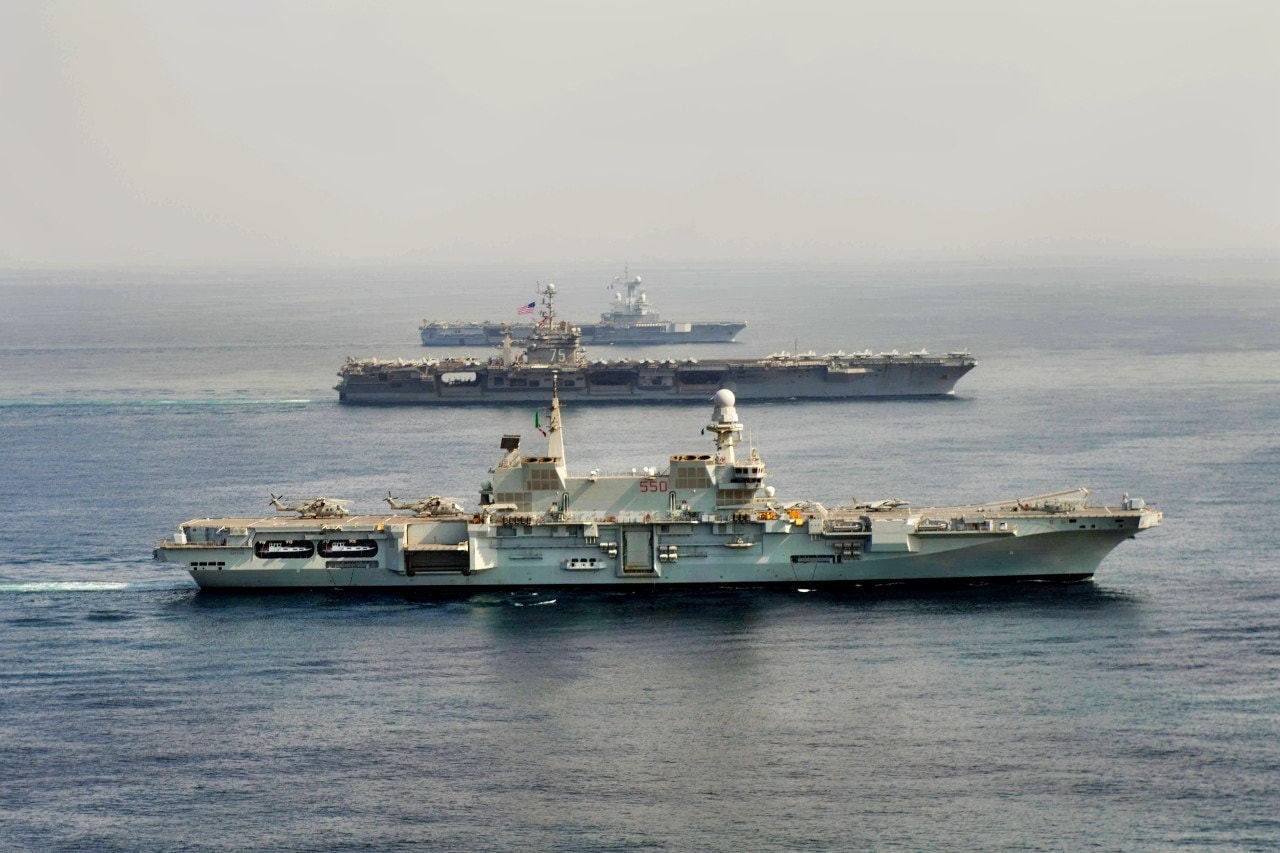
(Jan. 3, 2014) The Italian navy aircraft carrier ITS Cavour (CVH 550), front, the aircraft carrier USS Harry S. Truman (CVN 75) and the French navy aircraft carrier Charles de Gaulle (R 91), conduct operations in the Gulf of Oman. Harry S. Truman, flagship for the Harry S. Truman Carrier Strike Group, is conducting operations with Task Force 473 to enhance levels of cooperation and interoperability, enhance mutual maritime capabilities and promote long-term regional stability in the U.S. 5th Fleet area of responsibility. (U.S. Navy photo by Mass Communication Specialist 3rd Class Ethan M. Schumacher/Released)
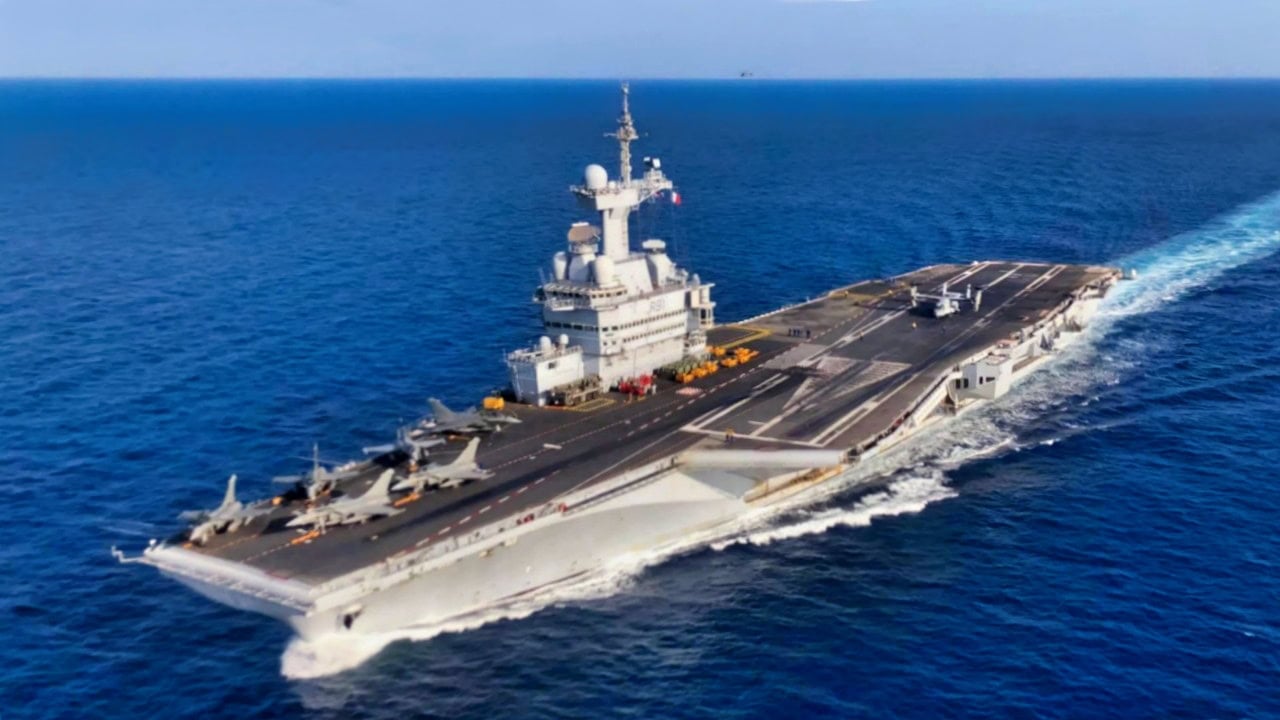
U.S. 5TH FLEET AREA OF OPERATIONS (April 24, 2019) A U.S. Marine MV-22 Osprey assigned to the 22nd Marine Expeditionary Unit sits on the flight deck of France’s Marine Nationale aircraft carrier FS Charles De Gaulle (R 91). This was the second time that Ospreys have landed aboard the French vessel. Marines and Sailors assigned to the 22nd MEU and Kearsarge Amphibious Ready Group are currently deployed to the U.S. 5th Fleet area of operations in support of naval operations to ensure maritime stability and security in the Central region, connecting the Mediterranean and the Pacific through the western Indian Ocean and three strategic choke points. (U.S. Marine Corps photo by Maj. Joshua Smith/Released)
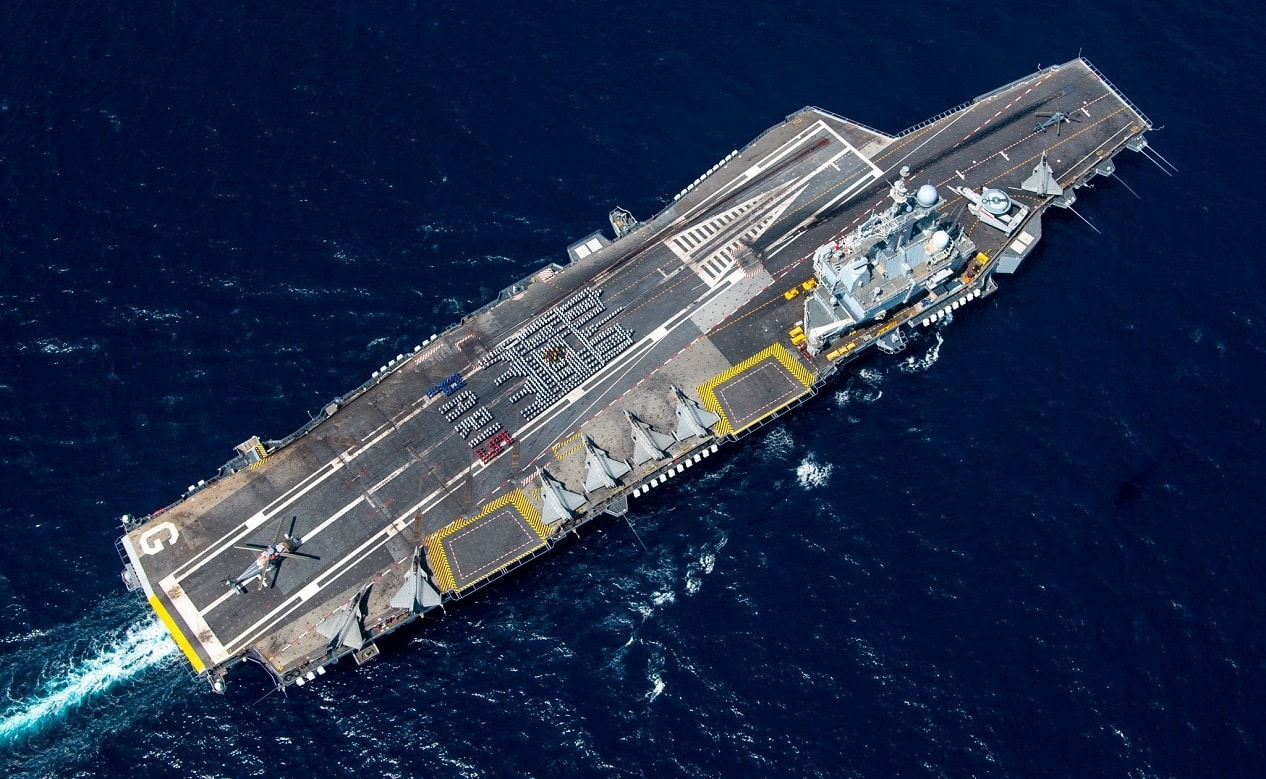
French Aircraft Carrier Charles de Gaulle.
French leaders also see the project as a boon France’s flagging industrial base. Building this large, complex warship should create defense industry jobs and strengthen the French defense industry more broadly.
The PANG Supercarrier: Prestige Project or Strategic Necessity?
Macron’s government has assessed that having a more robust carrier force would allow his government to act independently on the world stage.
In their view, the carrier equals greater strategic independence. But the French Navy has had a carrier for years, and, while it is more militarily independent than many other European states, France has not been a power for decades. It has lived in America’s shadow.
France creating a new capability might alleviate the burden on U.S. forces. But look at the British and their two-carrier fleet.
Britain has not reduced its dependence on the Americans at all, and the carriers they built are proving to be more hassle than they are worth.
There’s also the question of cost. Unlike the U.S. military, which exists in a budgetary fairytale, the French military’s most recent allocation was around $74.8 billion—roughly 2 percent of France’s total GDP. That’s far less than what the Russians, Americans, and Chinese spend on their militaries.
France’s defense budget cannot sustain this. Spending their limited money on a $12 billion nuclear carrier means France will have less money available to maintain and grow its submarine force, missile arsenal, and drone fleet, or to modernize ground forces to better prepare for a Ukraine-style war.
The carrier is optimized for 1990s warfare. It is not specialized for the kind of warfare raging today in Ukraine and Iran.
Thus, France’s desire to maintain its independence and project force is understandable.
It is, however, unrealistic and wasteful. France should not be wasting its money and resources on this boondoggle.
About the Author: Brandon J. Weichert
Brandon J. Weichert is the Senior National Security Editor at 19FortyFive.com. Recently, Weichert became the editor of the “NatSec Guy” section at Emerald.TV. He was previously the senior national security editor at The National Interest. Weichert is the host of The National Security Hour on iHeartRadio, where he discusses national security policy every Wednesday at 8pm Eastern. He hosts a companion show on Rumble entitled “National Security Talk.” Weichert consults regularly with various government institutions and private organizations on geopolitical issues. His writings have appeared in numerous publications, among them Popular Mechanics, National Review, MSN, and The American Spectator. And his books include Winning Space: How America Remains a Superpower, Biohacked: China’s Race to Control Life, and The Shadow War: Iran’s Quest for Supremacy. Weichert’s newest book, A Disaster of Our Own Making: How the West Lost Ukraine, is available for purchase wherever books are sold. He can be followed via Twitter/X @WeTheBrandon.