
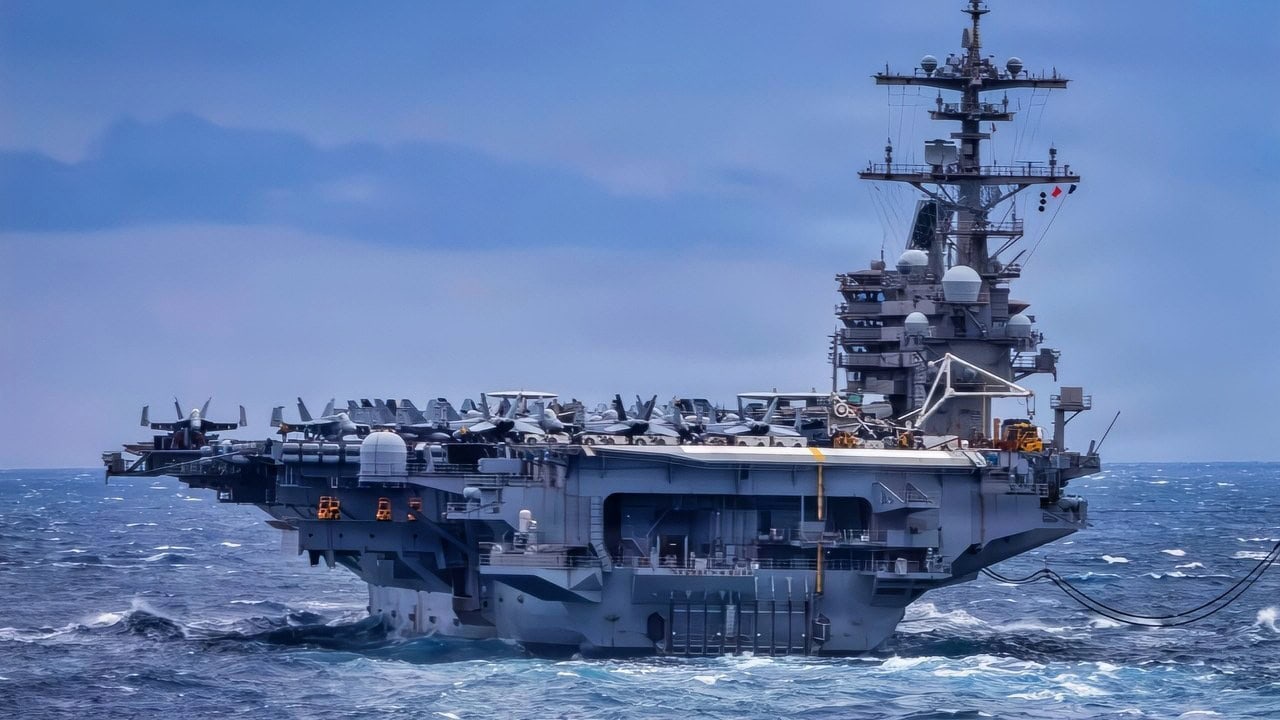
The Three Aircraft Carrier Calculus: USS George H.W. Bush Joins Operation Epic Fury
The USS George H.W. Bush (CVN-77) is preparing to deploy from Norfolk for the Middle East to enhance the US naval presence surrounding Operation Epic Fury.
The Bush Carrier Strike Group (CSG) recently completed its Composite Training Unit Exercise (COMPTUEX), the final certification required before deployment.
Once underway, the CSG is expected to reach the Mediterranean, or the CENTCOM theater, within 10-12 days.
The Bush will be the third US CSG in the region, joining the USS Gerald R. Ford, which was operating in the Red Sea, until a fire broke out, and the USS Abraham Lincoln, operating in the Arabian Sea.
The question now is, what exactly does a third carrier signal do?
Introducing the USS Bush
The USS George H.W. Bush is the tenth and final Nimitz-class aircraft carrier, commissioned in 2009.
Like the other US supercarriers, the Bush serves as a floating airbase, capable of projecting sustained air power anywhere in the world’s oceans.
The Bush CSG contains Carrier Air Wing 7, roughly 80-90 aircraft, guided-missile destroyers, cruisers, and logistical support ships.
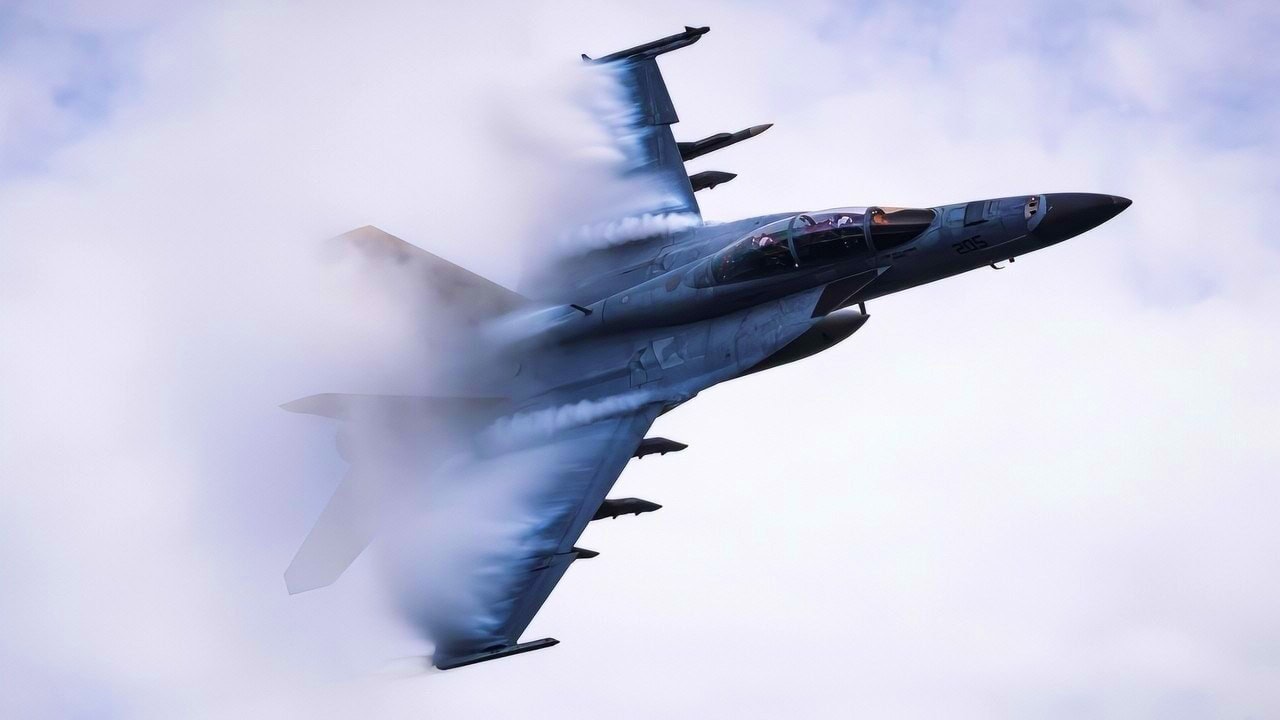
USS George Washington Aircraft Carrier Super Hornet. Image Credit: Creative Commons.
The aircraft aboard the Bush typically include the F/A-18E/F Super Hornet strike fighter, EA-18G Growler electronic warfare aircraft, E-2D Hawkeye airborne early-warning aircraft, and MH-60 Seahawk helicopters.
Capable of conducting dozens of sorties per day, the Bush can deliver precision strikes, provide EW support, conduct intelligence gathering, and conduct air superiority missions.
Three’s Company
Before the Bush deployment, two CSGs were already operating in the region. The Ford has been heavily involved in strike operations during Epic Fury. The Ford has been deployed for nearly 11 months, making relief necessary, especially following a fire on board.
The Lincoln, meanwhile, is operating in the Arabian Sea and the Gulf of Oman, providing strike capability against Iranian targets from the southern axis. Together, these two strike groups already provide significant naval aviation capacity.
So why send a third? On the surface, a third carrier might appear redundant; two carrier strike groups can already sustain continuous strike operations. However, a third carrier does enable operational advantages.
R&R
The Ford CSG has been deployed for nearly a year, meaning the Bush could replace the Ford in theater, allowing the Navy to maintain a constant presence without overstretching its crews. And, in fact, that seems likely based on the Ford’s laundry room fire.
Carrier deployments are typically limited to 6-8 months, making this rotation overdue and strategically necessary.
While not strictly necessary, a third carrier does increase sortie generation capability. A single carrier can generate roughly 120 sorties per day under high-tempo operations. Three carriers, therefore, provide the ability to conduct large simultaneous strike waves if needed.
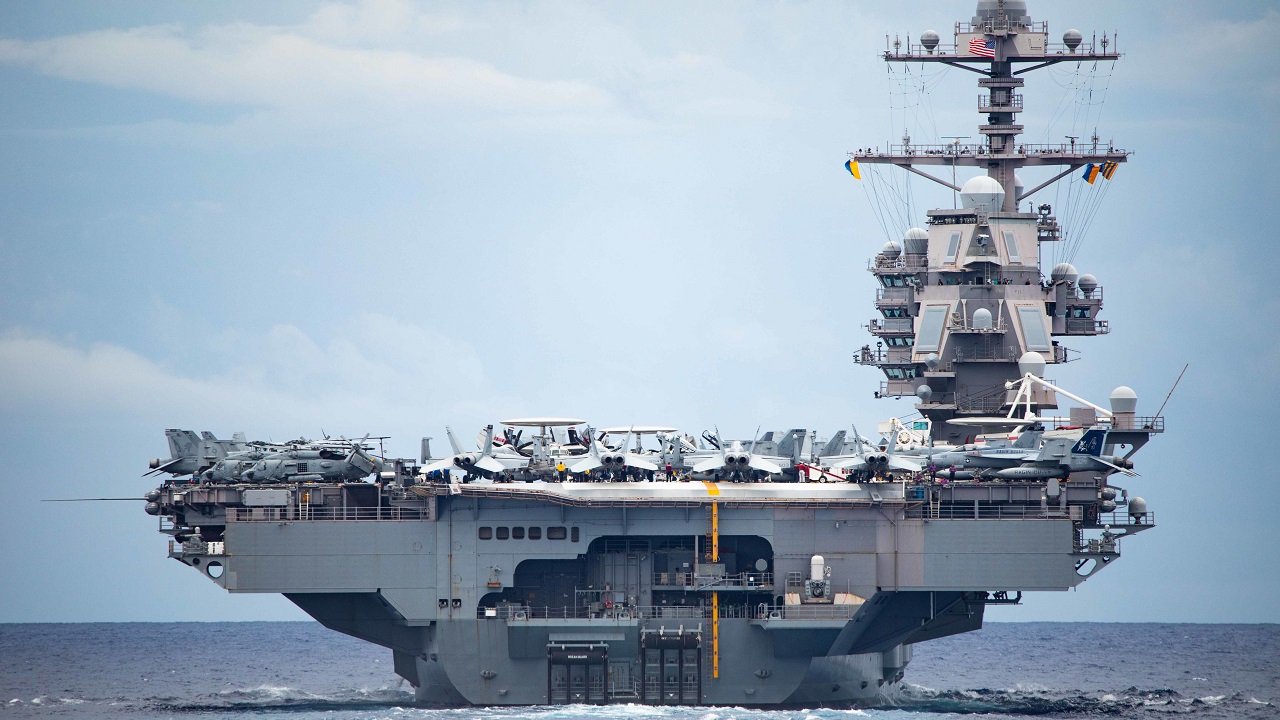
A view of the first-in-class aircraft carrier USS Gerald R. Ford (CVN 78) from aboard the Ticonderoga-class guided-missile cruiser USS Normandy (CG 60) as Normandy participates in a Tactical Force Exercise as part of the Gerald R. Ford Carrier Strike Group, Oct. 13, 2022. Ford is on its inaugural deployment conducting training and operations alongside NATO Allies and partners to enhance integration for future operations and demonstrate the U.S. Navy’s commitment to a peaceful, stable and conflict-free Atlantic region. (U.S. Navy photo by Mass Communication Specialist 2nd Class Malachi Lakey)
This could become a relevant capacity if Iran attempts a large retaliatory missile campaign, or new targets are assigned, or the campaign expands in some respect.
The third carrier also allows for enhanced geographic coverage. The Middle East maritime theater is large, and a third carrier can cover the Red Sea, another the Arabian Sea, and the Strait of Hormuz, while the third can be in the Mediterranean.
This approach spreads risk and ensures continuous strike coverage even if ships reposition. Three carriers also provide strategic redundancy, as carriers are high-value targets; a third carrier provides insurance in case one must withdraw for any reason. And, again, the Ford seems ready to depart.
Yet, while having a third carrier in theater offers obvious operational advantages, the fiscal and opportunity costs of deployment are high, making the merits of the deployment debatable.
Signal Expansion
Some observers might suggest that Bush’s deployment is a political/coercive signal. But the US and Israel have already conducted thousands of strikes inside Iran, with Epic Fury already in its fourth week of sustained operations.
At this stage, the conflict is already active, so the Bush deployment doesn’t align with the coercive pressure that carrier deployments often signal (as the Ford and Lincoln deployments to the region a few weeks ago did).
So does the deployment signal an intention to conduct a longer-term war? The US may be planning a longer-term commitment, but the carrier deployment doesn’t necessarily indicate that. Carriers are especially useful during the opening phases of a conflict, as Ford and Lincoln recently demonstrated.
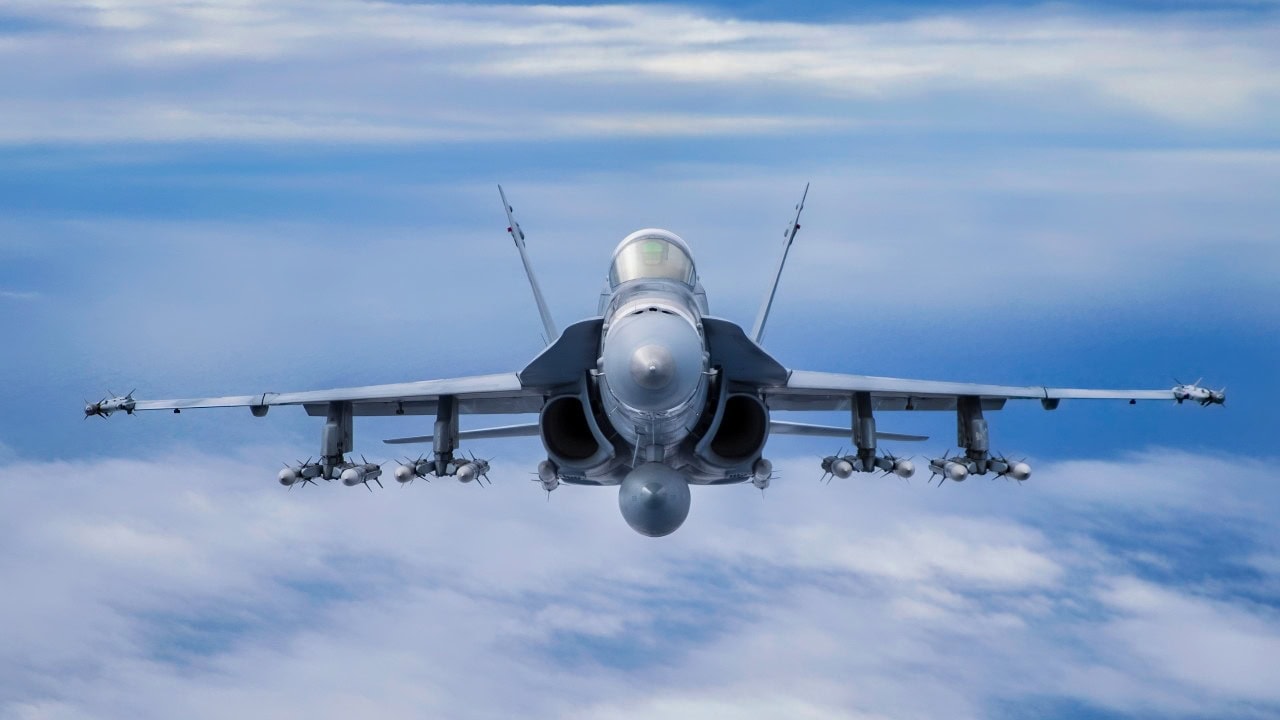
An F/A-18 Hornet with Marine Fighter Attack Squadron (VMFA) 323, MAG-11, 3rd Marine Aircraft Wing (MAW), carrying ten AIM-120 and two AIM-9X Air-to-Air missiles, prepares to refuel over the W-291 training area in southern California, March 6. MAG-11 supports and integrates aviation combat power and capabilities while enhancing 3rd MAW’s ability generate lethality for the supported Marine Air-Ground Task Force (MAGTF). (U.S Marine Corps photo by Sgt. Dominic Romero)
But over time, longer campaigns typically shift towards other assets, relying more heavily on US Air Force bombers, land-based fighters, Army long-range missiles, persistent ISR platforms, and even troops on the ground.
Best guess: the deployment of the Bush does not necessarily signal an escalation in the war. Instead, the deployment likely reflects the logistical reality of maintaining a sustained military campaign. The third CSG is likely being deployed to allow for endurance and flexibility.
But in practical terms, the deployment suggests the US plans to keep Epic Fury going, at least for a few more weeks.
About the Author: Harrison Kass
Harrison Kass is an attorney and journalist covering national security, technology, and politics. Previously, he was a political staffer and candidate, and a US Air Force pilot selectee. He holds a JD from the University of Oregon and a master’s in global journalism and international relations from NYU.