
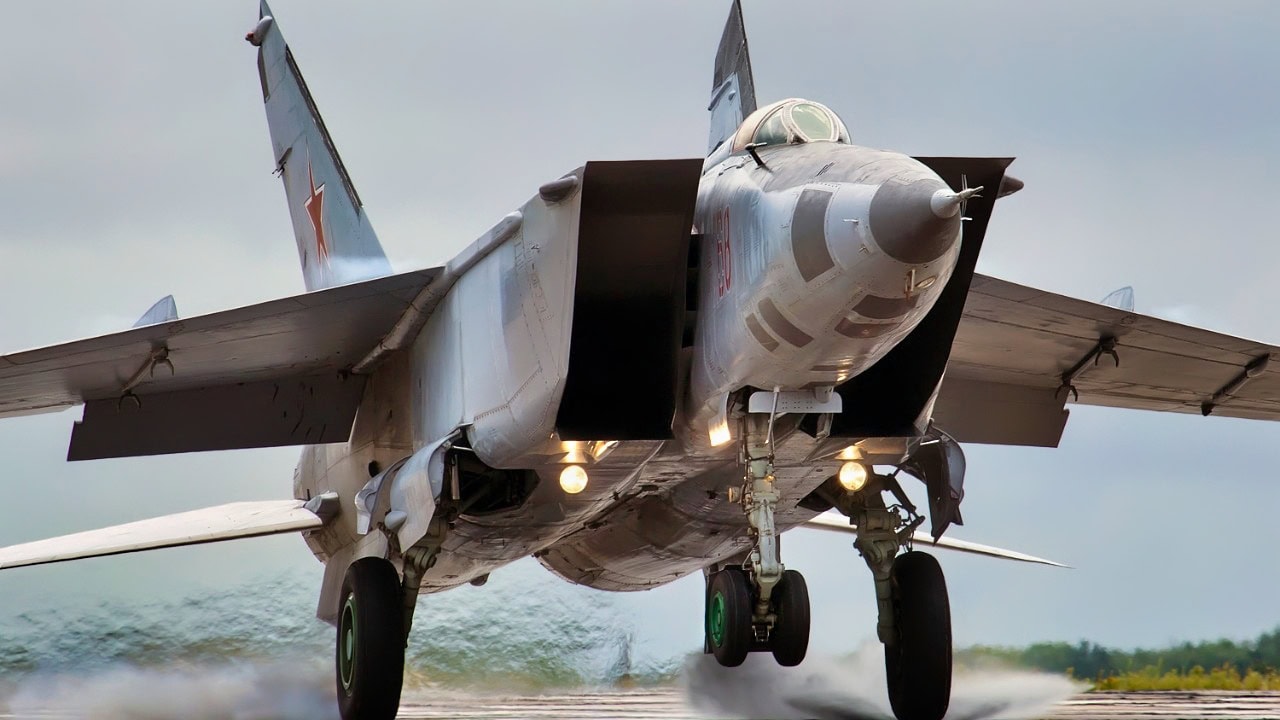
Summary and Key Points: Defense expert Christian D. Orr evaluates the MiG-25 Foxbat, a Cold War interceptor capable of speeds reaching Mach 2.8.
-This report analyzes the 1976 defection of Lt. Viktor Belenko, which revealed the aircraft’s technical limitations to the West.

MiG-25. Image Credit: Creative Commons.

MiG-25 Russian Fighter-Bomber. Image Credit: Creative Commons.
-Orr explores the Foxbat’s combat legacy, including its 1991 downing of a U.S. Navy F/A-18 Hornet piloted by LCDR Michael Speicher, and its eventual defeat by Israeli F-15A and USAF F-15C pilots.
-Following the July 2022 retirement by Algeria and the 2024 destruction of the Syrian Air Force fleet, the MiG-25 remains only as a museum specimen.
Beyond Mach 3: Evaluating the Tumansky R-15B-300 Engines and the MiG-25’s Raw Power
Of all the jet fighters designed in the Soviet Union, none scared the unholy hell out of Western airpower strategists and tacticians quite like the Mikoyan-Gurevich MiG-25 “Foxbat.”
Though it was still slower than the United States’ Lockheed SR-71 Blackbird spy plane’s Mach 3.56, the MiG-25 is one the fastest jet fighter-interceptors of all-time, with an on-paper max airspeed speed of Mach 3.2, but a realistic maximum of Mach 2.8.
The mystique surrounding the MiG-25 would eventually be dispelled. But the Foxbat had a strong pull on the history of military aviation.
MiG-25 Initial History in Brief
The MiG-25 made its maiden flight on March 6, 1964, and was officially introduced into service in 1970. It was the last aircraft designed by Mikhail Gurevich before his retirement.
On September 9, 1976, Lieutenant Viktor Belenko became the one responsible for dispelling the Foxbat’s myth when he defected from the Soviet Union to the United States via Japan while flying one of these warplanes. The plane was broken apart to study its secrets. It was then returned to the Soviet Union.
To use a Wizard of Oz analogy, if the MiG-25 was the “man behind the curtain,” then Belenko was like a masculine version of Dorothy, pulling away that curtain. (For a detailed and deeply moving account of Lt. Belenko’s life story, read the book “MiG Pilot: The Final Escape of Lt. Belenko” by John Daniel Barron.)

MiG-35. Image: Creative Commons.
Tech Specs and Vital Stats
Fuselage length: 78 feet 2 inches
Wingspan: 46 feet
Height: 20 feet
Empty weight: 44,092 pounds
Max takeoff weight (MTOW): 80,954 pounds
Powerplant: 2 × Tumansky R-15B-300 afterburning turbojet engines
The Tumansky R-15B-300s are the largest engines ever put on a fighter. Having personally seen the Foxbat’s afterburners at the MiG graveyard on Al Asad Airbase, Iraq, back in 2011, I can attest that they truly are a sight to behold.
The MiG-25 Foxbat Gets a Kill
For all the weaknesses in the MiG-25’s design revealed by Lt. Belenko’s defection, it was still the last Soviet-designed warplane to score an air-to-air kill against a U.S.-made jet. Interestingly, the Foxbat driver in question was not a citizen of any of the other former Soviet republics, but rather a Saddam Hussein-era Iraqi Air Force (IqAF) fighter pilot, Zuhair Dawoud.
It was January 17, 1991, the first night of the Persian Gulf War. That fateful night, Lieutenant Dawoud, attached at the time to the 84th Fighter Squadron, scored the IqAF’s only air-to-air kill of the Gulf War (and inflicted America’s first KIA) when he shot down then-Lieutenant Commander (later posthumously promoted to Captain) Michael Scott Speicher’s U.S. Navy F/A-18 Hornet.
In Dawoud’s own words (as quoted by The Aviation Geek Club’s Dario Leone:
“I reported what happened to the GCI [ground control intercept] and he told me to return to my original intercept course as I had ‘targets at 38km.’ Meanwhile, my radar became ready. I locked a target 38km from me and at 29km I fired [the] R-40RD missile from under my right wing. I kept the target locked with my radar [un]till I witnessed a huge explosion in front of me. I kept looking for the aircraft going down spirally to the ground with fire engulfing it.”
The Foxbat Gets Killed
Turnabout is fair play. In exchange for the lone moment of aerial triumph for the MiG-25, a total of five of them have been shot down in aerial combat.
-Just as the Israelis were the first to successfully use the F-16 and F-15 in combat, so too were they the first to kill the Foxbat in aerial battle. This transpired on February 13, 1981, when an Israeli Air Force (IAF) F-15A Eagle shot down a Syrian-piloted MiG-25 over Lebanon. What makes the shootdown even more noteworthy is that it was accomplished with the much-maligned AIM-7F Sparrow semiactive radar-guided missile.

A 40th Flight Test Squadron F-16 Fighting Falcon releases a Stand-in Attack Weapon for the first time Nov. 7 at Eglin Air Force Base, Florida. The mission marked the first time the weapon was successfully released from an aircraft. (U.S. Air Force photo by Staff Sgt. Blake Wiles)
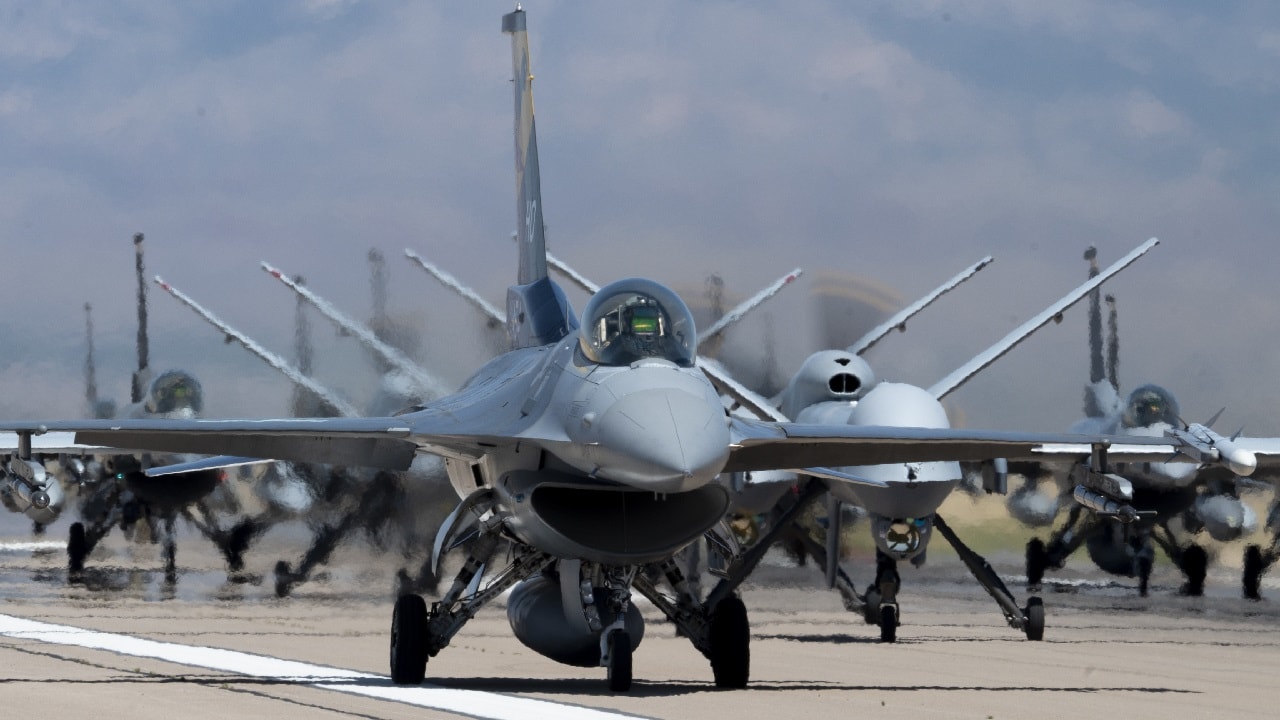
Forty-nine F-16 Vipers and MQ-9 Reapers assigned to the 49th Wing line up on the runway during an elephant walk at Holloman Air Force Base, New Mexico, April 21, 2023. The 49th Wing is the Air Force’s largest F-16 and MQ-9 formal training unit, building combat aircrew pilots and sensor operators ready for any future conflicts. (U.S. Air Force photo by Tech. Sgt. Victor J. Caputo)
-On July 29, 1981, another IAF pilot repeated the feat.
-Two nights after LCDR Speicher’s shootdown, the Americans finally bagged their first Foxbat: Two F-15Cs flown by U.S. Air Force Captains Rick “Kluso” Tollini and Larry “Cherry” Pitts shot down two MiG-25s. Once again, the unloved Sparrow missile did the trick.
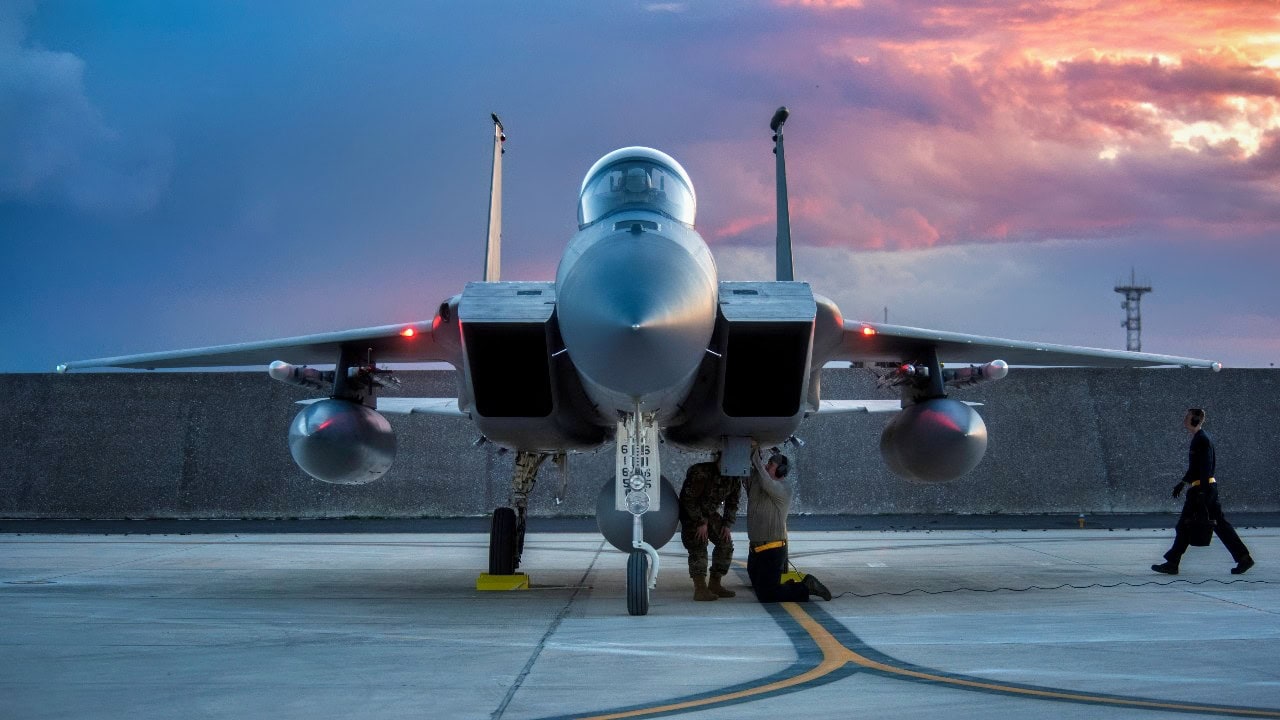
Airmen from the 48th Fighter Wing perform post flight checks on an F-15C Eagle at Amendola Air Base, Italy, Nov. 16, 2018. F-15C Eagles and an F-15D Eagle will be participating in the NATO Tactical Leadership Programme 18-4. TLP has prepared hundreds of NATO and allied forces’ flight leaders to be mission commanders. (U.S. Air Force photo/ Senior Airman Malcolm Mayfield)
-Last but not least, on December 27, 1992, Captain Gary “Nordo” North, pulled off the feat while enforcing the no-fly zone in southern Iraq as part of Operation Southern Watch, when he caught one of Hussein’s MiG-25 pilots flagrantly violating that no-fly zone.
Where Are They Now?
The Algerian Air Force and the Syrian Air Force were the last two holdouts to keep the MiG-25 in service. The former officially retired theirs in July 2022, while the latter saw their entire aircraft inventory destroyed by the IAF after the collapse of the Assad regime in early December 2024.
An estimated 1,186 MiG-25 airframes were built. At last count, 15 specimens have been preserved for posterity at museums and military bases across seven different countries. The solo stateside specimen is Serial No. 020657, a MiG-25RB at the National Museum of the United States Air Force at Wright-Patterson Air Force Base near Dayton, Ohio.
About the Author: Christian D. Orr, Defense Expert
Christian D. Orr is a Senior Defense Editor. He is a former Air Force Security Forces officer, Federal law enforcement officer, and private military contractor (with assignments worked in Iraq, the United Arab Emirates, Kosovo, Japan, Germany, and the Pentagon). Chris holds a B.A. in International Relations from the University of Southern California (USC) and an M.A. in Intelligence Studies (concentration in Terrorism Studies) from American Military University (AMU). He is also the author of the newly published book “Five Decades of a Fabulous Firearm: Celebrating the 50th Anniversary of the Beretta 92 Pistol Series.”