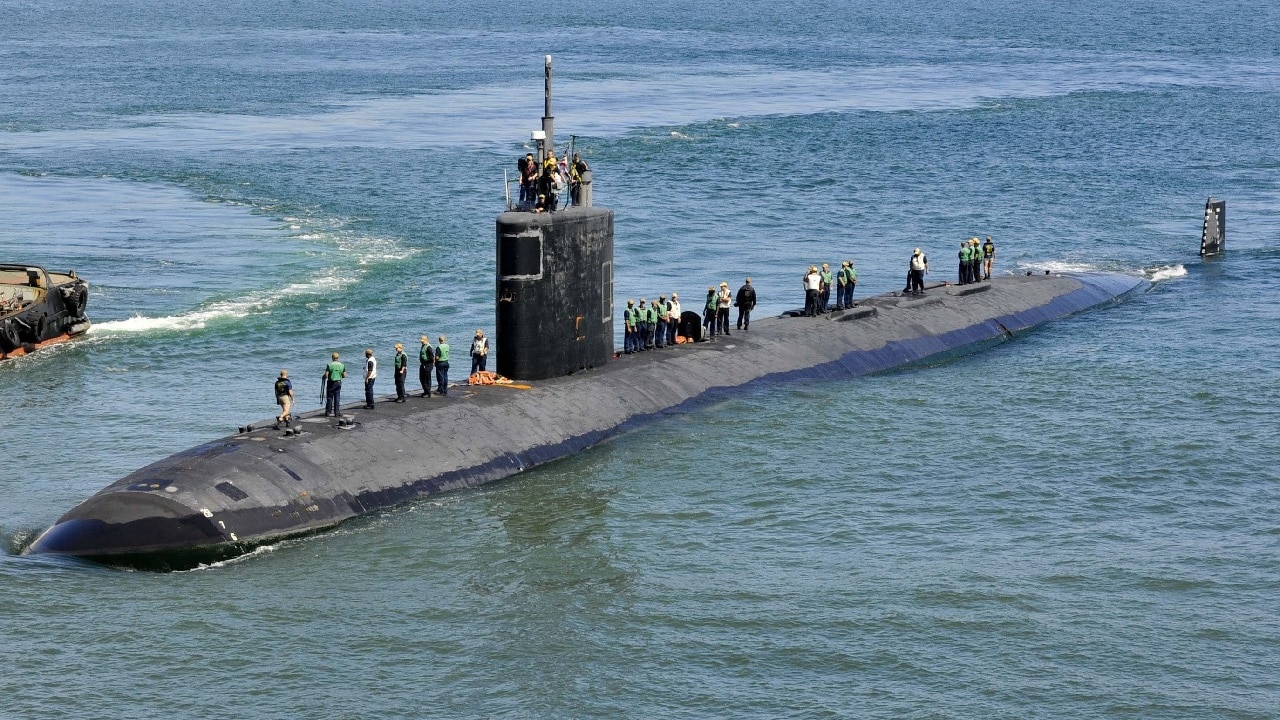
Summary and Key Points: Brandon J. Weichert, Senior National Security Editor at 19FortyFive, evaluates the looming “submarine shortage” as the U.S. Navy struggles to replace the iconic Los Angeles-class (688) attack fleet.
-With Virginia-class production hitting industrial bottlenecks and China now commanding the world’s second-largest undersea force, the U.S. fast-attack fleet of 53 boats is set to decline precipitously.
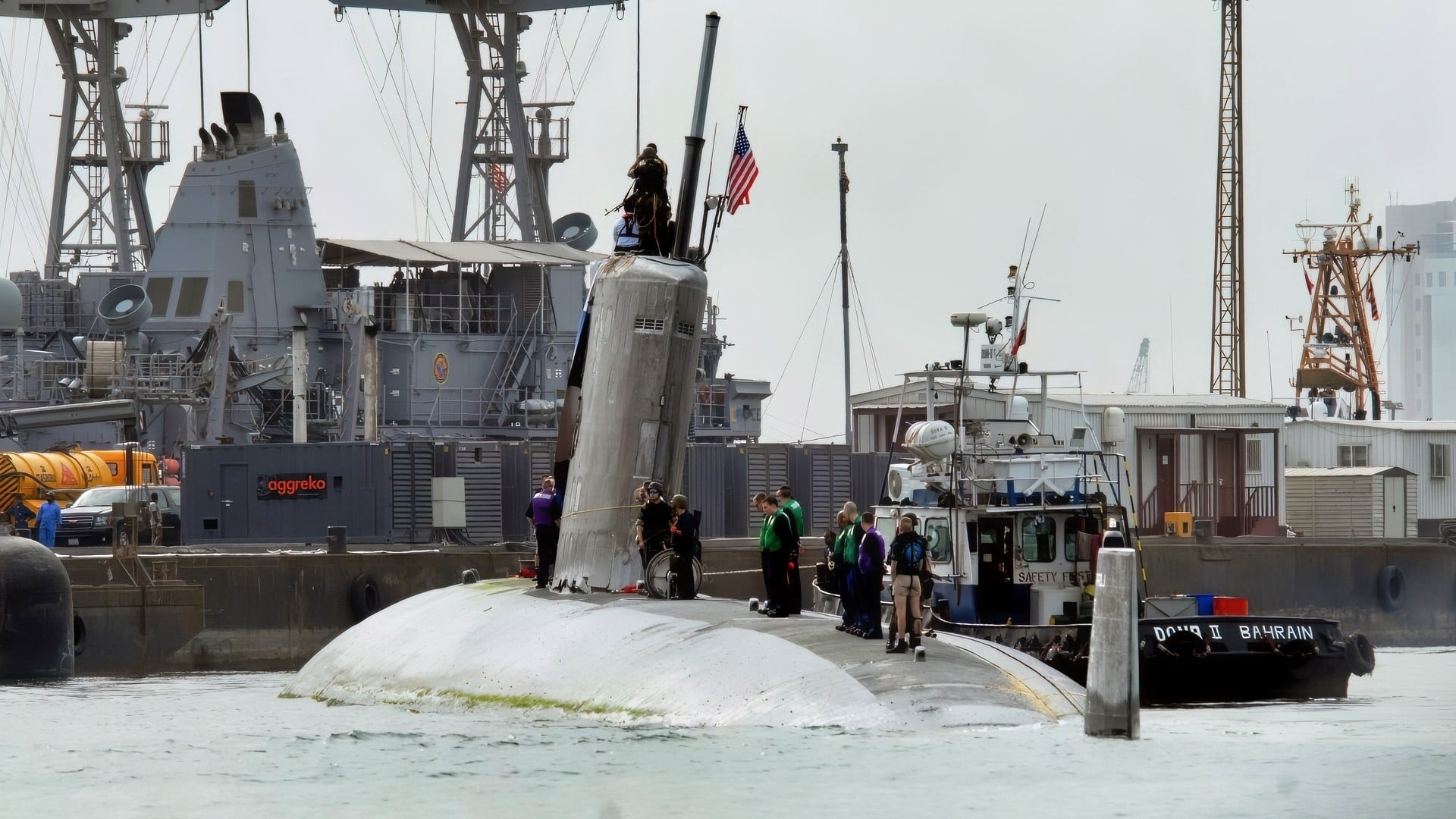
BAHRAIN (March 21, 2009) The Los Angeles-class attack submarine USS Hartford (SSN 768) arrives pier side at Mina Salman pier in Bahrain where U.S. Navy engineers and inspection teams will asses and evaluate damage that resulted from a collision with the amphibious transport dock ship USS New Orleans (LPD 18) in the Strait of Hormuz March 20. Overall damage to both ships is being evaluated. The incident remains under investigation. Hartford is deployed to the U.S. 5th fleet area of responsibility to support maritime security operations. (U.S. Navy photo by Cmdr. Jane Campbell/Released) (c)RoebuckPhoto
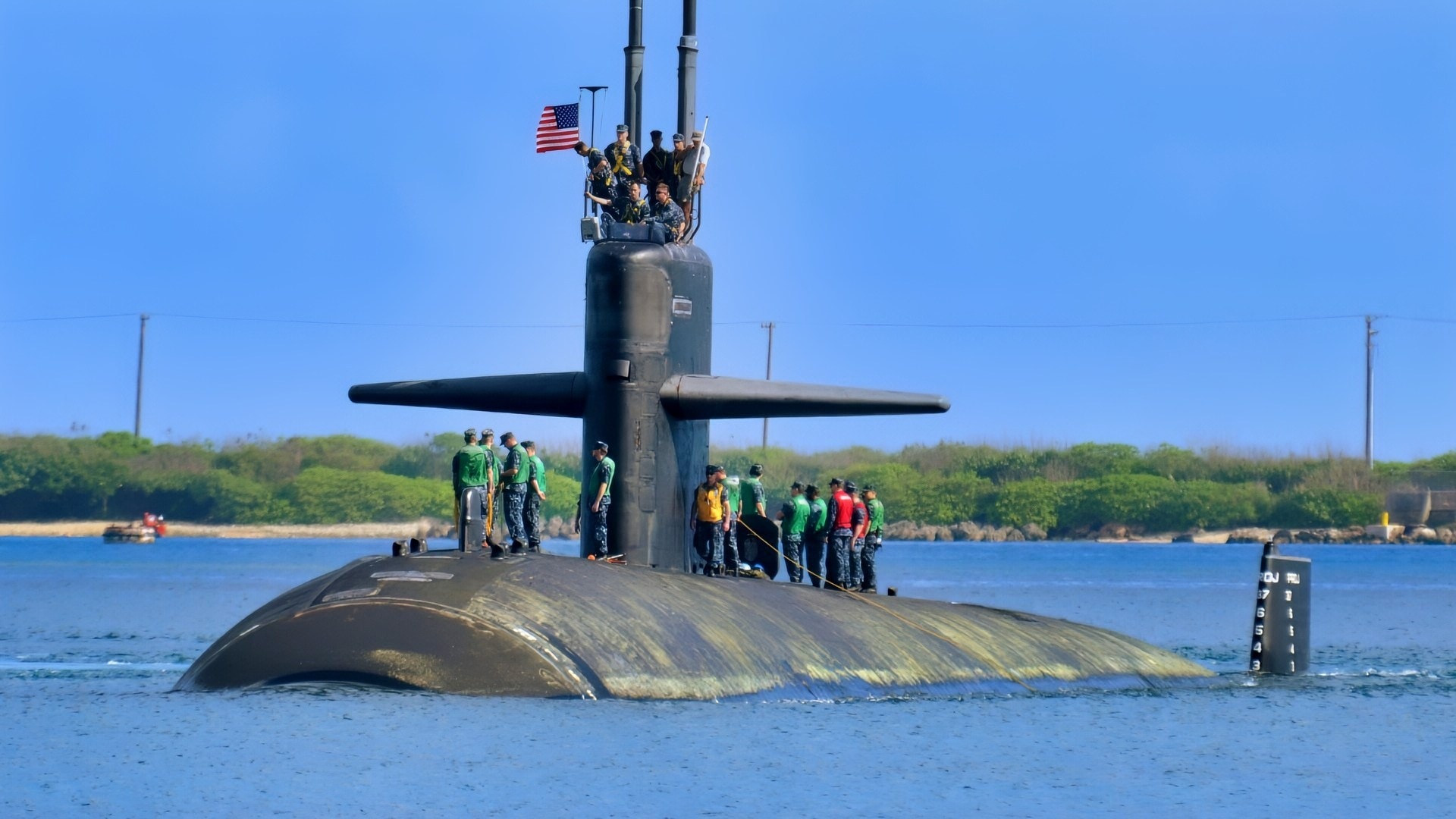
POLARIS POINT, Guam (May 7, 2013) The Los Angeles-class attack submarine USS Albuquerque (SSN 706) arrives in Apra Harbor, Guam, to conduct maintenance and liberty. Albuquerque is conducting operations in the U.S. 7th Fleet area of responsibility. (U.S. Navy photo by Mass Communication Specialist 1st Class Jeffrey Jay Price/Released)
-This report analyzes the costly prospect of life-extension overhauls versus a radical alternative: converting aging 688s into undersea drone motherships.
-Weichert concludes that without a rapid pivot, the U.S. faces a dangerous reduction in undersea combat power during a potential Pacific conflict.
The 688 Crisis: Why the U.S. Navy Can’t Afford to Retire the Los Angeles-Class Submarines
The Los Angeles-class attack submarine has been the workhorse of the United States Navy’s submarine force for nearly 50 years. It is, hands down, the most iconic submarine the United States Navy has ever built. And the Navy has been trying to replace it for nearly 30 years—with mixed success.
The Navy’s Plan to Deep Six the 688s
Between 1972 and 1996, the Navy built 62 submarines of this class, making it one of the largest and most successful submarine classes ever produced.
Even today, roughly 20-26 boats remain in service, making the class the largest portion of the American fast-attack submarine fleet.
As for the capabilities of these iconic submarines, they include carrying Mk-48 torpedoes, Tomahawk cruise missiles, Harpoon anti-ship missiles, and sophisticated sonar and electronic-warfare systems. These subs can reach speeds of more than 30 knots, carry dozens of weapons, and operate globally thanks to their nuclear reactors.
These submarines were the linchpin of America’s undersea dominance strategy for decades.
The Navy’s plan is to retire the Los Angeles-class attack submarines throughout the 2030s, replacing them with the Virginia-class attack submarines. There’s a problem with this desire, though. Only a small number of Virginia-class boats are entering service each year. Meanwhile, the submarine industrial base is broken. And the Columbia-class SSBN program is competing for shipyard capacity.
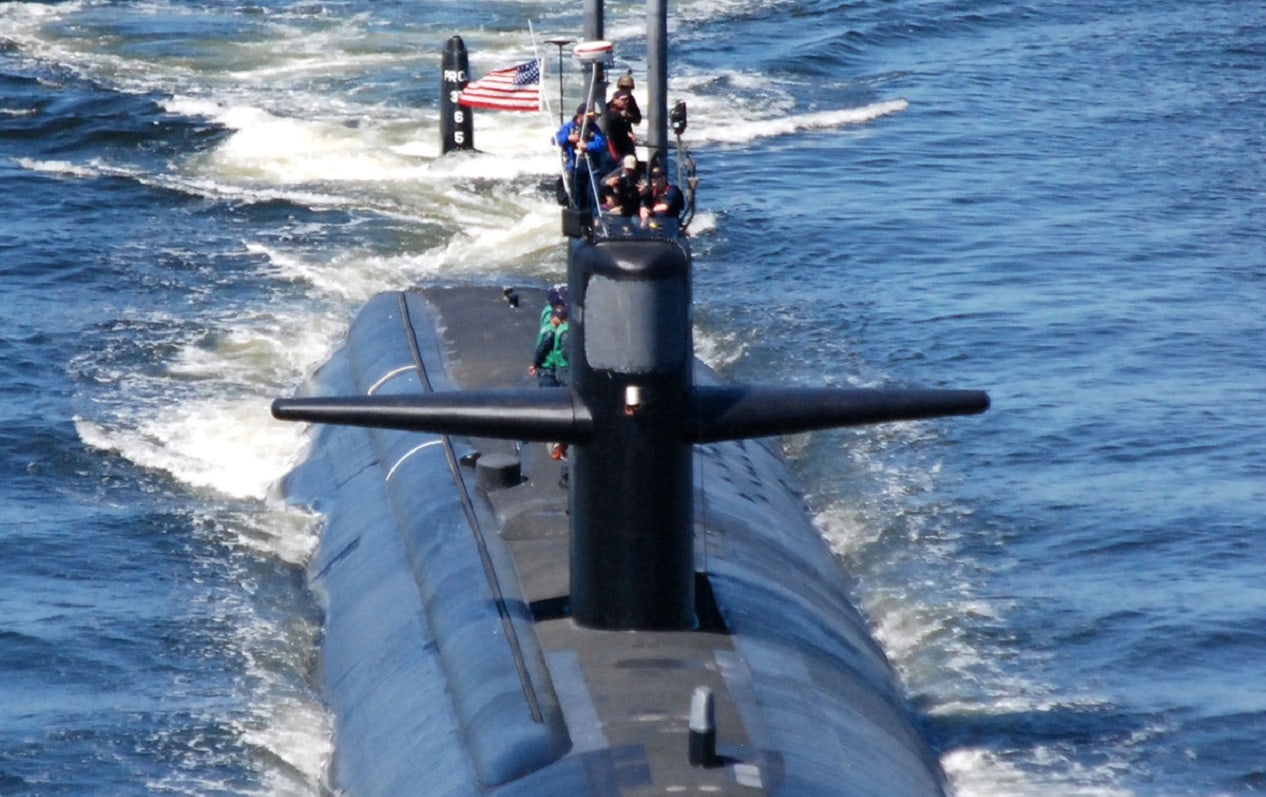
Los Angeles-Class Attack Submarine. Image Credit: Creative Commons.
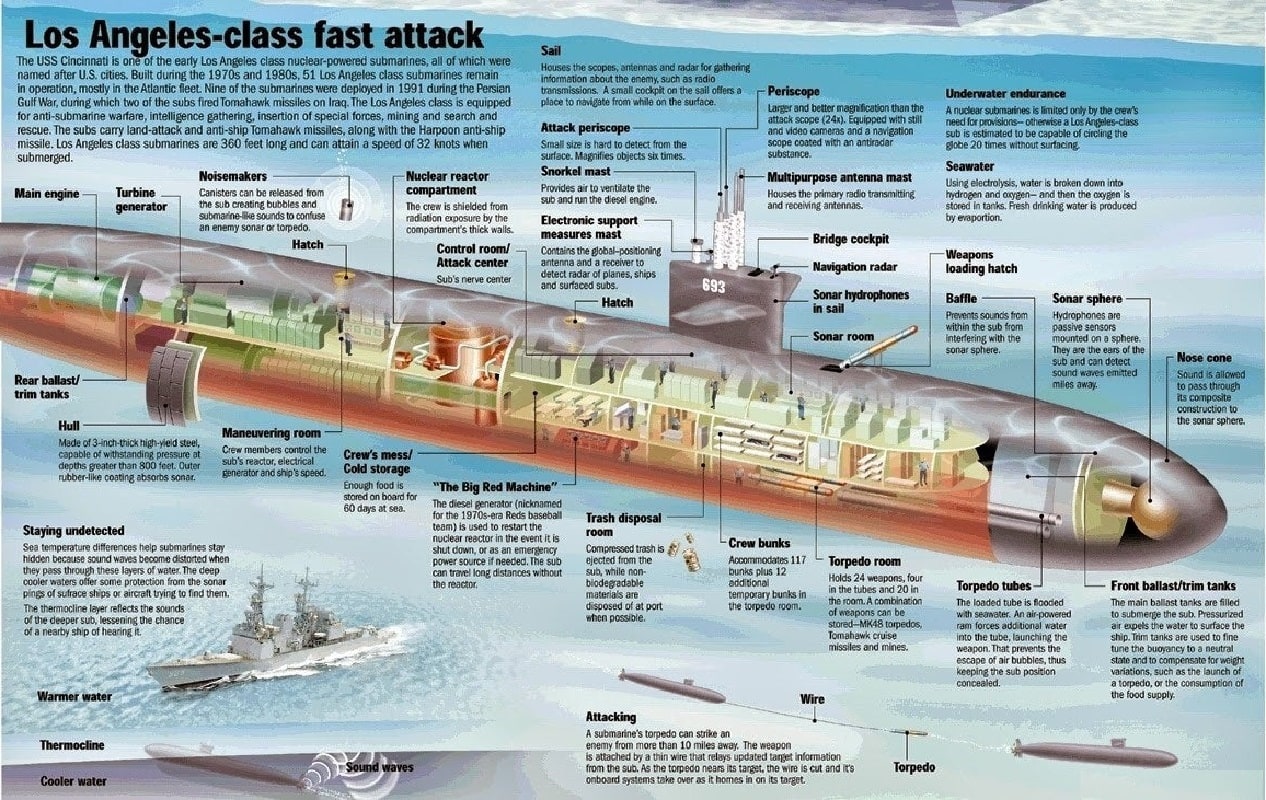
Los Angeles-Class diagram. Image Credit: US Navy.

PACIFIC OCEAN (July 31, 2018) – Sailors assigned to Los Angeles-class fast-attack submarine USS Olympia (SSN 717) participate in a swim call at sea, July 31 (U.S. Navy photo by Fire Control Technician Senior Chief Vien Nguyen)
Although the Navy today has 53 attack submarines, that number is set to decline precipitously soon.
For a Navy purportedly preparing for a potential war with China, that drop is strategically alarming.
The Risk of a Looming Submarine Shortage
One idea floating around the Navy’s upper echelon is to extend the service life of several Los Angeles-class submarines. Congress and the US Navy have considered extending the service of about five boats through reactor refueling and major overhauls.
This could buy time while new Virginia-class submarines are built.
Part of the problem with extending the service life of the Los Angeles-class attack submarines is that the Virginia-class submarine program has many issues.
With only two shipyards in the United States capable of building nuclear submarines—and with those shipyards having to maintain other naval craft while building new subs—the Virginia-class has not reached the force size required to retire the Los Angeles-class submarines.

(June 30, 2011) The Virginia-class attack submarine USS California (SSN 781) underway during sea trials. (U.S. Navy photo by Chris Oxley/Released).
Extending the Los Angeles-class submarines creates a unique set of problems for the Navy, too. Most of the subs in this class were built in the 1980s and 1990s. They have already operated for decades under a heavy operational tempo. Therefore, in order to extend the service lives of these boats, they must refuel nuclear reactors, inspect and reinforce hulls, and upgrade combat systems.
Life Extensions: Costly and Complicated
All these processes are costly and complex. And with the bottleneck at the shipyards themselves, the prospect that we could use refurbishing some of these Los Angeles-class attack subs as a stopgap until the Virginia-class subs are fully established is daunting.
It becomes less helpful, less of a stopgap, and more of an impediment, as we would then be tasking limited-capability shipyards to effectively double their workload, which would essentially negate any positive momentum in the development of America’s undersea force.
Plus, even the most modernized Los Angeles-class attack subs cannot match the capabilities of the newer Virginia-class submarines, particularly in stealth, sensors, and payload flexibility.
Still, if the Virginia-class attack submarines are not brought to full strength before the Navy retires the Los Angeles-class attack subs, the American undersea force will shrink drastically. All this at a time in which China’s navy has officially become the second-largest undersea force in the world (supplanting Russia and falling only behind the declining US Navy submarine force).
Thus, China’s growing submarine fleet gains a relative advantage over the Americans in the Indo-Pacific.
The Los Angeles-class subs are iconic. But they are aging. At the same time, the Navy cannot afford to lose them yet. Until the US can build enough Virginia-class boats more quickly, or field the SSN(X) sooner (which is highly unlikely), the Navy is stuck choosing between keeping aging submarines afloat and accepting a dangerous reduction in America’s undersea combat power.
A Radical Alternative: Turning the 688s Into Drone Motherships
There is, however, a possible third scenario that the Pentagon’s conventional thinkers are not considering.
Why not modify existing Los Angeles-class submarines to deploy fleets of undersea and aerial drones?
While the modifications to the submarines themselves would be costly, such advances should not be more expensive than completely overhauling the aging Los Angeles-class attack subs.
What’s more, by using the aging Los Angeles-class subs as undersea motherships for fleets of drones, the Navy would be drastically augmenting its attack capabilities for a fraction of the cost of either the Virginia-class submarine builds or even the price of totally overhauling the Los Angeles-class (which will never be as advanced as the Virginia-class subs).
About the Author: Brandon J. Weichert
Brandon J. Weichert is the Senior National Security Editor at 19FortyFive.com. Recently, Weichert became the editor of the “NatSec Guy” section at Emerald. TV. He was previously the senior national security editor at The National Interest. Weichert is the host of The National Security Hour on iHeartRadio, where he discusses national security policy every Wednesday at 8 pm Eastern. He hosts a companion show on Rumble entitled “National Security Talk.” Weichert consults regularly with various government institutions and private organizations on geopolitical issues. His writings have appeared in numerous publications, among them Popular Mechanics, National Review, MSN, and The American Spectator. And his books include Winning Space: How America Remains a Superpower, Biohacked: China’s Race to Control Life, and The Shadow War: Iran’s Quest for Supremacy. Weichert’s newest book, A Disaster of Our Own Making: How the West Lost Ukraine, is available for purchase wherever books are sold. He can be followed via Twitter/X @WeTheBrandon.