
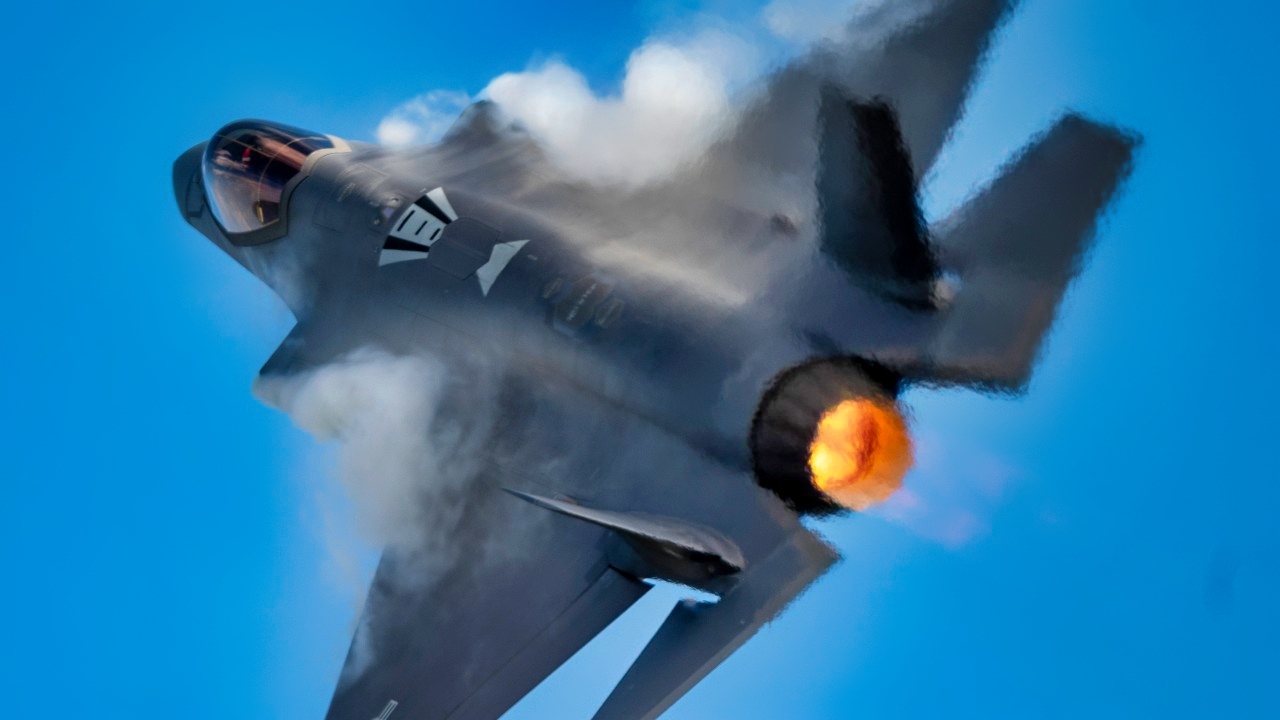
Summary and Key Points: Christian D. Orr, a veteran defense expert and former Air Force officer, evaluates the historical “Viper vs. Lightning” dogfights of 2015 and 2017. While critics highlighted rare F-16 Fighting Falcon wins, Orr analyzes how these simulations—conducted at Nellis AFB during Red Flag—actually refined the F-35’s flight control software.
-By removing the “hand-holding” automation that hindered pilots like Maj. Dan Flatley, engineers enabled the high-alpha maneuvers seen in the 2026 Iran War.
-The report concludes that the F-35’s recent victory over the Iranian Yak-130 validates a decade of evolving tactics and “fierce” technological maturation.
The Viper’s Sting: Analyzing the Rare Moments an F-16 Defeated the F-35 in Simulated Dogfights
DISCLAIMER: Mea culpa, mea culpa, mea maxima culpa: Yes, I know, the military-to-sports analogies and clichés are way overblown, but, speaking myself as a former military officer, please bear with me here. In professional boxing, a good little man rarely beats a good big man; Michael Spinks’ defeat of Larry Holmes for the heavyweight title in September 1985 was the exception to the rule.
So then, going with the dreaded sports-to-military (or is that the other way around, or does that even really matter?) analogy, we have the question of whether a 4th-generation non-stealth jet fighter can beat a 5th-generation stealth fighter jet in a dogfight.
Thus far, we only have one real-world combat example, and not surprisingly a’tall, the stealth jet emerged as the winner: on March 4, 2026, as part of Operation Roaring Lion/Operation Epic Fury, an Israeli Air Force F-35I “Adir (Mighty One)” made mincemeat out of an Iranian-owned, Russian-made Yakovlev Yak-130 (NATO reporting name: “Mitten;” gee, how intimidating, huh)
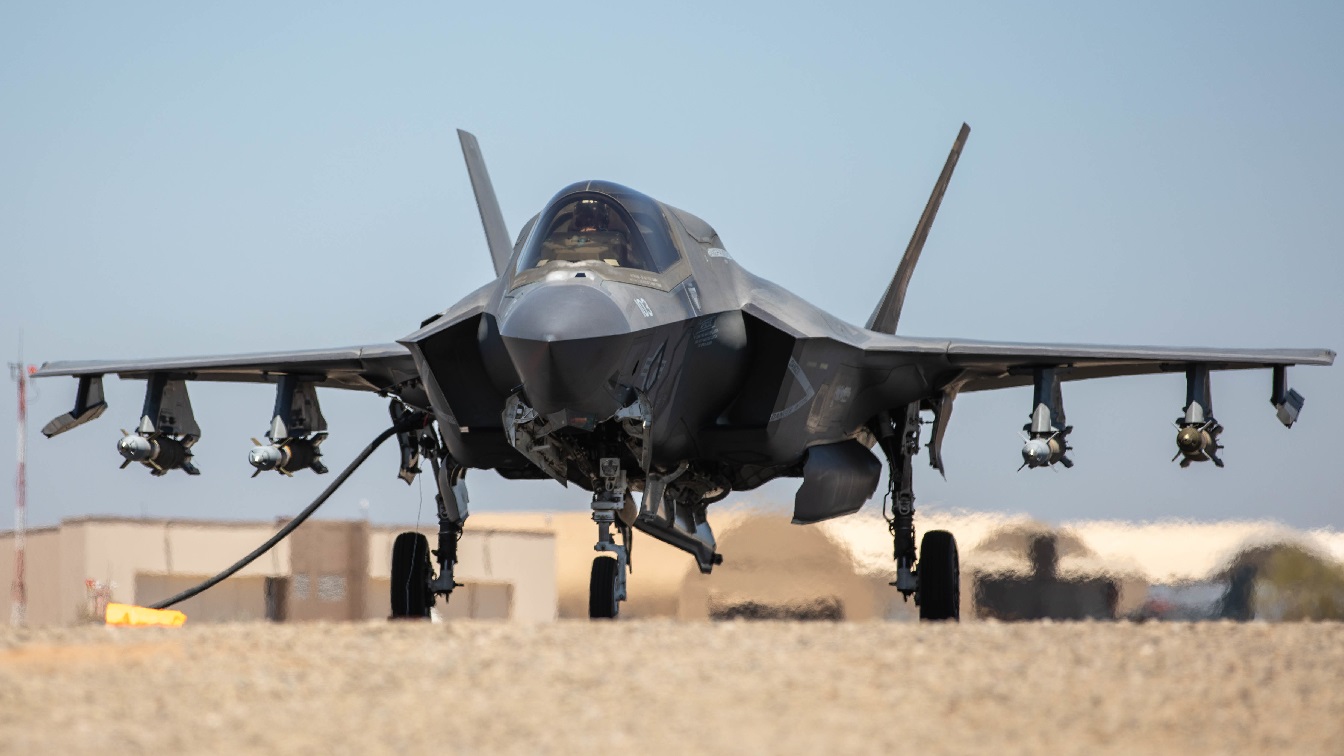
U.S. Marines with Marine Wing Support Squadron 371 , Marine Air Control Group 38, 3rd Marine Aircraft Wing (MAW), refuel a U.S. Marine Corps F-35B Lightning II with Marine Fighter Attack Squadron 225, Marine Aircraft Group (MAG) 13, 3rd MAW, on a Forward Arming and Refueling Point at U.S. Army Yuma Proving Grounds, Yuma, Arizona, May 23, 2022. The weapons configuration consists of six inert guided bombs, four mounted onto the wings and two loaded into the weapons bay, as well as an Air Intercept Missile 9X. Marine Aircraft Group 13 forces are capable of conducting offensive air support, anti-aircraft warfare, and aviation reconnaissance from expeditionary sites in any clime and place. (U.S. Marine Corps photo by Sgt. Samuel Ruiz)
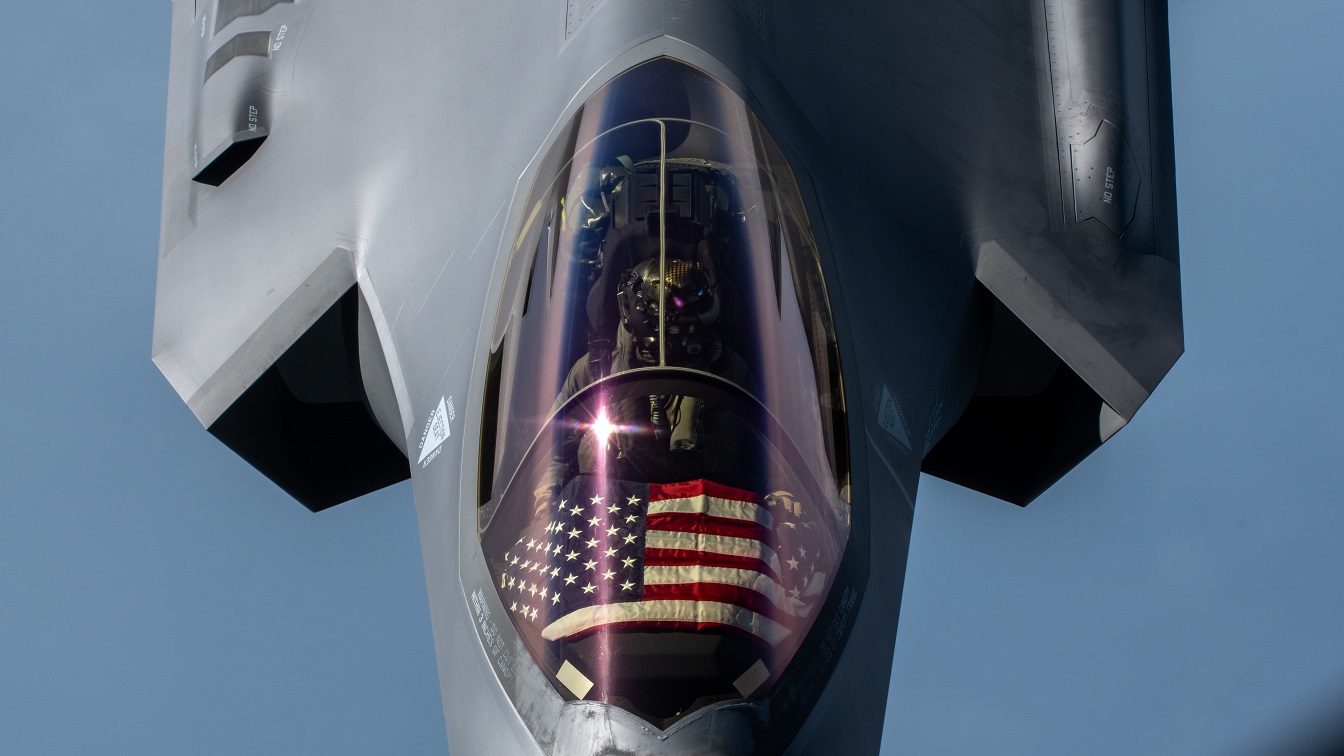
An F-35A Lightning II from the 354th Fighter Wing, Eielson Air Force Base, Alaska, flies behind a KC-135 Stratotanker assigned to the 117th Air Refueling Squadron, Forbes Field Air National Guard Base, Kansas, over the Indo-Pacific, March 10, 2022. Aircrews routinely fly missions aimed at sharpening the necessary skills needed to respond to emerging situations at a moment’s notice. (U.S. Air Force photo by Airman 1st Class Yosselin Perla)
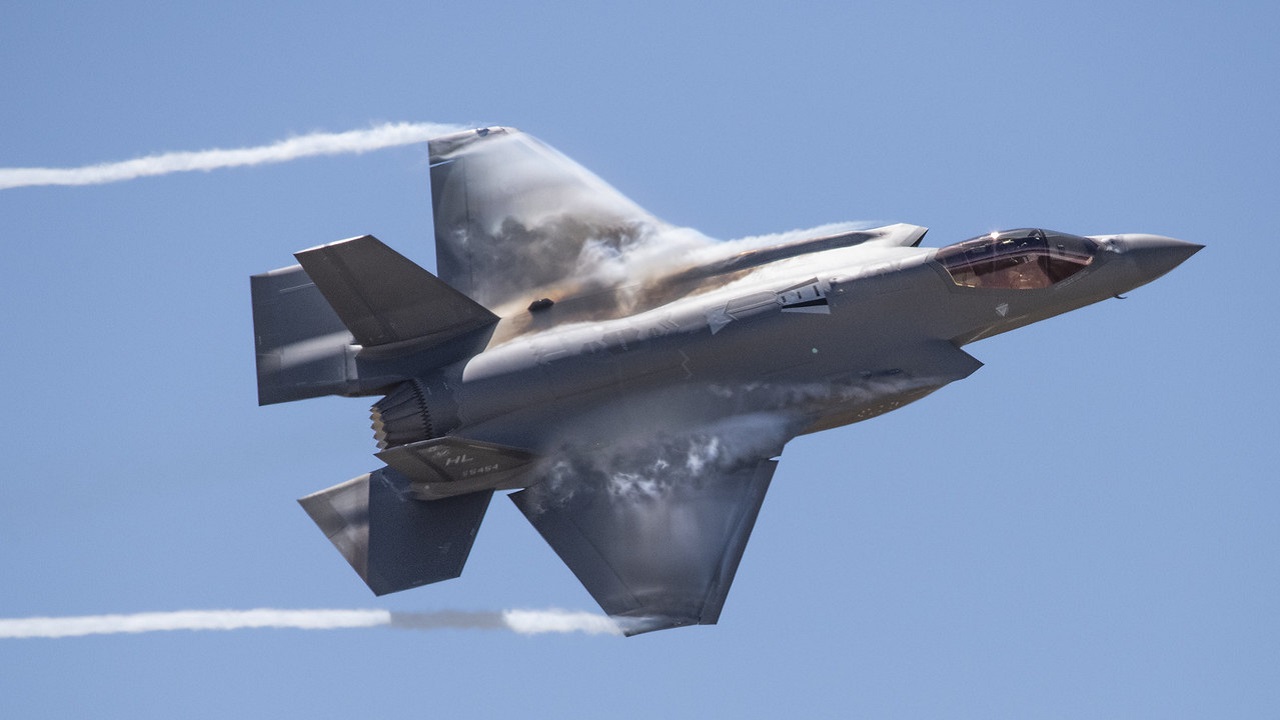
U.S. Air Force Maj. Kristin Wolfe, F-35A Lightning II Demonstration Team commander and pilot, showcases the unique aerial capabilities of the USAFs most advanced 5th generation multi-role stealth fighter, the F-35A, during Wings Over Solano at Travis Air Force Base, California, May 15, 2022. The Wings Over Solano open house and air show provided an opportunity for the local community to interact directly with the base and its Airmen and see capabilities on full display at Travis AFB. (U.S. Air Force photo by Heide Couch)
Yet there have been a few exceptional cases when 4th Gen beat 5th Gen in training exercises. One of the lucky few such Gen 4 warbirds to pull off such a feat was the F-16 Fighting Falcon (or as its own crews prefer to call it, the “Viper”), doing so against the F-35 Lightning II. So then, when, where, and how did the Viper pull off this seemingly next-to-impossible feat, and what lessons can be drawn from it?
Semantic/Nomenclatural Note
“Lightning II” is the American name for the F-35 as opposed to the Israeli one. However, you hardly hear anyone actually call it that conversationally as they do with, say, the F-22 Raptor or the F-15 Eagle.
Ironic Aside
Before we delve into the meat & potatoes of the story, yes, there is some definite irony in play here, as the F-16 and the F-35 are both Lockheed Martin products (granted, the F-16 started as a General Dynamics program, but that’s way in the past now).
However, the latter is a Skunk Works project, whilst the former, being non-stealth, is not.
The Scoop Part I: 2015
The first incident took place in 2015.
This part of the story comes to us from Stavros Atlamazoglou, whose name will sound familiar to 19FortyFive readers; however, his relevant article to our topic at hand was one that he wrote for The National Interest back on December 26, 2023, bluntly titled “Stop Saying An F-16 Can Defeat the F-35 Stealth Fighter.”
As can be implied from the title, the Viper’s “win” over Lightning II needs to be looked at in proper context and not blown out of proportion.
To wit:
“To begin with, the F-35 aircraft that was involved wasn’t a combat-ready jet but rather an aircraft designed to test flight qualities, in other words, to push the platform to its flight limits. As a flight-test aircraft, the F-35 didn’t have all the tech found in today’s operational F-35…One key piece of tech that was missing was the software that enabled an F-35 pilot to look at a target, lock it, and launch a missile at it by just pointing the helmet, regardless of which direction the aircraft was flying…A second reason why the results weren’t accurate is the timeframe. In 2015, the F-35 was still a brand-new aircraft undergoing testing. As a result, the Air Force, Marine, and Navy F-35 communities hadn’t had the time to develop tactics, techniques, and procedures for basic flight maneuvers, or dogfighting.”
Perspective, eh?
Even the best weapons systems go through their growing pains and teething phases.
Whilst the F-35 was the proverbial new kid on the block in 2015, the F-16 had already been around for 40+ years, having made its maiden flight back in 1974.
The Scoop Part Deux: 2017
Fast forward two years, and the F-35A was still fairly new on the scene, no longer an “infant” (metaphorically speaking) but definitely still a “toddler.”
The “toddler” F-35 and the “middle-aged” F-16 squared off against each other in the 17-01 edition of Red Flag, the U.S. Air Force’s premier air combat exercise, which takes place at Nellis AFB, Nevada (and celebrated its own 50th anniversary a year ago).
Now, mind you, to show you just how far the F-35A had come in such a short time, the F-35A attained a simulated kill ratio of anywhere from 15:1 to 20:1 (depending upon which source you consult).
Yet the nattering nabobs of negativism decided to focus on and sensationalize the “1” part of the ratio rather than the “15-20” part. And, yes the F-16 and its team used swarm tactics to beat the F-35 in combat.
However, once again, that needs to be viewed in proper context. In an anonymously written July 20, 2018 article for the Fighter Jets World website titled “That Time When F-16 Shot Down F-35A at Red Flag,” we get these insightful quotes from retired U.S. Marine Corps Maj. Dan Flatley, who helped design the training syllabus for F-35 dogfights: “’ When you first get in the F-35 and try to fight it visually, you immediately go back to everything you knew in your legacy fighter…If you try to fight it like a fighter it isn’t, you’re going to have terrible results.’”
In other words, unlike, say, dogfighters from World War II (e.g., the P-51D Mustang and P-47 Thunderbolt) all the way through the 1991 Persian Gulf (which saw the use of stealth warplanes like the F-117 Nighthawk for ground-attack but not air-to-air combat), the F-35 mainly focuses on flying undetected while using its array of fused sensors to paint a clear picture of the threat environment for miles out and to engage with targets before they’re ever seen.
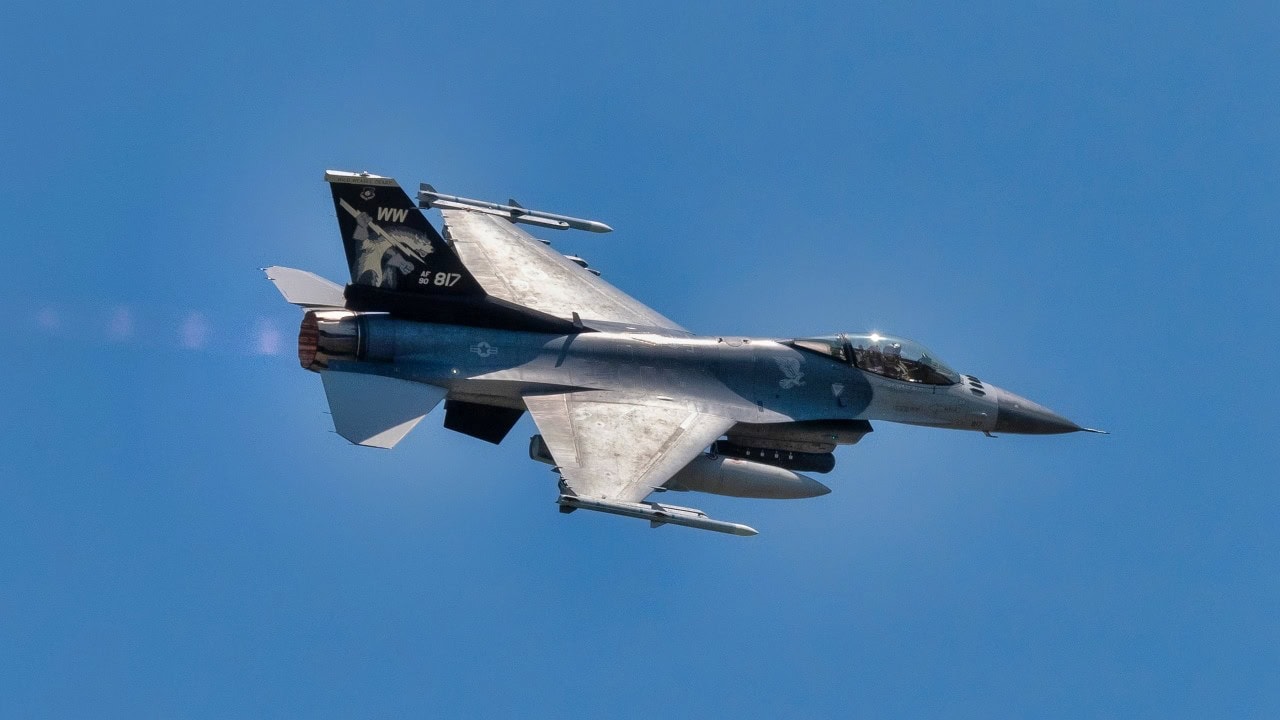
Capt. Charles “Static” Trader, both with the 13th Fighters Squadron F-16 pilots, performs an aerial demonstration in an F-16 Fighting Falcons during the Japanese-American Friendship Festival 2024 at Yokota Air Base, Japan, May 18, 2024. During two-day bilateral festival, The F-16 Fighting Falcon performs a multitude of aerial maneuvers during air festivals to showcase the ability and skill of the aircraft and pilot. (U.S. Air Force photo by Yasuo Osakabe)
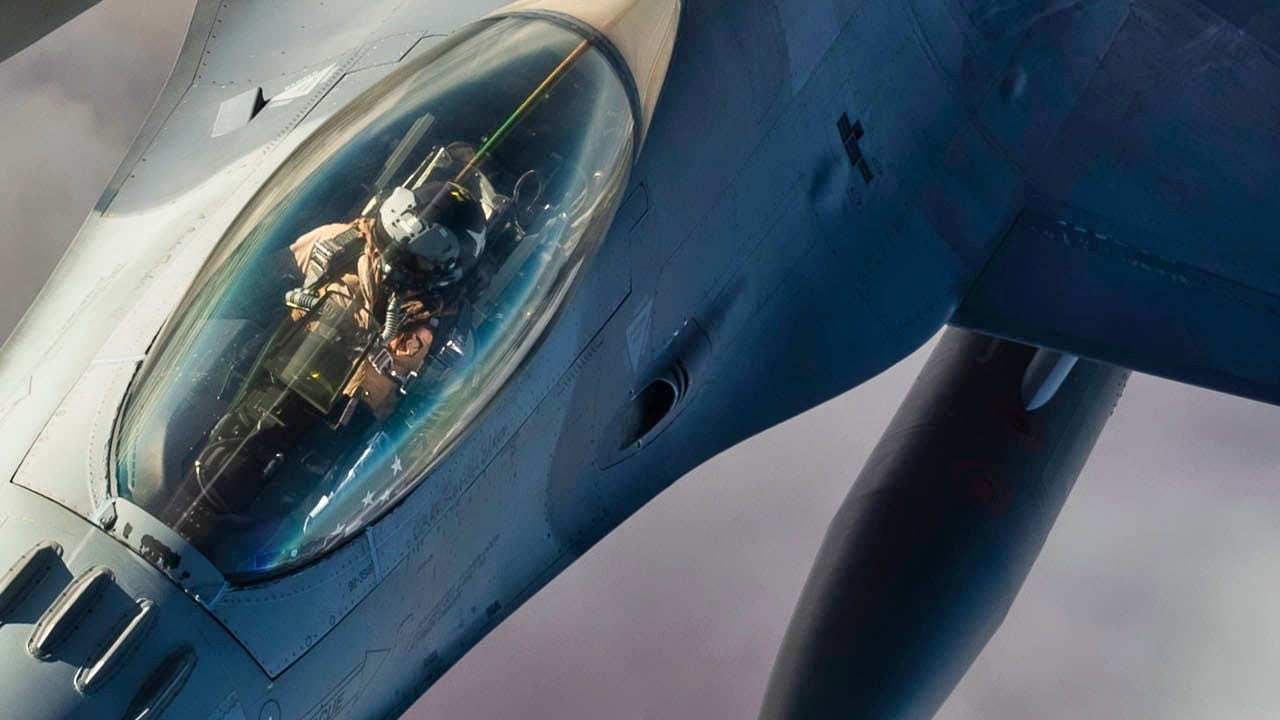
A U.S. Air Force F-16 Fighting Falcon is refueled over the U.S. Central Command area of responsibility Nov. 22, 2024. The F-16 avionics system includes highly accurate enhanced global positioning and inertial navigation systems in which computers provide steering information to the pilot. (U.S. Air Force photo by Staff Sgt. William Rio Rosado)

A U.S. Air Force F-16 Fighting Falcon aircraft pilot receives fuel from a KC-135R Stratotanker aircraft, assigned to the 340th Expeditionary Air Refueling Squadron, over Southwest Asia Feb. 26, 2021. The F-16 is a compact, multirole fighter aircraft that delivers airpower to the U.S. Central Command area of responsibility. (U.S. Air Force photo by Master Sgt. Joey Swafford)
Initially, the Skunk Works engineers unintentionally did the F-35 pilots a disservice, building flight controls with an incredible amount of automation, which Flatley said could make the plane “feel like it was fighting you,” or “feel like the hand of god pushing you in certain directions.”
Flatley and his fellow Lightning II drivers needed the ability to push their airplane right to the edge of its abilities — almost to the point where it would fall out of the sky because it hit slow speeds at insane angles — should they need to in a do-or-die dogfight.
Accordingly, Maj. (Ret.) Flatley flat-out told the engineers (in the blunt straightforward manner one would expect from a Marine Corps officer) that “’You guys are hand-holding us…We want more authority. I want to be able to throw my nose around if I need to,” referring to the warbird’s ability to point its front end at threats in order to better assess and target them.
Luckily, the Lockheed Martin eggheads listened to the good Major. And nine years later, F-35 drivers flying for America and Israel alike are better off for it.
About the Author: Christian D. Orr, Defense Expert
Christian D. Orr is a Senior Defense Editor. He is a former Air Force Security Forces officer, Federal law enforcement officer, and private military contractor (with assignments worked in Iraq, the United Arab Emirates, Kosovo, Japan, Germany, and the Pentagon). Chris holds a B.A. in International Relations from the University of Southern California (USC) and an M.A. in Intelligence Studies (concentration in Terrorism Studies) from American Military University (AMU). He is also the author of the newly published book “Five Decades of a Fabulous Firearm: Celebrating the 50th Anniversary of the Beretta 92 Pistol Series.”