

Summary and Key Points: Defense expert Stephen Silver notes that Iran has begun seeding the Strait of Hormuz with mines, and the two U.S. Navy ships specifically configured to sweep them are thousands of miles away in Asia.
-The USS Tulsa and USS Santa Barbara, Independence-class Littoral Combat Ships carrying the Navy’s mine countermeasures package, were spotted in Malaysia this week.
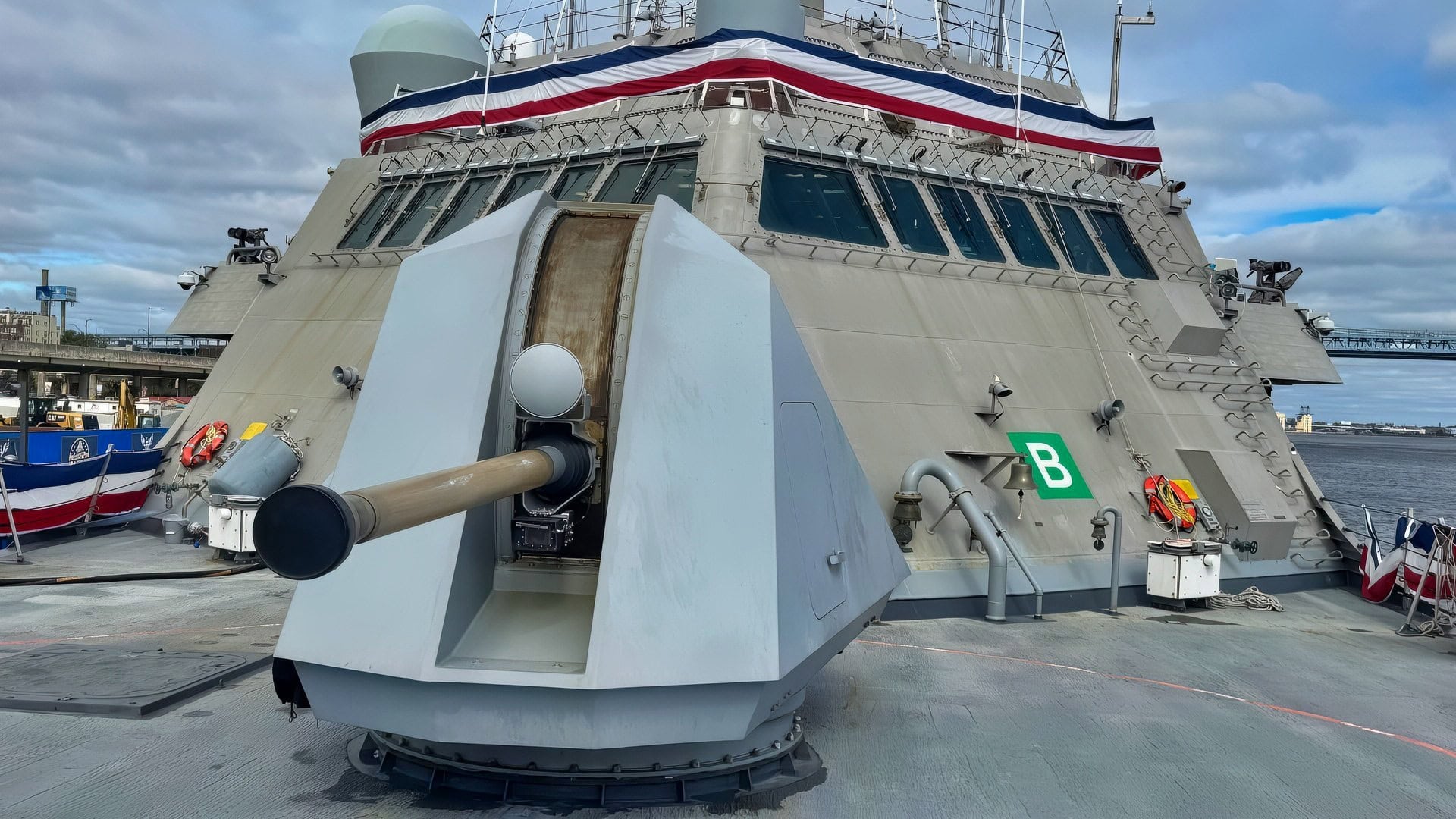
Littoral Combat Ship USS Cooperstown. Image Credit: 19FortyFive.com
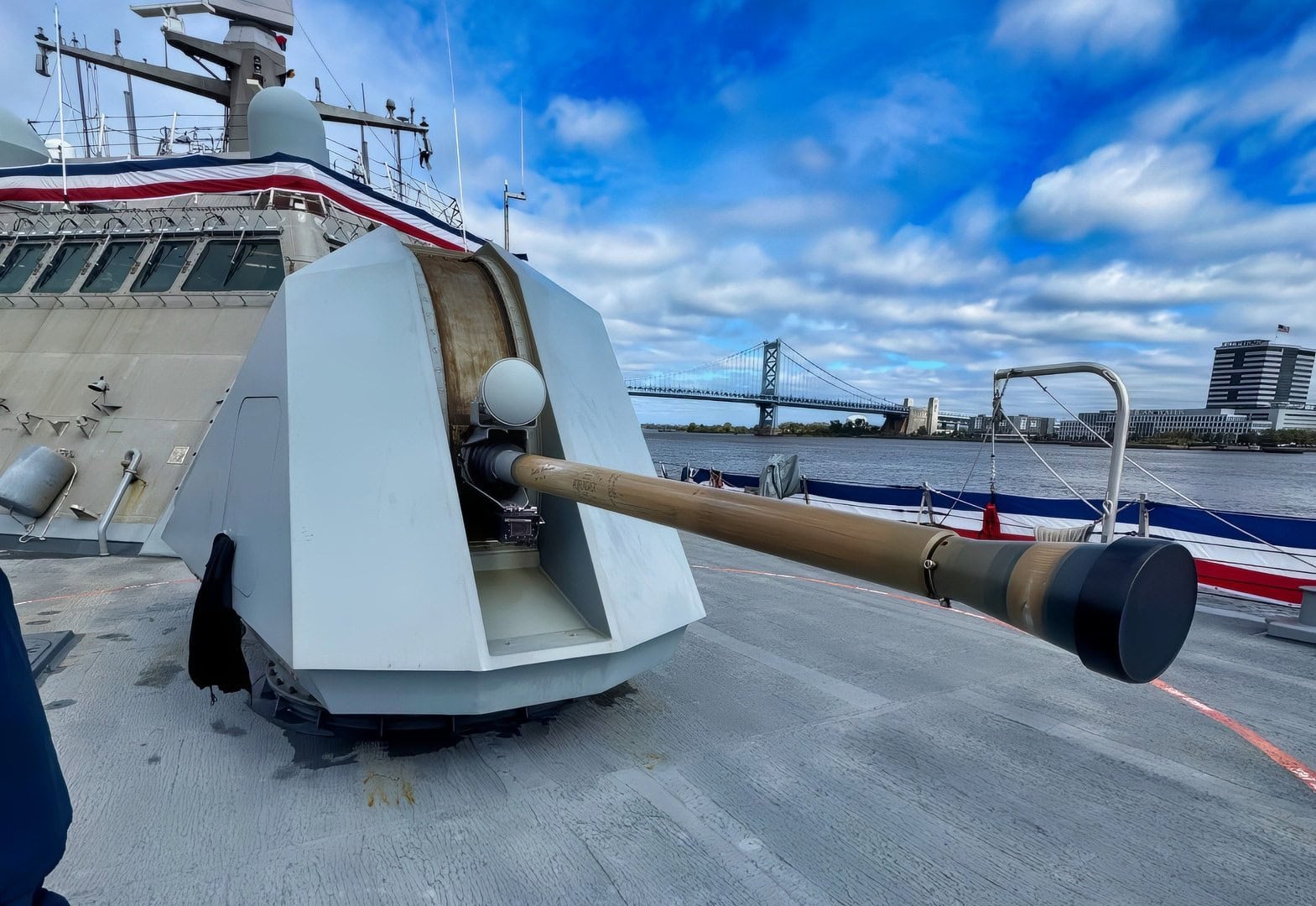
Littoral Combat Ship Deck Gun U.S. Navy. Image Credit: 19FortyFive.com
-Iran has over 5,000 naval mines in its arsenal, according to the Defense Intelligence Agency, and a doctrine built around exactly this scenario dating back to the 1987 Tanker War.
-The UK is sending minesweeping drones. NATO allies are refusing to help. The strait remains closed.
The Defense Intelligence Agency Says Iran Has 5,000 Naval Mines and a Doctrine Built Around Using Them — The U.S. Navy Is Not Positioned to Stop It
The Strait of Hormuz is currently closed, and there’s a possibility that the strait has been seeded with mines. But if the United States is going to remove such mines, there’s a problem: Its ships are in a different part of the world.
According to The War Zone (TWZ), the Independence-class Littoral Combat Ships (LCS) USS Tulsa and USS Santa Barbara, which are configured for minesweeping, are currently in Asia.
“Both of these ships were last known to be forward-deployed in the Middle East, having arrived in Bahrain in the past year or so to take the place of a group of now-decommissioned Avenger-class mine hunters,” TWZ reported. “Now, as Iranian attacks on commercial ships have caused a virtual halt to maritime traffic through the highly strategic Strait of Hormuz, these ships have emerged thousands of miles away.”
A spotter in Malaysia saw the ships there this week.
How the Littoral Combat Ship Mine Hunts
How do ships like that work? Well, I do have some insight, as I toured a Littoral Combat Ship last year, and I have two pictures above from that visit, as well as one just below.
“USS Tulsa and USS Santa Barbara are among a select number of Independence-class LCSs fitted with a mine countermeasures mission package, or ‘module,’” the War Zone said. “In its current form, the package includes towed mine-hunting sonar for the ships, Common Unmanned Surface Vehicles (CUSV) with mine-sweeping gear, and mine detection and neutralization systems carried by embarked MH-60 Sea Hawk helicopters.”

Littoral Combat Ship from Fleet Week 2025. Image Credit: Stephen Silver/19FortyFive.com
The Navy Times recently reported on the decommissioning last year of the mine countermeasure ships.
“The U.S. Navy decommissioned half of its Avenger-class mine countermeasure ships last year and began replacing them with littoral combat ships that possess anti-mine capabilities,” Navy Times reported.
“Naval mine warfare is a major tenet of Iran’s Islamic Revolutionary Guard Corps Navy military doctrine, according to a 2017 Office of Naval Intelligence report, and looks to be a factor in the ongoing Iran war.”
“The [littoral combat ship] MCM mission package is a sophisticated suite of manned and unmanned systems designed to locate, identify, and neutralize sea mines, at a safer distance from minefields than the Avenger-class MCMs,” a Navy official told Military Times.
The New York Times, this week, reported on “how Iran’s naval mines work.”
“Iran has strangled one of the world’s most critical shipping routes, the Strait of Hormuz, by threatening merchant ships and attacking tankers,” the Times reported. “But Iran also has more than 5,000 naval mines in its arsenal, according to estimates by the Defense Intelligence Agency. And Iran is beginning to deploy them, U.S. officials said.”
Of Naval mines more generally, per the Times, “Since World War I, militaries have developed a range of naval mines to harass and sink enemy ships. The most common are moored mines, warheads held just below the surface by a chain connected to a heavy anchor.
“In the bottom half of the spherical warhead are explosives, with a pocket of air above to provide buoyancy. Thick horns pointing outward contain devices that cause the mine to explode upon contact with a ship’s hull.”
Iran and Mine Warfare
The Office of Naval Intelligence report referenced one incident that took place in 1987, near the end of the Iran-Iraq War.
“In July 1987, the U.S. Navy was officially drawn into the conflict and began escorting Kuwaiti tankers that had been reflagged as U.S. vessels. The first such tanker, the Bridgeton, struck a mine 22 miles off of Farsi Island. U.S. Navy escorts noted significant small boat activity off of Farsi island hours before the mine strike, but failed to detect mine-laying. The Bridgeton attack represented the opening salvo between the United States and Iran.
“Two months later in September, the U.S. Navy detected an Iranian LSM, Iran Ajr, laying mines in a shipping channel near Bahrain. In response, the Iran Ajr was attacked by U.S. helicopters, boarded by Navy SEALs, and scuttled in the Persian Gulf. In response, Iran temporarily halted mine-laying operations, but the Tanker War continued.”
That wasn’t the last usage of mines by Iran, per that 2017 report from the Office of Naval Intelligence.
“Naval mines are a critical component of the IRGCN’s [Islamic Revolutionary Guard Corps Navy] strategy in the Strait of Hormuz and the Persian Gulf. It realized the impact mines made during the Tanker War and Operation Desert Storm and invested in new mines and mine delivery vessels. The IRGCN has a large inventory of mines, including contact and influence mines,” the report said.
Who Will Help Open the Strait of Hormuz?
According to The Guardian, the U.K. has agreed to send minesweeping drones to help open the Strait of Hormuz.
“Ministers are drawing up plans to send minesweeping drones to the Strait of Hormuz amid concerns in Whitehall that complying with Donald Trump’s demand to send ships could escalate the crisis,” the Guardian report said.
“The government is considering dispatching aerial minesweepers to help clear the vital waterway of mines in an attempt to allow the flow of oil exports to resume. However, officials said that sending ships, as requested over the weekend by the US president, could worsen the situation given the volatile nature of the war.”
“We will continue to work towards a swift resolution of the situation in the Middle East. Because there is no question that ending the war is the quickest way to reduce the cost of living,” Prime Minister Kier Starmer said this week, in comments released by his office.
Meanwhile, President Donald Trump complained on Truth Social Tuesday that most NATO allies had rejected the call to help with the Iran mission.
“The United States has been informed by most of our NATO ‘Allies’ that they don’t want to get involved with our Military Operation against the Terrorist Regime of Iran, in the Middle East, this, despite the fact that almost every Country strongly agreed with what we are doing, and that Iran cannot, in any way, shape, or form, be allowed to have a Nuclear Weapon,” the president said in his social post.
“I am not surprised by their action, however, because I always considered NATO, where we spend Hundreds of Billions of Dollars per year protecting these same Countries, to be a one way street — We will protect them, but they will do nothing for us, in particular, in a time of need.”
About the Author: Stephen Silver
Stephen Silver is an award-winning journalist, essayist, and film critic, and contributor to the Philadelphia Inquirer, the Jewish Telegraphic Agency, Broad Street Review, and Splice Today. The co-founder of the Philadelphia Film Critics Circle, Stephen lives in suburban Philadelphia with his wife and two sons. For over a decade, Stephen has authored thousands of articles that focus on politics, national security, technology, and the economy. Follow him on X (formerly Twitter) at @StephenSilver, and subscribe to his Substack newsletter.