
Summary and Key Points: Dr. Andrew Latham, a Defense Priorities fellow and professor at Macalester College, evaluates the maritime opening of a potential U.S.-Iran conflict.
-With Iran’s Kilo-class and indigenous Fateh and Ghadir submarines optimized for the shallow, confined waters of the Strait of Hormuz, this 19FortyFive report analyzes the disruption of U.S. Navy tempo.
-The analysis explores how diesel-electric stealth forces American commanders to prioritize Sea Control and Mine Countermeasures (MCM) over initial strike missions, evaluating the temporal window where asymmetric undersea threats exert the most influence before U.S. ASW assets consolidate dominance.
The Hormuz Chokepoint: How Iran’s Submarine “Mosquito Fleet” Could Delay U.S. Navy Sea Control
If fighting breaks out between the United States and Iran, the Strait of Hormuz will become a contested battlespace almost at once. American strikes against Iranian targets would be followed quickly by a scramble to secure sea lanes through one of the world’s most constrained waterways.
Naval forces already present in the region would not have the luxury of waiting for the air campaign to settle before confronting risk below the surface. Sea control in those waters would be an immediate operational requirement, not a downstream objective. That reality puts Iran’s submarine fleet squarely in the frame from the outset.
Tehran’s submarines would not overturn the balance of power at sea. The U.S. Navy would retain clear structural advantages. Yet in the confined waters of the Gulf and the Strait, even a modest undersea force can slow the consolidation of control at a moment when tempo matters most. Commanders would be required to secure defined sea space before they could operate there with confidence, and that sequencing carries consequences.
The Submarine Force Iran Brings to Sea
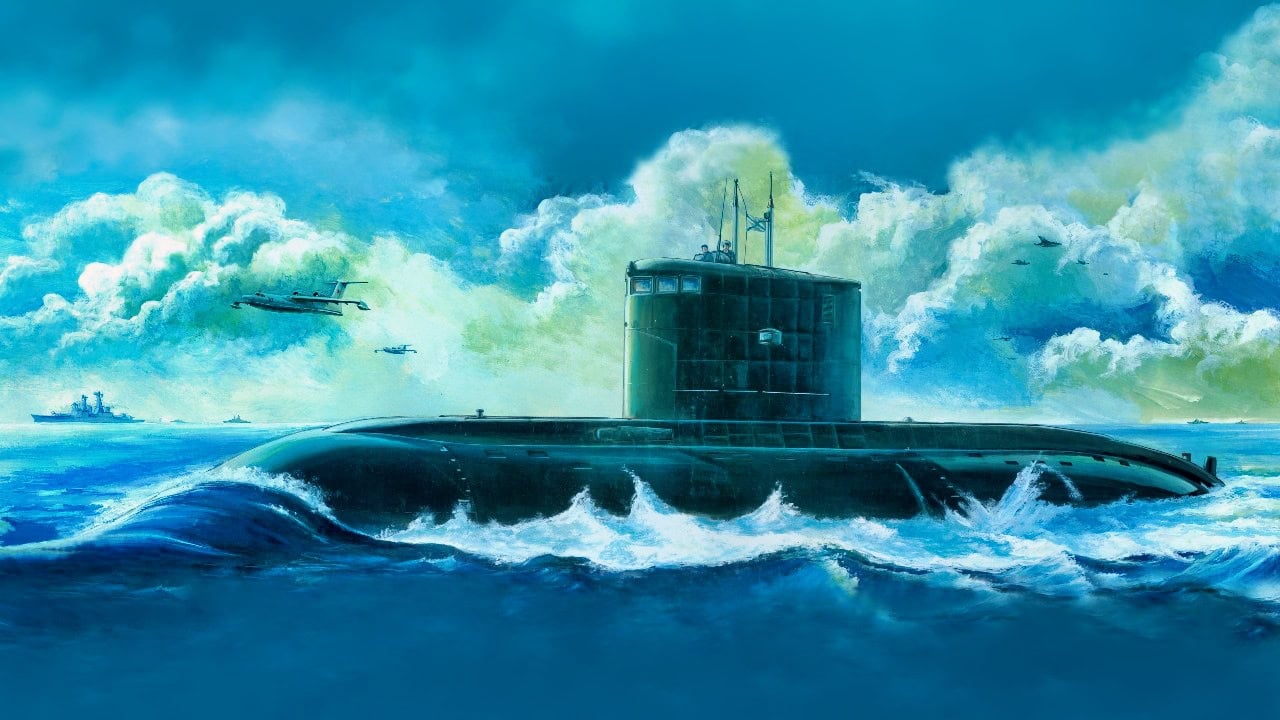
Iran’s submarine fleet was never meant for sustained patrols far from home waters. At its core are three Russian-built Kilo-class boats, supplemented by a small number of Fateh-class submarines constructed domestically. Alongside them operate roughly two dozen Ghadir boats built for shallow, confined environments. All rely on diesel-electric propulsion, which places clear limits on underwater endurance and operational reach.
Those limits shape how the force would be used in practice. A diesel-electric boat must manage its battery cycle carefully, which affects how long it can remain submerged before snorkeling becomes necessary and constrains the pace of extended operations. Yet when operating quietly on battery power in confined waters, especially in the Strait and the Gulf, these submarines are not simple targets.
Their configuration reflects a deliberate choice to trade range for suitability in a geographically compressed battlespace.
First Moves Under Fire
If hostilities begin, Iranian submarines would likely put to sea early, as remaining in port would expose them to preemptive strikes. Dispersal into congested waters provides concealment, or at least uncertainty.
Their task would not be to hunt carriers in the open ocean. It would be too complicated to move inside confined sea lanes. That could involve laying mines in high-traffic areas, positioning for opportunistic torpedo engagements, or simply operating in ways that force U.S. commanders to assume submarine presence even when contact is uncertain. A confirmed hit would be dramatic. A persistent but ambiguous undersea threat would be disruptive in quieter ways.
In the first week of war, that uncertainty would matter. U.S. vessels transiting the Strait could not assume the undersea picture was clear. Routes would be adjusted to hedge against risk. Escorts would spend more time searching and less time simply accompanying traffic. Even as strike operations ashore continued, senior commanders would devote steady attention to securing the sea itself.
Sea Control as a Precondition
The United States would almost certainly pursue objectives on land, degrading missile forces and military infrastructure.
Yet those efforts unfold alongside a maritime requirement that cannot be ignored. Securing the Strait of Hormuz is not merely symbolic. It is a prerequisite for sustained operations and for protecting commercial traffic moving through one of the world’s most sensitive chokepoints.
That requirement incurs a resource cost. Maritime patrol aircraft would spend more time on station than originally intended, and helicopters embarked on surface combatants would find that anti-submarine search would crowd out other duties. U.S. attack submarines would shift toward counter-hunting in the theater rather than operating more flexibly.
If mining were suspected, even on a limited scale, specialized countermeasure forces would have to be positioned forward and protected. The broader campaign would continue, but its tempo would increasingly be shaped by the effort required to secure the maritime domain before pressing advantages elsewhere.
Geography and Constraint
The Strait is narrow and, in places, relatively shallow, with depths often measured in the low hundreds of feet and strong currents complicating navigation. Commercial density adds further complexity. Distinguishing hostile activity from routine maritime traffic is not trivial in such an environment.
Iran’s smaller submarines are optimized for these conditions. They do not require long-range endurance to be relevant. They need only enough survivability to operate within a compressed window when American forces are balancing strike missions with sea-control requirements. In that period, even a limited undersea capability can exert an influence disproportionate to its size.
The Limits of the Threat
There are clear boundaries to this effect. Once the United States concentrates anti-submarine assets in the theater, the operating environment becomes harsher for Iranian boats. Persistent surveillance reduces safe maneuver space. Intelligence improves with time. The opportunity for surprise narrows.
Diesel-electric submarines in tight waters are formidable when they are unseen. Once tracked, the picture changes. They cannot match the sustained speed of nuclear boats, and battery endurance sets hard limits if the pressure does not ease. In a prolonged hunt inside a bounded sea, those limits narrow their options, and the danger mounts.
This temporal dimension is essential to a balanced judgment. Iran’s submarines would matter most in the early phase of war, when uncertainty is highest and American operational priorities are still settling. Their influence would diminish as U.S. forces impose greater control over the maritime domain.
So: Threat or Not?
In a shooting war, Iran’s submarine force would represent a real but bounded threat. It could delay the consolidation of sea control and require the dedication of anti-submarine resources at precisely the moment Washington would prefer to concentrate elsewhere. In the opening phase of a conflict fought in confined waters, that effect is not trivial.
What it cannot do is prevent the United States from establishing maritime superiority once sufficient assets are committed, and the operating environment tightens. It does not offer Tehran a durable path to sustained sea denial against a focused American response. Its leverage lies in disruption rather than endurance.
That distinction matters. In wars fought in confined geography, the early days often shape the trajectory that follows. Iran’s submarines would exert their influence in that narrow window. After that, the balance of power would reassert itself.
About the Author: Dr. Andrew Latham
Andrew Latham is a non-resident fellow at Defense Priorities and a professor of international relations and political theory at Macalester College in Saint Paul, MN. You can follow him on X: @aakatham. Dr. Latham writes a daily column for 19FortyFive.