Summary and Key Points: Dr. Rebecca Grant, Vice President of the Lexington Institute, evaluates the defensive resilience of the USS Abraham Lincoln (CVN-72) during the opening salvos of Operation Epic Fury.
-Amidst false IRGC claims of a successful ballistic missile strike, Grant analyzes the layered defense provided by Carrier Air Wing 9, specifically the E-2D Hawkeye’s early warning capabilities and the Space Force’s infrared launch detection.
-This 19FortyFive report explores the integration of SM-3 and SM-6 interceptors from the Aegis fleet, concluding that Iran’s unguided saturation tactics remain ineffective against the Navy’s sophisticated electromagnetic warfare and shock-tested double hulls.
Why Iran’s Claim of Striking the USS Abraham Lincoln Aircraft Carrier is Logistically Impossible
More than 900 strikes in the first 24 hours by U.S. forces alone make Operation Epic Fury the most sophisticated air campaign ever executed. Iran has countered with drones and ballistic missiles targeting Gulf states and U.S. bases across the region.
Most are intercepted, but tragically, one attack took the lives of three U.S. service members and injured others. U.S forces are continuing their offensive, but Operation Epic Fury is also proving to be a large-scale test of defensive operations.
Iran’s systems are not highly accurate, and their strikes have centered on large, pre-surveyed land targets.
However, on Saturday, Iran made the wild claim to have struck a U.S. aircraft carrier after launching four ballistic missiles.
U.S. Central Command called it out immediately. “Iran’s IRGC claims to have struck USS Abraham Lincoln with ballistic missiles,” CENTCOM posted on X. “LIE. The Lincoln was not hit. The missiles launched didn’t even come close. The Lincoln continues to launch aircraft in support of CENTCOM’s relentless campaign to defend the American people by eliminating threats from the Iranian regime.”

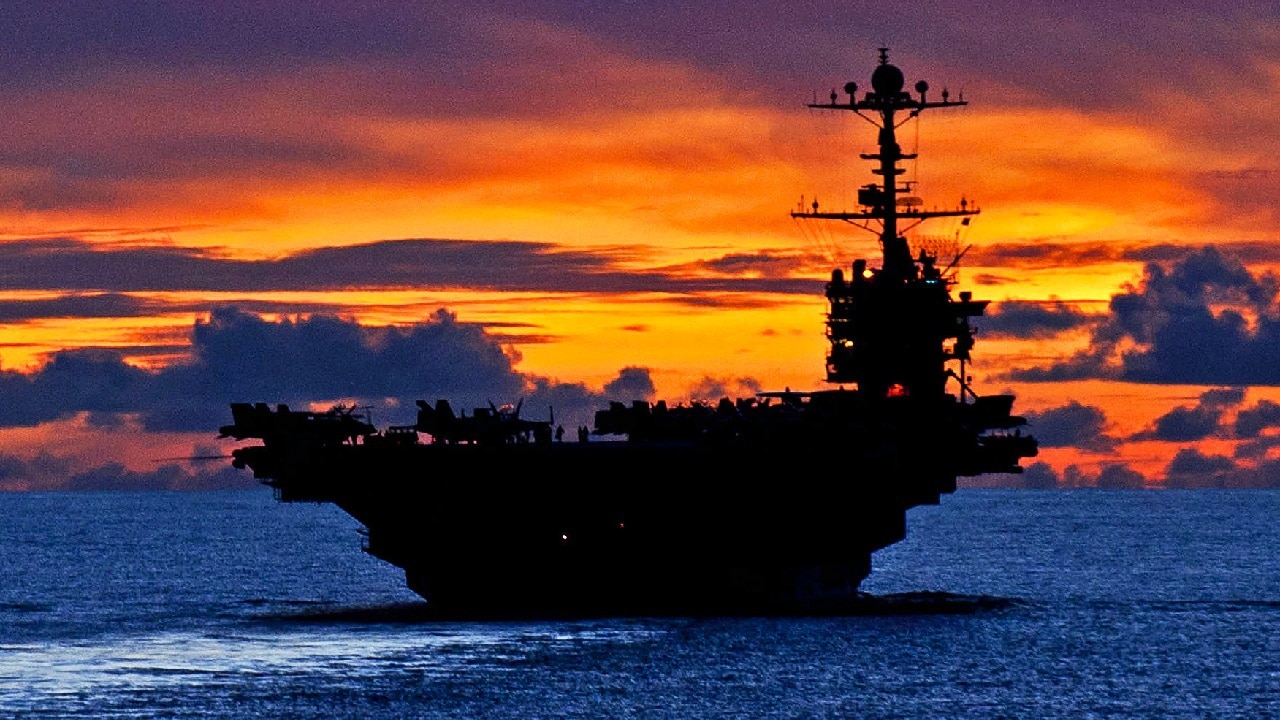
120511-N-WO496-003 STRAIT OF HORMUZ (May 11, 2012) Guided-missile cruiser USS Cape St. George (CG 71) and aircraft carrier USS Abraham Lincoln (CVN 72) transit the Strait of Hormuz. Both ships are deployed to the U.S. 5th Fleet area of responsibility conducting maritime security operations, theater security cooperation efforts and support missions as part of Operation Enduring Freedom. (U.S. Navy Photo by Mass Communication Specialist 3rd Class Alex R. Forster/Released)
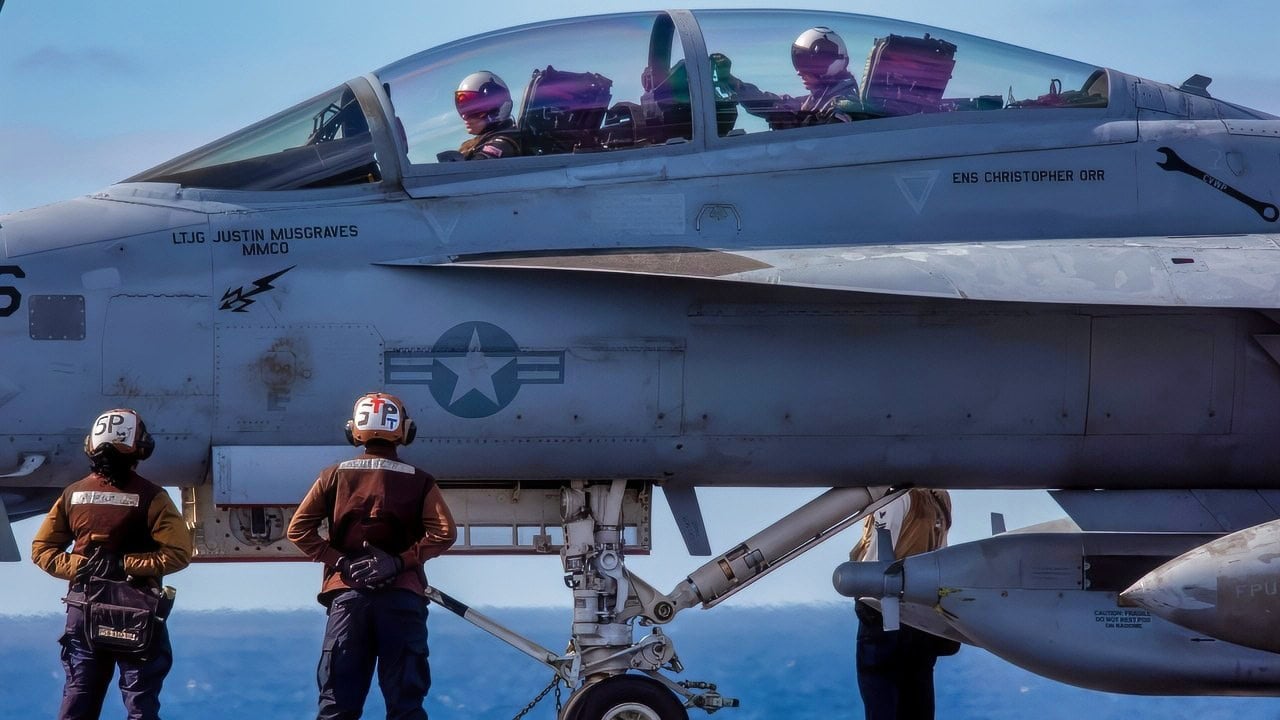
U.S. Navy Sailors prepare to taxi an EA-18G Growler, attached to Electronic Attack Squadron (VAQ) 133, on the flight deck of Nimitz-class aircraft carrier USS Abraham Lincoln (CVN 72) on Nov. 24, 2025. USS Abraham Lincoln (CVN 72), flagship of the Abraham Lincoln Carrier Strike Group, is underway conducting routine operations in the U.S. 3rd Fleet area of operations, demonstrating the U.S. Navy’s long-term commitment to a free and open Indo-Pacific. (U.S. Navy photo by Mass Communication Specialist Seaman Daniel Kimmelman)
The nuclear-powered USS Abraham Lincoln (CVN-72) is operating in the North Arabian Gulf, just outside the Strait of Hormuz. The USS Gerald R. Ford (CVN-78) rushed in from the Caribbean and was last spotted in the Eastern Mediterranean. Several carriers have rotated through CENTCOM since Oct. 7, 2023. Iran, along with China, boasts it has capabilities to target an aircraft carrier.
Iran Sinking a U.S. Navy Aircraft Carrier? Not A Chance
Here’s why Iran’s claim was ludicrous.
For starters, the U.S. Space Force detects the heat from the launch of Iran’s ballistic missiles. Detection and determination of missile type and trajectory begins the process of passing data to form the targeting track for interception.
The launch was likely also spotted by the Lincoln’s own E-2Ds Hawkeyes. Carrier Air Wing 9 aboard the Lincoln consists of eight squadrons flying F-35Cs, F/A-18E/Fs, EA-18G Growlers, E-2D Hawkeyes, CMV-22B Ospreys and MH-60R/S Sea Hawks.
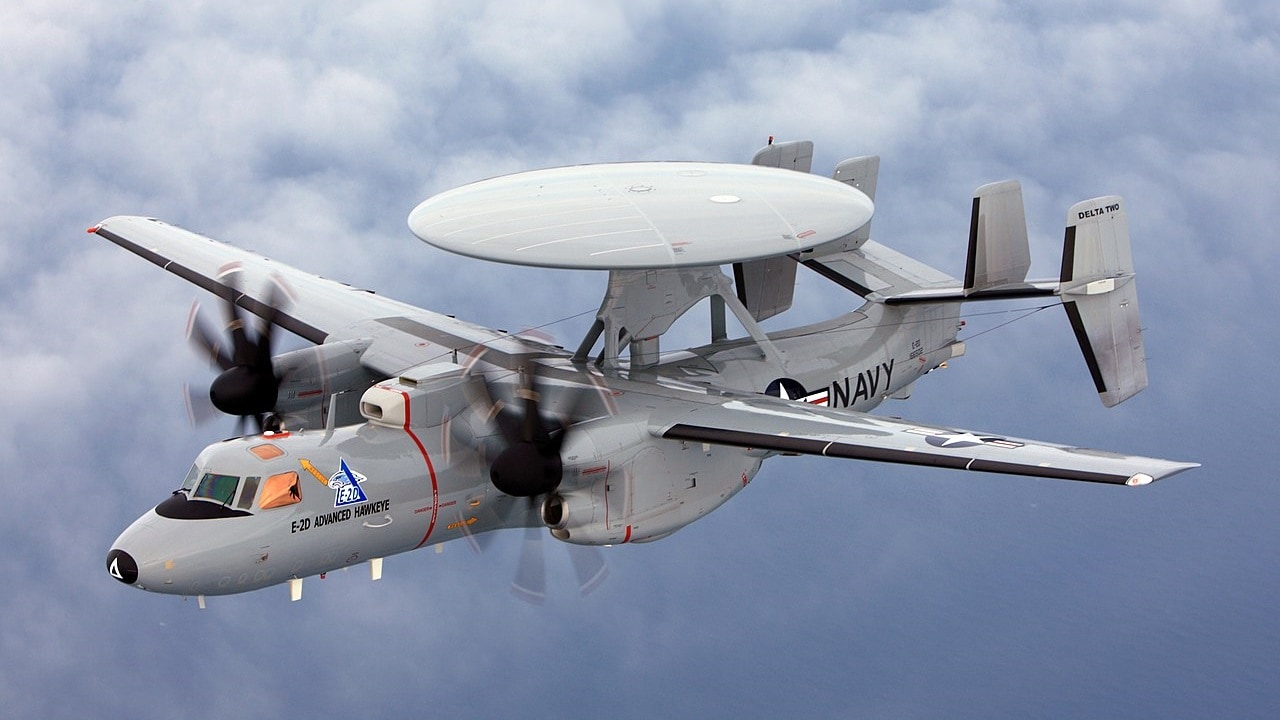
Dec. 9, 2009) E-2D Advanced Hawkeye aircraft conduct a test flight near St. Augustine, Fla. (Photo Courtesy Northrop Grumman/Released).
Few sing the praises of the Navy’s carrier-based radar plane, but its mission is critical. The E-2D, the newest version of the Hawkeye, has more powerful engines, an upgraded radar, and aerial refueling capacity for more time on station. The E-2D is optimized for theater air and missile sensing and early warning. As far back as 2012, the E-2D cut its teeth tracking drones and fighter-sized targets, even in the murk of maritime radar clutter. The E-2Ds proved their value in 2023–25 Red Sea operations against Iran-backed Houthi threats, and it turned out to be excellent preparation for Operation Epic Fury.
Once the Iranian ballistic missile track was established, defense and shot decisions flowed to CENTCOM’s team for integrated air and missile defense. No one (outside of Ukraine) is better versed in real-world missile defense. “Unique to US CENTCOM, U.S. forces face lethal air and missile threats from Iranian forces and their proxies who have conducted (and continue to conduct) attacks against American troops,” U.S. Army Colonel Glenn A. Henke wrote in Military Review in 2024.
Mindful of the escalating threat, the Combined Air Operations Center (CAOC) at Al Udeid opened a new missile defense cell for coordination with regional partners on January 13. The CAOC forms the air picture, including ballistic-missile tracks. “This is a significant step forward in strengthening regional defense cooperation,” says Admiral Brad Cooper, commander of CENTCOM. “This cell will improve how regional forces coordinate and share air and missile defense responsibilities across the Middle East.”
From their perch, the trajectory projection would show CENTCOM and the carrier strike group if the Lincoln was in danger or not.
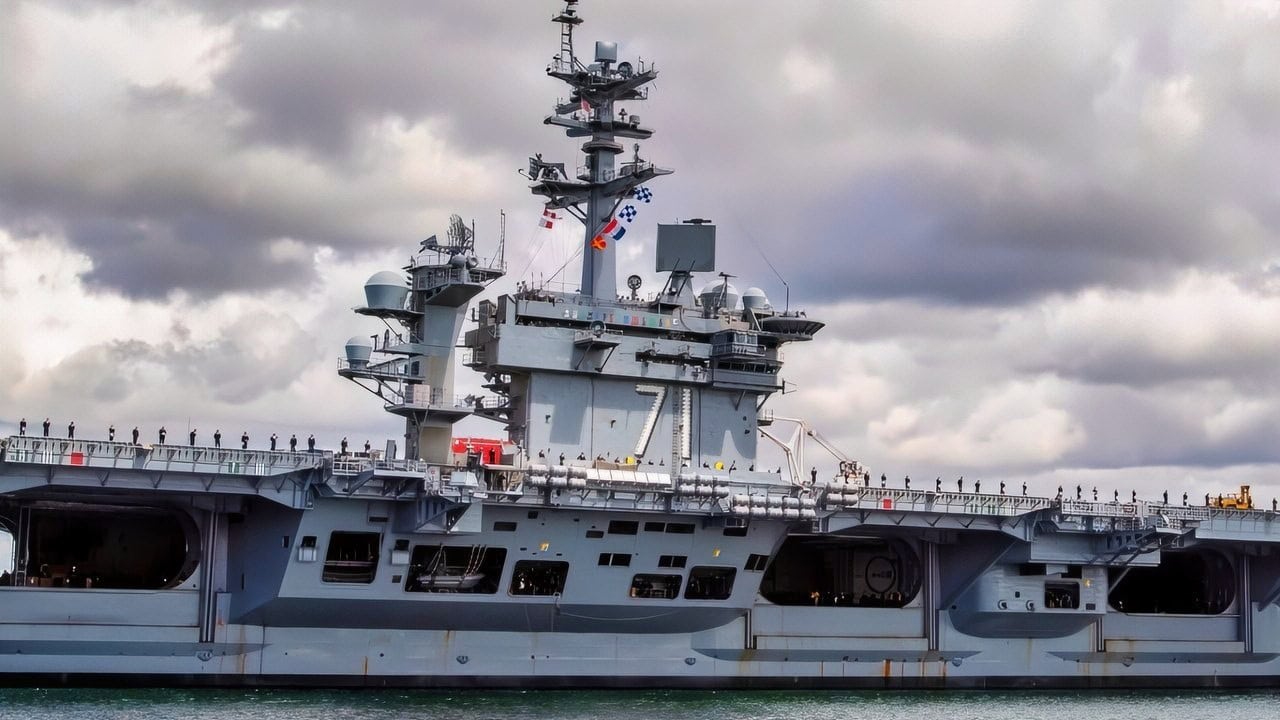
(March 23, 2023) Nimitz-class aircraft carrier USS Theodore Roosevelt (CVN 71) returns to Naval Air Station North Island following a regularly-scheduled maintenance availability and completion of sea trials, March 23. The ship changed its homeport from Bremerton to San Diego after completing an 18-month docking planned incremental availability in Bremerton, Washington, during which the ship received extensive restorations and upgrades to support the F-35C Lightning II, E-2D Advanced Hawkeye, and CMV-22B Osprey, as well as future platforms such as the MQ-25 Stingray unmanned aircraft system. (U.S. Navy photo by Mass Communication Specialist 2nd Class Keenan Daniels)
In all likelihood, the Iranians never really knew where the Lincoln was. Carriers practice forms of electromagnetic warfare that deceive adversary missile targeting. They are also maneuvering targets. With a top speed of 35 knots, the Lincoln would move quite a distance during the time of flight of a ballistic missile. The tight distances of the Middle East make this challenging, but quite likely the ballistic missiles fell miles away from the carrier.
Of course, Aegis destroyers also are in place with Standard Missiles ready to take out any missile heading toward the carrier. The Standard Missile (SM) 3 family accomplishes an exo-atmospheric kill at 65,000 feet. A couple of go-for-broke Iranian missiles were never going to get through the guided missile cruiser and the destroyer squadron of Carrier Strike Group 3.
The Navy is constantly improving its sea-based defense against ballistic missiles and now has the ability to intercept in terminal flight as well as mid-course. In May 2025, the Navy destroyer USS Thomas Hudner (DDG-116) successfully engaged a short-range ballistic missile with an SM-6 in a live-fire Sixth Fleet exercise in European waters.
Chances are the Lincoln stood down from that threat as Iran’s missiles went in the air. However, carriers do also have an array of close-in defenses. Carrier Air Wing 9’s F/A-18EFs and F-35Cs are capable of handling incoming drones and swerving cruise missiles. An F-35C from the Lincoln shot down an Iranian drone on February 3; an Israeli F-35 shot down a Houthi cruise missile in late 2023.
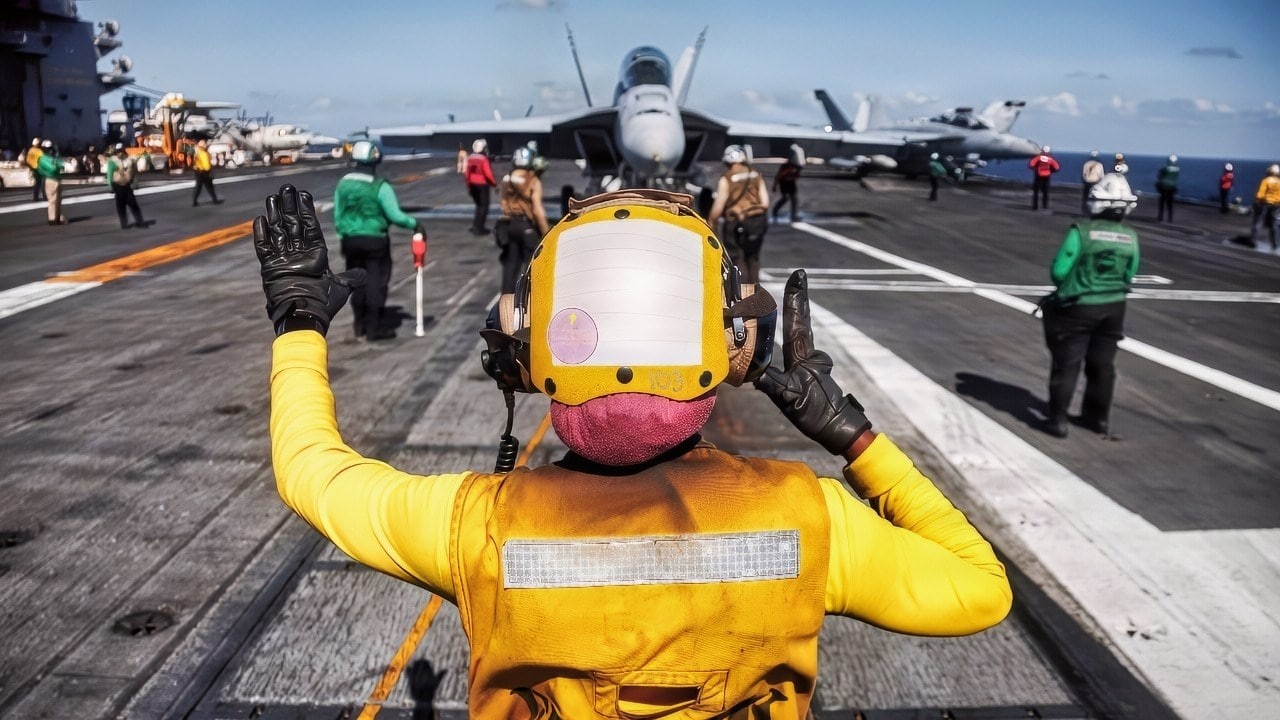
A U.S. Sailor signals to an F/A-18F Super Hornet aircraft, attached to Strike Fighter Squadron 213, on the flight deck of the world’s largest aircraft carrier, Ford-class aircraft carrier USS Gerald R. Ford (CVN 78), while underway in the Caribbean Sea, Feb. 5, 2026. U.S. military forces are deployed to the Caribbean in support of the U.S. Southern Command mission, Department of War-directed operations, and the president’s priorities to disrupt illicit drug trafficking and protect the homeland. (U.S. Navy photo)
Don’t forget the carrier itself has a blast-resistant double hull. In 2021, the Ford completed Full Ship Shock Trials, withstanding 40,000 pounds of blast from less than 75 yards. That’s the equivalent, by weight, to the warheads on 30 of China’s DF-21-type missiles. Advantage: U.S. Navy.
About the Author: Dr. Rebecca Grant, Lexington Institute
Dr. Rebecca Grant (Follow Her on X: @rebeccagrantdc), Vice President of the Lexington Institute, is a national security analyst based in Washington, DC, specializing in defense and aerospace research and national security consulting. She has researched and published hundreds of articles on national security and spoken at numerous forums. In addition, Dr. Grant has often appeared on television as an expert on national security for Fox News, Fox Business, CNN, and MSNBC and as a series regular on The Smithsonian’s Air Warriors. Dr. Grant also writes on China, Russia and other technology and national security topics for Fox News Opinion. Her military books include 75 Great Airmen (with Lt. Gen. Chris Miller), The B-2 Goes to War, and Battle-Tested: Aircraft Carriers in Afghanistan and Iraq. Dr. Grant graduated from Wellesley College and earned a PhD in International Relations from the London School of Economics, University of London.