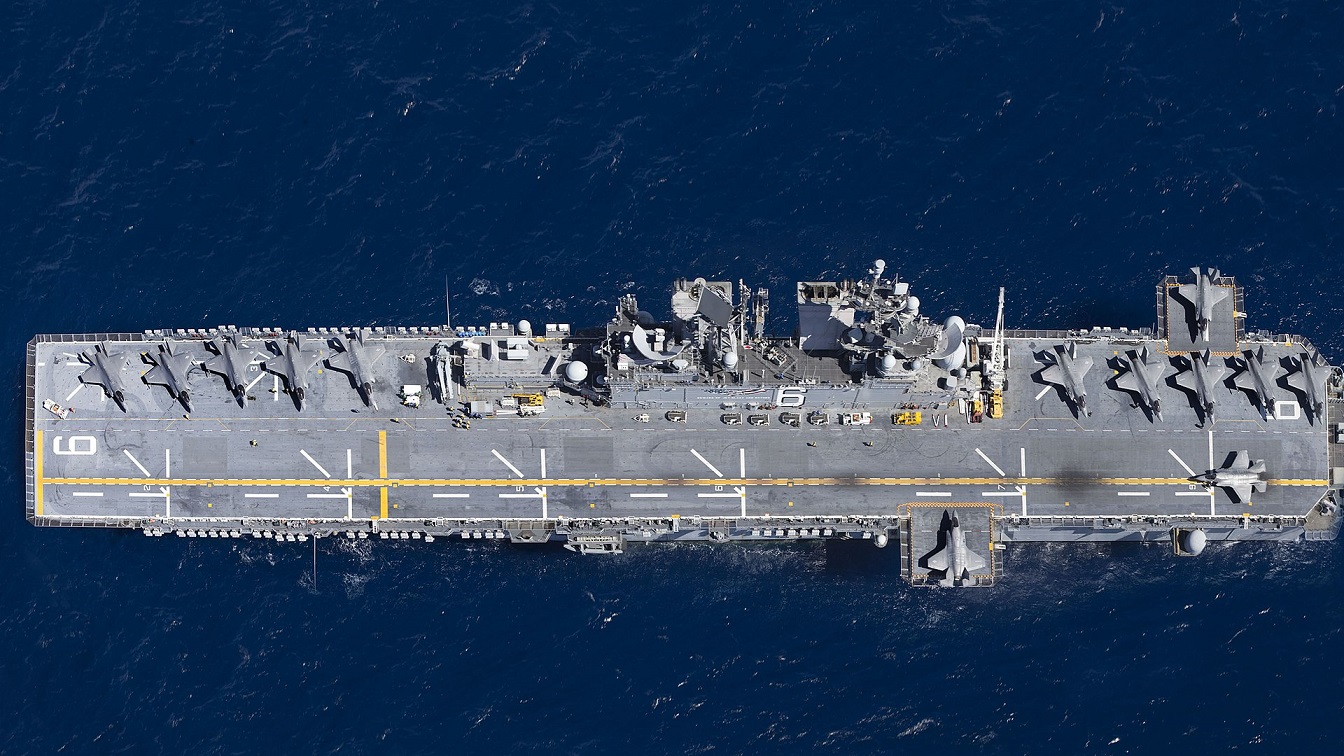
Summary and Key Points: Defense analyst Caleb Larson evaluates the America-class amphibious assault ships, highlighting the transition from the aviation-centric Flight 0 to the balanced Flight 1 design.
-The USS Bougainville (LHA-8) marks a strategic return to the well deck, correcting the “crimped capabilities” of its predecessors, the USS America and USS Tripoli.
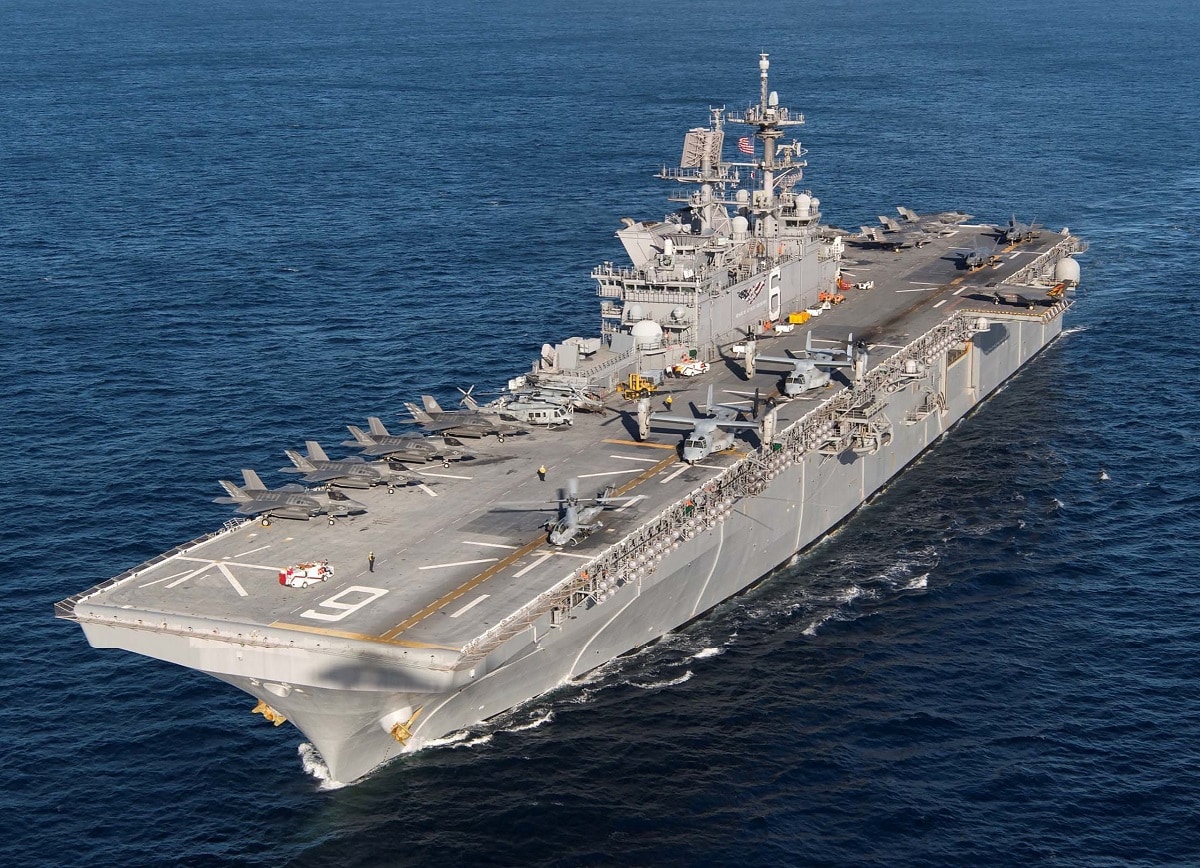
America-class. Image: Creative Commons.
-This report analyzes how the initial removal of the well deck favored F-35B sortie rates but hampered the landing of heavy armor and logistics.
-Larson explores the MV-22B Osprey’s limitations, concluding that the hybrid Flight 1 design is essential for modern expeditionary warfare.
The America-Class “Lightning Carrier” Evolution: Why the US Navy is Bringing Back the Well Deck in 2026
The America-class amphibious assault ship represents a significant change in how the United States Navy and United States Marine Corps envisioned the future of amphibious warfare early in the 21st century.
Conceived as the successor to the Tarawa-class amphibious assault ships, the earliest America-class ships were deliberately designed to serve as small aircraft carriers rather than traditional amphibious assault ships.
Interestingly, the U.S. Navy webpage that provides details about Navy amphibious assault ships explains that “LHAs are the largest of all amphibious warfare ships, resembling a small aircraft carrier. They are capable of Vertical/Short Take-Off and Landing (V/STOL), Short Take-Off Vertical Landing (STOVL), Vertical Take-Off and Landing (VTOL) tiltrotor and Rotary Wing (RW) aircraft operations.”
The first two of the America-class ships, the USS America and the USS Tripoli, were built around aviation, with their design supporting a sustained air component: the vertical-landing F-35B. But to support an expanded aviation component, the America-class design removed one of the key features of previous amphibious assault ships: the well deck.
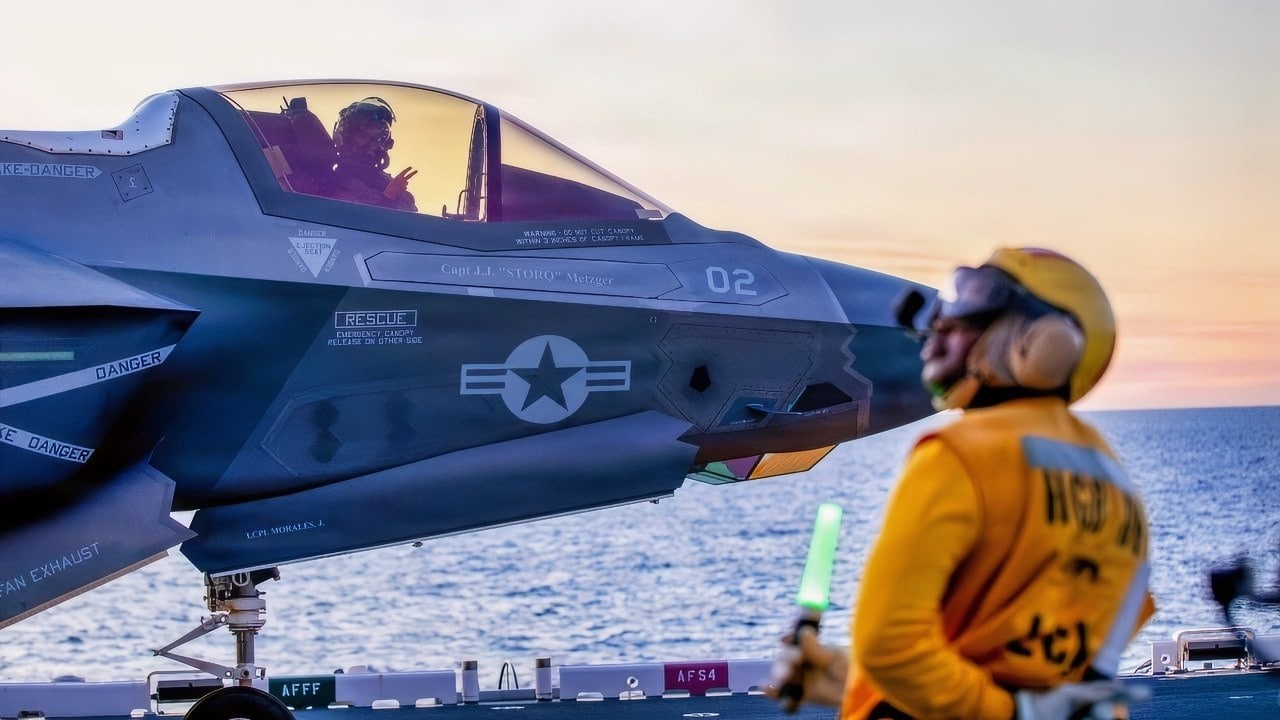
Chief Aviation Boatswain’s Mate (Handling) Stephane Togue, assigned to Wasp-class amphibious assault ship USS Makin Island (LHD 8), prepares to signal an F-35B Lightning II, attached to Marine Fighter Attack Squadron 211, for takeoff, Dec. 4, 2025. Makin Island is currently underway conducting routine operations in the U.S. 3rd Fleet. (Photo by Mass Communication Specialist Seaman Abraham Ramirez)

GULF OF ADEN – U.S. Navy Petty Officer 1st Class Rey White, an aviation boatswains mate handler with the Essex Amphibious Ready Group (ARG), launches an F-35B Lightning II from the Wasp-class amphibious assault ship USS Essex (LHD 2), Sept. 22, 2018. The Essex is the flagship for the Essex ARG and, with the embarked 13th Marine Expeditionary Unit, is deployed to the U.S. 5th Fleet area of operations in support of naval operations to ensure maritime stability and security in the Central Region, connecting the Mediterranean and the Pacific through the western Indian Ocean and three strategic choke points. (U.S. Marine Corps photo by Cpl. Francisco J. Diaz Jr./Released)
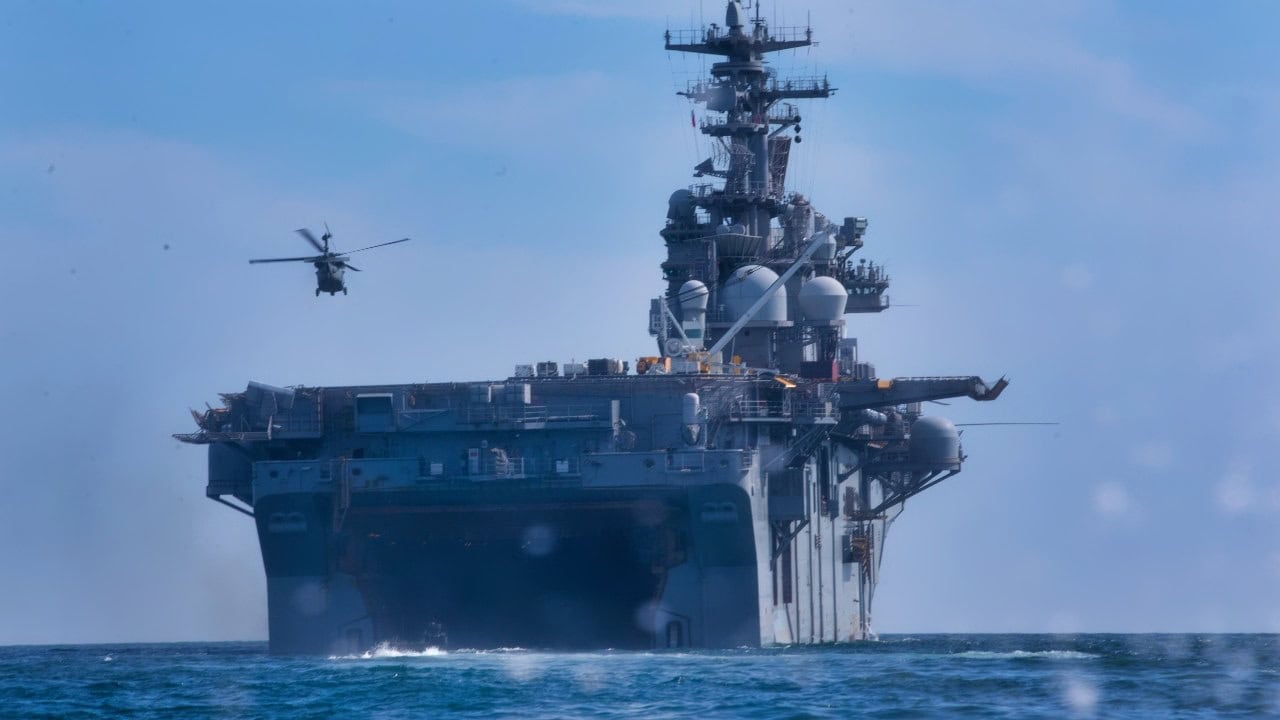
U.S. Marines with Bravo Company, 2d Assault Amphibious Battalion, 2d Marine Division approach the USS Wasp (LHD 1) in assault amphibious vehicles off of Onslow Beach during a three-day ship-to-shore exercise on Camp Lejeune, N.C., June 27, 2020. During the exercise, the Marines conducted amphibious maneuvers and dynamic ship-to-shore operations with the USS Wasp (LHD 1). (U.S. Marine Corps photo by Lance Cpl. Jacqueline Parsons)
That floodable internal bay is used to launch and recover landing craft.
The elimination of the well deck afforded the America-class substantial internal volume, which the design leveraged to support combat aviation.
Consequently, the America-class’s initial design included increased fuel storage, expanded aircraft maintenance areas, larger hangar and support space, and larger magazines for aviation ordnance stowage. This unique configuration allowed the America-class to support expanded air wings and increased sortie rates.
It gave the America-class the moniker “lightning carriers,” reflecting their air wing size. But the America-class’s initial design was not without its detractors and did not escape criticism.
Crimped Capabilities
The removal of the ships’ well deck dictated how Marines could conduct amphibious operations.
Traditionally, Marine doctrine assumed a sizable air and surface assault, and amphibious ships would deploy Marines by helicopter and tiltrotor aircraft such as the MV-22B Osprey, as well as by landing craft launched from well decks for troops and heavy equipment.
But the America-class’s initial design, as seen in the USS America and USS Tripoli, Marines instead have to rely almost entirely on vertical lift capacity for amphibious assault.
As a consequence, heavy equipment is harder to land on shore. Logistically significant loads are typically transported ashore by landing craft, but without a well deck, equipment must find another means of transportation.
Assault capability, therefore, skews toward speed and range instead of mass.
Aircraft like the MV-22 Osprey can launch from behind the horizon, but carry fewer Marines per lift than large landing craft, and are less suited to large-scale amphibious landings where heavy logistical items move ashore in bulk.
A Marine Corps Critique
An article written in 2008 shed some light on the internal debate surrounding the America-class’s aviation-centric design. “Although Marines are enthusiastic about the new ship, many of them question the decision to build a $3 billion ship without a well deck. It’s been a point of contention between the Navy and Marine Corps for some time,” the article explained.
“The aviation-centric design of the LHA replacement — or LHA(R) — also has raised questions about its long-term usefulness. Considering that Marines require heavy trucks and armored vehicles once they reach the shore, most of that equipment can only be transported by hovercraft, not by helicopters.”
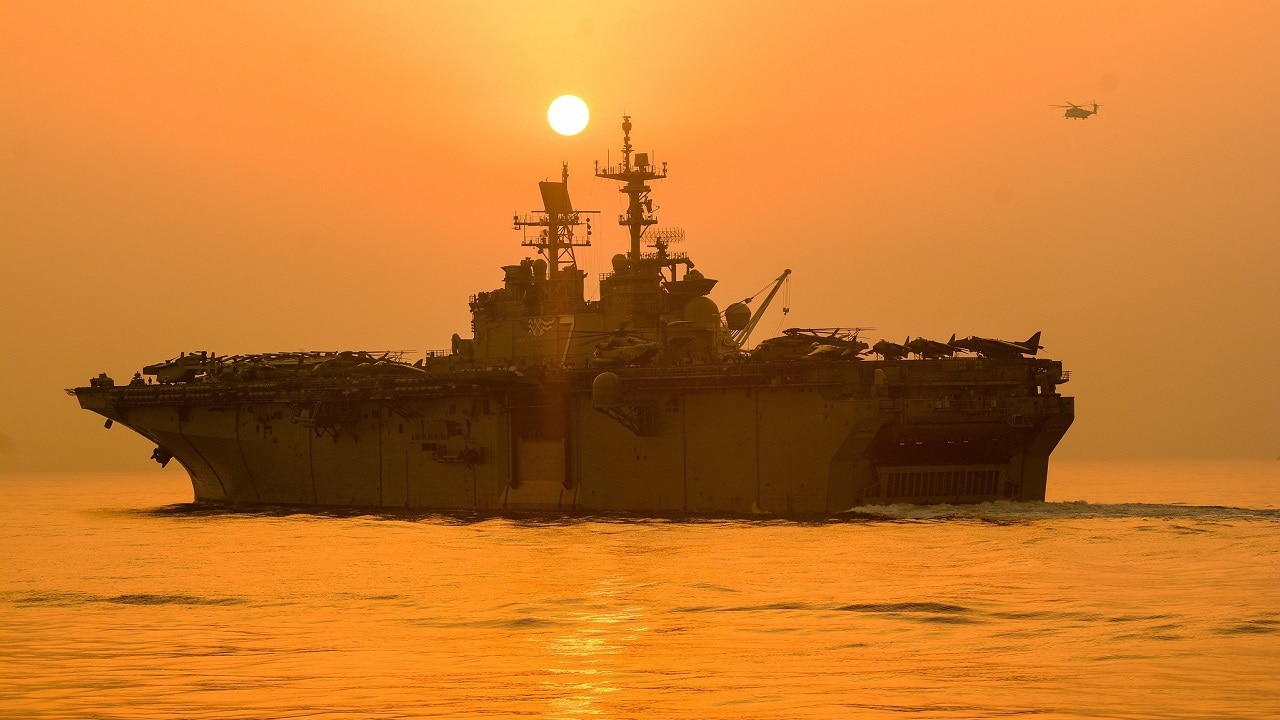
(Aug. 4, 2021) The Wasp-class amphibious assault ship USS Iwo Jima (LHD 7) transits the Strait of Hormuz, Aug. 4, 2021. Iwo Jima is deployed to the U.S. 5th Fleet area of operations to ensure maritime stability and security in the Central Region, connecting the Mediterranean and the Pacific through the western Indian Ocean and three strategic choke points. (U.S. Navy photo by Seaman Logan Kaczmarek)
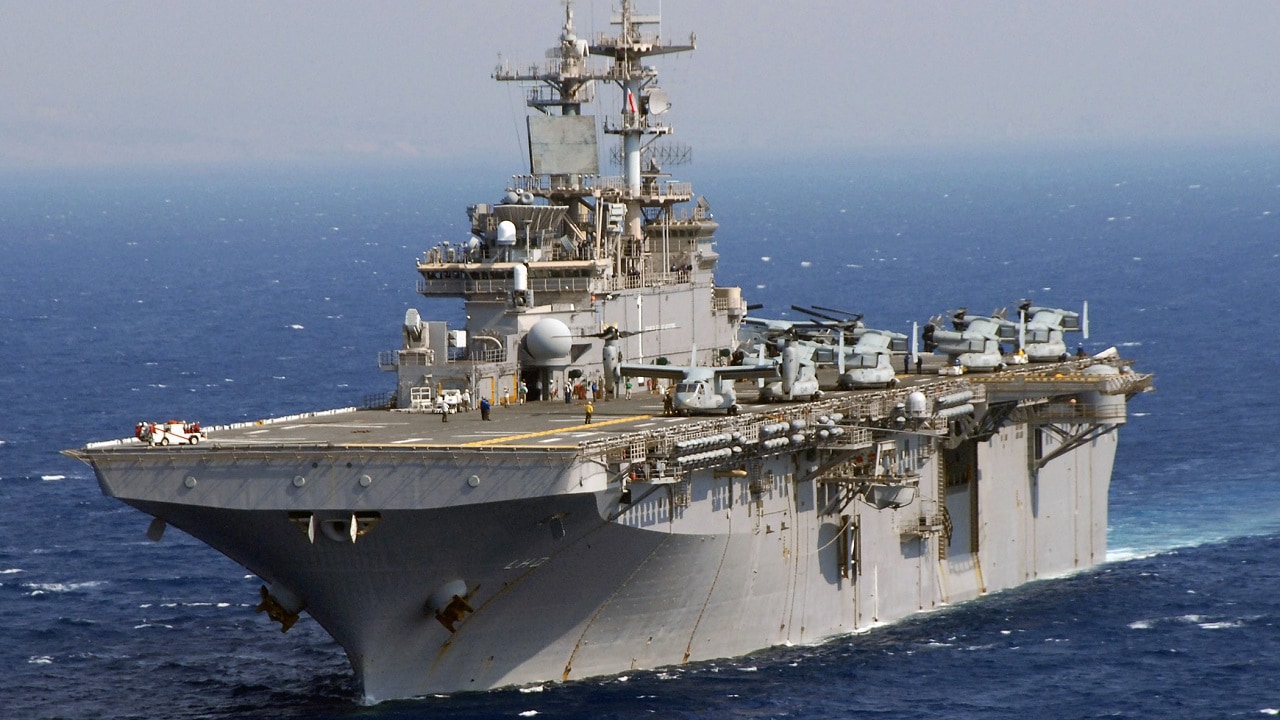
(Oct. 4, 2007) – U.S. Marine Corps MV-22 Ospreys, assigned to Marine Medium Tiltrotor Squadron (VMM) 263, Marine Aircraft Group 29, prepare for flight on the deck of the multipurpose amphibious assault ship USS Wasp (LHD 1). Wasp is on surge deployment to the Middle East carrying the Osprey to its first combat deployment. U.S. Navy photo by Mass Communication Specialist 2nd Class Zachary L. Borden (RELEASED)
“It’s been a long-running debate, and it’s still not settled,” says Robert Work, a naval analyst with the Center for Strategic and Budgetary Assessments in Washington, D.C. “There are a lot of questions on LHA(R). Will it become the standard, or will it become only a niche capability?”
In the end, the initial America-class design is a niche capability.
Course Correction
The trade-off between aviation and amphibious capability enabled the U.S. Navy and Marine Corps to modify later America-class ships.
Starting with the USS Bougainville, the well deck was restored.
This came at the cost of some space dedicated entirely to aviation, but it restored the ability to disembark landing craft. The change reflected the broader recognition that amphibious ships must balance air power with surface assault capability to support Marine expeditionary operations fully. While the first two America-class ships emphasized air power, subsequent America-class ships took a more even approach.
The U.S. Navy explains that “LHA Flight 0 [the first two America-class ships] will enhance Marine Corp aviation with greater maintenance capability and JP-5 fuel capacity in lieu of a well deck. LHA Flight 1 [the subsequent, redesigned America-class ships] will reincorporate a well deck to enhance expeditionary war fighting capabilities while maintaining the principal aviation characteristics of the Flight 0.”
So it seems the U.S. Navy would like to keep a robust aviation component aboard the Flight I America-class builds — despite the criticism Flight 0 received in the past.
About the Author: Caleb Larson
Caleb Larson is an American multiformat journalist based in Berlin, Germany. His work covers the intersection of conflict and society, focusing on American foreign policy and European security. He has reported from Germany, Russia, and the United States. Most recently, he covered the war in Ukraine, reporting extensively on the war’s shifting battle lines from Donbas and writing on the war’s civilian and humanitarian toll. Previously, he worked as a Defense Reporter for POLITICO Europe. You can follow his latest work on X.