China Is Watching: The AUKUS Submarine Deal Must Succeed
A push began last summer, from some quarters of the Australian defense and national security community, encouraging Canberra to extricate itself from the tripartite AUKUS nuclear-powered submarine project.
There are several data points to support their argument, but mostly it is based on the numbers: The program will cost hundreds of billions of dollars and threatens to leave Australia less capable of defending itself, which is quite the opposite of AUKUS’ intent.
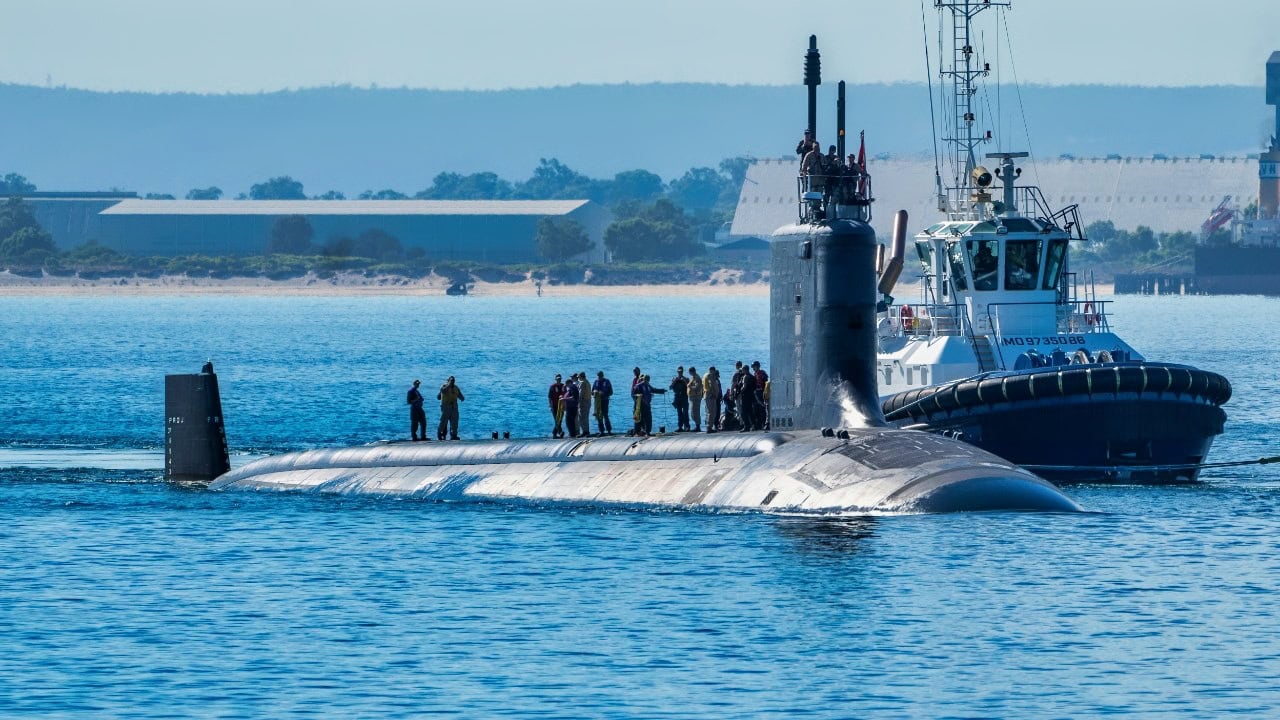
Western Australia, Australia (Feb. 25, 2025) The Virginia-class fast-attack submarine USS Minnesota (SSN 783) prepares to moor at HMAS Stirling, Western Australia, Australia, Feb. 25, 2025. Minnesota arrived in Western Australia kicking off the first of two planned U.S. fast-attack submarine visits to HMAS Stirling in 2025. Minnesota is currently on deployment supporting the U.S. 7th Fleet, the U.S. Navy’s largest forward-deployed numbered fleet, operating with allies and partners in preserving a free and open Indo-Pacific region. (U.S. Navy photo by Lt. James Caliva)
One of the loudest voices in opposition to AUKUS is former Prime Minister Paul Keating, who said that a U.S. decision to cancel the project “might very well be the moment Washington saves Australia from itself … from the most poorly conceived defense procurement program ever adopted by an Australian government.”
Keating said the United States would lose nothing by walking away from the AUKUS project—indeed, Washington could still “achieve what they have been after all along … turning Australia into a U.S. nuclear-armed fort pointed against China.”
However, there are plenty of arguments suggesting that AUKUS’ failure would have dire implications, not just for Australia’s national security interests, but also for those of the United States and its other regional allies.
One of the fundamental negative consequences would be a considerable submarine capability gap with no immediate solution. The Royal Australian Navy might be left with no submarines at all if AUKUS collapses before a new submarine fleet is delivered.
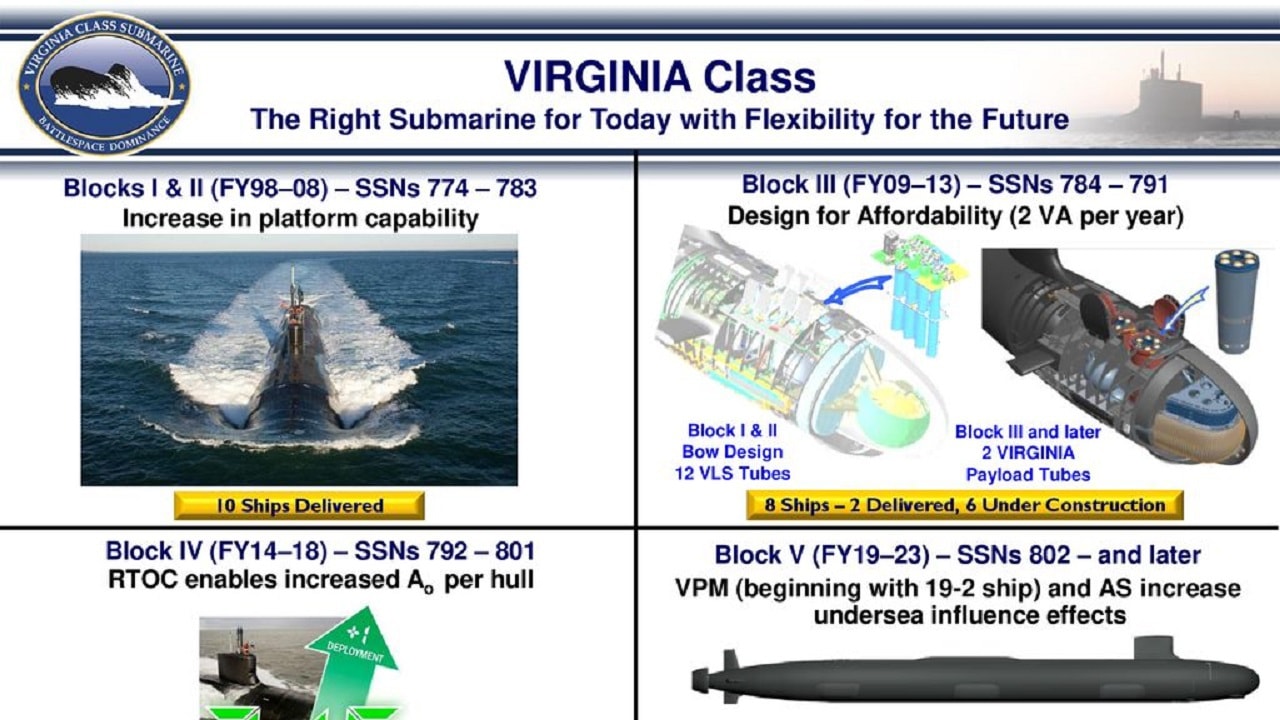
(FY98–08) – SSNs 774 – 783. Block III (FY09–13) – SSNs 784 – 791. Increase in platform capability. Design for Affordability (2 VA per year) Block I & II Bow Design. 12 VLS Tubes. Block III and later 2 VIRGINIA Payload Tubes. 10 Ships Delivered. 8 Ships – 2 Delivered, 6 Under Construction. Block IV (FY14–18) – SSNs 792 – 801. Block V (FY19–23) – SSNs 802 – and later. RTOC enables increased Ao per hull. VPM (beginning with 19-2 ship) and AS increase undersea influence effects. 10 Ships – 5 Under Construction, 5 Under Contract. In Design Phase, FY19 Construction Start. 16.
This gap would be created by the time lag between the retirement of Australia’s aging Swedish-made Collins-class submarines and the delivery of a suitable replacement—if, indeed, one could be found.
Money, Technology, and AUKUS Geopolitics
Another problem is one that affects most any major defense procurement program: they are usually front-loaded.
It generally costs a nation “more to get out of these multinational consortia than it does to stay on board,” said a senior retired U.S. naval officer familiar with the AUKUS program’s parameters.
Australia could lose more than $2 billion of the total $9 billion already committed to the United States and the United Kingdom to improve and expand their defense industrial bases.
This money would be wasted on a defunct program, and there would be no guarantee that any sum would be refunded.
Australia is also one of the major customers for other U.S.-made weapon systems, namely the F-35 fighter aircraft.
If the AUKUS program is not carried through to its logical conclusion, there could be many ripple effects that would adversely affect the procurement of that fifth-generation fighter, as well as other major cooperative programs involving the United States and the United Kingdom.
Further, in the author’s experience, technological autonomy carries far more weight in Australia than it does in the United States, Europe, or other Asian allies.
An abandonment of AUKUS could have disastrous psychological effects and damage cooperative defense efforts for years to come.
And The Other Proposed Partners
The AUKUS deal is not conducted in a vacuum, and changes to it would affect more than just the three partners.
One possibility quietly discussed at first, but more loudly now, is that South Korea and Japan could join the consortium.
A proposed program to jointly design and build small, modular nuclear reactors would enable those two nations to operate boats powered by nuclear propulsion systems.
Acronyms like JAKUS and ROKUS have already been batted around as preliminary discussions take place.
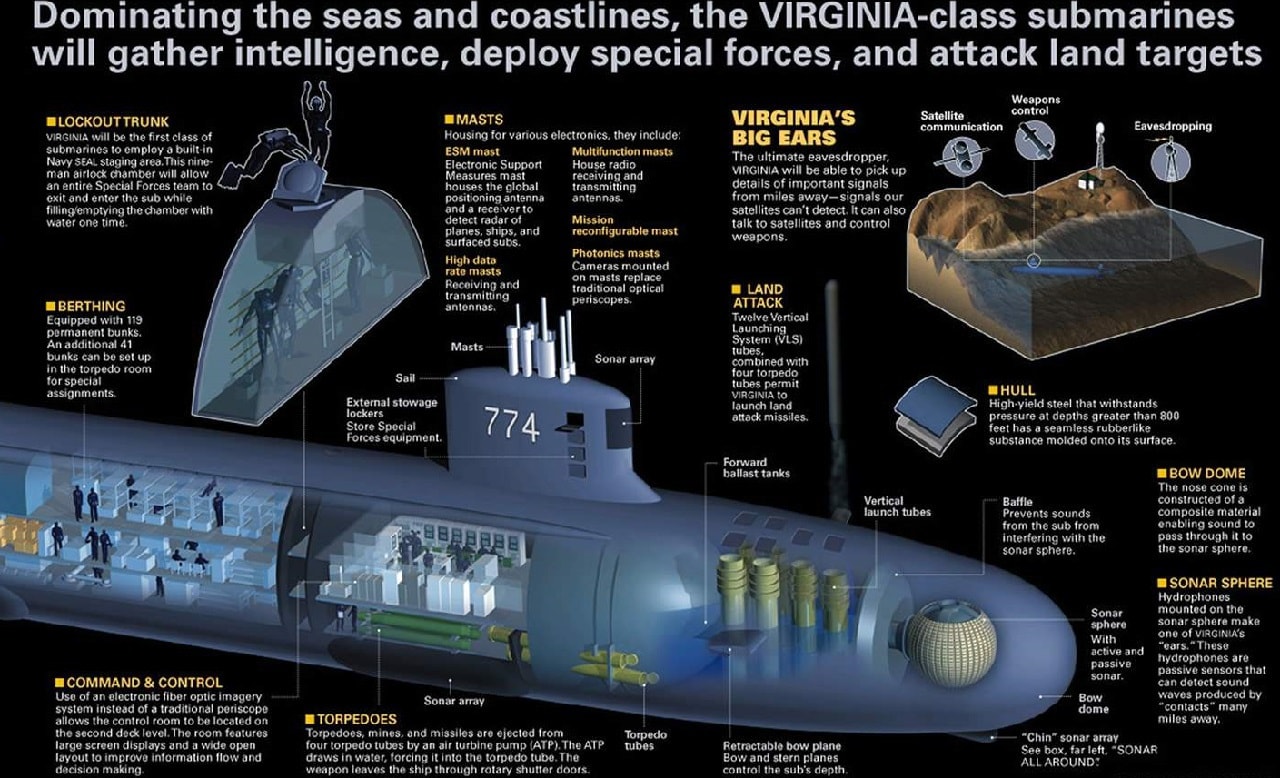
Image of Virginia-class Submarine features. Image Credit: Creative Commons.
AUKUS is, therefore, not only critical to the U.S.-UK-Australia axis. This effort could become the linchpin by which the United States and its eastern allies achieve parity with the People’s Liberation Army Navy.
In other words, this effort may determine whether the strategic balance in the Indo-Pacific continues to keep Beijing’s rapidly expanding naval power at bay.
MORE – Russia’s Su-57 Felon Stealth Fighter Is No Joke
About the Author: Reuben F. Johnson
Reuben F. Johnson has thirty-six years of experience analyzing and reporting on foreign weapons systems, defense technologies, and international arms export policy. Johnson is the Director of Research at the Casimir Pulaski Foundation. He is also a survivor of the Russian invasion of Ukraine in February 2022. He worked for years in the American defense industry as a foreign technology analyst and later as a consultant for the U.S. Department of Defense, the Departments of the Navy and Air Force, and the governments of the United Kingdom and Australia. In 2022-2023, he won two awards in a row for his defense reporting. He holds a bachelor’s degree from DePauw University and a master’s degree from Miami University in Ohio, specializing in Soviet and Russian studies. He lives in Warsaw.