
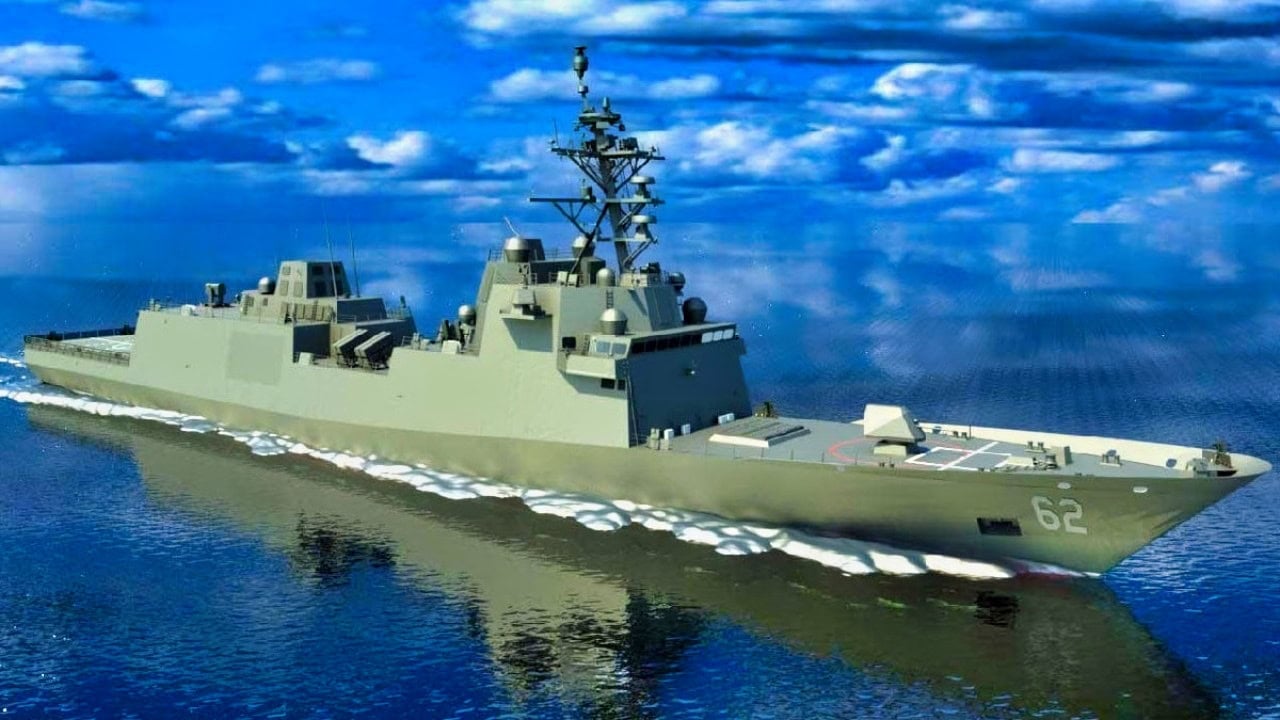
Why the U.S. Navy’s Constellation-Class Frigates Seemed Destined to Fail
In November 2025, the U.S. Navy abruptly cancelled most of its Constellation-class frigate program, cutting what had once been planned as a 20-ship fleet down to just two vessels already under construction.
The decision, announced by Secretary of the Navy John Phelan, was a sharp reversal for what had been pitched as a fast, low-risk solution to the Navy’s growing shortfall in small surface combatants.
Instead, the program had become mired in rising costs and design instability – forcing the Navy to walk away and redirect funding into a new frigate concept it believes can be built faster.
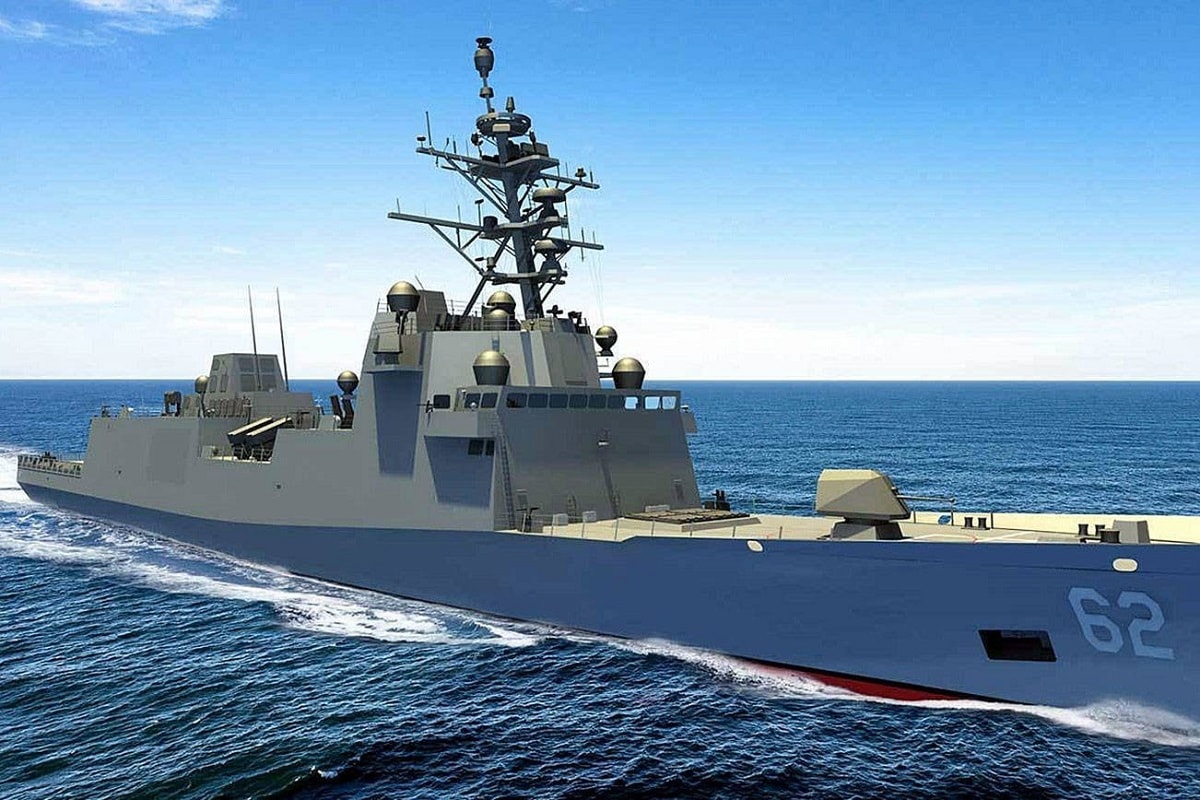
Imager: Fincantieri handout.
Only two ships – USS Constellation (FFG-62) and USS Congress (FFG-63) – will now be completed, largely to sustain the industrial base and avoid workforce disruption at the Wisconsin shipyard building them.
The collapse of the program is not only a single procurement failure, either.
This was one of a number of decisions made in recent years that reflect a deep structural problem in U.S. naval shipbuilding, namely, the inability to turn ships around quickly and affordably.
What the Constellation-Class Was Supposed to Be
The Constellation-class frigate began as the Navy’s answer to a well-understood problem. By the late 2010s, the service faced a growing capability gap. Its Littoral Combat Ship program had failed to deliver a survivable, multi-role small surface combatant, while larger destroyers were too expensive to deploy in sufficient numbers.
The solution was the FFG(X) program, launched to build the frigate quickly and use a proven design to reduce risk.
In 2020, the Navy awarded the contract to Fincantieri Marinette Marine, selecting a design based on the Franco-Italian FREMM frigate. The logic was that by adopting an existing hull, the Navy could avoid the costly mistakes that typically accompany entirely new designs.
Early estimates had placed the cost of follow-on ships – those built after the first one has been perfected – at somewhere between $850 million and $950 million each, making the class significantly cheaper than Arleigh Burke-class destroyers.
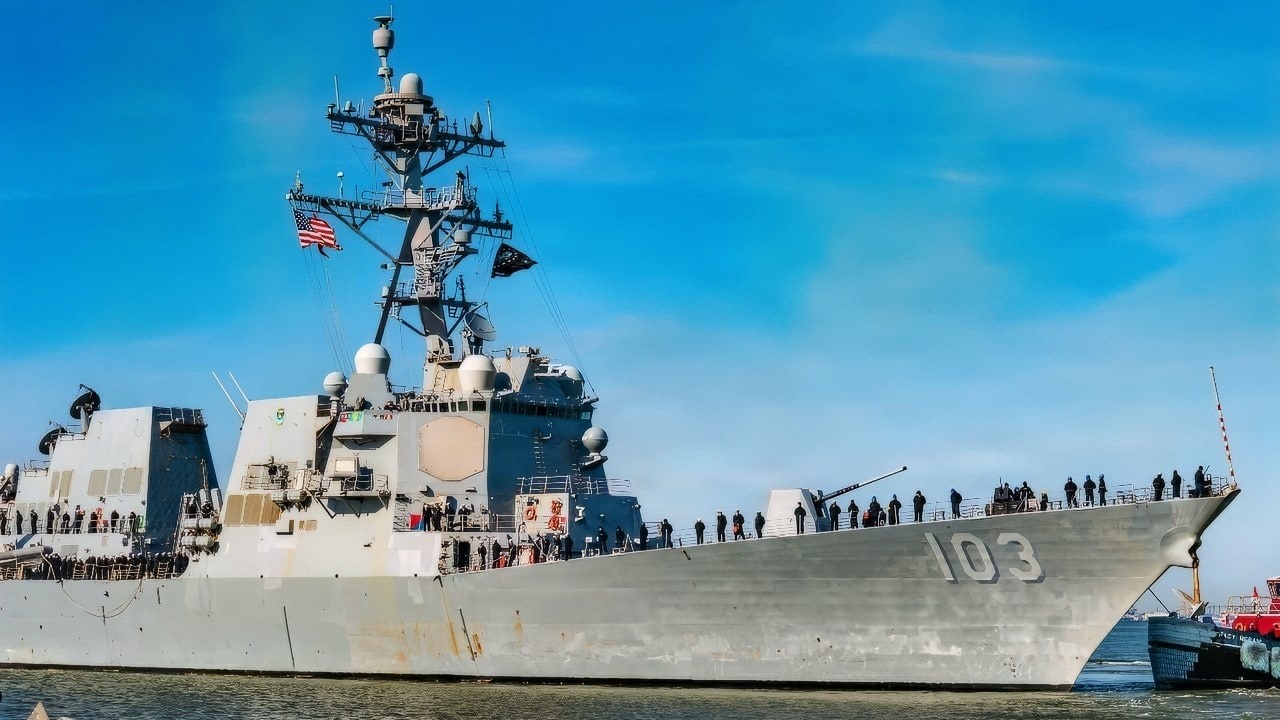
(Feb. 3, 2026) – The Arleigh Burke-class guided missile destroyer USS Truxtun (DDG 103) departed Naval Station Norfolk for a scheduled deployment on Feb. 3, 2026. The ship’s company includes approximately 300 Sailors, with an additional 26 embarked air wing personnel assigned to the “Valkyries” of Helicopter Maritime Strike Squadron 50. U.S. 2nd Fleet, reestablished in 2018 in response to the changing global security environment, develops and employs maritime ready forces to fight across multiple domains in the Atlantic and Arctic in order to ensure access, deter aggression and defend U.S., allied, and partner interests. (U.S. Navy photo by Mass Communication Specialist 2nd Class Derek Cole)
The ships were designed to perform escort duties for both carrier and amphibious groups, and conduct independent patrols, even in contested environments. The vessels would also be tasked with anti-submarine warfare and surface combat operations.
The program was considered a low-risk acquisition effort, with the Navy deliberately choosing to adapt an older design rather than build a new, cutting-edge capability.
How the Constellation-Class Got “Fat”
Almost immediately after the contract was awarded, the Constellation-class began to drift away from the original promise of building a better version of the vessel on which it was based. Although the design was based on the FREMM frigate, the Navy had introduced a series of modifications to meet U.S.-specific requirements, including changes to the combat systems and survivability standards.
The ship also required extensive work to ensure it could integrate with existing Navy networks and weapons systems.
As U.S.-specific requirements accumulated, the ship physically grew well beyond the FREMM’s baseline. By 2025, the design had expanded by hundreds of tons – at least 500 to 759 metric tons, depending on the source – which was as much as a 13 percent weight increase.
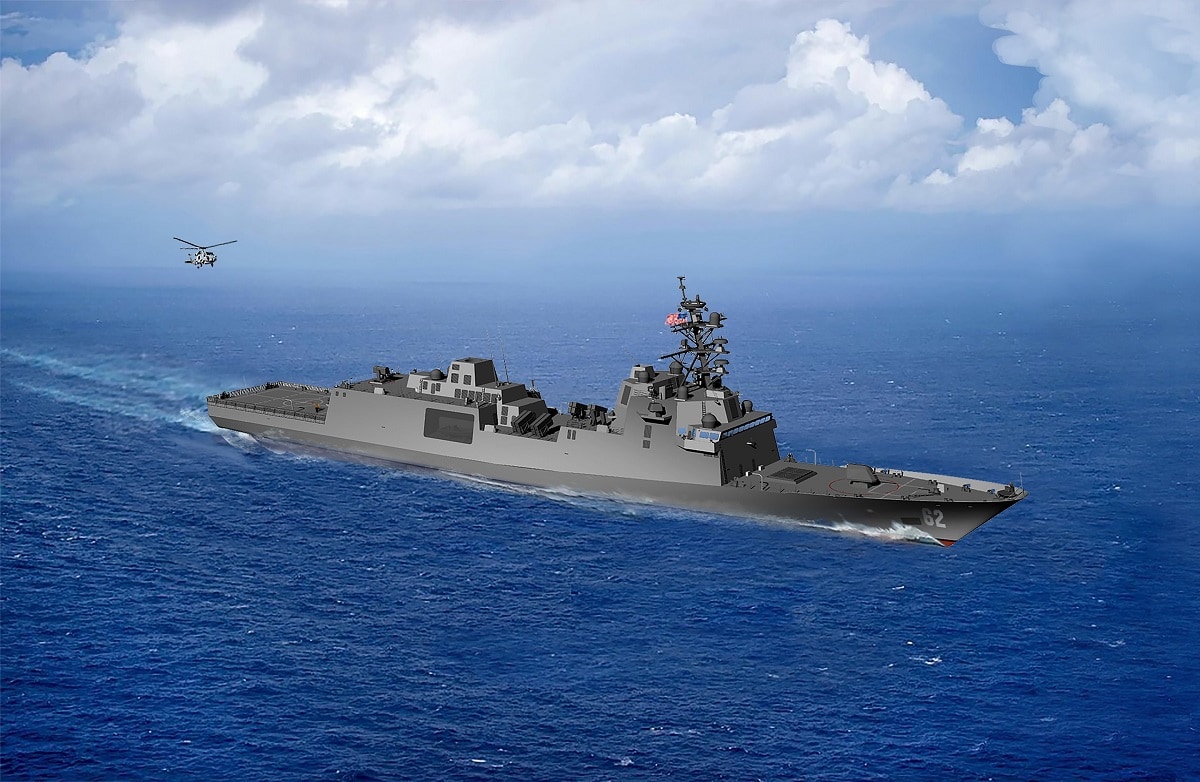
An artist rendering of the U.S. Navy guided-missile frigate FFG(X). The new small surface combatant will have multi-mission capability to conduct air warfare, anti-submarine warfare, surface warfare, electronic warfare, and information operations. The design is based on the FREMM multipurpose frigate. A contract for ten ships was awarded to Marinette Marine Corporation, Wisconsin (USA), on 30 April 2020.
The ship also became longer by around 23 feet. The growth was the direct result of the addition of a full Aegis-derived combat system paired with the AN/SPY-6(V)3 radar, which is significantly heavier and more power-intensive than the systems originally carried by the FREMM. The hull was also redesigned to ensure the vessel met U.S. Navy-standard survivability standards, forcing major structural reinforcements and adaptations, with additional compartmentalization. As the ship was lengthened, its displacement grew, too.
And as the changes racked up, the ship started to look more like a new ship, and not an “off-the-shelf” concept at all. The Navy included 32 Mk 41 vertical launch cells capable of firing Tomahawks and standard missiles, and integrated Cooperative Engagement Capability. It had new and improved electronic warfare systems and advanced anti-submarine warfare suited, including the CAPTAS-4 sonar and towed array.
It was a new ship in all but name, and the consequences were entirely predictable. There were delivery delays of at least three years, pushing the initial timelines from 2026 to 2029. Costs rose, and the uncertainty about the final design generated uncertainty within the industrial base.
That’s why by the end of 2025, the program was canceled. The Navy had attempted to balance maintaining a low-risk, proven design with tailoring it to meet evolving operational demands.
Why Does This Keep Happening?
The Constellation-class program is not an isolated incident. U.S. Navy acquisition efforts have fallen into similar traps over the last two decades, in which initial designs were allowed to expand to meet growing requirements until they became too complex and expensive to deliver.
In a 2024 report on the Constellation program, the U.S. Government Accountability Office concluded that “unstable design has stalled construction and compromised delivery schedules,” a direct result of the Navy moving into construction before the design was mature. The same report also warned that unplanned weight growth during ship construction risked compromising ship capabilities.
Those warnings were not new, either. The GAO has consistently identified the same failure point across Navy programs: building begins before the design is stable, forcing engineers to fix problems mid-construction.
In the case of the Constellation, the Navy approved construction with incomplete information about key systems, including structural design and piping/ventilation. That process meant the project got stuck in a cycle in which requirements expanded, design stability degraded, construction slowed, and costs rose.
Are American Adversaries Making the Same Mistakes?
While the Navy spent years redesigning a single frigate class that was ultimately canceled, the United States’ adversaries were busy expanding their own naval capabilities. China’s People’s Liberation Army Navy has expanded rapidly, reaching approximately 370 ships as of 2025, building and launching a new Type 003 supercarrier named “Fujian,” and preparing to deploy more next-generation carriers with next-generation airwings.
China’s industrial base is arguably more robust than that of the United States, proving repeatedly that it can not only build new military assets quickly, but iterate on designs more rapidly, too.
The Constellation-class was originally intended to help fill a growing gap in small surface combatants, but instead, by the time the design stabilized, the timeline had slipped by at least three years, with the lead ship not expected until 2029.
The Center for Strategic and International Studies noted in March 2025 that China now “dominates” the shipbuilding industry – and to get there, they aren’t falling into the same traps as the United States. Beijing is building new ships at a rapid pace.

SOUTH CHINA SEA (Oct. 19, 2021) The Arleigh Burke-class guided-missile destroyer USS Milius (DDG 69), rear, and the Japan Maritime Self-Defense Force (JMSDF) Akizuki-class destroyer JS Akizuki (DD 115) transit the South China Sea in formation. Milius is assigned to Commander, Task Force (CTF) 71/Destroyer Squadron (DESRON) 15, the Navy’s largest forward-deployed DESRON and the U.S. 7th Fleet’s principal surface force. (U.S. Navy photo by Mass Communication Specialist 3rd Class Christine Montgomery) 211019-N-TC847-1020
“China’s lead in the global commercial shipbuilding market is huge and growing. The country’s largest state-owned shipbuilder built more commercial vessels by tonnage in 2024 than the entire U.S. shipbuilding industry has built since the end of World War II,” a 2025 CSIS report notes.
Beijing has made great strides through a combination of military and civil infrastructure, integrating its commercial industrial base into the military in a way that the United States has yet to match – but as time goes by, it’s abundantly clear that the United States will need to do the same.
Wow. The long-delayed Constellation Class Frigate will be canceled.
Constellation (FFG-62) and Congress (FFG-63) will be built, but all other planned ships have been scrapped. pic.twitter.com/XrZul8VAXF
— OSINTtechnical (@Osinttechnical) November 25, 2025
And, it’s already happening, with the Navy and Pentagon expanding partnerships with commercial shipyards and civilian industry under initiatives like the Maritime Industrial Base program, which explicitly aims to leverage private-sector manufacturing capacity to accelerate naval production and repair timelines.
MORE – Russia’s Navy Will Soon Have ZERO Aircraft Carriers
About the Author: Jack Buckby
Jack Buckby is a British researcher and analyst specialising in defence and national security, based in New York. His work focuses on military capability, procurement, and strategic competition, producing and editing analysis for policy and defence audiences. He brings extensive editorial experience, with a career output spanning over 1,000 articles at 19FortyFive and National Security Journal, and has previously authored books and papers on extremism and deradicalisation.