
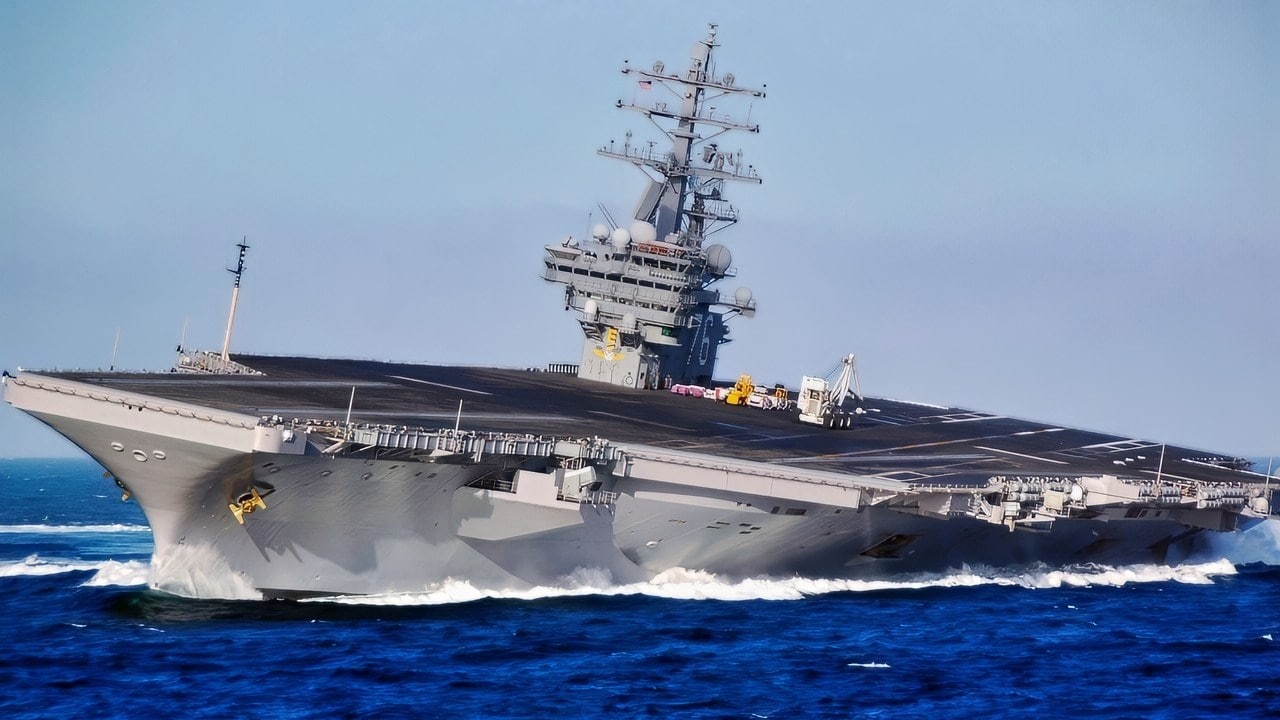
Washington has spent the better part of a decade arguing about the Ford class‘s electromagnetic catapults. Beijing spent roughly the same period building a full-scale replica of the ship on a weapons range in the Gobi Desert. One of these activities reflects a clear-eyed understanding of what the aircraft carrier actually does. It isn’t the one happening in the Pentagon.
Secretary Phelan says his review of the Ford program — expected to wrap up within weeks — is about cost-benefit analysis. Is EMALS worth the headaches? Is the sortie rate actually better than a Nimitz?
Rear Adm. Ben Reynolds told Pentagon reporters last week the numbers will be “eye-watering.” Maybe so. But these are procurement questions. Neither man is answering the strategic one underneath them: whether a single platform should still be expected to perform two fundamentally different missions that have spent the last decade drifting apart — and are now pulling the carrier program in opposite directions.
Aircraft carriers do two things. They project lethal airpower and anchor a strike group — that’s the warfighting mission. And they serve as visible, legible instruments of American intent that foreign governments, populations, and adversaries can all read in real time — that’s the diplomatic mission. For most of the postwar era, the overlap between those two functions was clean enough that no one had to choose. A carrier that could fight could also signal, and the same hull served both purposes well enough.
That’s no longer true, and here’s why it can’t simply be engineered away: the threat environment for each mission now pulls in a fundamentally different direction. The warfighting mission demands dispersion, standoff, and expendability. DF-21D and DF-26 anti-ship ballistic missiles — with ranges that dwarf anything in the carrier air wing’s unrefueled combat radius — have made the supercarrier’s traditional operating posture inside those threat rings strategically untenable.
China isn’t trying to outbuild American carriers. The target range in the Gobi says it plainly: they’re practicing destroying them. Meanwhile, submarines and long-range unmanned systems are steadily absorbing the deep-strike mission the carrier once monopolized. The arsenal ship concept — a large, magazine-heavy surface combatant with a fraction of the carrier’s crew and none of its flight deck complexity — addresses the warfighting gap more efficiently than anything flying off a Ford-class deck today.
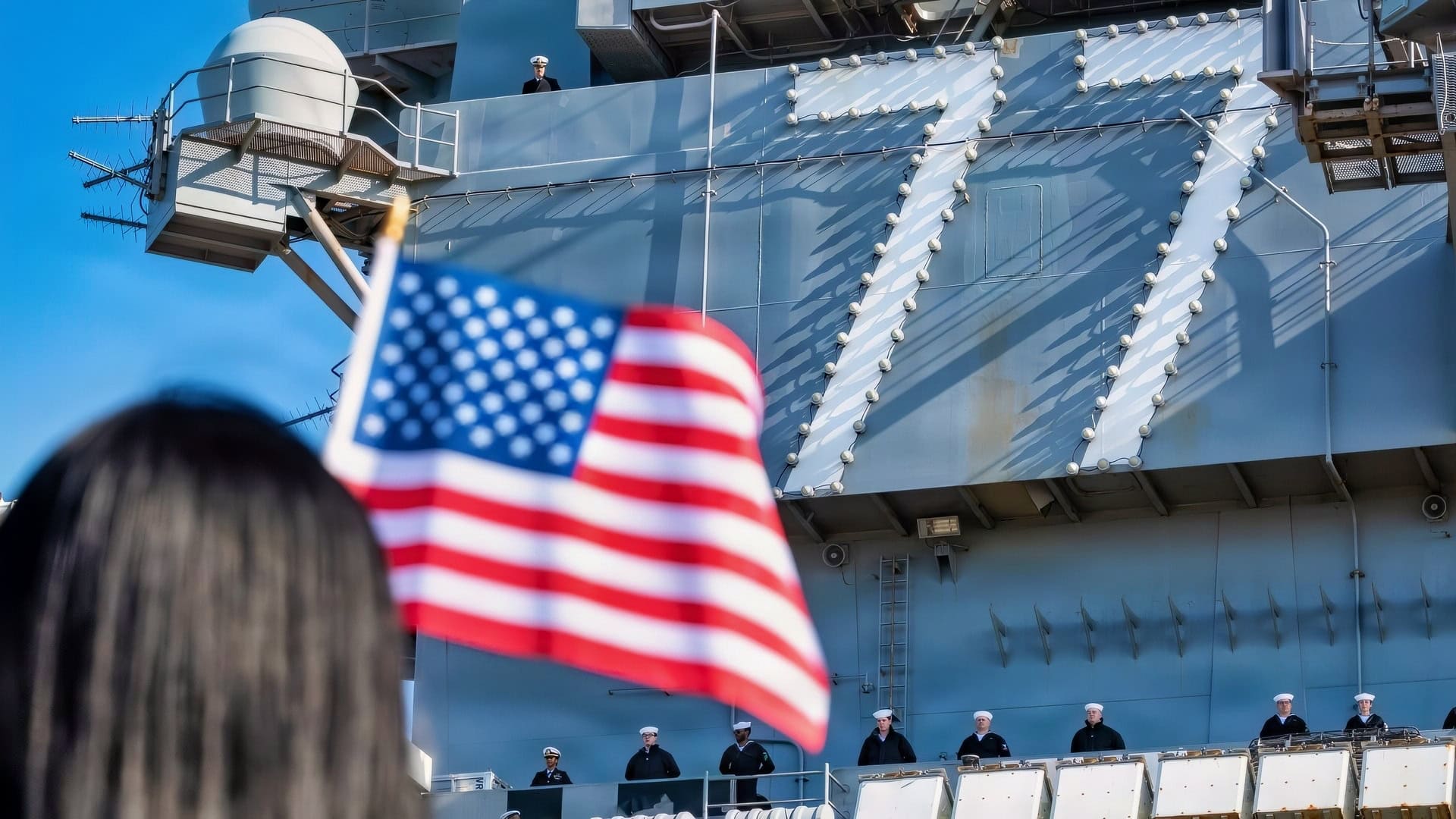
NAVAL STATION NORFOLK (March 31, 2026) A Navy spouse waves goodbye to Sailors assigned to the Nimitz-class aircraft carrier USS George H.W. Bush (CVN 77), the flagship of the George H.W. Bush Carrier Strike Group, man the rails as the ship departs Naval Station Norfolk to begin operations in support of its scheduled deployment, March 31, 2026. More than 5,000 personnel are assigned to the George H.W. Bush Carrier Strike Group. The George H.W. Bush Carrier Strike Group provides combatant commanders and America’s civilian leaders increased capacity to underpin American security and economic prosperity, deter adversaries, and project power on a global scale through sustained operations at sea. (U.S. Navy photo by Mass Communication Specialist 2nd Class Derek Cole)
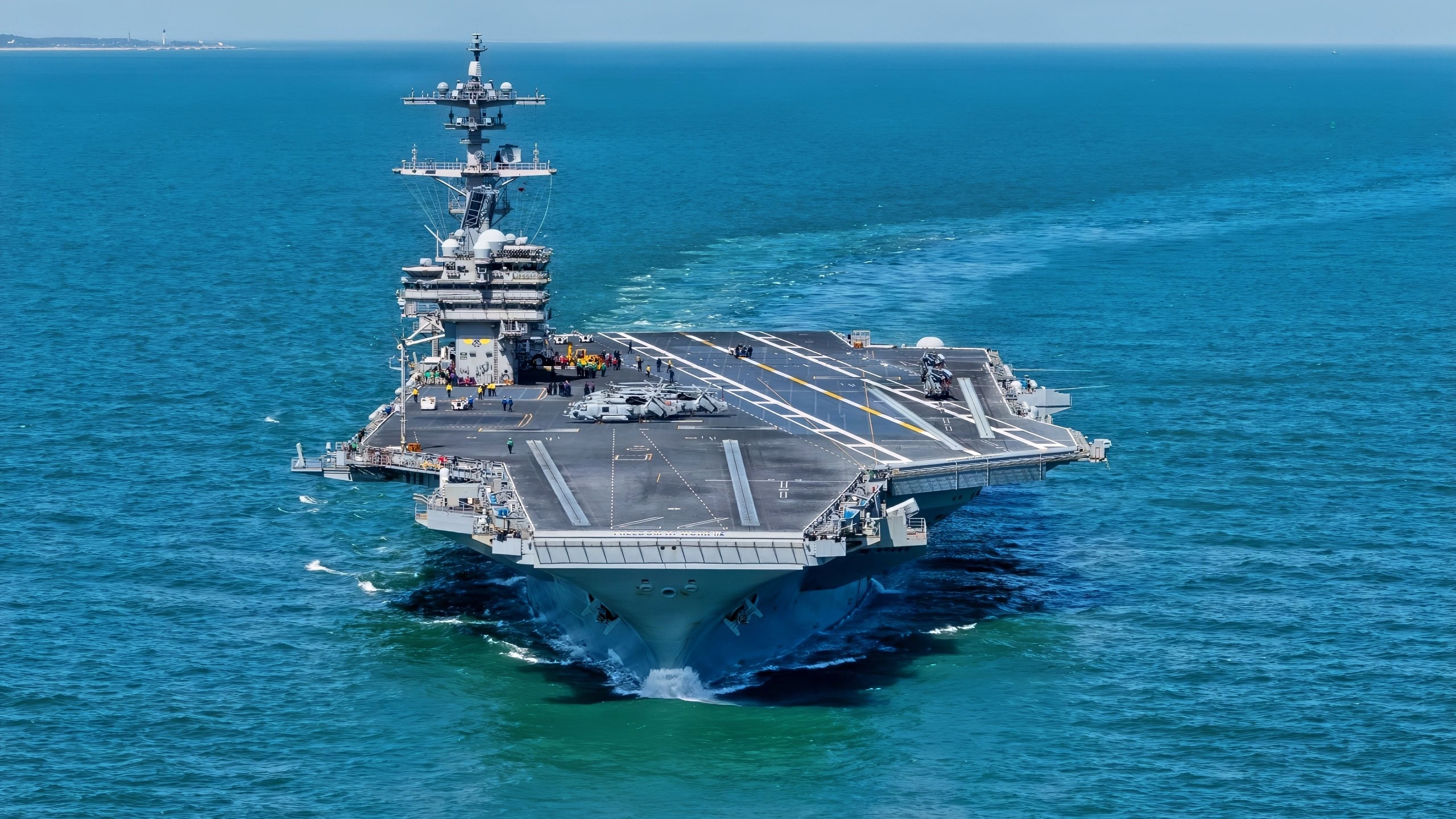
ATLANTIC OCEAN (March 31, 2026) Nimitz-class aircraft carrier USS George H.W. Bush (CVN 77) departs Naval Station Norfolk for a regularly scheduled deployment. The George H.W. Bush Carrier Strike Group departed Naval Station Norfolk on March 31, 2026. The strike group, comprised of nearly 5,000 Sailors, provides combatant commanders and America’s civilian leaders increased capacity to underpin American security and economic prosperity, deter adversaries, and project power on a global scale through sustained operations at sea. (U.S. Navy photo by Mass Communication Specialist 2nd Class Jayden Brown)
And yet the arsenal ship has never gotten serious traction. The standard explanation is institutional inertia and the aviation community’s political weight in the Pentagon. That’s real. But there’s a more honest answer: arsenal ships fail the diplomatic mission completely, and somewhere in the building everyone knows it.
A magazine of cruise missiles below the waterline is invisible to everyone who matters diplomatically. No foreign ministry can read it. No adversary can calculate against it in real time. No population watching a crisis develop can see it on the horizon and grasp what it means. In 1996, Bill Clinton sent two carrier battle groups through the Taiwan Strait. The message was received without a shot being fired. After October 7, Ford’s appearance in the Eastern Mediterranean didn’t require a single airstrike to do its work. An arsenal ship cannot do either of those things. Neither can an attack submarine. Neither can a drone swarm. Visibility, scale, and immediate recognizability aren’t incidental features of carrier diplomacy — they are the mechanism.
Which brings the China picture back into focus, and this time it’s not just alarming — it’s instructive. Beijing is simultaneously building more conventional carriers while investing heavily in the systems designed to kill ours.
That looks like a contradiction until you realize it isn’t: Chinese planners have separated the two missions in their own force design, deploying carriers for regional presence and developing asymmetric strike capability to neutralize the American version. The Gobi target range and the carrier construction program aren’t pulling in different directions. They are two parts of the same strategic conclusion — one that Washington hasn’t quite reached yet, but should.
The answer is not a better Ford. It’s two different tools built honestly for two different jobs.
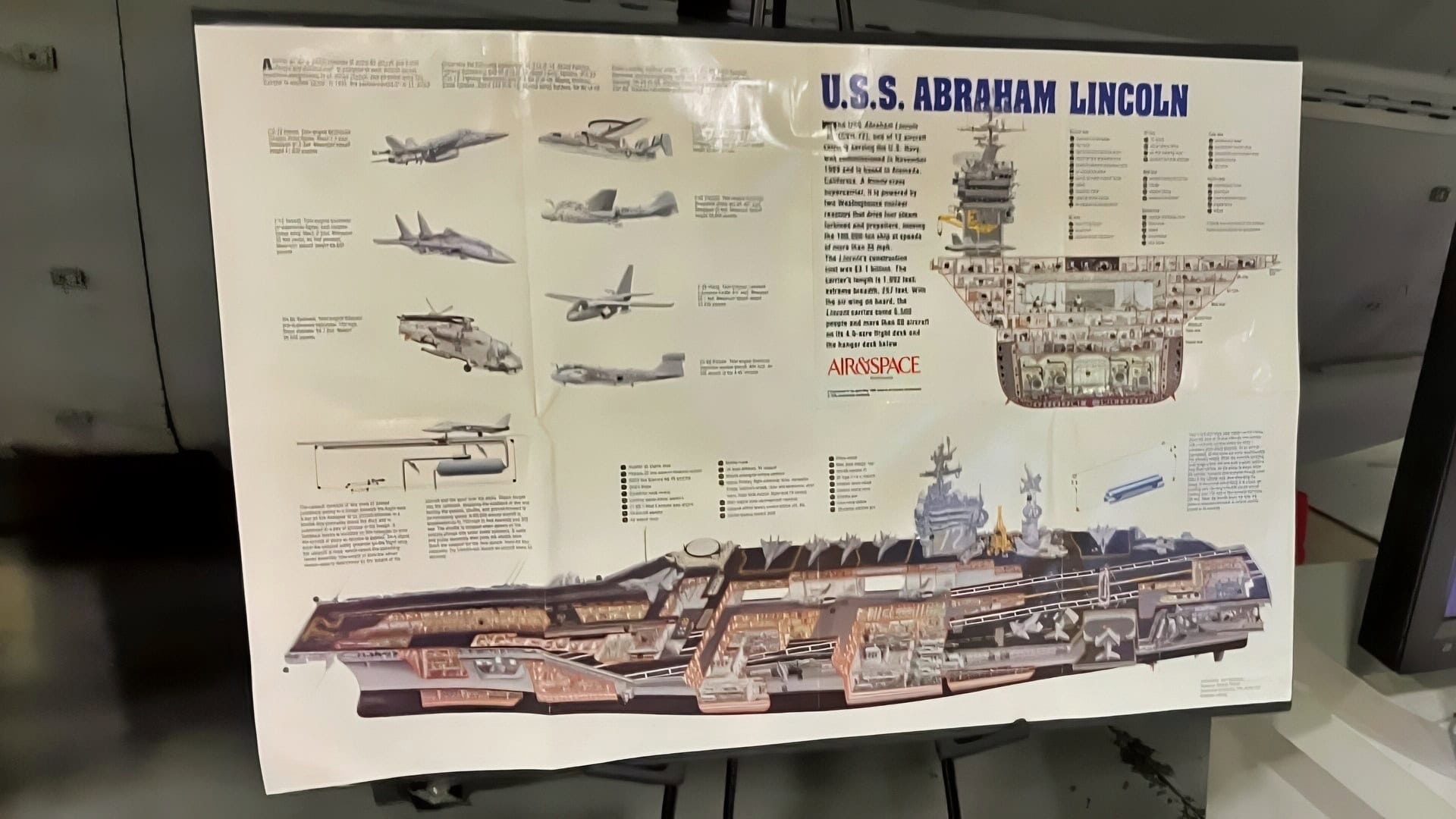
Aviation Museum of Kentucky USS Abraham Lincoln Carrier Photo. 19FortyFive.com Image.
Track one handles the warfighting mission: arsenal ships, SSGNs, and long-range unmanned strike platforms operating at standoff ranges where a $15 billion hull has no business being anyway. Cheaper, smaller-crewed, and far more appropriate for high-end Pacific conflict than a nuclear-powered airfield trying to operate inside a missile engagement zone.
Track two handles the presence mission: a purpose-built platform that is nuclear-powered, carrier-scale, and visually unmistakable — but stripped of the manned aviation infrastructure that makes the Ford so expensive and so persistently unreliable. No EMALS. No arresting gear. No nine-figure strike fighters to lose in the opening exchange.
An organic drone wing, layered air defense, and a hull designed to show up, be seen, and be hard to kill. This isn’t purely theoretical. The UK’s Queen Elizabeth class — no catapults, conceived as much for deterrence and presence as for strike — operates credibly at roughly half Ford’s displacement. Japan’s Izumo conversions offer an even more economical data point. Neither is a direct template, but both demonstrate that “credible presence platform” and “$15 billion EMALS supercarrier” are not the same thing, and don’t have to be.
The objection writes itself: a carrier without strike fighters is just a big target. But a hull carrying no irreplaceable manned aircraft, with an unmanned wing and layered defenses designed from the keel up for survivability, is more continuously deployable than a Ford-class ship that has spent ten months at sea, caught fire, and is still out there because the Navy has nothing else to send. And if China is building conventional carriers for presence while spending separately on the weapons designed to kill ours — that’s not a rebuttal to this argument. It’s the argument.
Phelan will likely land somewhere incremental: CVN-82 redesigned, EMALS reconsidered, the program stretched. The pull of sunk costs and shipyard politics is real and understandable. But the service has shown in the last six months — killing the Constellation frigate, walking away from the decade-long Boise saga — that it can make hard calls when the evidence is too loud to ignore.
The evidence here is loud. Two missions this divergent, require two different platforms. Every billion dollars spent forcing one hull to reconcile them is a billion dollars that won’t build the arsenal ship the warfighting mission actually needs.
Aircraft carriers are not obsolete. The job description is.
About the Author: Dr. Andrew Latham
Andrew Latham is a professor of international relations and political theory at Macalester College in Saint Paul, MN. You can follow him on X: @aakatham. He writes a daily column for 19FortyFive.com.