
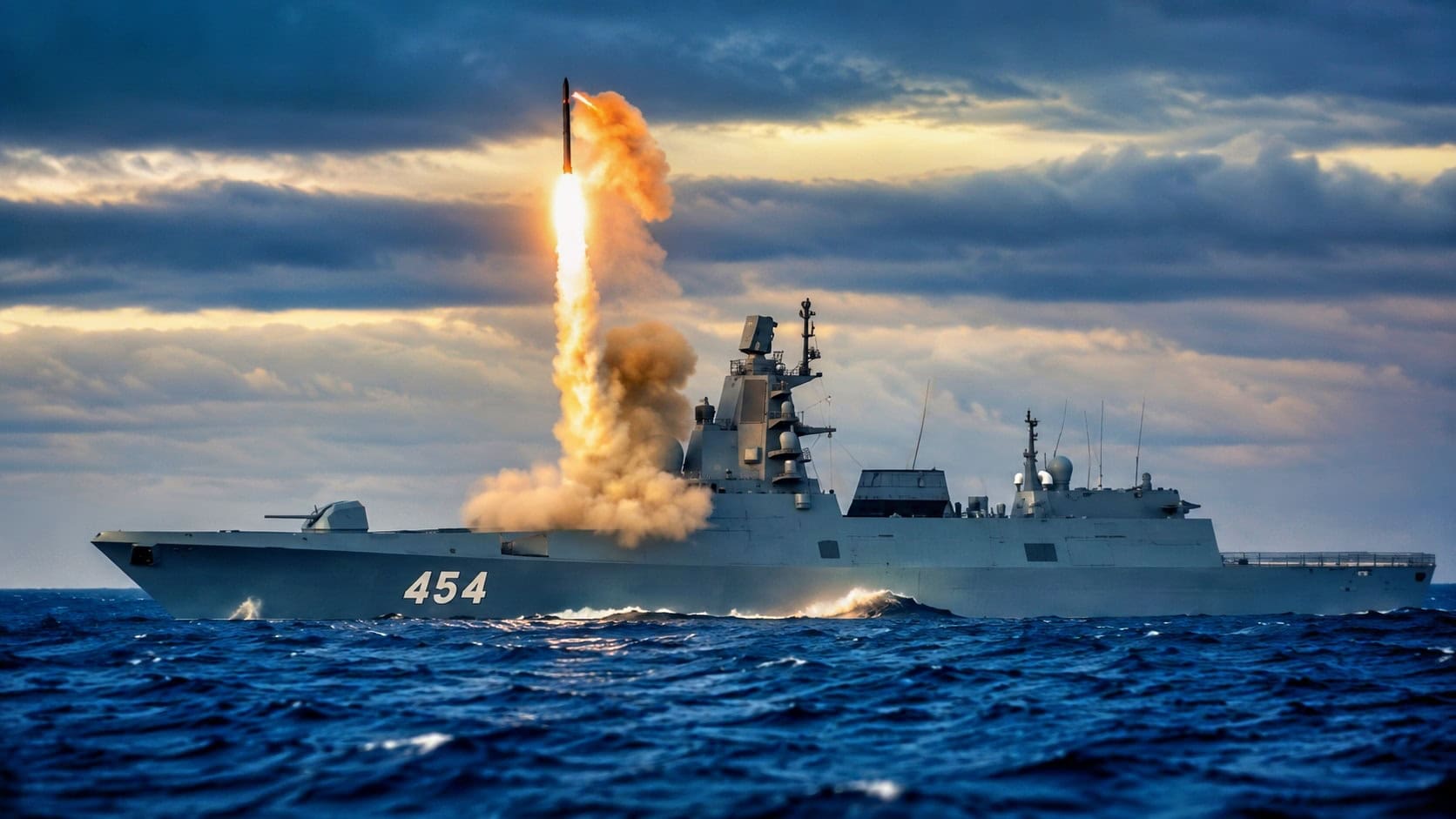
Since the end of the Cold War, Russia’s shipbuilding industry has found itself in a quagmire that it cannot seem to escape. It has been unable to construct any new destroyer-sized hulls for its surface fleet and is now reliant primarily on smaller frigates and corvettes. The Admiral Gorshkov-class frigates are among the more recent additions to the Russian fleet. Armed with 16 to 32 Vertical Launch Systems (VLS tubes), these frigates are capable of firing cruise missiles, anti-ship missiles, or Zircon hypersonic cruise missiles. The Program hit a rut relatively early in its development as Ukraine, the primary manufacturer of the ship’s engines, decided to halt cooperation with the Russians after the 2014 annexation of Crimea.
Off to a Shaky Start for Gorshkov-class
The Gorshkov-class was intended to replace older Soviet-era frigates, such as the Neutrashimy and Krivak classes, as part of a broader effort to revitalize and modernize the Russian Navy. Design of the new frigate was approved in 2003, and the first hull was laid down in 2006.
The first ship, Admiral Gorshkov, was originally intended for 2009, but the date was repeatedly pushed back until she was finally commissioned in 2018, nearly a decade later than originally planned.
Her sister ship, Admiral Kasatonov, was laid down in 2009 before being commissioned in 2020. Currently, three Gorshkov-class frigates are operational with two more being fitted out, and another four under construction.
The main bottleneck delaying the initial batch of Gorshkov-class frigates was the engines. Originally, Russia entered into a contract with Zorya-Mashproekt, a Ukrainian manufacturer specializing in gas turbine engines.
However, following Russia’s annexation of Crimea in 2014, this contract was promptly terminated, forcing the Kremlin to seek a domestic manufacturer. The task fell to NPO Saturn.
The initial plan was to finish development on the new engines by 2018, which would have resulted in further delays on new frigates. The Russian state directly intervenes, fast-tracking the development of the new engines.
Other Delays and Current Program Prospects
The engines were not the only hurdle delaying the delivery of new frigates. Initial testing on Admiral revealed several issues requiring urgent attention. Multiple problems were identified with the frigate’s main 130mm gun, affecting its accuracy and reliability.
Other issues included problems with the onboard S-350 air defense system and engine issues that were prone to causing onboard fires.
All of these issues combined pushed back delivery of Admiral Gorshkov by nine years and left the future of the Gorshkov-class program in doubt. Following her commission, the ship circumnavigated the globe, traveling over 35,000 nautical miles, marking the first circumnavigation by the Russian Navy since 1886.
After the completion of Admiral Gorshkov, the program has proceeded much more smoothly. Construction on these ships has been slow, but since the issues on the first ship have been resolved, the timeframe between initial construction and final commissioning has gradually decreased with each subsequent addition.
The fourth vessel in the class, Admiral Isakov, is currently under construction and is the first to receive the new domestically made gas turbines, replacing those made in Ukraine.
The Russian Navy is set to acquire a fleet of 10 frigates, though talks are ongoing to increase the number to 20 or 30.
Design and Capabilities
The Gorshkov-class is built to conduct anti-air warfare, anti-ship operations, anti-submarine missions, and land-attack strikes within a single integrated platform. They are relatively compact compared with destroyers, with a displacement of roughly 4,500 tons standard and about 5,400 tons at full load, a length of around 135 meters, and a beam of approximately 16 meters.
Despite their moderate size, they carry an unusually dense array of weapons, allowing them to engage threats across multiple domains. Their physical layout incorporates stealth features such as angled surfaces, enclosed masts, and reduced thermal and radar signatures, making them harder to detect by modern sensors.
For its primary armament, the Gorshkov-class relies on its missile tubes. At the heart of its offensive capability is the universal vertical launch system, commonly referred to as UKSK, which consists of 16 cells on the initial ships, with later variants reportedly fitted with 24 to 32 launch cells.
These launchers can fire a variety of missiles, including Kalibr cruise missiles for land attack and anti-ship roles, Oniks supersonic missiles designed to engage surface targets, and the newer Zircon hypersonic missiles. This flexibility allows each vessel to tailor its loadout depending on mission requirements, making it adaptable to many types of operations.
Defensive Armaments and Proposed Upgrades
For air defense, the frigates are equipped with the Poliment-Redut system, which combines advanced phased-array radars with vertical-launch surface-to-air missiles capable of intercepting aircraft, cruise missiles, and other aerial threats.
The radar system can track multiple targets simultaneously, allowing the ship to defend both itself and nearby vessels. Complementing this are close-in weapon systems, including the Pantsir-M system or earlier Kashtan installations, which integrate rapid-fire cannons and short-range missiles to counter incoming threats at close distances.
The ships also carry an A-192 130mm naval gun, which can engage surface targets, support amphibious landings through shore bombardment, and provide limited anti-air fire when needed.
According to some reports, the Russians have considered producing a heavily upgraded variant designated Project 22350M. This “Super Gorshkov,” as some have dubbed it, plans to incorporate an enlarged magazine capable of carrying up to 64 VLS tubes for offensive weaponry.
The proposed variant has a displacement of around 7,000 tons, making it noticeably heavier than previous variants. The design was first proposed in 2019, but as of now, there is no official confirmation that the Russian Navy is interested in procuring any Super Gorshkov.
About the Author: Isaac Seitz
Isaac Seitz, a Defense Columnist, graduated from Patrick Henry College’s Strategic Intelligence and National Security program. He has also studied Russian at Middlebury Language Schools and has worked as an intelligence Analyst in the private sector.