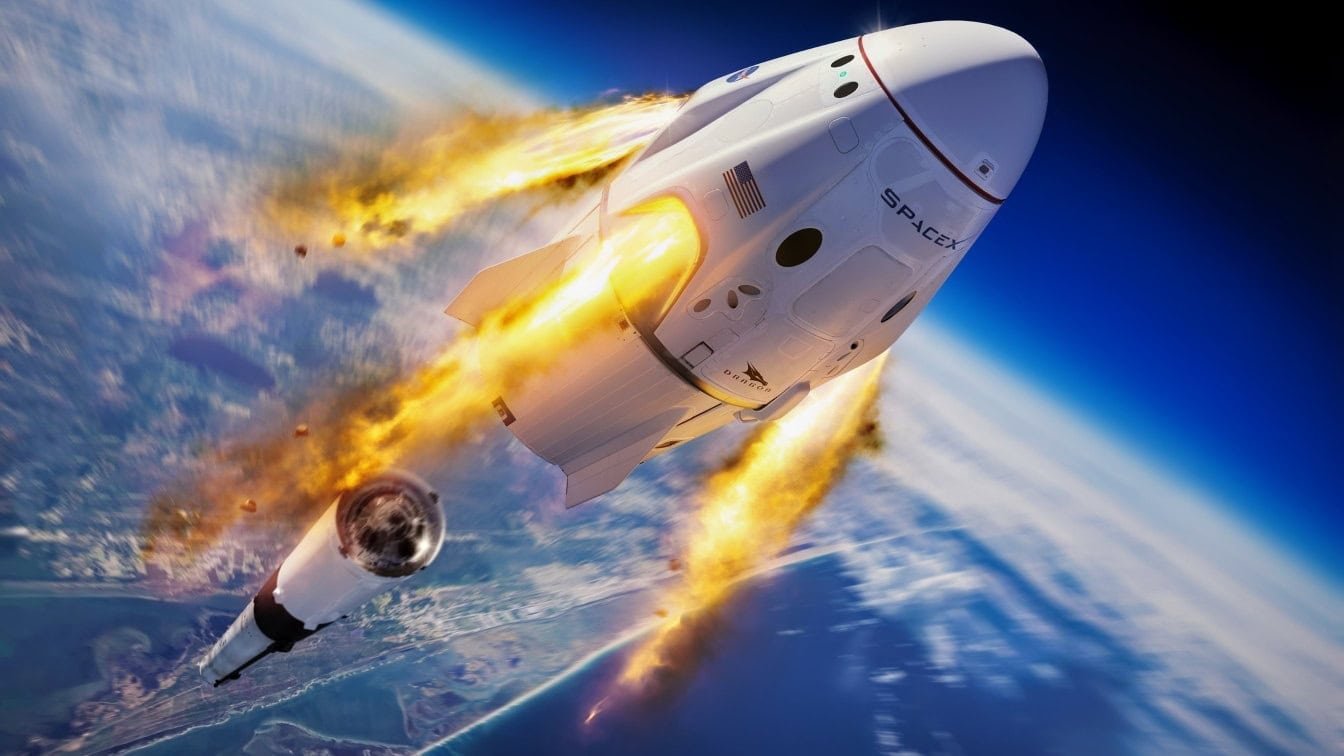
Business, like life, is about adaptation. Recently, SpaceX stunned the world by announcing it will deprioritize its Mars mission in favor of returning astronauts to the lunar surface.
Critics argue that this move may stem from alleged failures in SpaceX’s ongoing mission to send people to Mars. Indeed, complications have clearly arisen in Elon Musk’s quest to permanently colonize Mars.
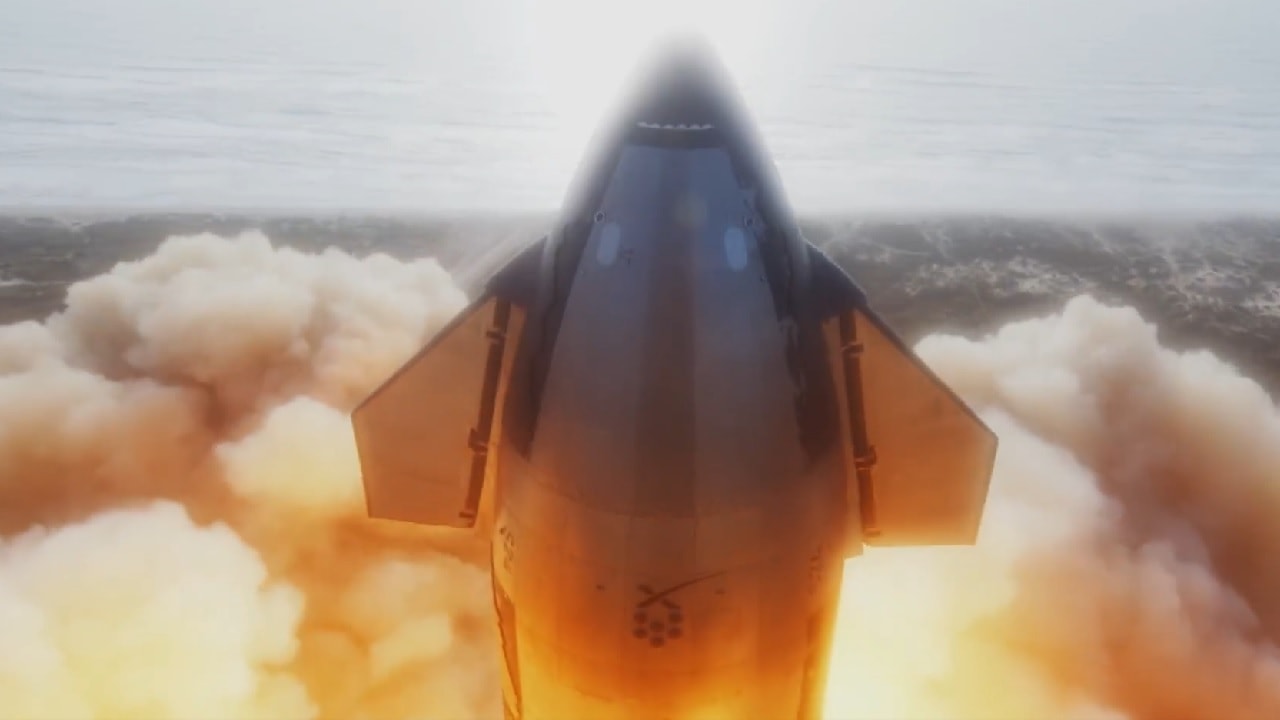
SpaceX Rocket Takeoff. Image Credit: Creative Commons.
That does not mean SpaceX is abandoning its mission to establish permanent colonies on Mars.
In fact, Musk’s direct-to-Mars approach, while ambitious, was always a dangerous supposition.
That’s because the technology and skill set needed not only to get humans to Mars but also to stay there are so advanced that it might not be possible under current limitations.
You have to run before you jump, and jump before you learn to fly, after all. So, the decision by SpaceX to shift focus away from an immediate manned mission to Mars and instead to the moon makes much more sense.
Why the Moon Makes Strategic Sense
A lunar SpaceX mission and base serve as a practical strategic move for SpaceX.
For starters, SpaceX’s biggest customer is the United States government. The Trump administration has made landing boots on the moon a national strategic priority.
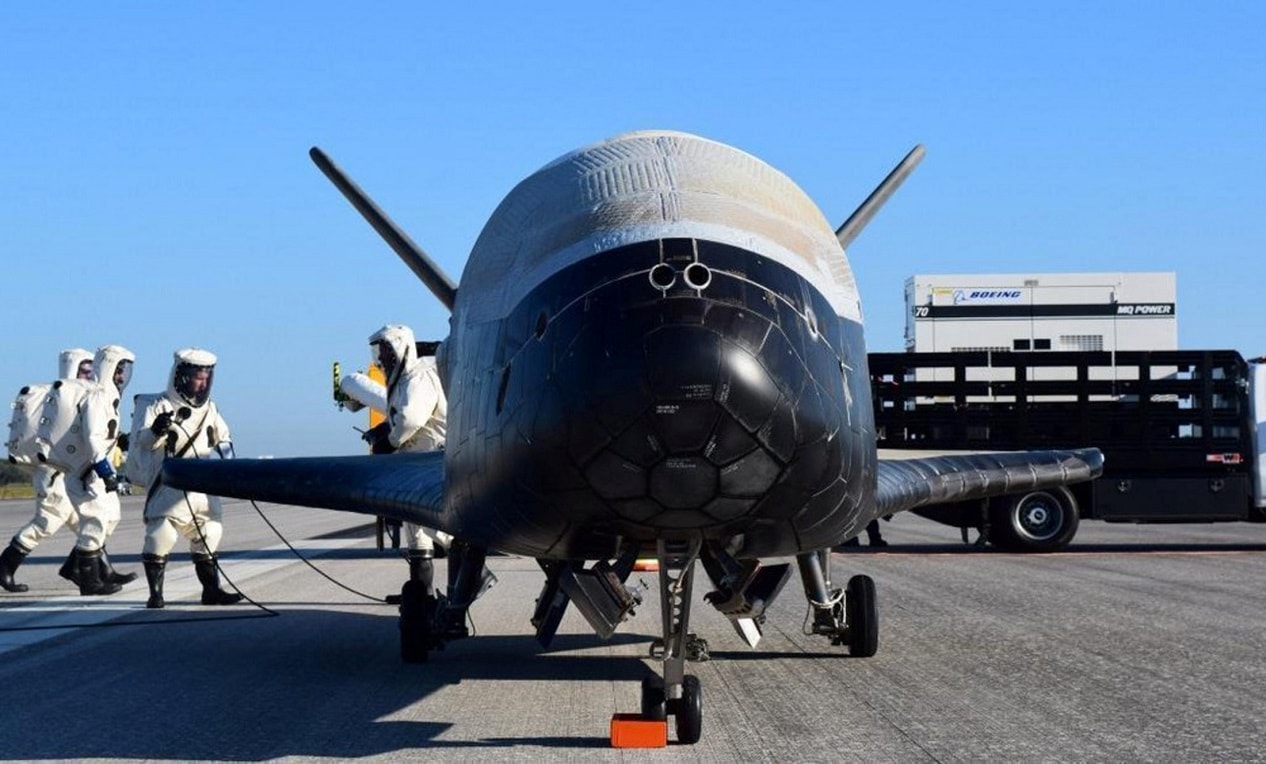
The U.S. Airforce’s X-37B Orbital Test Vehicle mission 4 after landing at NASA’s Kennedy Space Center Shuttle Landing Facility in Cape Canaveral, Florida, U.S., May 7, 2017. U.S. Air Force/Handout.
NASA cannot do this on its own.
Musk has already invested in developing the Starship. But the problems arising from getting boots on Mars mean that Starship has nowhere to go.
Unless Musk retasks it as a lunar mission system.
This keeps both Starship viable and money flowing into SpaceX’s coffers, enabling it to continue enhancing its capabilities over time.
While the technology and capabilities to get humans to Mars are still not yet mature, the technology is there to sustain US missions to the moon.
SpaceX can innovate for a Mars mission by pioneering human settlement of the Moon.
After all, the moon is significantly closer to Earth and offers easier, more frequent launch windows than Mars.
There’s also the added benefit that Musk can test his growing artificial intelligence and robotics in the lunar environment as part of real-world scenario experimentation for the inevitable SpaceX mission to Mars.

NASA’s Discovery. Image Credit: 19FortyFive.com taken on October 1, 2022.
The Moon as a Mars Testbed
SpaceX can also practice propellant harvesting from the moon’s natural resources. One idea is to make any human settlement on the moon affordable by ensuring it is self-sufficient.
That means people living on the moon will need to exploit its natural resources to produce rocket fuel and other essentials.
While the moon lacks water, it is abundant with ice. By harvesting the lunar ice, scientists on the moon can create rocket fuel in situ.
Other complications from prolonged deep space human habitation can be worked out by SpaceX on the moon, which is essentially a puddle jump away from the safety of Earth, as opposed to trying all these technologies and techniques–with human life on the line–in the deep wilds of space nearest to Mars.
These systems and methods can be perfected on the moon and then integrated into the inevitable SpaceX manned mission to Mars.
Building a Lunar Gateway to Mars
One of the greatest problems facing SpaceX’s Mars mission is how Musk can transfer everything needed to kickstart a manned colony on the Red Planet directly from Earth to Mars.
But conducting a manned mission from the Moon’s lower gravity to Mars might be better.
It certainly would be cheaper than trying to do everything from the Earth’s heavy gravity well straight to Mars. From the moon, however, one needs less fuel. From a physics standpoint, it might work better.
Over time, a manned position on the moon could feed into the development of a SpaceX manned mission on Mars.
The moon has one-sixth of Earth’s gravity.
Escaping a shallow gravity well like the moon’s requires a fraction of the fuel needed to punch through Earth’s atmosphere, permitting heavier, more heavily shielded spacecraft.
There’s the aforementioned in-situ resource utilization (ISRU).
And the components launched from Earth can be assembled in lunar orbit, simplifying logistics.
Plus, by the time the technology supporting a SpaceX Mars mission was fully mature, thanks to their new operations on the moon, those pesky problems, like better radiation shielding for human crewmembers on the flight (and once on the Martian surface), will likely have been solved.
The Geopolitical Dimension
All this is to say that SpaceX’s reprioritization of the moon ahead of Mars is not an implicit failure of the SpaceX dream of creating habitats for humans on Mars.
Instead, it is a necessary intermediate step to ensure not only the establishment of colonies there but also their survival.
Plus, the moon is a strategic location.
It is the strategic high ground of the Earth-Moon System. The nation that comes to control that territory will have serious advantages over the other nations on Earth.
This is why China is committed not just to landing on the moon but to establishing permanent bases there.
A Better Path to the Red Planet
SpaceX is America’s most advanced private space company and has done more to keep the United States ahead of China in the new space race.
By redirecting their attention away from Mars toward the moon, SpaceX can ensure that they help America remain in the lead in the new space race by helping NASA get boots on the moon again and, likely, establishing a set of American lunar colonies.
The new plan works out better for everyone.
America gets its most powerful private space company to push its astronauts to the lunar surface, while SpaceX gets the time and, if you’ll pardon the expression, the space it needs to mature the technologies and techniques that will make a Mars mission work.
About the Author: Brandon J. Weichert
Brandon J. Weichert is the Senior National Security Editor at 19FortyFive.com. He also manages The Weichert Brief on Substack. Weichert also hosts “National Security Talk” on Rumble. He is the author of four bestselling national security books, the most recent of which is A Disaster of Our Own Making: How the West Lost Ukraine (Encounter Books). Follow him via Twitter/X @WeTheBrandon.