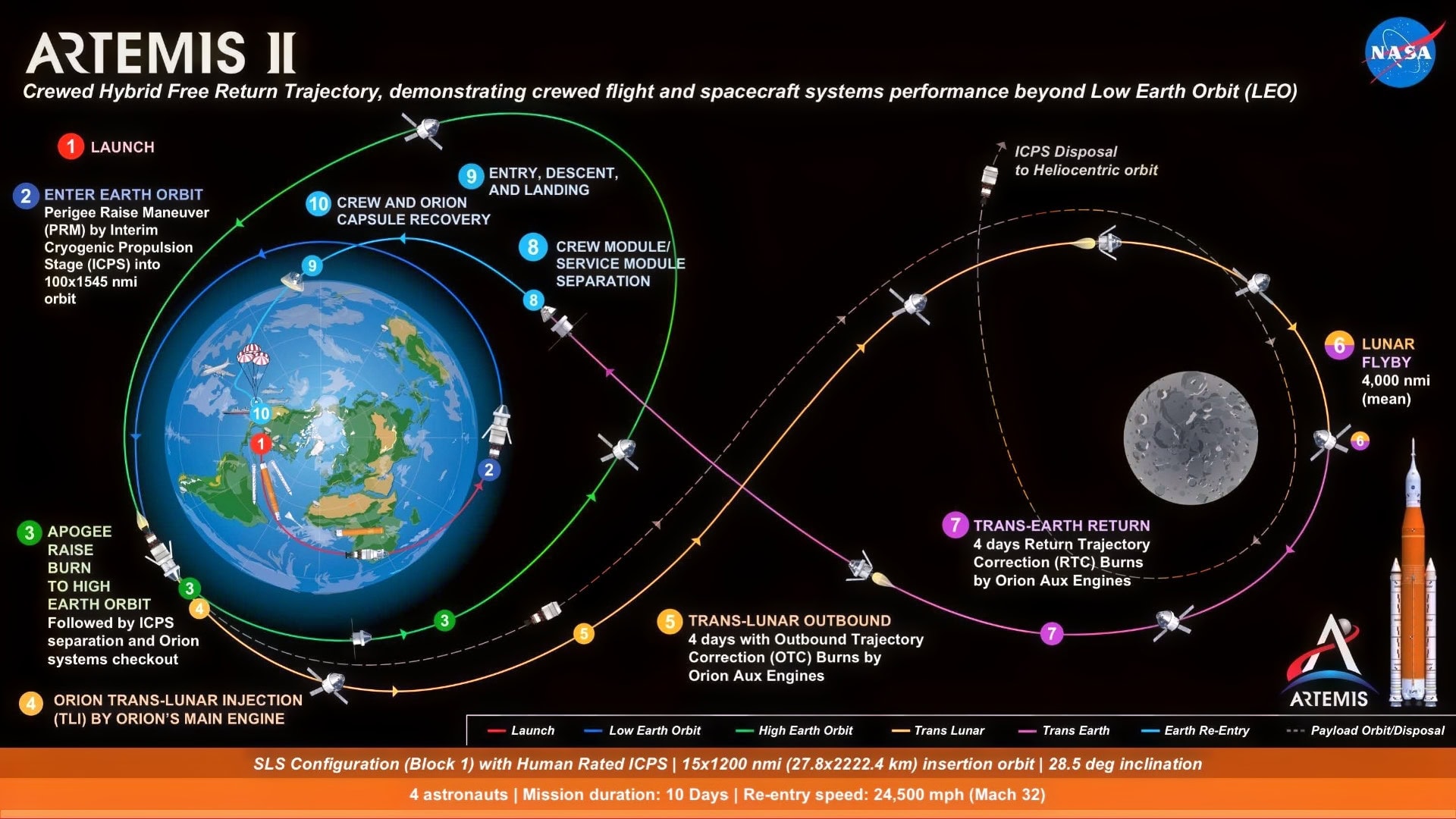
Recently, NASA made history by returning a crew of astronauts to the Moon. Well, not quite to the moon.
They were sent on a 96-hour trip around the moon. But that was a key mission. It helped NASA work out any problems with the underlying technology they will soon use to return Americans to the lunar surface.
The next phase of NASA’s plan for returning astronauts to the moon involves Artemis III. This next lunar mission will conduct in-orbit rendezvous tests with lunar landing systems from SpaceX (Starship) and Blue Origin (Blue Origin lander).
During these tests, four NASA astronauts will not only connect their ship to the SpaceX and Blue Origin gear but also traverse the hallways connecting these systems, thereby ensuring that every aspect of this highly complex, very dangerous mission works.
The Americans understand fully that they must get this mission right.
That’s because, if they fail, their number one geostrategic competitor–the People’s Republic of China–is right on their heels.
Beijing has already stated that they intend to land its taikonauts on the moon by the 2030s.
What’s more, Beijing has indicated they intend to claim real estate on the moon by establishing a semi-permanent manned research facility on the moon’s southern pole.
Landing people there would be but the first step of a much more complex mission set to dominate the moon’s strategic position as the “high ground” of the Earth-Moon System and exploit the bountiful resources there.
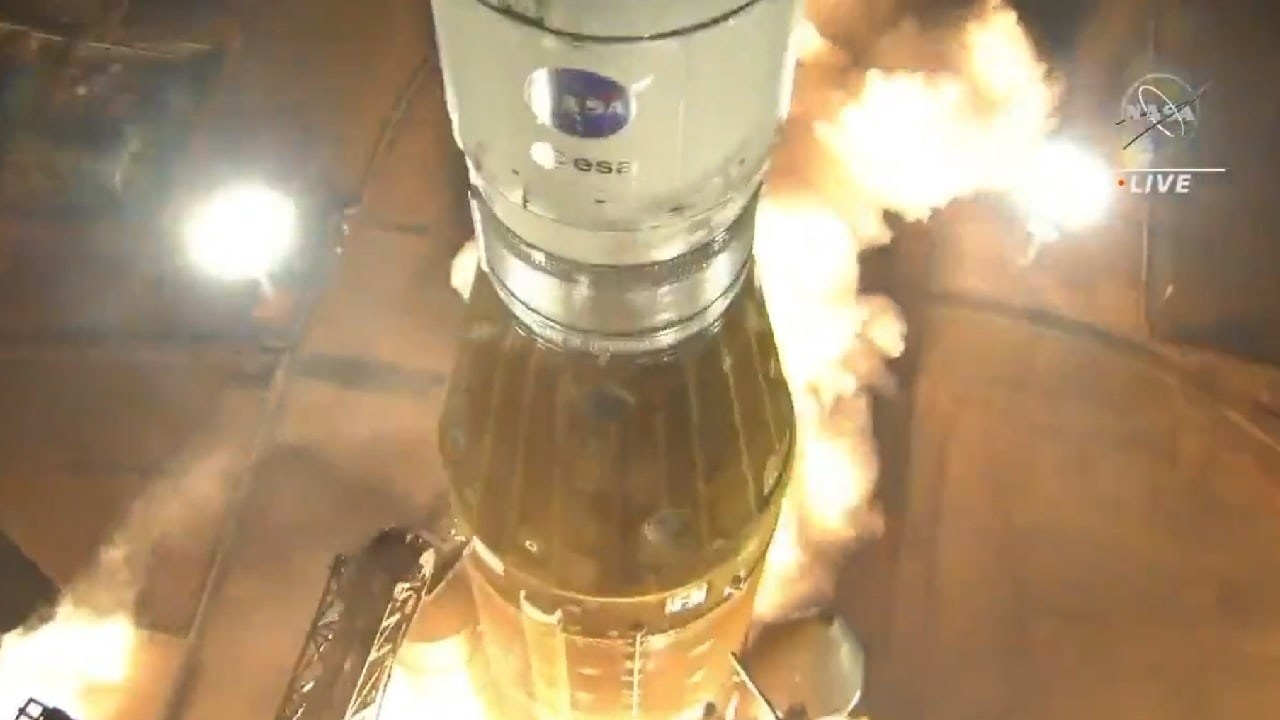
Artemis I. Image Credit: NASA Twitter Screenshot.
Why America Must Relearn What Apollo Already Knew
The Americans basically have to restart their lunar capabilities from scratch. After the final Apollo moon mission, Washington essentially mothballed America’s heavy-lift rocket capability (the only Saturn V rockets left are sitting on display at the Johnson Space Center in Texas, disassembled).
So, even though the Americans have already “been there, done that” in terms of landing people on the moon, they must relearn everything that they’ve forgotten since the 1970s.
And that’s why Artemis II had to orbit the Moon rather than land there simply, and why Artemis III must now test the components that will both land on the lunar surface and return Americans from it when the manned lunar landing mission is officially authorized.
Testing these complex systems under the stresses of space, with live astronauts aboard, might seem like another annoying bureaucratic complication that delays boots on the moon.
Still, it’s a necessary step toward a successful return to the moon.
What’s more, the Americans are clearly still ahead of the Chinese space program, which continues working on its own mission but is not yet in the physical testing phase.

Shuttle Discovery at National Air and Space Museum on October 1, 2022. Image Credit: 19FortyFive.com
One cannot just deploy to the moon without first ensuring that all systems necessary for a successful mission there can be tested in real time.
And before anyone starts complaining that we did this same mission decades ago with less technology, people seem to forget that we also did a series of “test runs” around the moon before Neil Armstrong.
His crew actually landed there (cue the tinfoil hats insisting we never went to the moon at all).
The Lessons of Apollo 1
The tragedy of Apollo 1 remains one of the darkest chapters in NASA history.
On January 27, 1967, NASA astronauts Virgil I. “Gus” Grissom, Edward H. White III, and Roger B. Chaffee clamored into Apollo 1 for what was supposed to be the first Earth-orbiting flight of the Apollo Command and Service Module.
They were testing the launch systems before the mission when a flash fire erupted in the pure-oxygen capsule. The three pioneers could not reach the escape hatch before the conflagration consumed them.
That tragedy, had it not occurred on the launchpad, would have likely occurred at some other point during the flight. Or it would have occurred on another Apollo mission.
Since that horrific event happened, though, NASA learned of a serious design flaw in its Apollo capsules and went to work redesigning them to ensure that no such accident could happen again. Apollo 2-6 were a series of uncrewed test flights of the Saturn V rocket and the Command and Lunar Modules, ensuring that the underlying technologies worked well.
Then came Apollo 7 in October 1968. This mission marked the return of astronauts to space since the Apollo 1 disaster. It wasn’t until Apollo 8 that three Americans–Frank Borman, Jim Lovell, and Bill Anders–left the cradle of Earth’s orbit and orbited the moon. Apollo 9 then tested the Apollo program’s lunar landing hardware for the first time. Apollo 10 then did a lunar landing “dress rehearsal” around the moon. It was not until Apollo 11 that Americans landed on the lunar surface.
Artemis Is Moving Faster Than Apollo
The history of the previous lunar program is important. Because we’ve streamlined these processes. Thankfully, no astronauts have died in the Artemis mission so far (unlike the Apollo 1 incident).
What’s more, most of the benchmarks met in the Apollo program were done over multiple iterations that surely slowed the landing of men on the moon from what it might have been.
All this is to say that, contrary to what some people are arguing, Artemis might actually be doing more in fewer missions than did the Apollo program.
Ultimately, if Artemis does not result in Americans returning to the moon soon, then the Artemis missions will clearly be failures.
The China Clock Is Ticking
But the current head of NASA, Jared Isaacman, is a protege of Elon Musk’s. Plus, Isaacman was an astronaut who broke records in the private space program.
The guy is the definition of an expert in this domain. He brings with him years of real experience in spaceflight operations and a clear strategy for achieving this herculean task of returning Americans to the moon before the Chinese can get there.
Plus, Artemis III is incorporating elements of America’s impressive–and growing–private space sector. That’s an added complication that must be worked through.
The Apollo program had uniform systems. Artemis does not.
They must ensure that all these systems underlying the Artemis program work together seamlessly.
The Moon Is the Opening Battle of the Next Space Age
The critics demanding an immediate lunar landing misunderstand what is actually happening. Artemis III is not delayed.
It is the final proving ground before America commits astronauts to the most ambitious human spaceflight mission in more than half a century.
The Chinese are racing toward the moon. America cannot afford another Apollo 1. Nor can it afford to broadcast a failed lunar landing to the world while Beijing closes the gap.
That is why Artemis III matters.
The moon is no longer a symbol. It is a strategic territory.
The nation that masters the logistics of reaching it, operating on it, and exploiting its resources will shape the future balance of power in space.
America learned during Apollo that there are no shortcuts to greatness.
Every successful moon landing is built atop countless tests, rehearsals, and hard-earned lessons.
Artemis III is the last major hurdle before the United States returns to the lunar surface.
If it succeeds, America will remain in front of China and secure a commanding position in the next great frontier. If it fails, Washington may find itself watching from Earth as Beijing plants the flag that defines the new space age.
About the Author: Brandon J. Weichert
Brandon J. Weichert is the Senior National Security Editor at 19FortyFive.com. He also manages The Weichert Brief on Substack. Weichert also hosts “National Security Talk” on Rumble. He is the author of four bestselling national security books, the most recent of which is A Disaster of Our Own Making: How the West Lost Ukraine (Encounter Books). Follow him via Twitter/X @WeTheBrandon.