
After years of failed tests, missed deadlines, and more than $12 billion in spending, the United States is finishing the fielding of its first hypersonic weapon, the Army’s Long-Range Hypersonic Weapon, nicknamed Dark Eagle — the first operational hypersonic missile America will have ever put in the field. It is built to strike a target more than 1,700 miles away in roughly 15 to 20 minutes, at reported speeds far beyond anything conventional defenses are designed to stop, on a maneuvering trajectory that radar struggles to track. The milestone is real, and it is also a measure of how far behind the United States has fallen: Dark Eagle is the answer, arriving years late, to a capability China and Russia fielded first. And almost as soon as it became available, a U.S. combatant command reportedly requested that it be sent to a live theater.
What Dark Eagle Is, And Why Defenses Struggle Against It
Dark Eagle is a ground-launched, surface-to-surface boost-glide hypersonic weapon built for the U.S. Army by Lockheed Martin. It is built around the Common Hypersonic Glide Body, a warhead developed with Sandia National Laboratories: a two-stage rocket booster accelerates the weapon to well above hypersonic speed and then falls away, after which the unpowered glide body — capable of sustaining velocities above Mach 5 on its own — flies the rest of the way to the target.
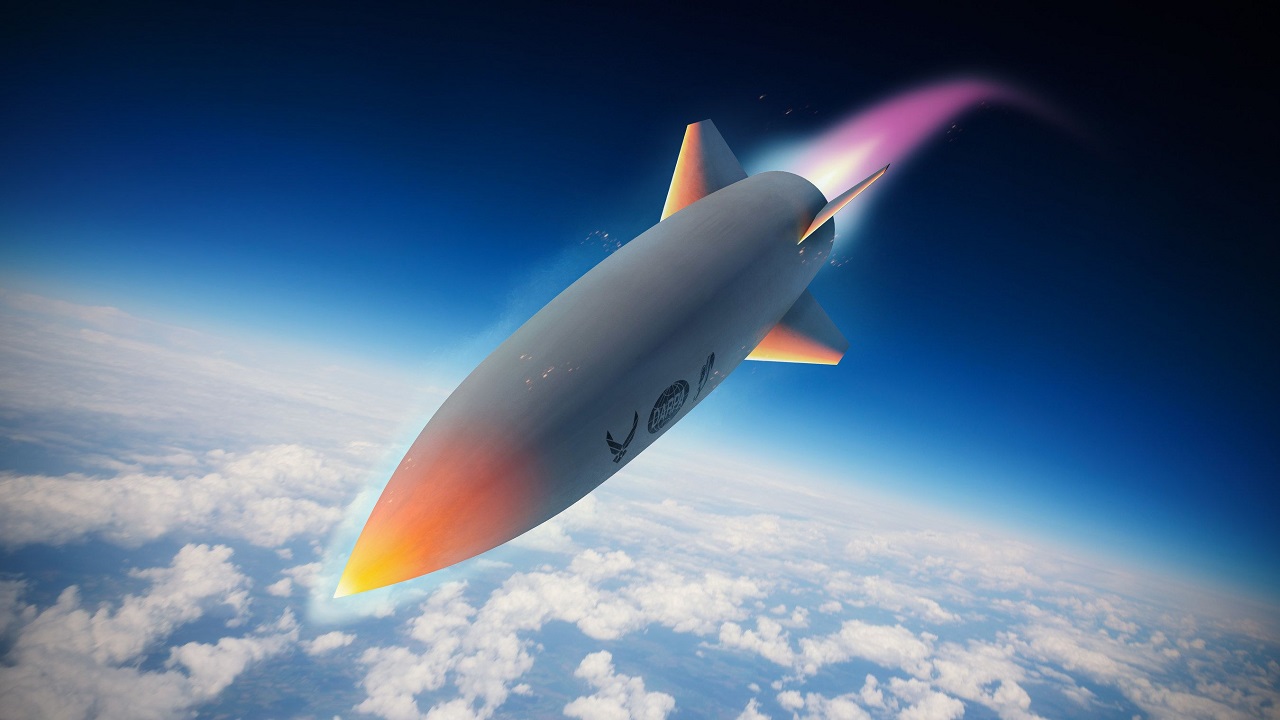
Hypersonic Missile Sample Image VIA DARPA.
Boost-glide is the category that separates these weapons from older missiles. A traditional ballistic missile follows a predictable arc that defenders can compute and intercept; the Dark Eagle glide body instead makes unpredictable turns and altitude changes at extreme speed, presenting a problem that existing missile defenses were never built to solve.
The performance figures are striking, though the most dramatic of them should be read as reported rather than officially confirmed. The weapon has an intermediate range of 1,725 miles (about 2,776 kilometers) and is described as reaching a maximum-range target in roughly 15 to 20 minutes.
Its peak speed has been reported as high as Mach 17, though the Army holds its exact capabilities secret, and other accounts cite only that the glide body exceeds Mach 5.
Either way, the combination of speed and maneuverability is the point: a target that is constantly changing destination, arriving in minutes, and flying too fast and too low for reliable tracking gives an air-defense operator almost no way to compute an intercept. The weapon was designed specifically to defeat the advanced air defenses of China and Russia.
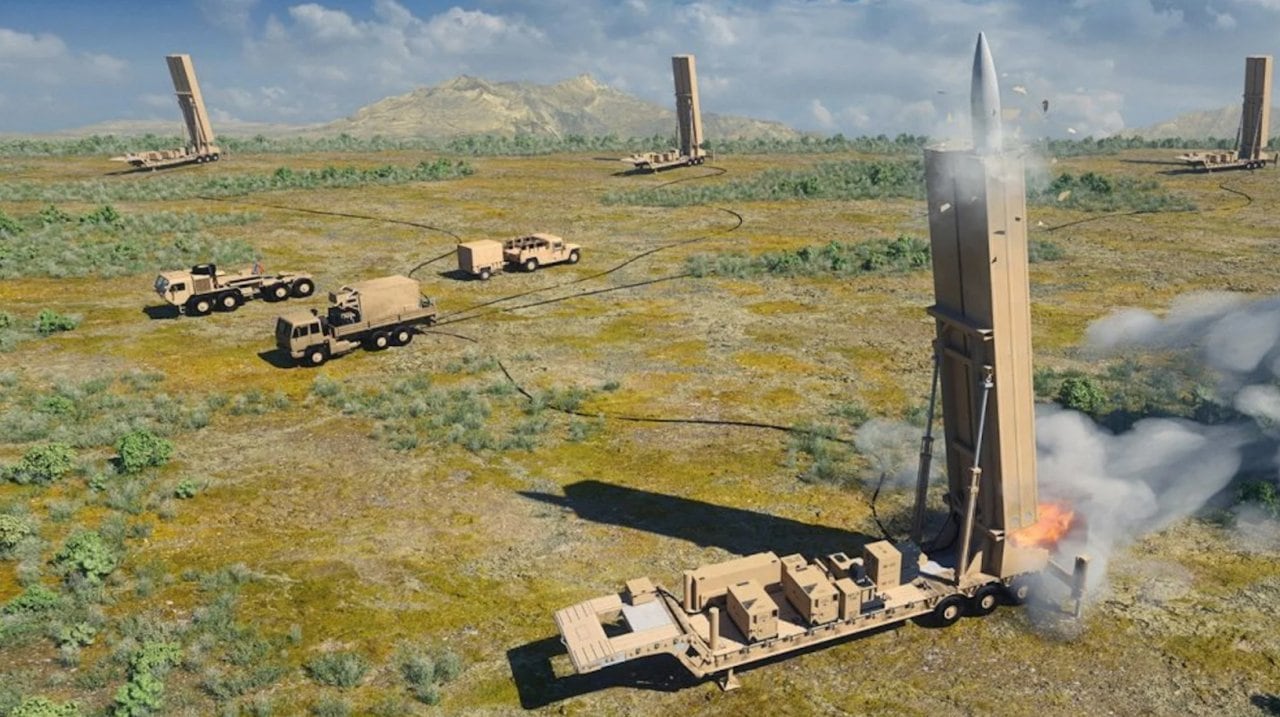
The system is road-mobile, a key to its survival. A single Dark Eagle battery consists of four trailer-mounted transporter-erector-launchers, each carrying two missiles for a total of eight ready rounds, plus a battery operations center and support vehicles.

Hypersonic Missile VIA artist rendering. Image Credit: Lockheed Martin.
Because the launchers can disperse and relocate, the battery can complicate an adversary’s efforts to find and destroy it before it fires. The booster at the heart of the weapon is shared with the Navy’s Conventional Prompt Strike system, which fires the same glide body from surface ships and submarines, making the glide body the common core of America’s emerging conventional hypersonic arsenal across two services.
The Long Road Of Failure: $12 Billion And A String Of Scrubbed Tests
Getting to this point took the better part of a decade and a great deal of money, much of it spent on failure. The Common Hypersonic Glide Body first flew in a test in 2017, and the Army and Navy formally agreed to co-develop it in 2018.
Then came the hard years. A booster test failed in late 2021; a full-system test failed in June 2022 and was logged as a “no test”; another test that October was delayed for a root-cause assessment; and a launch in September 2023 was canceled at the last moment due to a pre-flight mechanical failure. Each setback pushed the program’s schedule further behind its targets, and the Army missed its original deadline to field the first battery by the end of fiscal 2023.
The breakthrough came in 2024. The Army and Navy conducted a successful end-to-end flight test of the complete weapon in June 2024, followed by a second successful end-to-end test that December, the pair of flights establishing that the system worked and could repeat the feat. Even so, the first operational deployment kept slipping — past fiscal 2023, past fiscal 2025 — and the program has accumulated more than $12 billion in funding since 2018.
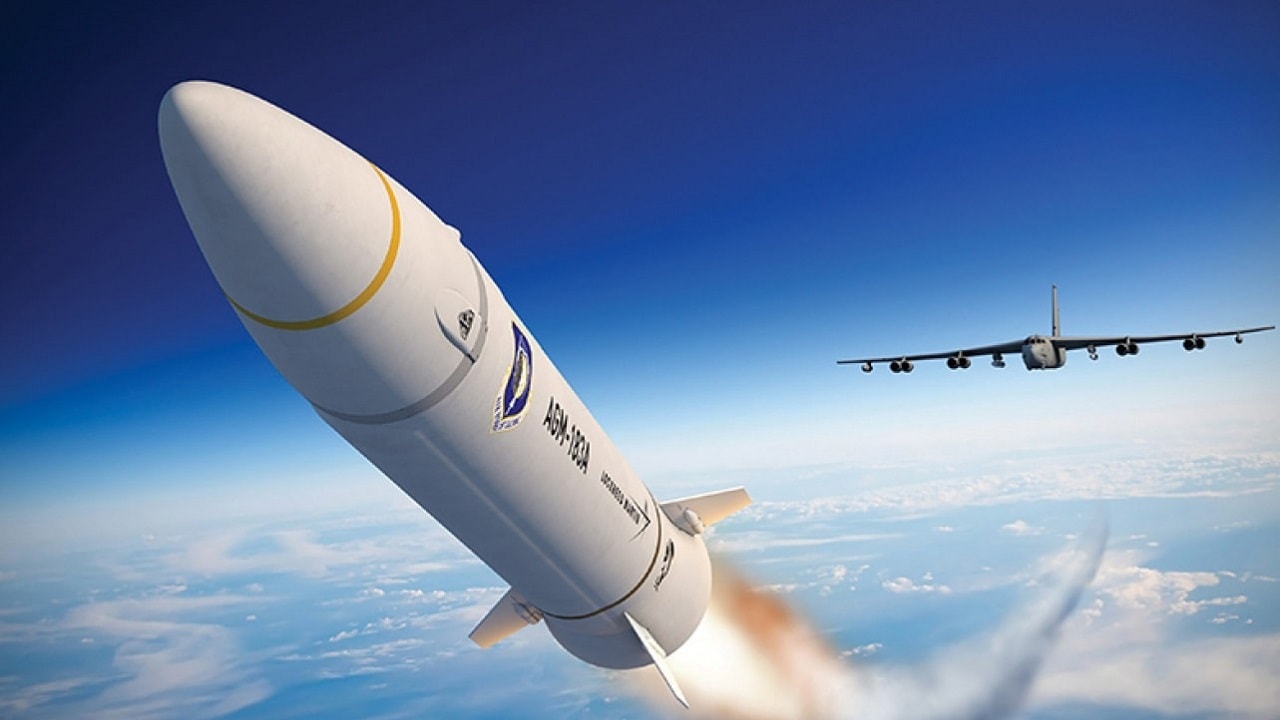
Hypersonic missile artist rendering. Image Credit: Creative Commons.
The cost per missile is its own constraint: reporting puts the figure at roughly $15 million per round, while a 2023 Congressional Budget Office study estimating the cost of buying 300 similar boost-glide missiles put it at around $41 million per missile in program-acquisition terms. However, the figure is counted, Dark Eagle is dramatically more expensive than a cruise missile, which shapes how freely it could ever be used.
The Fielding: Bravo Battery And America’s First Hypersonic Unit
The decisive turn is happening now. Fielding activities for Dark Eagle began in December 2025 and were expected to wrap up within the following months, an Army spokesperson confirmed, and once delivery of the entire battery is complete, Dark Eagle will become the United States’ first-ever operational hypersonic weapon.
The precision matters here: some ballistic missiles already in the U.S. arsenal fly at hypersonic speeds, but they lack the maneuvering flight profile of these new weapons, which is what makes Dark Eagle a genuinely new capability rather than a faster version of an old one.
The unit carrying it is Bravo Battery, 1st Battalion, 17th Field Artillery Regiment, assigned to the 3rd Multi-Domain Task Force at Joint Base Lewis-McChord in Washington State. The battery was activated in December 2025 and completed its initial setup, system integration, and unit training, with its soldiers having trained on the equipment since 2021, when the Army first delivered the ground gear — launchers, command systems, and support vehicles, but no missiles — to the unit. As of the spring, the battery had received its launch equipment and partial missile deliveries, with full operational capability dependent on completing the missile complement and validating the system under live conditions.
The Army’s senior missile official, Lt. Gen. Frank Lozano, said in March that the service was within weeks of fully equipping the battery.
A second Dark Eagle battery is scheduled for the fourth quarter of fiscal 2026, and the Army plans to field additional batteries across its other Multi-Domain Task Forces.
The Reported Iran Request: A Pending Ask, Not An Order
The newest and most sensitive development is a reported request to send the weapon into a live fight, and it should be understood precisely for what it is.
According to a Bloomberg report at the end of April 2026, carried widely by other outlets, U.S. Central Command submitted a request to deploy Dark Eagle to the Middle East for possible use against Iran, with a person with direct knowledge of the request saying it remained pending and Central Command declining to comment.
The reported justification is operational: Iran is said to have relocated ballistic-missile launchers beyond the range of the Army’s Precision Strike Missile, which can reach targets more than 300 miles away, and Dark Eagle’s far greater range would let it strike those launchers deep inside Iranian territory.

The Marines could land in Iran tomorrow. Navy SEALs would prepare the beach. The 82nd Airborne could infiltrate. The invasion would succeed initially. Then Iran would launch drones and missiles at every U.S. base, satellite terminal, and air defense radar in the Middle East. Getting in is easy. Surviving is the problem.
Several cautions are essential. This is a single-origin report — Bloomberg’s — that many outlets have repeated rather than independently confirmed, it describes a request that has not been approved or executed, and it would, if carried out, mark the first operational deployment of a U.S. hypersonic weapon even though the system has not been declared fully operational.
It also comes against a fragile backdrop: a U.S.-Iran ceasefire framework has been in place since earlier in the spring, and a deployment request of this kind, if genuine, could signal preparations for further strikes should the arrangement break down.
The reporting situates the request within broader U.S. military planning, including a reported CENTCOM briefing to President Trump on options against Iran.
None of that has been officially confirmed, and the request’s status as a pending, unapproved ask — not a decision and not an action — is the part to hold onto.
Where Dark Eagle Sits: A Catch-Up, Not A Lead
The honest framing of Dark Eagle is that America is arriving at a capability its rivals reached first, and the catch-up is specific. Dark Eagle is widely understood as the U.S. response to hypersonic weapons already deployed by Russia and China, an effort to close a conventional-deterrence gap against near-peer adversaries. The comparison has to be drawn carefully because not all hypersonic weapons perform the same function.
Russia’s Avangard is a strategic, nuclear-armed, intercontinental system in a different category altogether; the genuine peer to Dark Eagle is China’s DF-17, a road-mobile, conventionally armed, theater-range boost-glide weapon built for the same kind of mission. Measured against that conventional-theater category, the United States is behind on fielding, not behind on hypersonics in every sense, and Dark Eagle narrows precisely that gap.
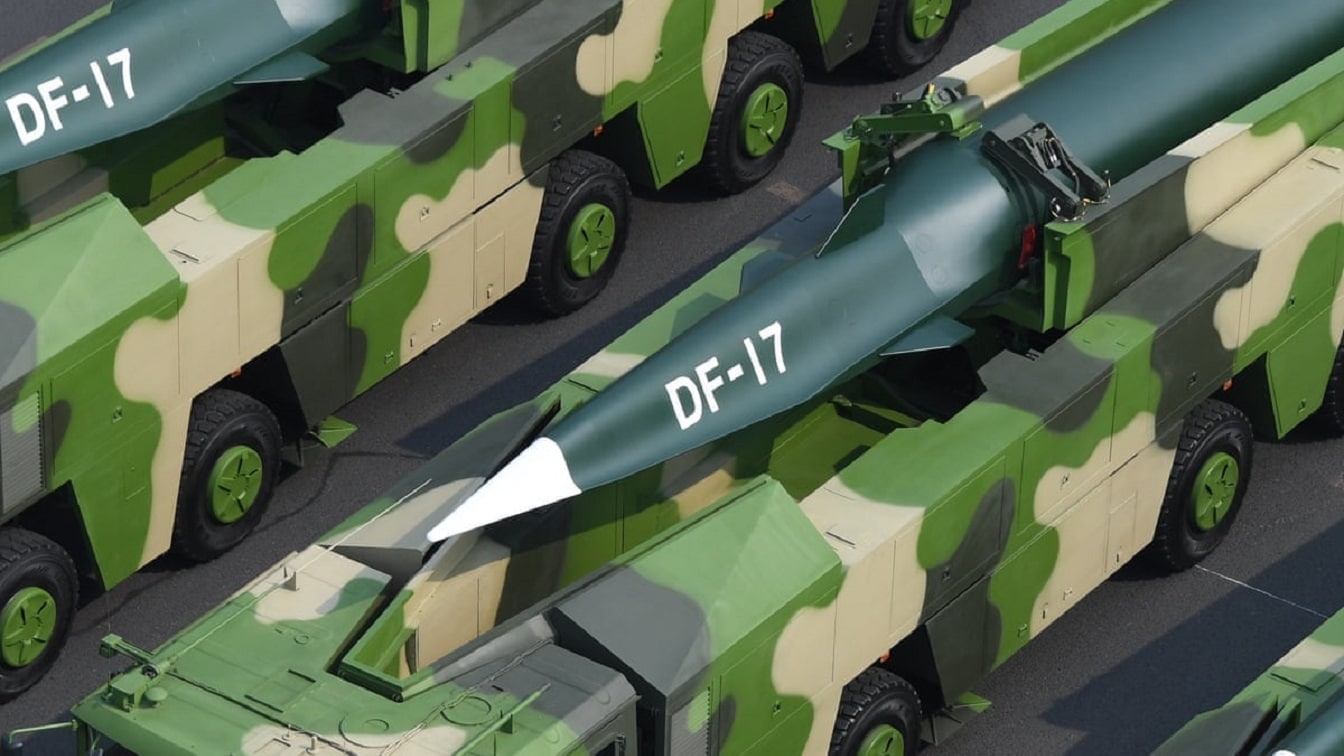
DF-17 Chinese Missile. Image Credit: Creative Commons.
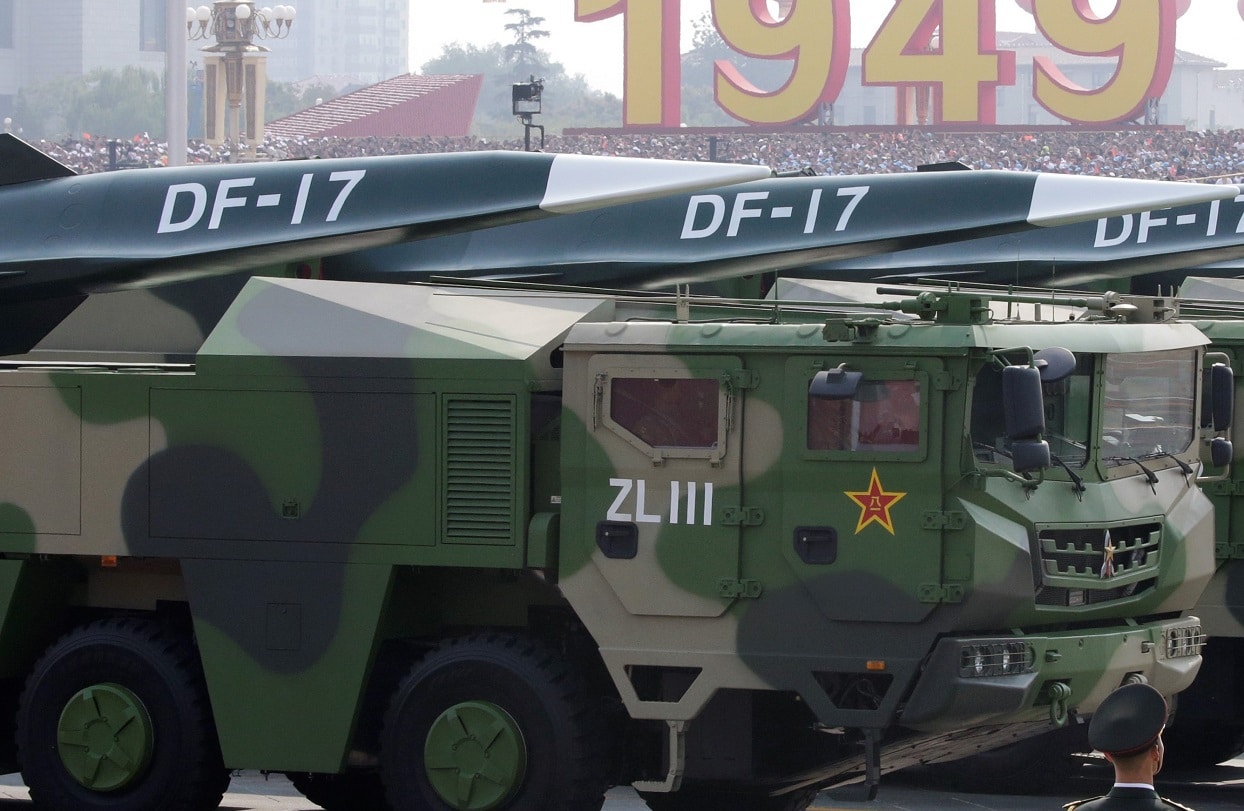
Image of DF-17 missile. Image: Creative Commons.
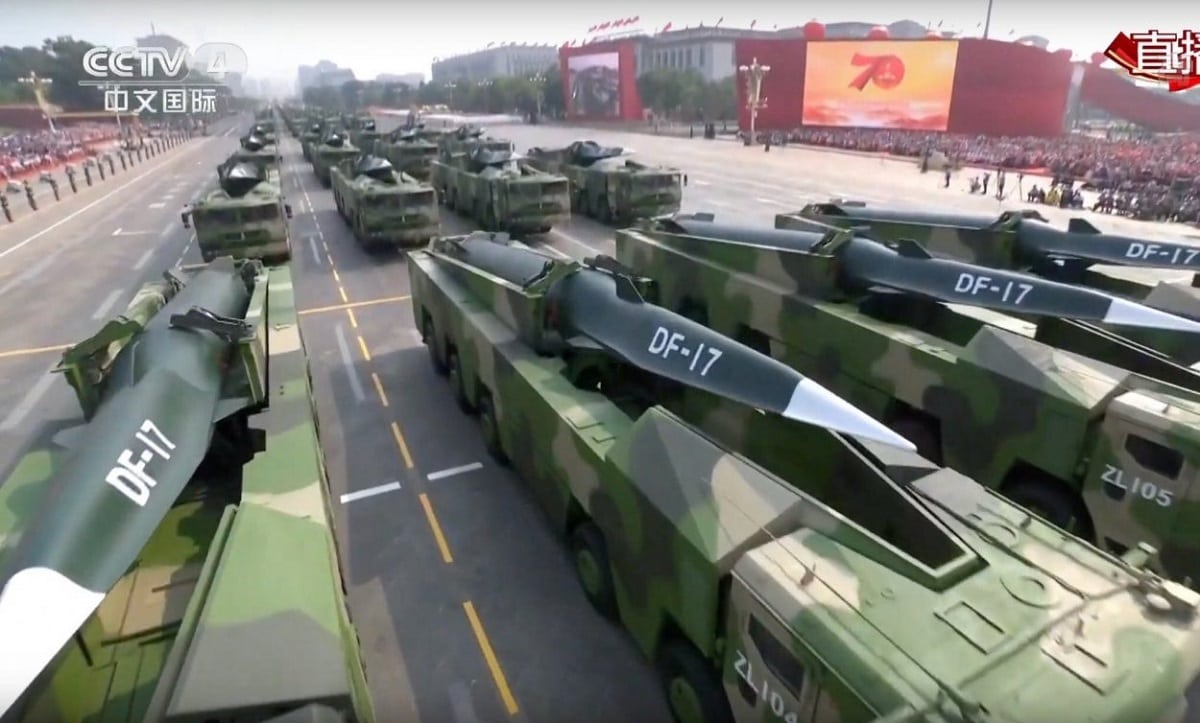
DF-17 Missiles
The other limit is scale, and it is real. At roughly $15 million per missile and only two rounds per launcher, a single battery fields just eight ready rounds, which sharply limits the size of any salvo and makes the weapon far too expensive to fire freely, as cruise missiles are used.
A capability that exists in tiny numbers and at high cost is a precision instrument for the highest-value targets, not a weapon of volume.
That is the tension at the center of the program: Dark Eagle is a genuine technological milestone and a real addition to American long-range firepower, and it is also expensive, fielded in small numbers, and arriving years after the adversaries it was built to counter.
Whether it becomes a decisive capability or a boutique one will depend on how many the United States can afford to build and field, and on whether the catch-up that took a decade and $12 billion can be turned into something more than a single battery of eight missiles in the Pacific Northwest.
About the Author: Harry J. Kazianis
Harry J. Kazianis (@Grecianformula) was the former Senior Director of National Security Affairs at the Center for the National Interest (CFTNI), a foreign policy think tank founded by Richard Nixon based in Washington, DC. Harry has over a decade of experience in think tanks and national security publishing. His ideas have been published in the NY Times, The Washington Post, The Wall Street Journal, CNN, and many other outlets worldwide. He has held positions at CSIS, the Heritage Foundation, the University of Nottingham, and several other institutions related to national security research and studies. He is the former Executive Editor of the National Interest and the Diplomat. He holds a Master’s degree focusing on international affairs from Harvard University.