
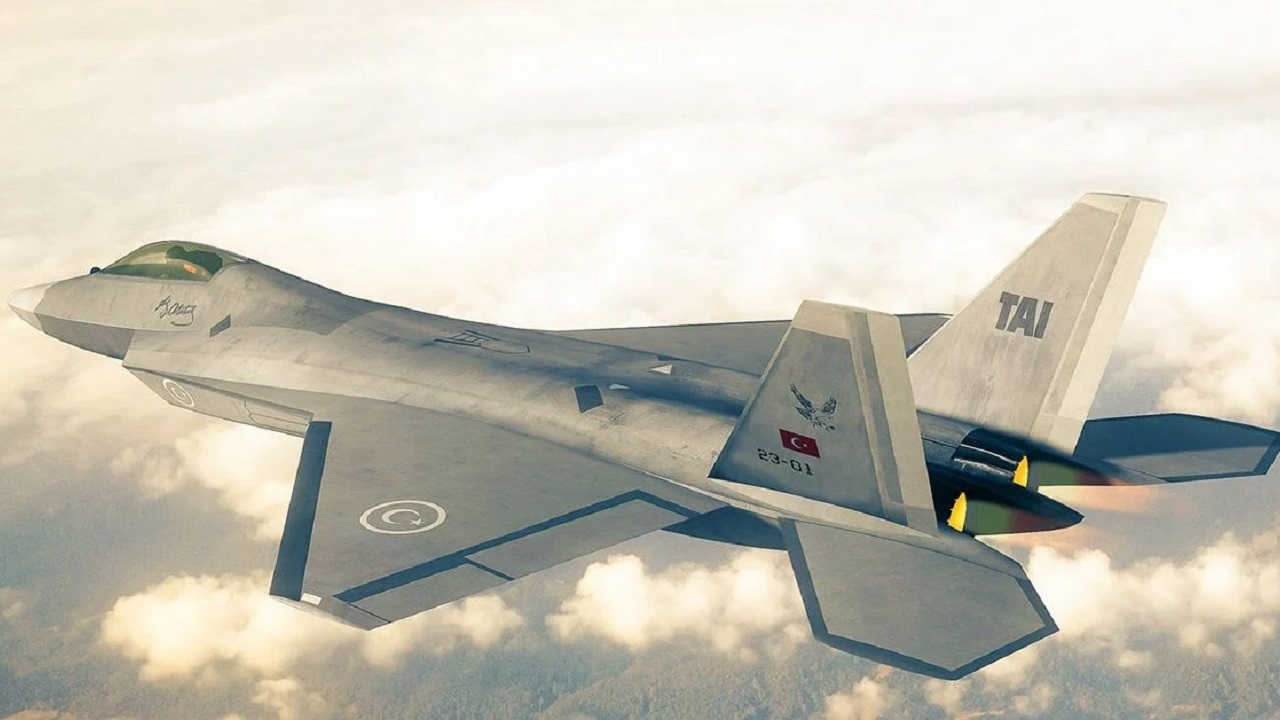
The TF Kaan is a Turkish-designed fifth-generation stealth fighter manufactured by Turkish Aerospace Industries (TAI). The aircraft has garnered significant international support, with multiple countries expressing interest in acquiring it.
Ankara has high hopes for the aircraft, with plans to develop dedicated loyal wingman drones and multiple other fighter variants.
With its first flight in 2024 and the aircraft not yet in production, the TF Kaan still has a way to go before it reaches full operational status.
Its future on the international market will likely hinge on how quickly the Turks can develop new engines to replace the American power plants currently powering the fighter.
TF Kaan Development
Prior to the development of the TF Kaan, Turkey’s Defense Industry Executive Committee (SSIK) launched a series of preliminary studies assessing the feasibility of designing and developing a next-generation aircraft.
Turkey initially reached out to Saab to help out with the aircraft’s development, but these plans were ultimately abandoned, and a deal was instead reached with BAE Systems to provide engineering assistance.
Between 2018 and 2023, the Turks showed off several mockups of the aircraft before a fully functional prototype was rolled out in 2024, which then took its first flight.
TAI has since completed three prototypes, with plans to deliver its first 20 Block 10 aircraft to the Turkish Air Force by 2028.
The fighter is expected to improve with each subsequent Block. The hope is that by 2030, the Kaan will be equipped with fully indigenous parts with improved avionics, engines, and stealth systems.
A number of nations have expressed interest in procuring the aircraft, including Egypt, Pakistan, Saudi Arabia, and multiple others.
In 2025, Indonesia signed a contract expressing interest in purchasing 48 Kaan fighters, but based on Indonesia’s past behavior, this can hardly be considered a binding agreement.
Specs and Capabilities
TF Kaan is marketed as a fifth-generation multirole fighter, incorporating stealth, speed, and advanced electronic systems.
The aircraft features a twin-engine configuration, which offers greater thrust, increased payload capacity, and improved survivability compared to single-engine designs.
Its aerodynamic profile is streamlined for both agility and supersonic performance, with expectations that it will reach speeds exceeding Mach 1.8.
The airframe has been shaped to reduce radar visibility, using angled surfaces and internal weapons bays to minimize detection by enemy radar systems.
Radar-absorbent materials are also expected to be incorporated into its structure, further reducing its radar cross-section during combat operations.
A key component of the TF Kaan’s capabilities lies in its onboard systems, particularly its avionics and sensor suite.
Like other fifth-generation fighters, it is designed with sensor fusion technology that integrates data from multiple sources into a unified display for the pilot.
This includes an AESA radar, advanced electro-optical targeting systems, and sophisticated electronic warfare capabilities.
These systems are intended to provide superior situational awareness and allow the pilot to detect and engage threats at longer distances.
In addition, helmet-mounted display technology is expected to enhance the pilot’s ability to track targets and navigate complex combat environments without relying solely on cockpit instruments.
The aircraft’s weapons systems are designed to support a wide variety of missions, including both air-to-air and air-to-ground combat.
It is expected to carry domestically developed missiles, such as the Bozdoğan short-range missile and the Gökdoğan beyond-visual-range missile, as well as precision-guided munitions and stand-off weapons.
The use of internal weapons bays allows the aircraft to maintain its stealth profile during critical operations, though it can also be fitted with external hardpoints when stealth is less of a priority and additional payload capacity is needed.
This flexibility allows TF Kaan to perform multiple roles, ranging from air superiority to strike missions.
Domestically Built But With an Important Caviat
For a while, Turkish officials debated tirelessly over the aircraft’s engines. Initially, it considered purchasing EJ200 engines from Eurojet, which powered the first TF-X prototype.
However, Turkey soon entered into talks with Rolls-Royce over the possibility of joint production on a new engine for the aircraft.
In 2018, however, General Electric entered the ring and proposed selling the GE F110, which already powers Turkey’s F-16 fleet.
Officials went back and forth on whether to partner with GE or Rolls-Royce for Kaan’s engines. Eventually, the decision was made to select the F110 as the initial engine, with plans to develop a domestically designed and manufactured TF35000 engine to power the aircraft in the future.
The GE F110 is arguably the best choice for Turkey, but there is a nuance to choosing aircraft components from the United States.
As the sole owner of the technology, the U.S. determines where its engines get exported. This means that as long as the aircraft uses American engines, all export orders must be approved by the Americans.
Consequently, customers with ties to China, such as Pakistan, are unlikely to receive the aircraft anytime soon.
A number of British companies also provide smaller components for the aircraft (the full extent of which is unknown).
This potentially gives the British significant leverage over Ankara, as the UK can simply choose to stop supplying these components should tensions between the two nations deteriorate in the future.
About the Author: Isaac Seitz
Isaac Seitz, a Defense Columnist, graduated from Patrick Henry College’s Strategic Intelligence and National Security program. He has also studied Russian at Middlebury Language Schools and has worked as an intelligence Analyst in the private sector.