
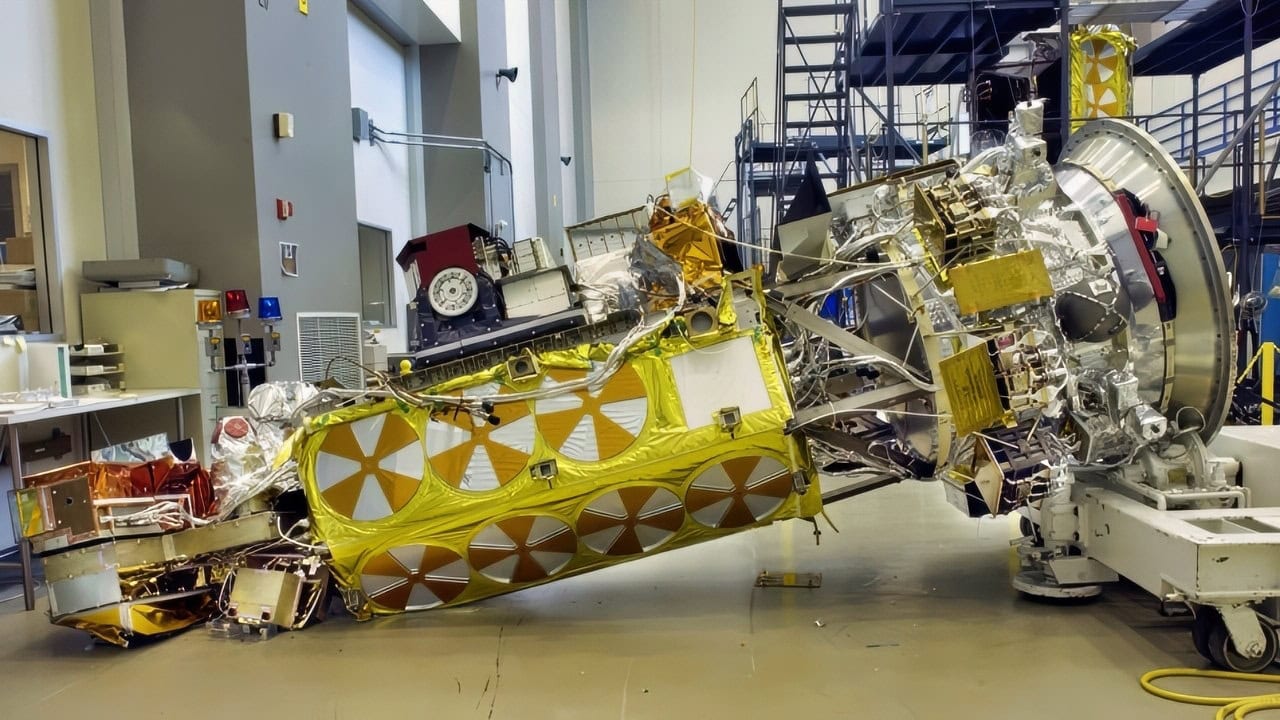
Summary and Key Points: On September 6, 2003, the nearly complete NOAA-N Prime weather satellite toppled from its handling cart onto a clean-room floor at Lockheed Martin in Sunnyvale, California. The cause was 24 bolts that another program had quietly removed from the shared fixture without documentation — and a verification no one performed. NASA’s investigation ran a year; the spacecraft was rebuilt, launched in 2009 as NOAA-19, and operated for more than sixteen years.
The fall
It was a Saturday morning in Sunnyvale, California, in a high-bay clean room at Lockheed Martin Space Systems, and the spacecraft on the work stand was nearly finished. NOAA-N Prime, a weather satellite the size of a delivery van, 14 feet long and six feet across, stood upright on a wheeled fixture called a turnover cart, a piece of ground equipment built to rotate a satellite through 360 degrees and tilt it up to 90 degrees, so that technicians can reach whatever face of the machine the day’s work requires. The task that morning was routine: tilt the spacecraft from vertical to horizontal so the team could adjust the fit of one of its atmospheric instruments. The team had done such operations many times. The cart had held satellites many times.
The tilt began, and the satellite kept going. It slid off the fixture, past the point where anyone could do anything, and slammed into the concrete floor with the team standing feet away. Nobody was hurt.
The spacecraft was another matter: the structure and many of the instruments and components aboard took extensive damage in the fall, in full view of the people whose job was to protect it. Photographs taken afterward show one of the most sophisticated machines the American weather enterprise had ever ordered lying on its side on a factory floor like a tipped refrigerator.
What hit the floor
The thing on the floor was the last and most capable member of a line of American polar-orbiting weather satellites reaching back to 1960, a family that had become the quiet workhorse of civilian Earth observation, most of its members outliving their design lives again and again. Satellites of this type circle the planet from pole to pole about 14 times a day, and every point on Earth passes beneath them. They image clouds, profile the temperature and humidity of the atmosphere in vertical slices, monitor the space environment, and relay distress signals from ships and downed aircraft as part of the international search-and-rescue system. Their data feeds the forecast models that civilian meteorologists and military planners alike depend on.
NOAA-N Prime was valued at roughly $233 million, carried years of assembly and test work, and was closing in on its delivery date when it went over.
Twenty-four missing bolts
The cause was established almost immediately because it was lying in plain sight. The satellite mated to its turnover cart through an adapter plate, and the plate was supposed to be fastened to the cart with 24 bolts. When investigators examined the fixture after the accident, the adapter plate was not secured to the cart at all: the 24 bolts were simply not there. Nothing had been holding the spacecraft to its fixture except gravity and friction, and the moment the tilt shifted the load, both let go.
The bolts had not failed; they had been borrowed. At some earlier point, while the cart sat idle in a shared staging area, a crew from a different program had taken the two dozen bolts for their own hardware. The NASA investigation report states it plainly: the bolts were removed “by another project while the cart was in a common staging area,” an activity never communicated to the team that would use the cart next. No paperwork recorded the removal. No tag hung on the cart. The fixture looked, from across the room, exactly as it always had, and the empty bolt holes waited.
Somebody did check
What makes this accident a case study rather than a freak event is what happened in the minutes before the lift, because the story is not that nobody looked. The handling procedure required the team to verify the cart’s configuration physically before the operation, and the Responsible Test Engineer running the job verified it instead from paperwork, concluding from the records of a prior operation that the cart was ready. The paperwork, of course, knew nothing about the borrowed bolts.
Then came the moment the investigation board would return to again and again. A technician supervisor on the floor noticed the empty holes and said so. The observation was dismissed, the team’s attention already narrowed onto their individual tasks, and the operation proceeded. The lead technician and the quality inspector then signed the step certifying the cart’s configuration had been verified, without either of them performing or witnessing the check. Every layer of protection existed on paper. The undocumented removal defeated the records, the records-based shortcut defeated the physical check, a spoken warning was waved off, and the signatures went on a verification no one had done. One year later, almost to the day, NASA relearned nearly the identical lesson when a reused design that was never tested end-to-end put the Genesis sample capsule into the Utah desert. Different hardware, same disease.
The board’s verdict
The mishap investigation board took a year and produced a 113-page report, chaired by NASA’s deputy associate administrator for space science and drawing members from research centers across the agency and from Air Force Space Command, with advisors from the weather service and the Federal Aviation Administration. Its verdict was blunt about where the fault lay, and it was not with a single careless technician. The proximate cause was procedural: the operations team, in the board’s words, “failed to execute their satellite handling procedures”.
But the report’s force is in the layers beneath that sentence. A factory system had allowed hardware to be altered without documentation and shared equipment to circulate with no reliable record of its state. A team culture had normalized verifying “proven” equipment from paperwork rather than eyes and hands, because the cart had always been fine before. Schedule and cost pressure ran through the background. The board’s conclusion was the uncomfortable one that recurs across the era’s failures: the accident was preventable at multiple independent points, and every one of those points failed the same way, by trusting the layer before it.
That pattern places this fall in a familiar family, the one produced by the “faster, better, cheaper” years of American spaceflight, when margins were thinned in the name of speed and cost. The same era gave us a European rocket destroyed by a single reused software routine running when it had no job to run, a Mars probe lost to two teams using two systems of units, and the Genesis capsule in the desert. In each case the machine was exquisite and the failure was clerical: a line of code, a unit conversion, a drawing, a bolt count. What remained, when the margins were gone, was the assumption that someone else had checked.
Rebuilt
What happened next is the half of the story the accident’s fame tends to leave out. NASA and NOAA did not write the satellite off. The damage assessment ran for months, and the decision came back to repair the spacecraft and fly it. Lockheed Martin, whose facility and procedures had put it on the floor, forfeited all profit it had earned or would earn on the spacecraft bus and completed the work on a cost-only basis, the company’s spokesman confirmed, absorbing a charge on the order of $30 million, while the repair bill itself ran to roughly $135 million, a figure NASA’s spokesman gave at the time. The rebuild had one stroke of luck: because this was the final satellite of its line, spare instruments and qualified components from the program’s earlier builds were available on shelves, and the rebuilt spacecraft needed only a handful of newly made parts.
It took more than five years. The repaired satellite crossed the country to Vandenberg Air Force Base in the belly of a C-5 transport in late 2008, and then space travel supplied its own reminder that machines test patience: the first launch attempt scrubbed on a fault in the pad’s nitrogen pressurization system, the second on a failed air-conditioning compressor serving the rocket’s nose fairing. On the third attempt, at 2:22 in the morning on February 6, 2009, a Delta II rocket carried the satellite to orbit. On reaching space, it received its operational name, NOAA-19, the same spacecraft that had lain on the Sunnyvale floor, renamed at the finish line. By June it had taken over as the primary afternoon weather satellite for the United States.
Then it simply refused to stop working. Built for a two-year mission, NOAA-19 delivered global weather observations for sixteen and a half years, through hurricane seasons and volcanic eruptions and thousands of search-and-rescue relays, outliving the program that built it and most of the satellites that flew before it. When NOAA retired the aging polar fleet’s last members in the summer of 2025, NOAA-19 was among the final survivors, decommissioned on August 13, 2025, with the University of Wisconsin’s satellite meteorologists marking the farewell of a spacecraft that had served eight times its design life. Machines that fall off carts are not supposed to become some of the longest-serving of their kind, the way a lander built for minutes on a hostile world keeps transmitting long past its warranty. This one did exactly the job it was built for, for far longer than anyone promised, and the fall became a footnote to a career instead of an obituary.
The cheapest part
The ledger of the accident is worth stating in its plainest form. On one side: a $233 million spacecraft carrying some of the most advanced meteorological instruments of its generation, a clean room, a trained team, a written procedure, a quality system, and half a century of institutional experience handling satellites. On the other side: 24 bolts, worth a few dollars apiece, and a piece of paper nobody updated.
The bolts won.
That is the finding under the finding, and it is why this accident is still taught. The hardware was the easy part; humanity has learned to build machines that survive launch, vacuum, radiation, and sixteen years of orbital sunrise. Keeping track of what has been done to the machine, by whom, and telling the next shift, is the hard part, and it is the failure that keeps recurring, in factories and operating rooms and cockpits alike. The satellite that fell in Sunnyvale spent the rest of its long life measuring the atmosphere of an entire planet, and the instrument that failed on the ground that Saturday was the oldest one in the building: the checklist, which only works when the people holding it believe the empty holes in front of them over the paperwork that says the holes are full.
About the Author: Harry J. Kazianis
Harry J. Kazianis (@Grecianformula) was the former Senior Director of National Security Affairs at the Center for the National Interest (CFTNI), a foreign policy think tank founded by Richard Nixon based in Washington, DC. Harry has over a decade of experience in think tanks and national security publishing. His ideas have been published in the NY Times, The Washington Post, The Wall Street Journal, CNN, and many other outlets. He has held positions at CSIS, the Heritage Foundation, the University of Nottingham, and several other institutions related to national security research and studies. He is the former Executive Editor of the National Interest and the Diplomat. He holds a Master’s degree focusing on international affairs from Harvard University.

