
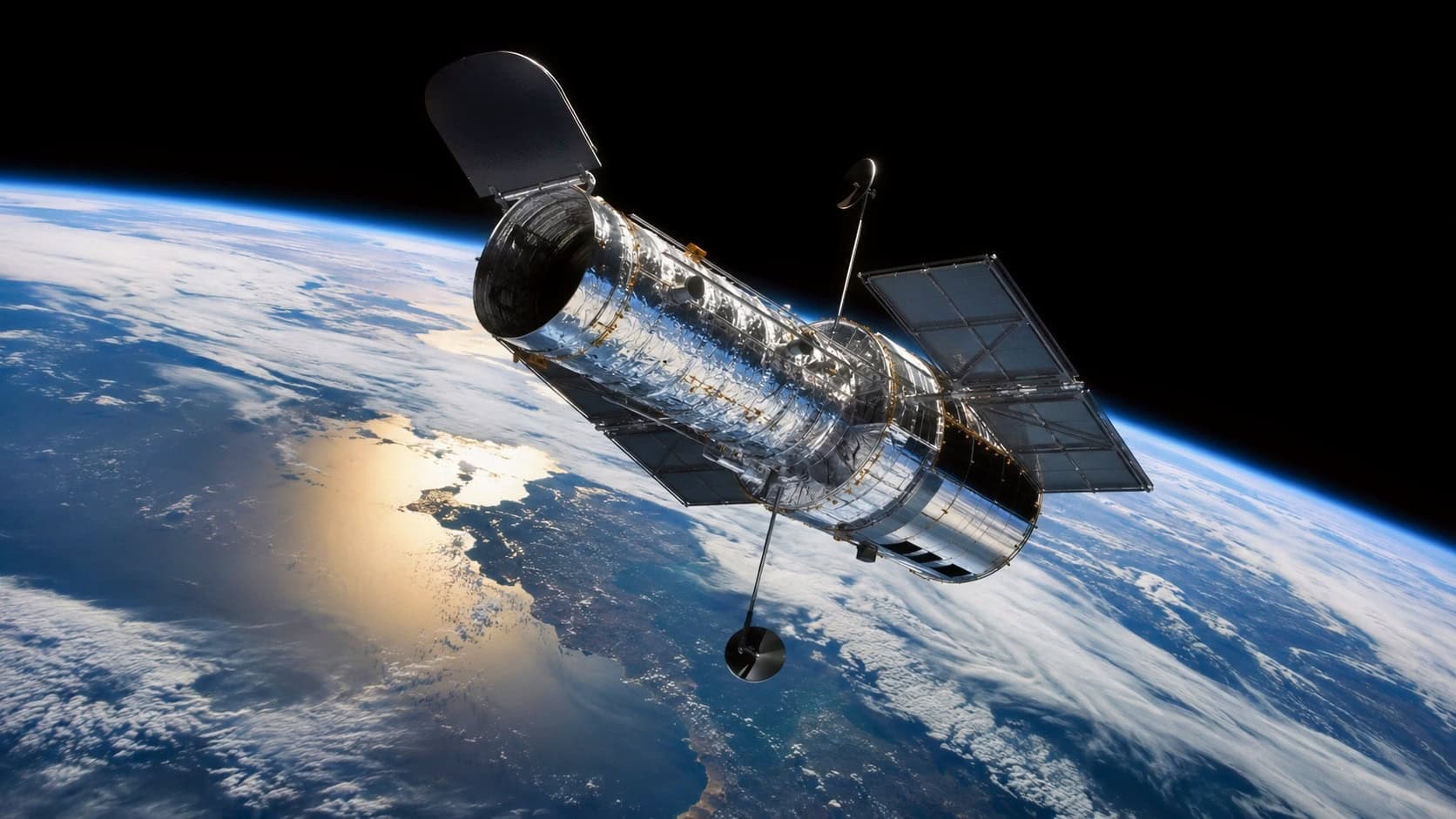
Summary and Key Points: The Neil Gehrels Swift Observatory has served as astronomy’s first responder for 21 years, whirling toward exploding stars and black holes faster than any other telescope. Now it is falling toward Earth, and on July 3, a refrigerator-sized robot built by a four-year-old company launched on a daring attempt to catch it in orbit and shove it back up. If it works, it will not just save one telescope. It will prove out the capability that could one day rescue Hubble, and it marks a striking bet: NASA reaching for a startup to do the job after its own multibillion-dollar servicing program collapsed.
A NASA Space Telescope Is Falling Out of the Sky. To Save It, NASA Handed the Job to a Startup That Had Never Flown a Spacecraft
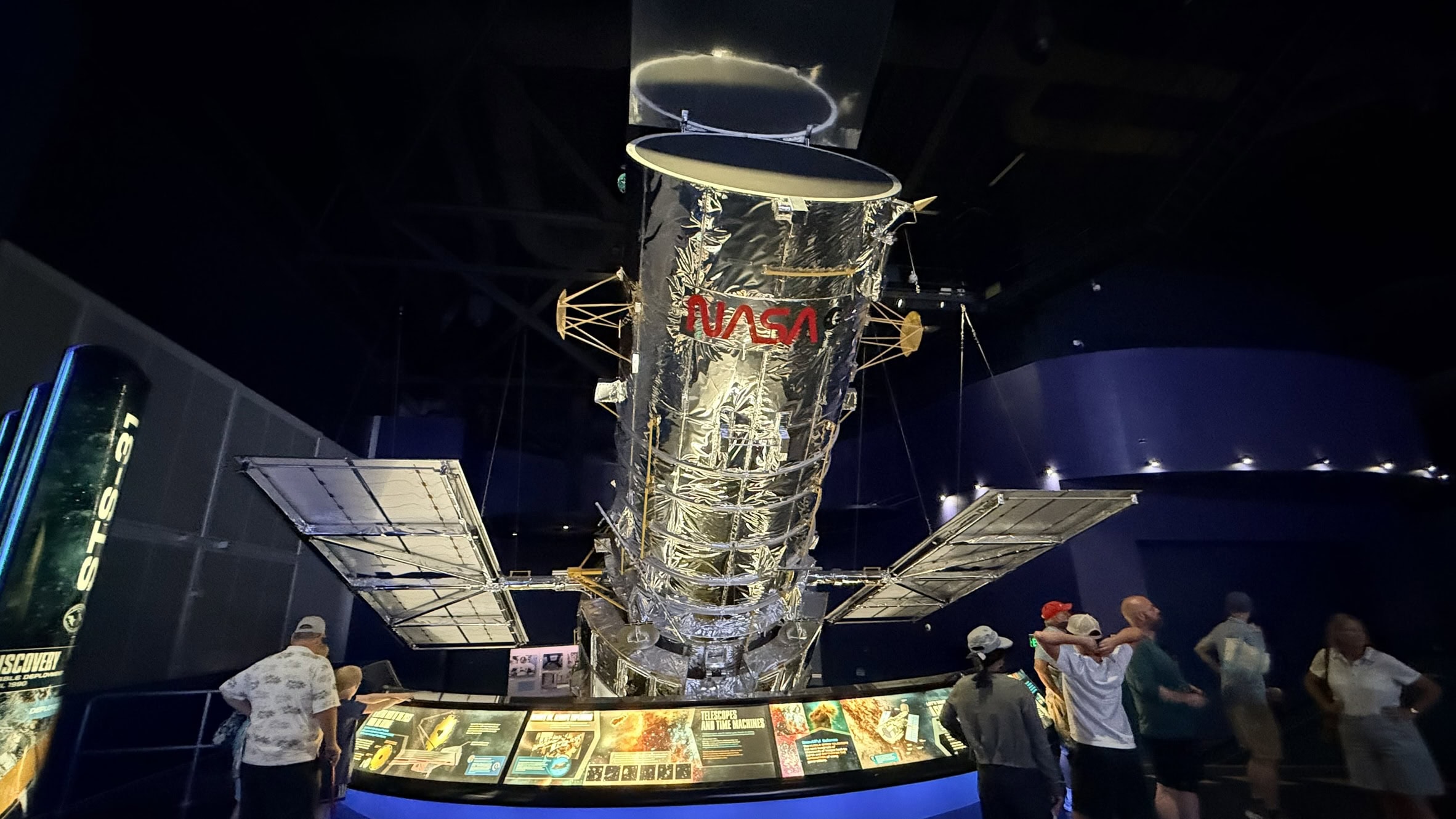
NASA Hubble Telescope Mock-Up. 19FortyFive Original Photo.
Since 2004, NASA’s Neil Gehrels Swift Observatory has done something no other space telescope can. When a gamma-ray burst flares somewhere in the universe, the most powerful class of explosion known to physics, often lasting only seconds, Swift can automatically slew to point at it within a minute or two, lock on, and radio the coordinates to observatories around the world so they can catch the afterglow before it fades. NASA describes the mission as an “astrophysical first responder,” a dispatcher that tells every other instrument where to look. It detects about a hundred such bursts a year, and there is no replacement waiting to take its place.
That irreplaceable telescope is now falling out of the sky, and NASA’s attempt to save it has become one of the most unusual missions the agency has ever attempted.
A Race Against the Sun
Swift has no engine of its own. Launched into a roughly circular orbit about 370 miles up, it has slowly spiraled downward for two decades under the faint but relentless drag of the upper atmosphere. That descent was manageable until the Sun intervened. The Sun runs on an 11-year activity cycle, and its most recent peak, in 2024, was stronger than forecasters expected, flinging out flares and eruptions that heated and puffed up Earth’s outer atmosphere. That expanded atmosphere reached higher and thickened the wisps of gas at Swift’s altitude, sharply increasing the drag on the telescope.
NASA Space Shuttle Atlantis at the Kennedy Space Center. 19FortyFive Image by Harry J. Kazianis.
NASA had expected Swift to stay aloft into the early 2030s. Instead, mission managers realized its survival was a matter of months. By 2026, the telescope had sunk to around 250 miles, and without intervention, it was projected to drop below the altitude from which it could still be rescued by around October, then eventually burn up on reentry. In February 2026, NASA halted Swift’s science operations entirely and turned the telescope to fly in the orientation that presented the least surface area to the onrushing air, a stopgap to shave off drag and buy a few more weeks of altitude. As one Swift astronomer put it, the community was already missing it badly.
The Catch
The rescuer is a spacecraft called LINK, and on July 3, 2026, after two scrubbed attempts, it launched. Rather than rising from a pad, it was carried aloft under a modified Lockheed L-1011 airliner called Stargazer, which climbed to about 40,000 feet over Kwajalein Atoll in the Pacific and dropped a Northrop Grumman Pegasus XL rocket that ignited in midair and delivered the little robot straight into Swift’s orbital plane. NASA has since confirmed that ground teams established contact with LINK.
What LINK now has to do is genuinely hard, and it has never been done to a satellite like this. About a third of Swift’s size, LINK will spend weeks catching up to the telescope, then approach and photograph it from every angle so engineers can inspect a 22-year-old spacecraft for damage and decide where to grab it. Then, using a set of robotic arms, it will attempt to seize a telescope that was built in the early 2000s with no handholds, no docking port, and no thought whatsoever of ever being serviced. Once it has a firm grip, LINK will fire its ion thrusters and, over roughly two to three months of gentle pushing, try to lift Swift back up about 100 miles to its original altitude, well clear of the International Space Station’s neighborhood.
NASA Space Shuttle Atlantis at the Kennedy Space Center. 19FortyFive Image by Harry J. Kazianis.
Every step is a first, and NASA has been careful not to promise success; officials have not even said how much longer Swift could keep observing if the boost works. A great deal can go wrong, from the grab itself to the condition of Swift’s decades-old thermal insulation, which engineers on a related spacecraft have described as having turned brittle and glass-like with age. The Sun, too, gets a vote, and another burst of solar activity could drag Swift down faster than LINK can lift it.
Why NASA Reached for a Startup
Here is the part of the story that matters more than the rescue itself. The company that built LINK, Katalyst Space Technologies of Arizona, was founded in 2020, and before this mission it had never flown a spacecraft. NASA awarded it a firm-fixed-price contract of about $30 million in September 2025 and gave it roughly nine months to design, build, test, and launch the vehicle, a timeline that veterans of the field called almost unheard of, against an industry norm closer to two years. Katalyst won the job over more established bidders, beating out Starfish Space and a team pairing Cambrian Works with the servicing specialist Astroscale.
That NASA outsourced the rescue at all represents a real shift, and the reason is instructive. Only two years earlier, NASA had been building its own satellite-servicing spacecraft, a flagship demonstration called OSAM-1, designed to grab and refuel an aging Landsat satellite. It became a case study in how such programs go wrong. Originally projected to cost somewhere between $626 million and $753 million, OSAM-1’s price ballooned past $2 billion, according to a 2023 report by NASA’s Office of Inspector General, and in March 2024, the agency canceled it outright, citing technical, cost, and schedule problems and a lack of any committed partner. NASA had spent roughly $2 billion and flown nothing.
Set the two side by side, and the contrast is stark: a government program that spent about $2 billion over roughly a decade and never left the ground, and a startup handed $30 million and nine months to actually launch. Whatever happens to Swift, that comparison is why the wider space industry is watching this mission so closely. It is a live test of whether small commercial firms can do quickly and cheaply the kind of on-orbit servicing that NASA’s traditional approach could not deliver at all.
The Real Prize Is Hubble
The stakes extend well beyond a single gamma-ray telescope, and everyone involved knows it. The techniques LINK is attempting, autonomously approaching, grappling, and reboosting a satellite that was never designed to be handled, are exactly the capabilities that could extend the lives of countless spacecraft, and one in particular. The Hubble Space Telescope, kept aloft for decades by visiting Space Shuttle crews, is also slowly losing altitude, and with the shuttles retired, there is no longer any way to send astronauts to boost it. A robotic push may be the only option left.
Swift’s own principal investigator has said plainly that the Hubble team is watching this mission very closely. If a small robot can grab a falling 22-year-old telescope and shove it back into a stable orbit, it becomes possible to imagine doing the same for the most famous observatory ever built and for the growing population of valuable satellites launched with no expectation of ever being touched again.
For now, all of that rides on a refrigerator-sized machine chasing a falling telescope across low Earth orbit, closing the distance week by week. Sometime in the next few months, LINK will reach out with its robotic arms and try to grab hold of an observatory that was never built to be caught. NASA has been careful to call it an attempt, not a certainty. But whether it succeeds or not, the agency has already signaled something new about how America intends to save what it has put into space, and the outcome of this one improvised rescue will shape which satellites get to live and which are left to burn.
About the Author: Harry J. Kazianis
Harry J. Kazianis (@Grecianformula) was the former Senior Director of National Security Affairs at the Center for the National Interest (CFTNI), a foreign policy think tank founded by Richard Nixon based in Washington, DC. Harry has over a decade of experience in think tanks and national security publishing. His ideas have been published in the NY Times, The Washington Post, The Wall Street Journal, CNN, and many other outlets worldwide. He has held positions at CSIS, the Heritage Foundation, the University of Nottingham, and several other institutions related to national security research and studies. He is the former Executive Editor of the National Interest and the Diplomat. He holds a Master’s degree focusing on international affairs from Harvard University.

