
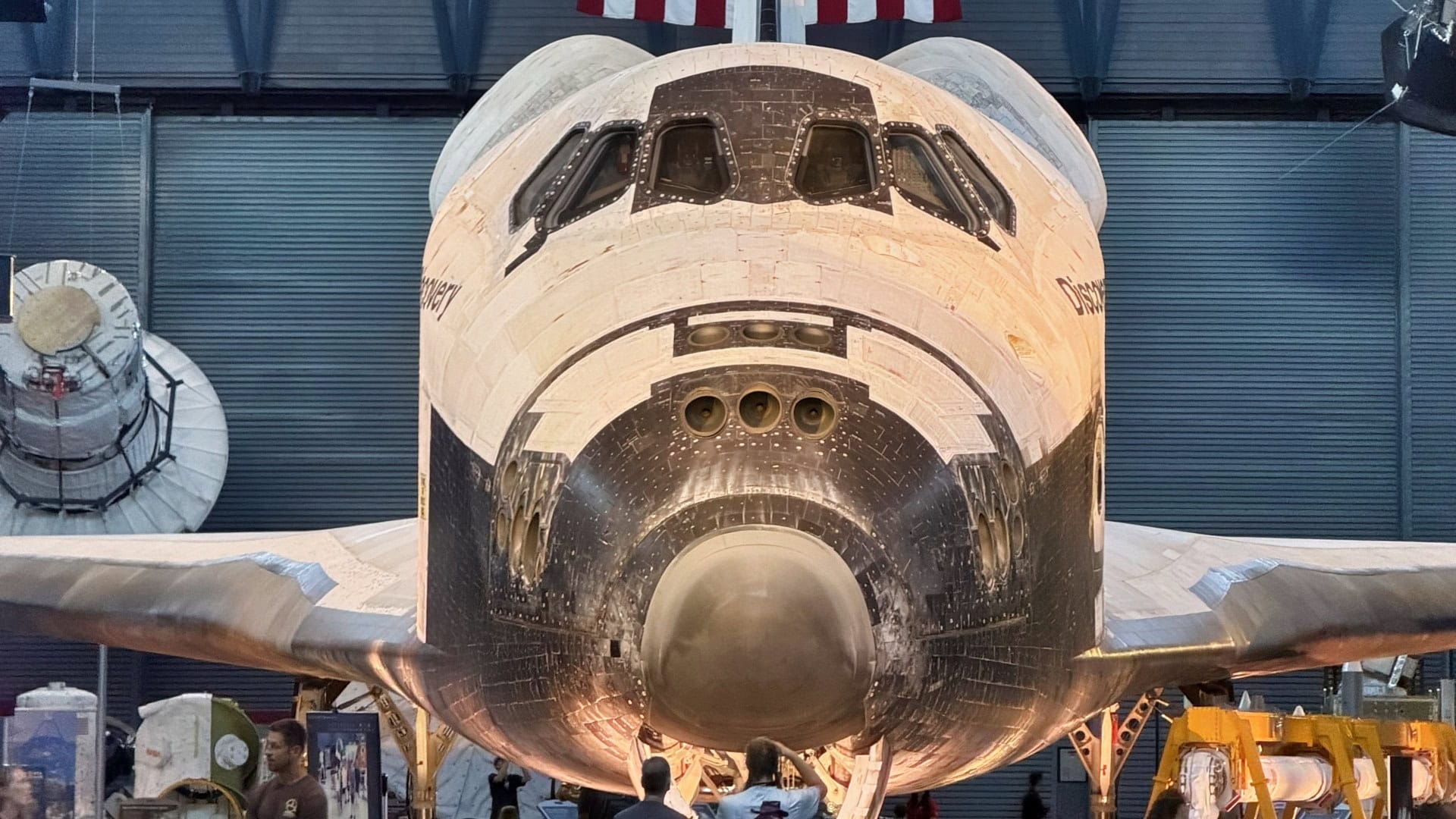
The Space Shuttle Is a Real Aerospace Miracle: On October 3, 1967, Air Force Major William “Pete” Knight dropped away from a B-52 over the California desert in the rocket-powered X-15A-2, lit the engine, and reached Mach 6.72, about 4,520 miles per hour. The press called him the fastest man alive. Nearly six decades later, no one has flown a crewed, powered airplane faster, and the X-15 program that produced the flight is rightly remembered as the bridge between aviation and spaceflight.
What almost nobody says out loud is that the bridge led somewhere, and the thing on the other side made Knight’s number look slow. From 1981 to 2011, the Space Shuttle orbiters returned to Earth as winged aircraft, achieving roughly four times the X-15’s once-in-history peak on every single flight, with as many as seven people aboard. The fastest crewed winged flight in history was not a single moment over the desert in 1967. It was a routine the shuttle performed 133 times, ending on an ordinary concrete runway.
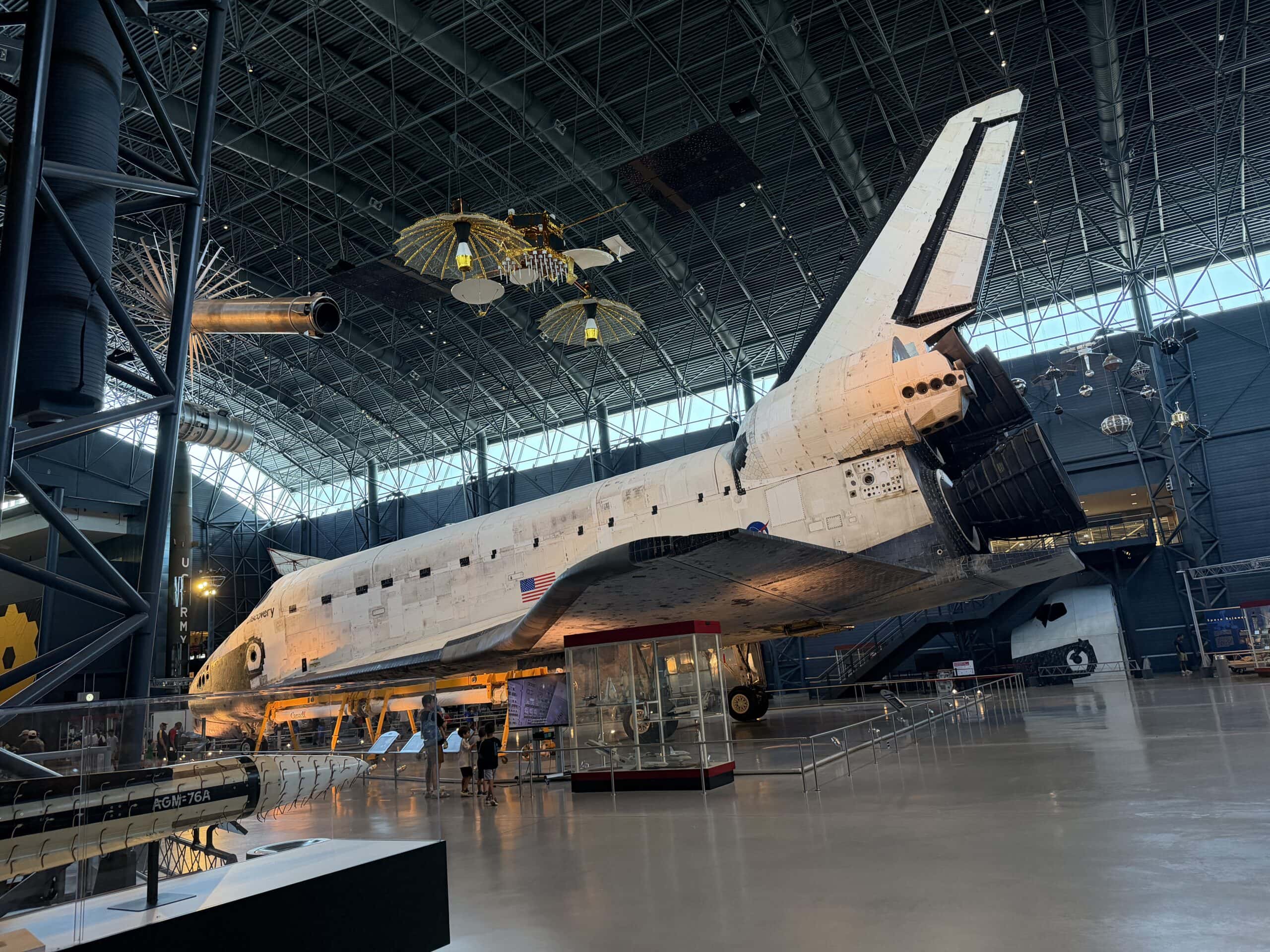
Space Shuttle Discovery at Smithsonian 19FortyFive Photo
The SR-71, the X-15, and Apollo 10: How the Speed Records Are Actually Divided
The reason the shuttle’s speed gets no glory is bureaucratic, and understanding it is the whole story. Official aviation speed records are divided into categories, and the categories were written for airplanes, not for a vehicle that launches like a rocket and lands like a glider.
The official absolute record for a crewed aircraft belongs to the Lockheed SR-71 Blackbird, which flew a measured course above the California desert at 2,193.64 miles per hour, about Mach 3.3, on July 28, 1976, with Eldon Joersz at the controls and George Morgan behind him. Joersz later admitted the crew had privately hoped for a rounder number, saying, “We were quietly a little disappointed that we’d missed it by 7 mph.” That record qualifies as the official one because the SR-71 took off and landed under its own power.
The X-15 flew twice as fast as the Blackbird, but Guinness World Records does not count it for the crewed-aircraft record because it was carried aloft under a B-52’s wing and could not take off on its own. And the fastest human beings in history were not in an airplane at all: the crew of Apollo 10, Thomas Stafford, Eugene Cernan, and John Young, hit 24,790 miles per hour falling back from the Moon on May 26, 1969, a record that still stands more than half a century later.
The shuttle fits none of those boxes. It launched vertically as a rocket, so it could never claim the SR-71’s self-powered category. It was a spacecraft in orbit, so its cruising speed was unremarkable by orbital standards; everything in low Earth orbit, the International Space Station included, moves at roughly 17,500 miles per hour, because physics allows nothing slower at that altitude. The result is that the fastest winged, crewed flying machine ever built holds no official airspeed record of any kind. The categories simply have no place to put it.
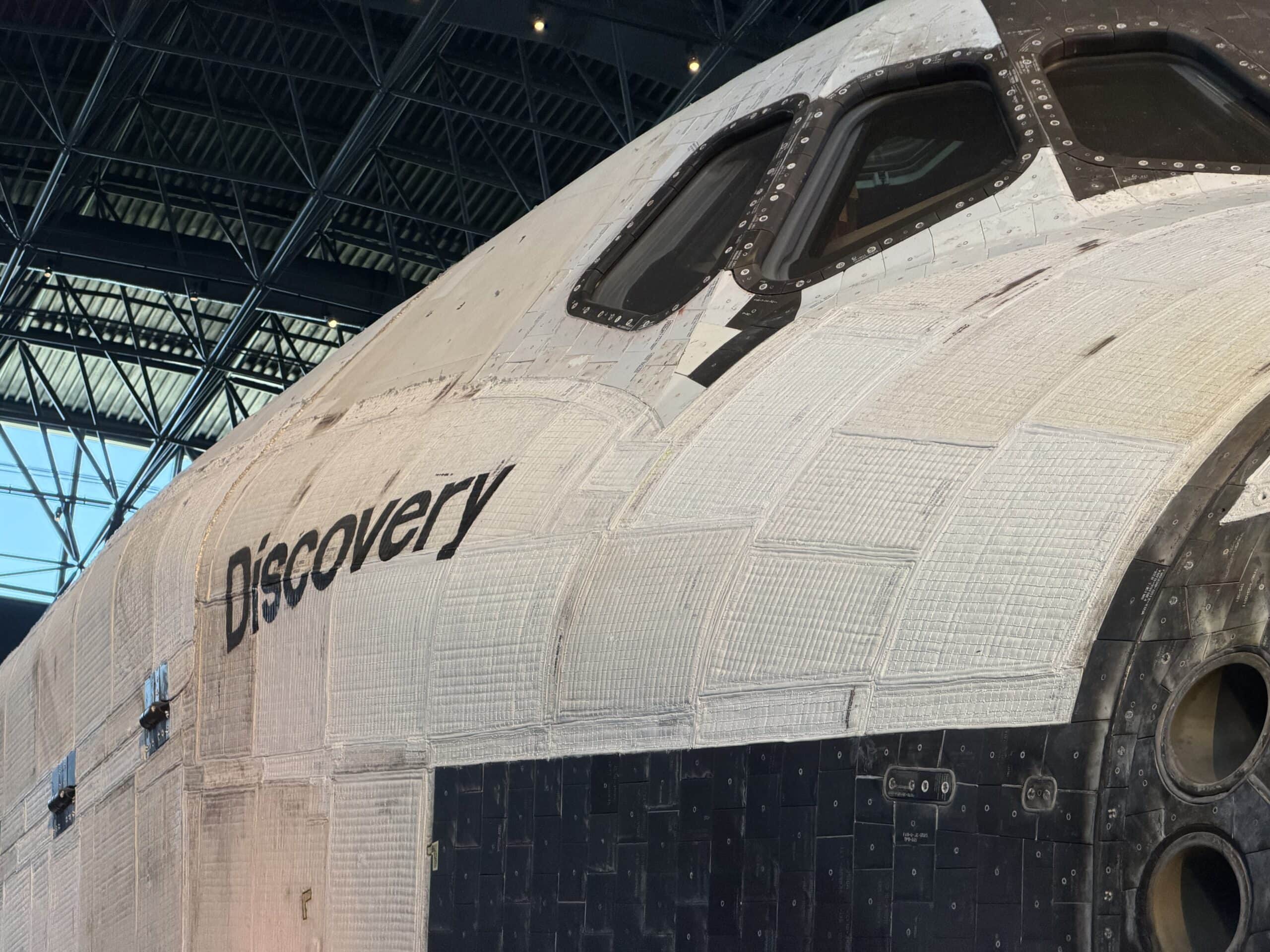
Space Shuttle Discovery at Smithsonian 19FortyFive Photo
Mach 25 With Wings: What Space Shuttle Reentry Actually Was
Strip away the category rules and look at what the vehicle did. About an hour before landing, an orbiter briefly fired its engines to drop out of orbit, then entered the top of the atmosphere at approximately 17,500 miles per hour, around Mach 25, by NASA’s own figures. At those speeds, the air no longer behaves like air; the heat is so intense that the molecules’ chemical bonds begin to break apart.
The orbiter’s hottest surfaces approached 3,000 degrees Fahrenheit, and the vehicle flew through the resulting sheath of glowing plasma with its nose held high, a 100-ton glider with no engine to save it if anything went wrong.
Put that number against the legends. Mach 25 is nearly four times the speed at which Pete Knight survived for a few moments in 1967 wearing a pressure suit in a single-seat rocket plane. It is roughly eight times the Blackbird’s official record. The X-15 program‘s fastest flight was a one-time peak by one of the most experienced test pilots alive; several X-15 pilots earned astronaut wings simply for how high their aircraft briefly climbed. Shuttle crews did Mach 25 as a matter of routine, on the way home, 133 times across 135 missions, with mission specialists and payload commanders aboard who were scientists and engineers rather than test pilots.
The two flights that did not end in a landing on a runway, Challenger and Columbia, are the program’s tragedies and a permanent reminder that none of this was ever actually routine. But the record of what the vehicle did with wings and people, again and again, has no equal in the history of flight, and no successor: the winged vehicles that have reentered from orbit since then are uncrewed.
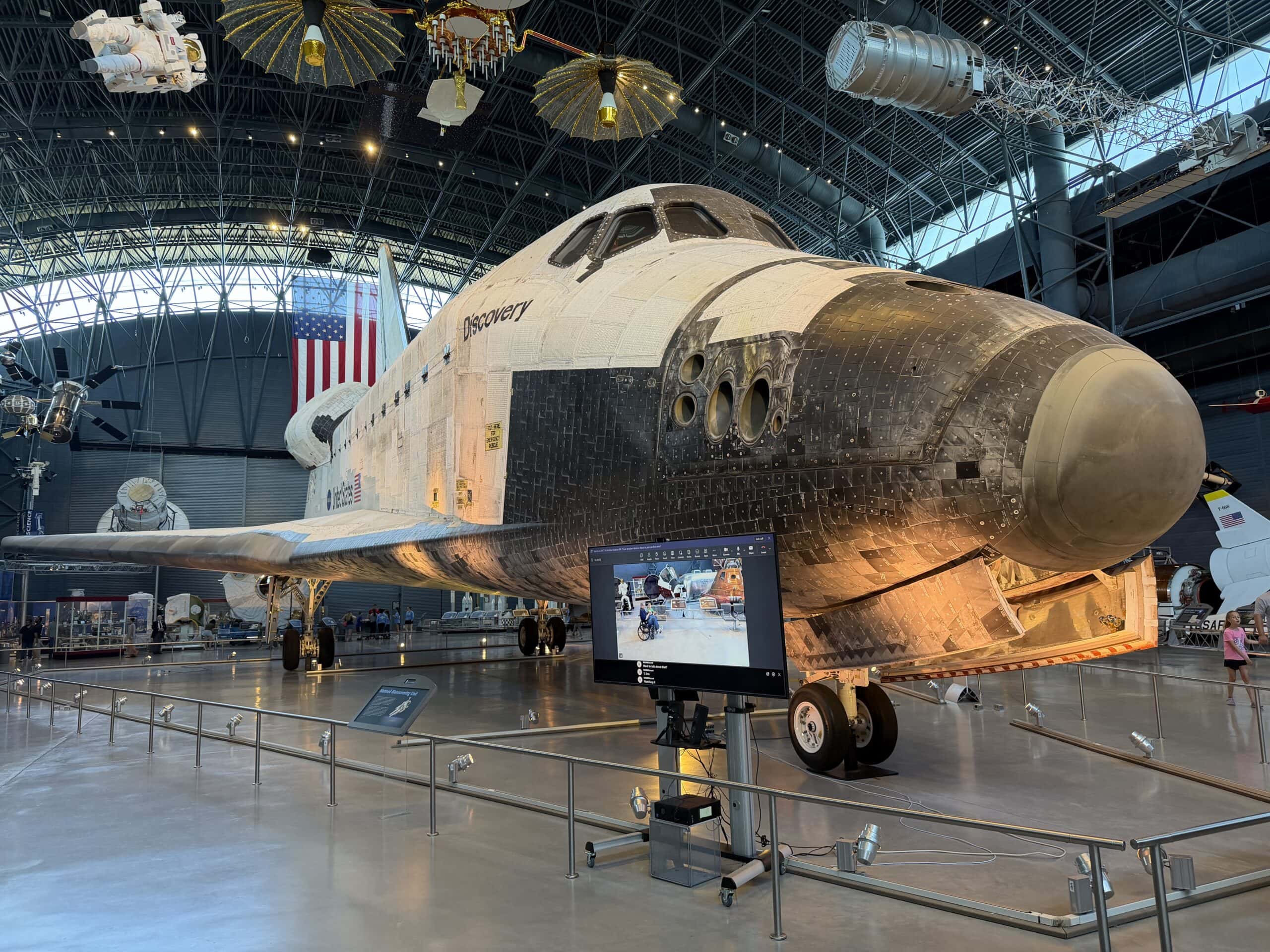
Space Shuttle Discovery at Smithsonian 19FortyFive Photo
Zero to 17,500 in Eight and a Half Minutes, Then a Landing With No Engines
The speed story bracketed both ends of every mission. Going uphill, the shuttle went from a standstill on the pad to orbital velocity, zero to about 17,500 miles per hour, in roughly eight and a half minutes, an acceleration no operational crewed aircraft has ever approached.
Coming home was stranger still, because the world’s fastest aircraft landed with no engines at all. From the deorbit burn to wheels-stop, the orbiter was a glider, and there was no go-around, no second try, no wave-off. The commander typically took manual control about 22 miles from the runway and flew a final approach nearly seven times steeper than an airliner’s, a minus-20-degree descent that pilots compared to flying a falling brick.
Touchdown came at 213 to 226 miles per hour, roughly a third faster than a jetliner lands, followed by a drag chute at about 185 knots. Every landing the program ever made was a dead-stick landing at speeds that would be an emergency anywhere else in aviation, performed so consistently that the public stopped watching.
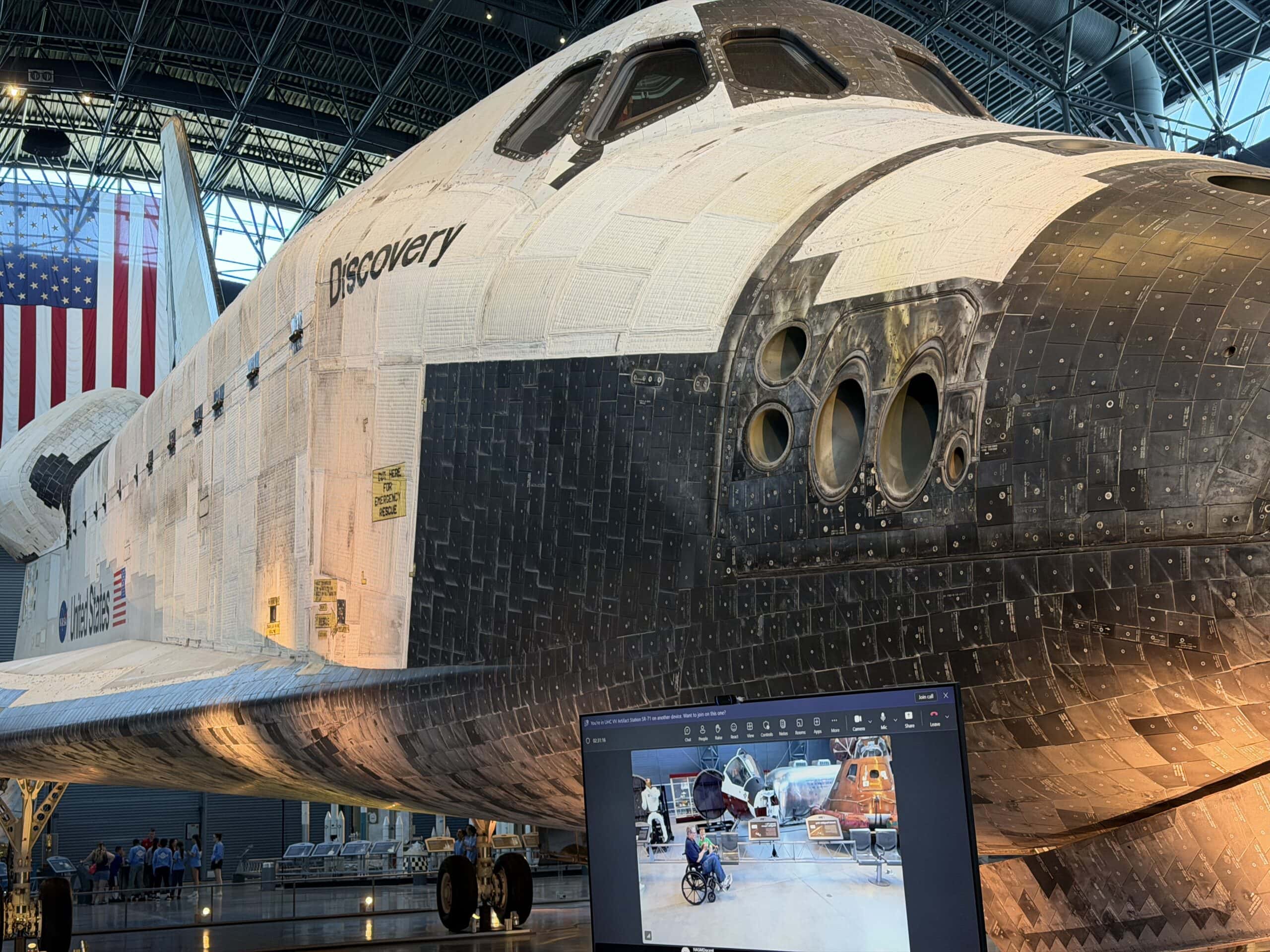
Space Shuttle Discovery at Smithsonian 19FortyFive Photo
Fifteen Years Since the Last Flight, and a Fight Over Where the Fastest One Sits
Next week marks fifteen years since the machine last did any of this. STS-135, the final shuttle mission, launched on July 8, 2011, and Atlantis rolled to a stop in Florida before dawn on July 21, closing a thirty-year program. The orbiters went to museums, and the speed that never had a record category faded into the one line every placard repeats without context, 17,500 miles per hour, a number visitors read and file away as space trivia rather than as the fastest thing wings have ever done with people behind them.
One of those museum pieces is currently the subject of a fight that has put the shuttle back in the news for the first time in years. Discovery, the fleet leader with 39 missions flown, more than any other orbiter, including the 1990 flight that carried the Hubble Space Telescope to orbit, has hung in the Smithsonian’s Udvar-Hazy Center in Virginia since 2012. A provision folded into law in July 2025 directed NASA to move a flown, crewed spacecraft to Houston, with $85 million attached, and Discovery was universally understood to be the target.
The Smithsonian has warned that the orbiter would need significant disassembly to travel, and that taking it apart would destroy much of its historical value, with cost estimates starting well above the appropriated funds.
NASA’s current administrator, Jared Isaacman, signaled early this year that he was reluctant to force a damaging move, yet the agency was still circulating a draft solicitation this spring for transport concepts, one that reserves the right to demand the vehicle move intact, without cutting or disassembly. As of this month, the question of where Discovery will sit is unresolved.
Wherever that fight ends, fifteen years after the last landing, the fastest crewed aircraft in history hangs in a hangar in Virginia, wings that have done Mach 25 spread over the heads of visitors, most of whom walk past it to photograph the SR-71 Blackbird parked nearby, the official record holder, a machine Discovery outran by a factor of eight every time it came home.
About the Author: Harry J. Kazianis
Harry J. Kazianis (@Grecianformula) was the former Senior Director of National Security Affairs at the Center for the National Interest (CFTNI), a foreign policy think tank founded by Richard Nixon based in Washington, DC. Harry has over a decade of experience in think tanks and national security publishing. His ideas have been published in the NY Times, The Washington Post, The Wall Street Journal, CNN, and many other outlets worldwide. He has held positions at CSIS, the Heritage Foundation, the University of Nottingham, and several other institutions related to national security research and studies. He is the former Executive Editor of the National Interest and the Diplomat. He holds a Master’s degree focusing on international affairs from Harvard University.