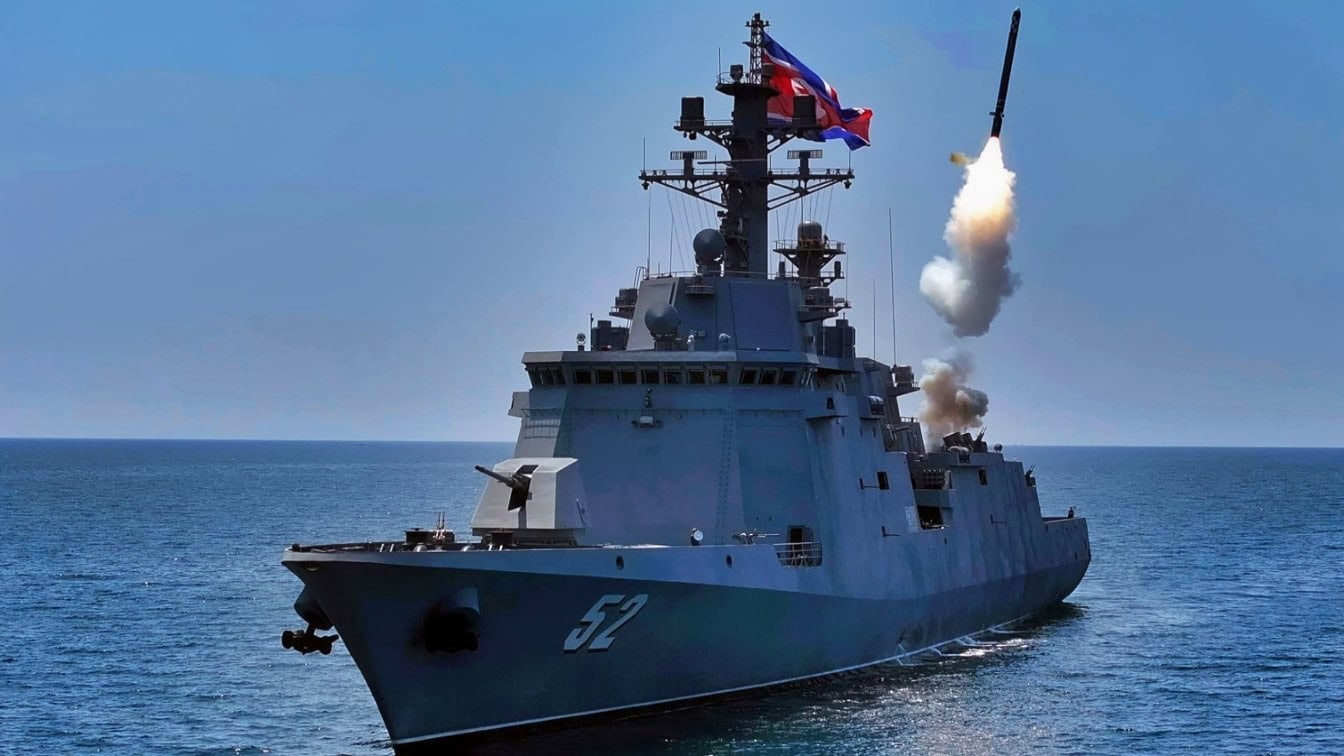
Summary and Key Points: North Korea is preparing to bring its new destroyer Kang Kon into operational service, roughly a year after the warship partially capsized during a failed launch that crushed sections of its hull. Kim Jong-un denounced the accident, ordered rapid repairs, and Pyongyang relaunched the ship and conducted integrated live-fire trials of its missiles, main gun, electronic warfare systems, and combat management suite. Kim has since ordered a sustained naval buildup, including two 5,000-ton destroyers a year for five years and a planned 10,000-ton warship, in the most ambitious naval modernization effort in the country’s history, a development South Korea and its partners are watching closely.
North Korea’s Navy and Military Might Are Growing
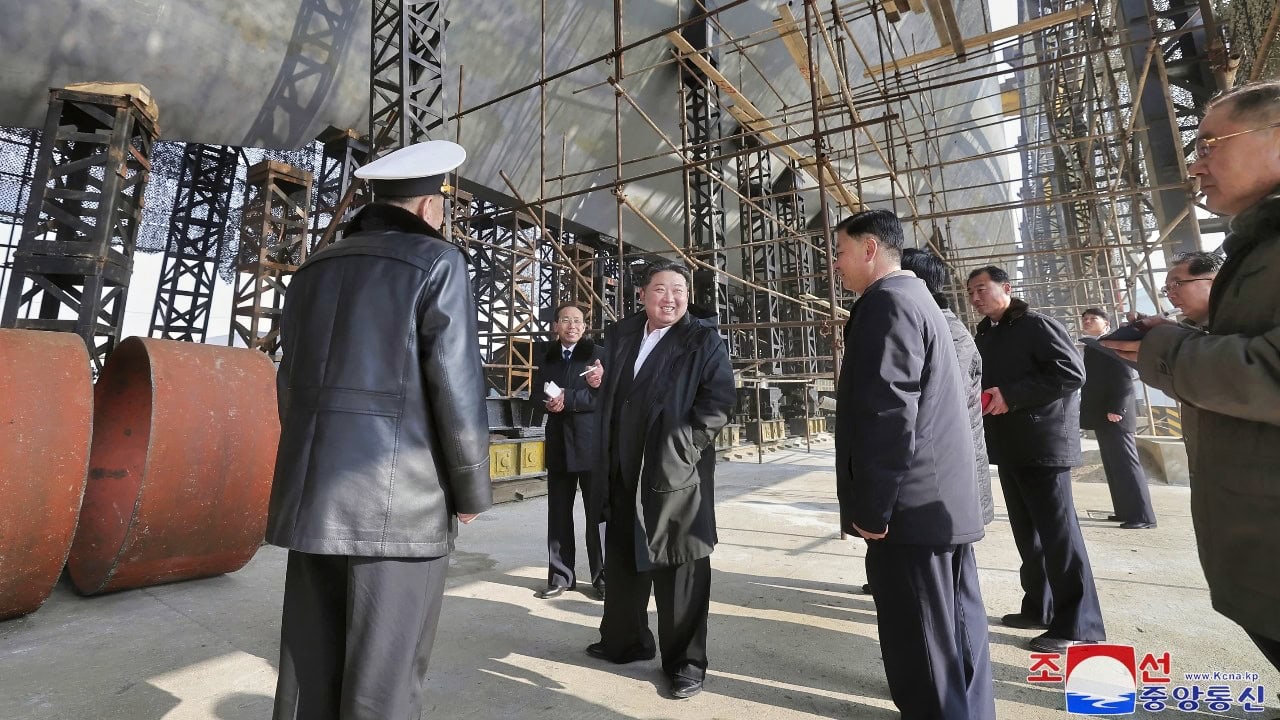
North Korea Nuclear Submarine. Image Credit: KCNA.
Kim Jong-un’s People’s Democratic Republic of Korea (DPRK, or North Korea) has been the laughing stock globally for decades, long before he ever ascended to power.
Yet, the image of North Korea as a perennial joke militarily (when compared to its South Korean and Japanese neighbors, or to the United States) requires some readjustment.
Yes, it’s an autarkic political system in Pyongyang.
But Kim Jong-un has demonstrated a desire to be different from his platform-shoe-wearing father. Indeed, the younger Kim appears more aligned with his dynamic grandfather, the man who founded the DPRK in the shadow of the Cold War.
In this sense, then, the younger Kim is much less interested in thrill-seeking and blind power moves that defined his father’s tenure as ruler, and much more interested in state-building.
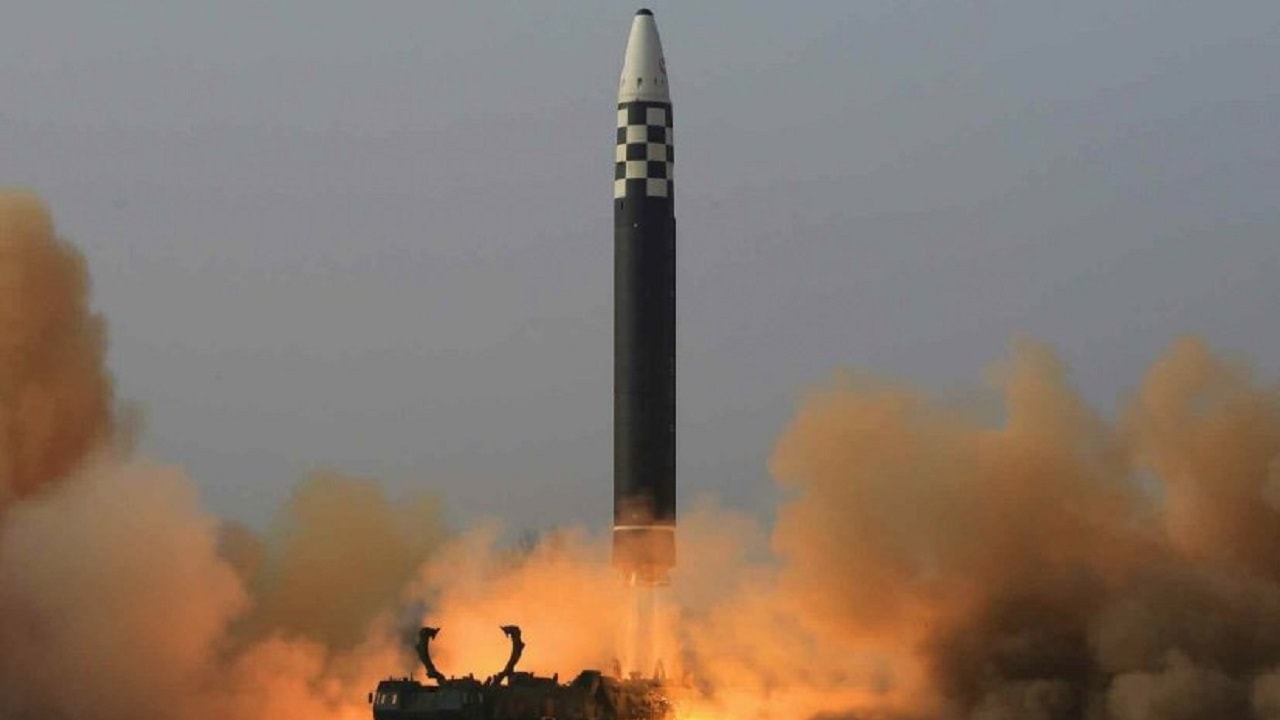
North Korea ICBM. Image Credit: DPRK State Media.
Specifically, Kim Jong-un is more committed to preserving the regime through military modernization and greater levels of global engagement than his father was.
From Trump Diplomacy to Putin’s War
After a nasty war of words between the North Korean dictator and President Donald Trump during Trump’s first non-consecutive term in office, Kim was wise enough to accept the US president’s invitation to engage in diplomacy.
What followed was one of the most remarkable journeys a North Korean dictator has experienced since the founding of the communist regime.
He met with the American president. The two had several photo ops together. They even appeared to enjoy each other’s company, much to the chagrin of hardliners in Pyongyang and Washington, D.C.
Following Trump’s ouster from the presidency in 2020 by Joe Biden, the US-North Korean relationship cooled.
But the outbreak of the war in Ukraine gave Kim Jong-un another opening to pursue dynamic diplomacy—this time, with Russia. Moscow needed North Korean military assistance in the form of materials, weapons, and troops.
Recognizing the supreme opportunity, Pyongyang drove a hard bargain with Vladimir Putin’s government in Moscow and extracted considerable military agreements with the Russians.
Together, they’ve formed a symbiosis over the Ukraine War that has seen North Korean troops fighting and dying for Russia while Russia provides North Korea with considerably advanced military technology.
Meanwhile, Kim Jong-un has endeavored to raise his standing with Beijing.
Not wanting to be seen merely as a proxy for Beijing, Kim wants the Chinese to see him as a partner–and he has leveraged both his positive meetings with Trump and his ongoing alliance with Putin to show he’s not just their pawn.
The Kang Kon’s Resurrection
Looking at one specific program (of many) where the North Koreans are making serious strides militarily is the development of the new North Korean destroyer, the Kang Kon.
Last year, Kim Jong-un was humiliated when the destroyer partially capsized after its launch mechanism failed. That crushed sections of the hull.
In classic Stalinist fashion, Kim denounced the humiliating failure as a “criminal act,” then arrested multiple officials, and demanded that the ship receive repairs within weeks.
Most Western analysts assumed the damage to the destroyer would delay the program for years. Instead, North Korea repaired the ship, relaunched it, and has not started live-fire combat trials with it.
Unlike the DPRK of even a decade ago, the country today has demonstrated a remarkable capacity not only to pursue more complex combat systems–like the Kang Kon–but also to overcome technical adversity.
North Korea desires to possess a credible missile-armed surface fleet. Pyongyang’s new naval capability should worry Seoul.
And the growing relationship between Pyongyang and Moscow over military issues underscores how the North Koreans are rapidly catching up to the South Koreans in key areas–and risk overwhelming them, unless Seoul embraces its own rapid military modernization program as well as a new diplomatic strategy regarding Pyongyang.
The Weapons Tests Were Far More Than a Gunnery Exercise
Kim personally observed the testing of Kang Kon’s weapons.
These included strategic (nuclear-capable) cruise missiles, the ship’s main naval gun, automatic cannons, electronic warfare (EW) systems, target detection systems, and combat information processing.
The tests further included fire-control integration.
The purpose of the live-fire exercises was to verify that the entire Kang Kon combat system was viable. Kim and his navy were not just interested in testing the missiles.
They wanted to test that the entire ship functioned as a modern, integrated warship.
Shortly after the tests, Kim ordered the warship into operational service within two months. So, by this Fall, North Korea will have a modern, lethal destroyer in its navy.
That represents a major milestone for the DPRK. After all, most of their navy consists of antiquated holdovers from the Soviet era. Kang Kon is something entirely new.
North Korea Builds a Nuclear Navy
For decades, North Korea’s military strategy centered on land-based ballistic missiles, massive artillery, and special operations forces.
But Kim Jong-un wanted to expand that strategy into the maritime domain. His objective appears to be creating a fleet capable of launching nuclear-capable cruise missiles from multiple directions.
That is all aimed at the current defensive capabilities and doctrines of the US, Japanese, and South Korean missile-defense planning.
In other words, like the Russians in Ukraine, the Iranians in the Middle East, and the Chinese in the First Island Chain of the Indo-Pacific, Kim intends to overwhelm existing Western missile-and-air-defense systems via saturation.
Rather than simply relying on road-mobile missile launchers, as North Korea has traditionally done, Pyongyang also wants mobile sea-based launch platforms.
That suggests the relative peace South Korea has enjoyed over the last several decades might very well be coming to an end, given how tailored to countering Seoul’s defenses the Kang Kon (and other North Korean military developments) is.
Kim’s Naval Ambitions Are Growing
Kim isn’t stopping with only two destroyers, though. He has publicly ordered two new 5,000-ton destroyers every year for five years.
There’s also his command to construct a new 10,000-ton destroyer. What’s more, Kim has called for the development of additional underwater weapons and the continued expansion of nuclear naval capabilities.
These developments represent the most ambitious naval modernization effort in North Korean history. And they’re likely to succeed, given Kim Jong-un’s commitment to this particular cause.
He doesn’t just want to sit on an iron throne, as his father did. He wants to wield power globally. By making North Korea a regional powerhouse, with a significantly advancing navy, Kim is proving himself to be a far more serious strategist than his father ever was.
Implications for the US Navy
Western military planning largely dismissed the Korean People’s Navy as little more than an aging coastal force.
Now, North Korea is transforming its navy into a distributed missile-launching force capable of threatening South Korean naval forces, Japanese maritime assets, regional logistics routes (of which there are many), and even US carrier strike groups.
Looks like the joke may be on the world’s Western militaries.
Whether these ships perform as advertised remains uncertain.
North Korea’s shipbuilding industry has limited experience in producing complex modern surface combatants, and combat effectiveness depends on crew training, maintenance, networking, and logistics (not just hardware).
But the aforementioned alliances with Russia and even China indicate that North Korea is not developing these warships entirely on its own.
The pace of progress behind Kang Kon and other newer North Korean systems is noteworthy. Not just because of the speed involved, but because it likely underscores my thesis that North Korea is receiving copious assistance from the likes of Russia.
Pyongyang moved from an internationally embarrassing launch failure of its destroyer to conducting integrated weapons trials and preparing that previously failed Kang Kon destroyer for operational service almost exactly a year after the humiliating launch experience.
Naval modernization in North Korea, therefore, is more resilient than most Western experts understand. Thus, the threat posed by North Korea to Western forces has just expanded exponentially.
About the Author: Brandon J. Weichert
Brandon J. Weichert is the Senior National Security Editor at 19FortyFive.com. He also manages The Weichert Brief on Substack. Weichert also hosts “National Security Talk” on Rumble. He is the author of four bestselling national security books, the most recent of which is A Disaster of Our Own Making: How the West Lost Ukraine (Encounter Books). Follow him via Twitter/X @WeTheBrandon.