
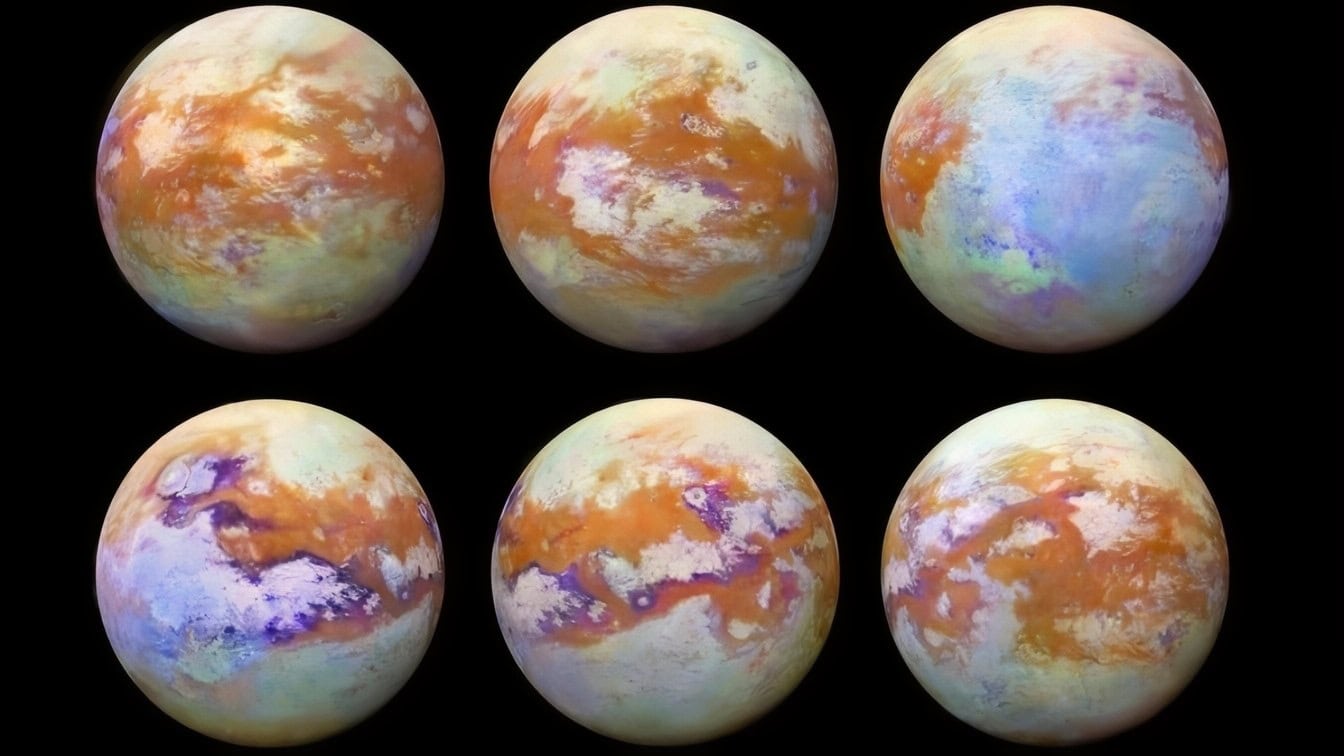
Titan is Saturn’s largest moon and one of the most Earth-like worlds in the Solar System. Titan features clouds, rain, rivers, lakes, seas, coastlines, erosion, sand dunes, and seasonal weather—all very Earth-like.
Only, on Titan, every familiar ingredient has been replaced; instead of water, Titan’s weather cycle is driven by liquid methane and ethane.
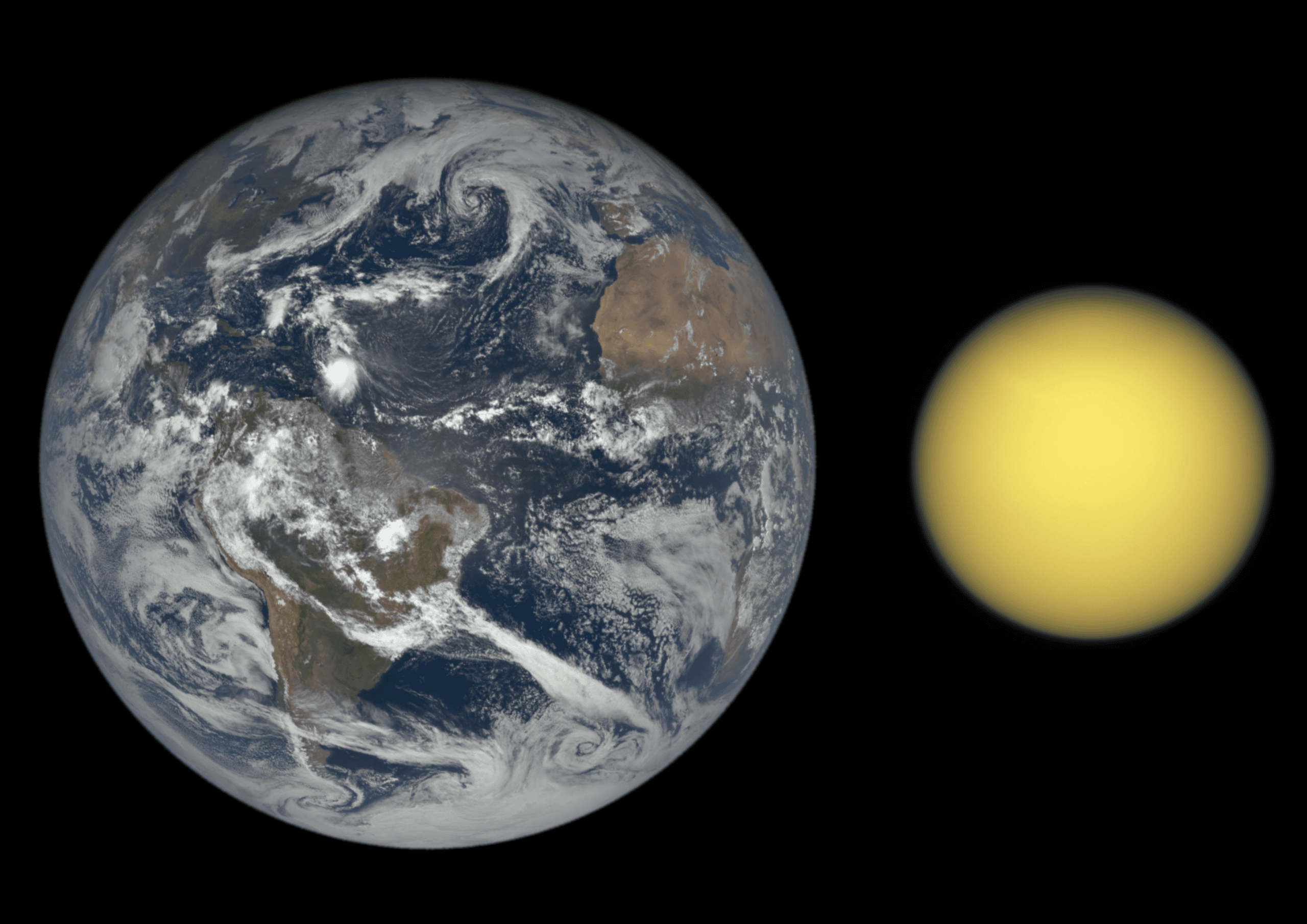
Earth image derived from DSCOVR/EPIC. Titan image derived from Cassini spacecraft narrow-angle camera (NAC). The relative sizes are calibrated using the known distances to each target at the time of image acquisition and the angular resolution of the respective instruments. Titan’s apparent size includes its extended atmospheric haze.
Surface temperatures average about -290 degrees Fahrenheit, making all water harder than granite on Earth.
This arrangement forces scientists to ask an important question: does life actually require liquid water, or do we only assume as much because life on Earth is based on liquid water?
NASA’s Dragonfly mission, planned to launch in 2028, is designed to investigate this question.
Earth in Reverse
Titan is the only known world besides Earth with an active liquid cycle on its surface. On Earth, for example, water evaporates and forms clouds before falling as rain, which then fills rivers and oceans. Titan follows the same basic pattern—only with hydrocarbons.
On Titan, methane evaporates from seas, forms clouds, falls as rain, and the rivers carry that methane into an enormous northern sea.
The result is that everything is familiar—only it behaves quite differently. Because of Titan’s extreme cold, methane becomes a liquid. So does ethane.
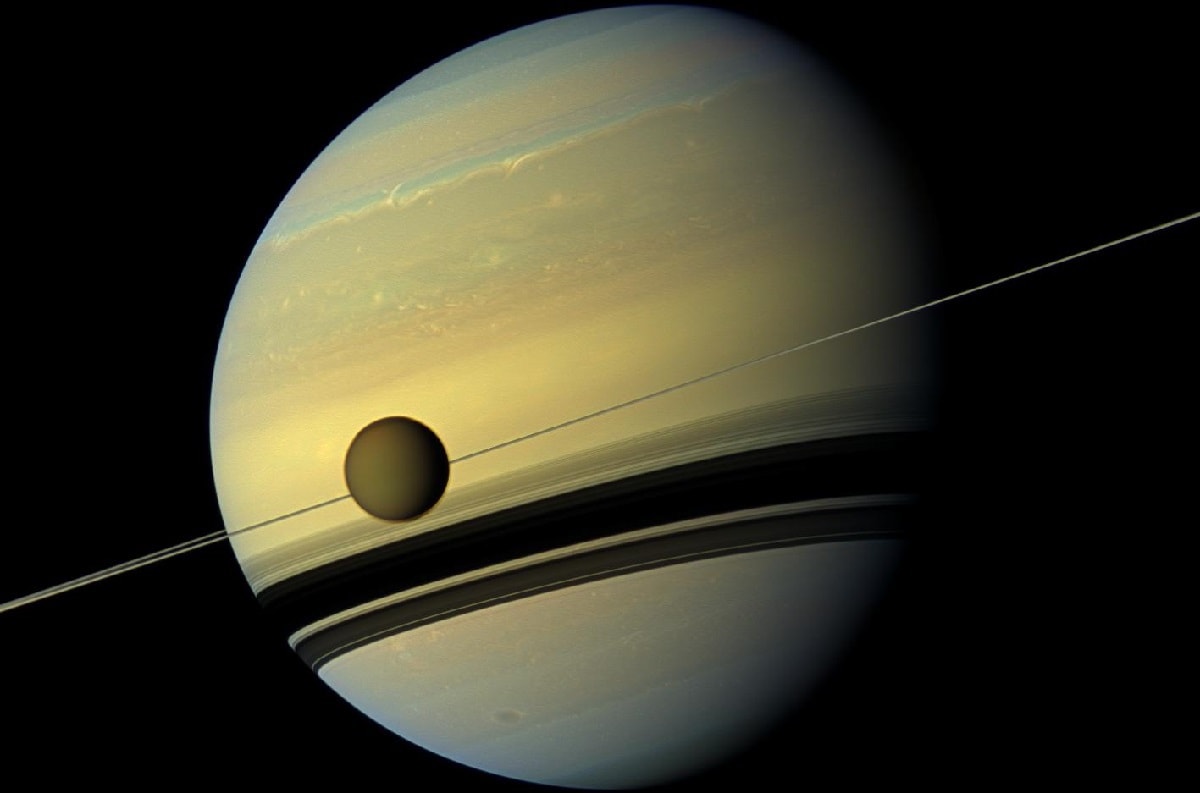
Saturn and Titan. Creative Commons Image.
But water freezes into solid rock. So Titan’s mountains and bedrock consist primarily of rock-hard water ice.
But Titan’s liquid methane carves valleys just as water does on Earth. Rivers gradually reshape the landscape through erosion.
This demonstrates that many geological processes are driven by fluid mechanics rather than the specific chemistry of water.
Alien Weather
Titan experiences a genuine meteorological cycle. Clouds form seasonally, rainstorms occur, and the rivers swell and empty into lakes.
At the poles exist massive hydrocarbon seas. Kraken Mare is the largest known sea on Titan, larger even than Lake Superior on Earth.
Notably, Titan’s atmosphere is about four times denser than Earth’s, yet gravity is only about 14 percent of Earth’s.
The result is that methane raindrops fall slowly, allowing droplets to grow much larger than raindrops on Earth.
Meaning the weather behaves in ways unlike anything seen on Earth.
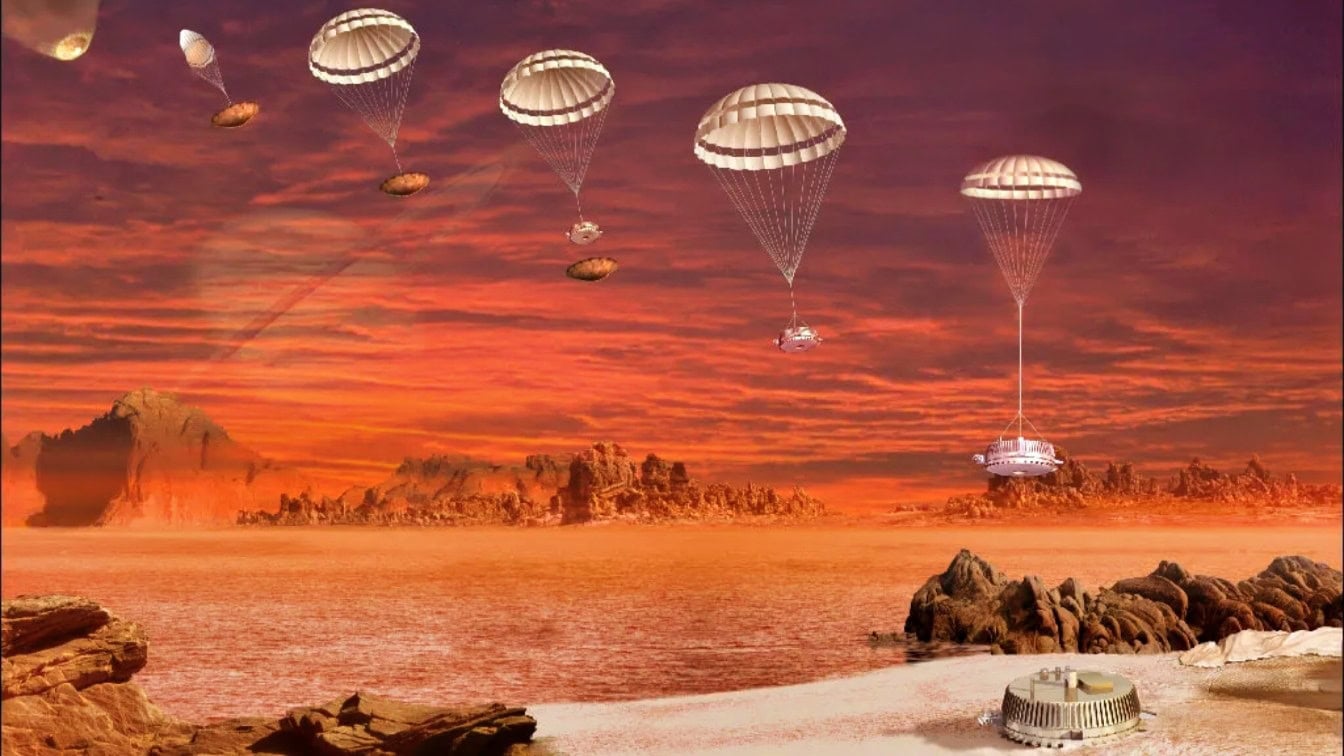
Titan Landing NASA Photo Handout
Titan also has an orange haze because the thick atmosphere is mostly nitrogen with significant methane. Ultraviolet sunlight continually breaks methane molecules apart, and they recombine into increasingly complex carbon compounds.
These particles become a thick orange atmospheric haze.
Eventually, they settle onto the surface as complex organic material, as tholins.
So Titan is constantly building new organic chemistry, an environment that scientists describe as a natural laboratory for prebiotic chemistry.
The Importance of Titan
The traditional definition of habitability centers on liquid water. That’s where the entire concept of the “Goldilocks Zone” comes from.
But Titan challenges that assumption. Although far too cold for liquid water on the surface, Titan possesses stable liquids, abundant carbon chemistry, atmospheric energy, and active geological processes.
Titan raises the possibility that complex chemistry can develop under conditions radically different from Earth.
One important scientific question: could methane support life? Earth cells rely on water as a solvent, and cell membranes function because water is a polar liquid.
Methane is non-polar, however; ordinary terrestrial biology would freeze and fail almost instantly on Titan. However, researchers have explored theoretical alternatives.
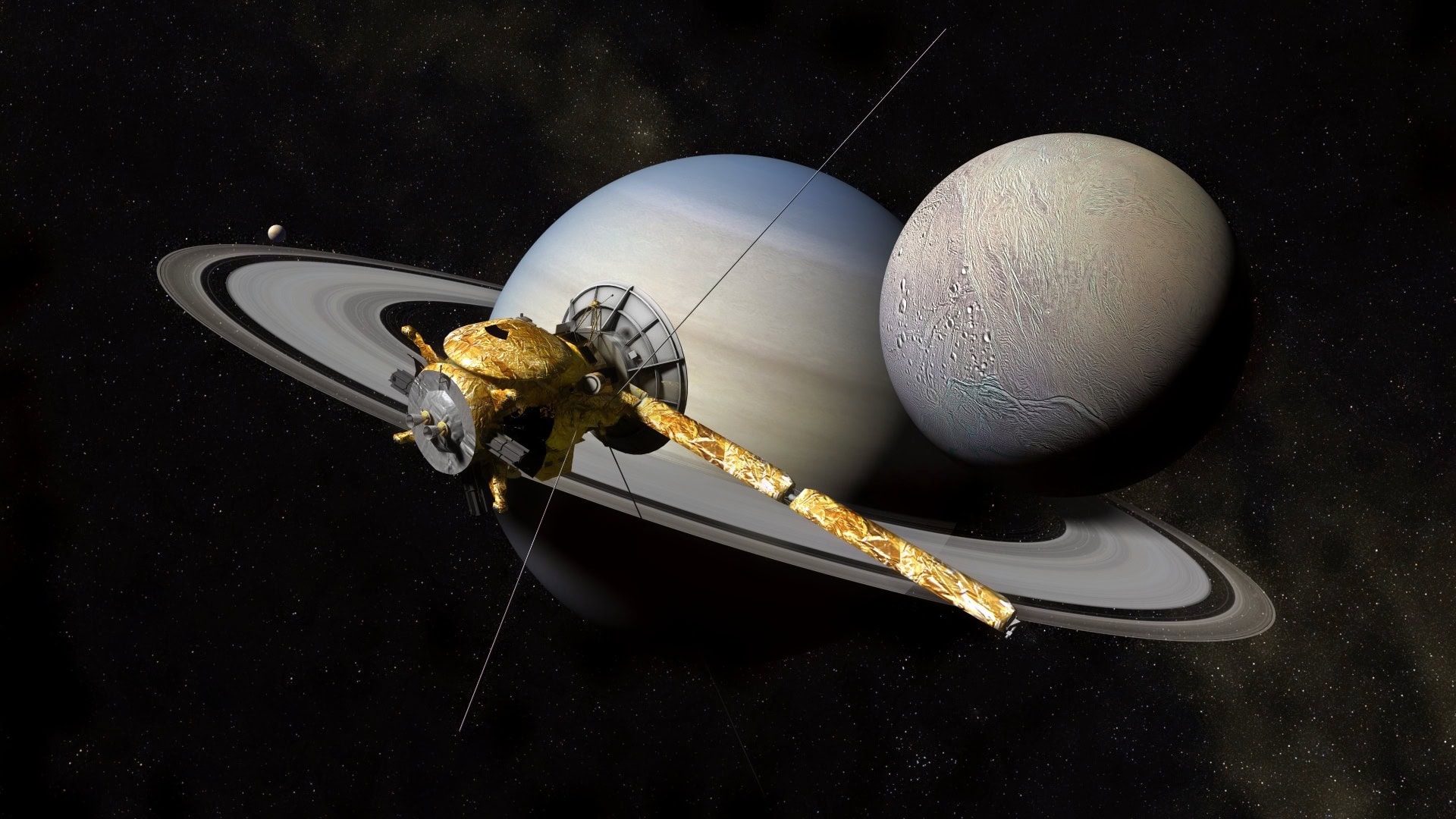
Cassini Saturn Probe NASA Photo
Cornell University researchers propose azotosomes—hypothetical membrane structures composed of nitrogen, carbon, and hydrogen.
Computer modeling suggests that azotosomes could remain flexible in liquid methane.
Still, there is no evidence that such life exists, though the work demonstrates that Earth-style biology may not be the universe’s only possible biology.
The Hidden Ocean
Despite the subzero temperatures, Titan is not entirely frozen. Beneath the world’s thick icy crust, scientists believe a global subsurface ocean of liquid water may exist. Internal heating likely keeps this ocean liquid.
This creates two potentially important chemical environments: one, a methane-rich surface, and two, a water-rich interior.
The interaction between these two environments may be significant. Accordingly, Dragonfly will land in the Shangri-La dune fields before exploring the Selk crater, where scientists believe a large asteroid struck Titan millions of years ago.
Saturn 5 Rocket. Image from NASA Kennedy Space Center Taken on 6/28/2026. Taken by Harry J. Kazianis for 19FortyFive.com
The impact temporarily melted portions of Titan’s icy crust, producing localized pools of liquid water.
Here, water mixed with Titan’s abundant organic compounds, creating conditions for increasingly complex chemistry.
Dragonfly hopes to better inform our understanding of what conditions are needed to sustain life.
About the Author: Harrison Kass
Harrison Kass is a writer and attorney focused on national security, technology, and political culture. His work has appeared in Tablet, City Journal, The Hill, The Spectator, and The Cipher Brief. He holds a JD from the University of Oregon and a master’s in Global & Joint Program Studies from NYU. More at harrisonkass.com.