
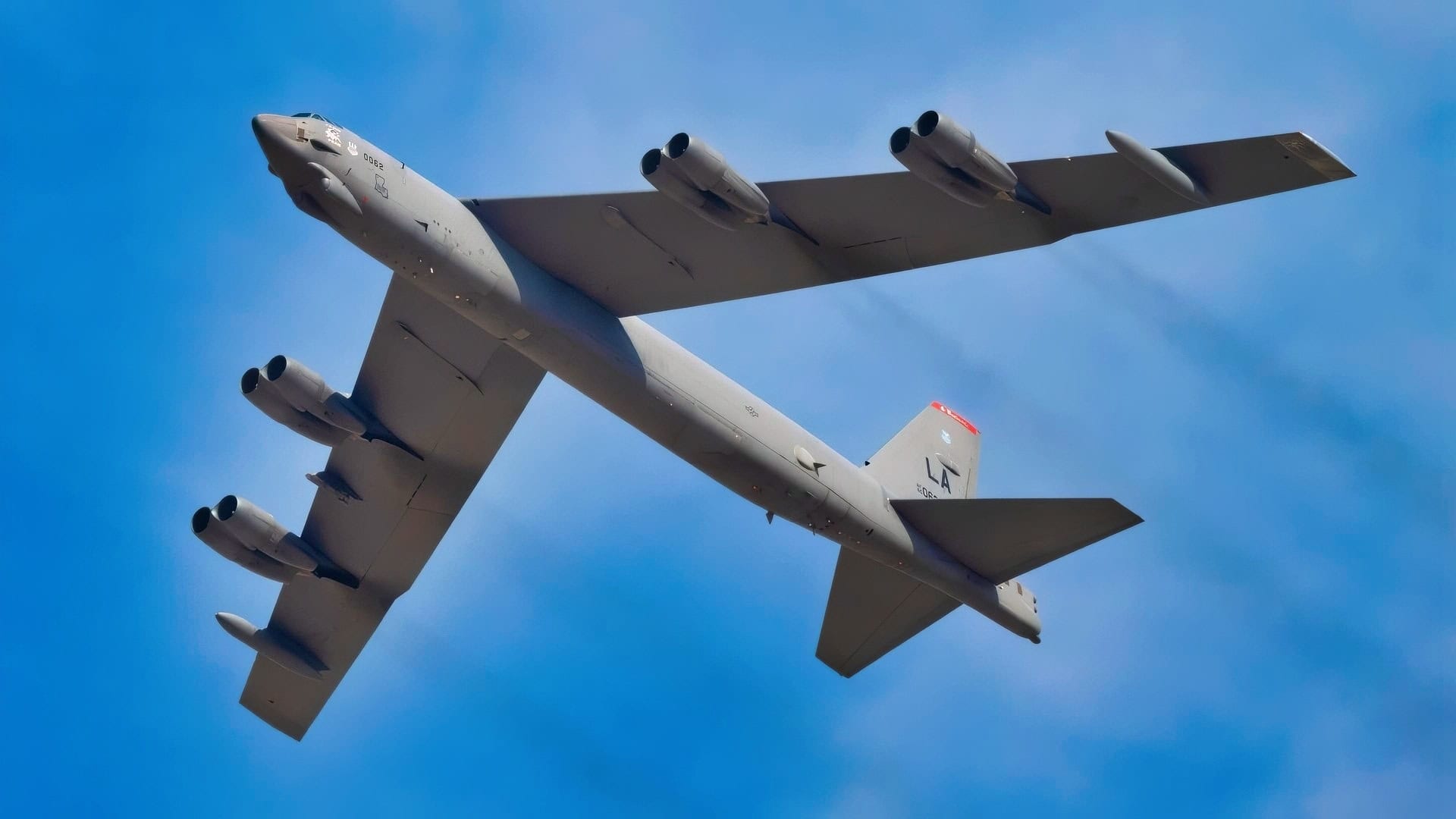
B-52J Bomber: The Aerospace and Industrial Paradox: The United States Air Force is attempting something no air force has done: taking a fleet of bombers whose newest airframe was delivered in 1962 and rebuilding them to fight into the 2050s, when the last B-52 will retire at nearly 100 years old. The effort carries a new designation, the B-52J, and rests on two great programs running in parallel, one to replace every engine in the fleet and one to replace every radar. As of July 2, 2026, those two programs are moving in opposite directions, and the whole undertaking has just passed through the darkest month in its history.
Why the B-52 Is Being Rebuilt to Fly Until the 2050s
The case for the rebuild starts with arithmetic. The Air Force operates 76 B-52H bombers, each powered by eight Pratt & Whitney TF33 turbofans, which were designed in the late 1950s and have been out of production since 1985. The service has concluded that the TF33 cannot be supported beyond 2030, which has set a hard deadline for a re-engining effort the institution had studied and repeatedly abandoned since the 1990s, including a 1996 Boeing proposal that was rejected on cost-analysis grounds and later judged flawed.
The Commercial Engine Replacement Program, CERP, finally launched in 2018, and in September 2021, Rolls-Royce won the roughly $2.6 billion engine contract over GE and Pratt & Whitney with the F130, a military version of the BR725 business-jet engine that already powers the Air Force’s C-37 and E-11 fleets. More than 600 engines will be assembled in Indianapolis.
The engines travel with a second transformation: a new Raytheon AN/APQ-188 active electronically scanned array radar, blending the sensor of the F/A-18’s APG-79 with the processor of the F-15’s APG-82, to replace a mechanically scanned APQ-166 the service describes as obsolete and increasingly unsupportable.
Add new communications, displays, power generation, and structural work, and the result is different enough that the Air Force decided the fleet needed a new letter. Program managers once considered a two-stage rename, B-52I when the radars arrived, then B-52J with the engines, before dropping the interim designation; as a former program manager explained, an aircrew’s checklists, training, and expectations all hang on the designation painted on the jet.
The Engine Program Finally Passed Its Biggest Test, Three Years Late
For most of its life, CERP has been a case study in schedule erosion. The Government Accountability Office’s 2024 assessment found the Air Force had underestimated the funding needed to finish detailed design, pushing the combined B-52J’s initial operational capability to 2033, three years past the original plan and the second delay announced since 2022.
Then came the inlet. GAO’s 2025 assessment revealed that while digital models used during rapid prototyping showed the new engines would fit the aircraft, physical performance data showed that the Boeing-designed engine inlet produced non-uniform airflow that violated requirements, forcing a redesign and a wind-tunnel campaign that ran through the summer of 2025. The program’s critical design review, originally planned for 2023, slid to April 2026, and GAO put the earliest initial production decision at March 2028.
This May, the corner finally turned. The Air Force announced that CERP had passed its critical design review, clearing Boeing to begin converting the first two bombers at its San Antonio facility, with the first aircraft scheduled to arrive later this year and the modified jets bound for flight test at Edwards. The F130 engine itself has been ahead of the airframe work throughout: it passed its own design review in December 2024 and completed altitude and operability testing at the Arnold Engineering Development Complex in February, with the first integration engines set to reach the Air Force in 2027.
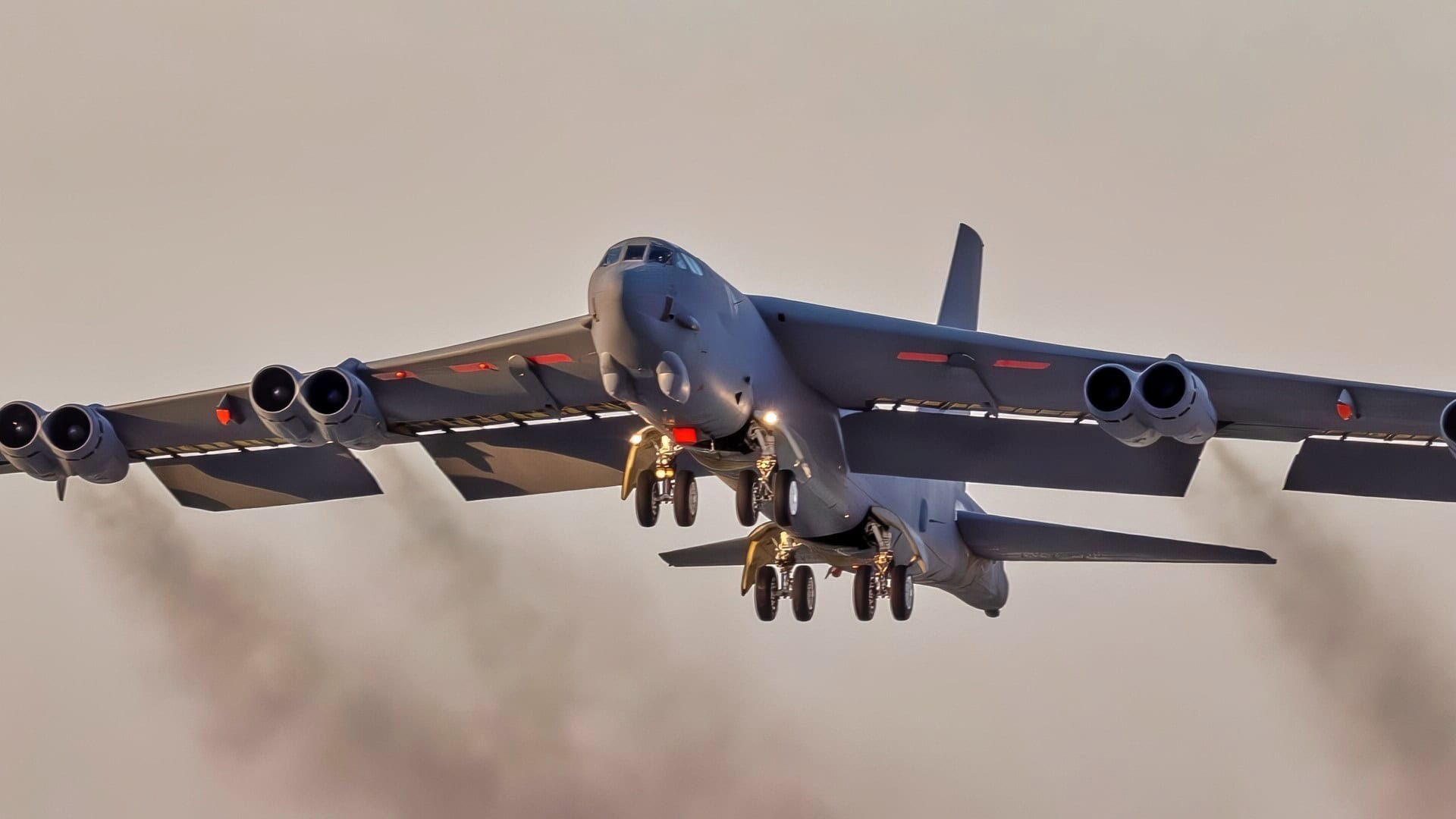
A modified B-52H Stratofortress departs Edwards Air Force Base for an evening training mission on June 25, 2025. The aircraft is assigned to the 419th Flight Test Squadron, Global Power Bombers Combined Test Force, tasked with supporting developmental testing across the B-52, B-1, and B-2 bomber portfolio. Along with most 412th Test Wing aircraft, B-52H bombers at Edwards include special instrumentation to conduct a variety of testing activities. (Air Force photo by Chase Kohler)
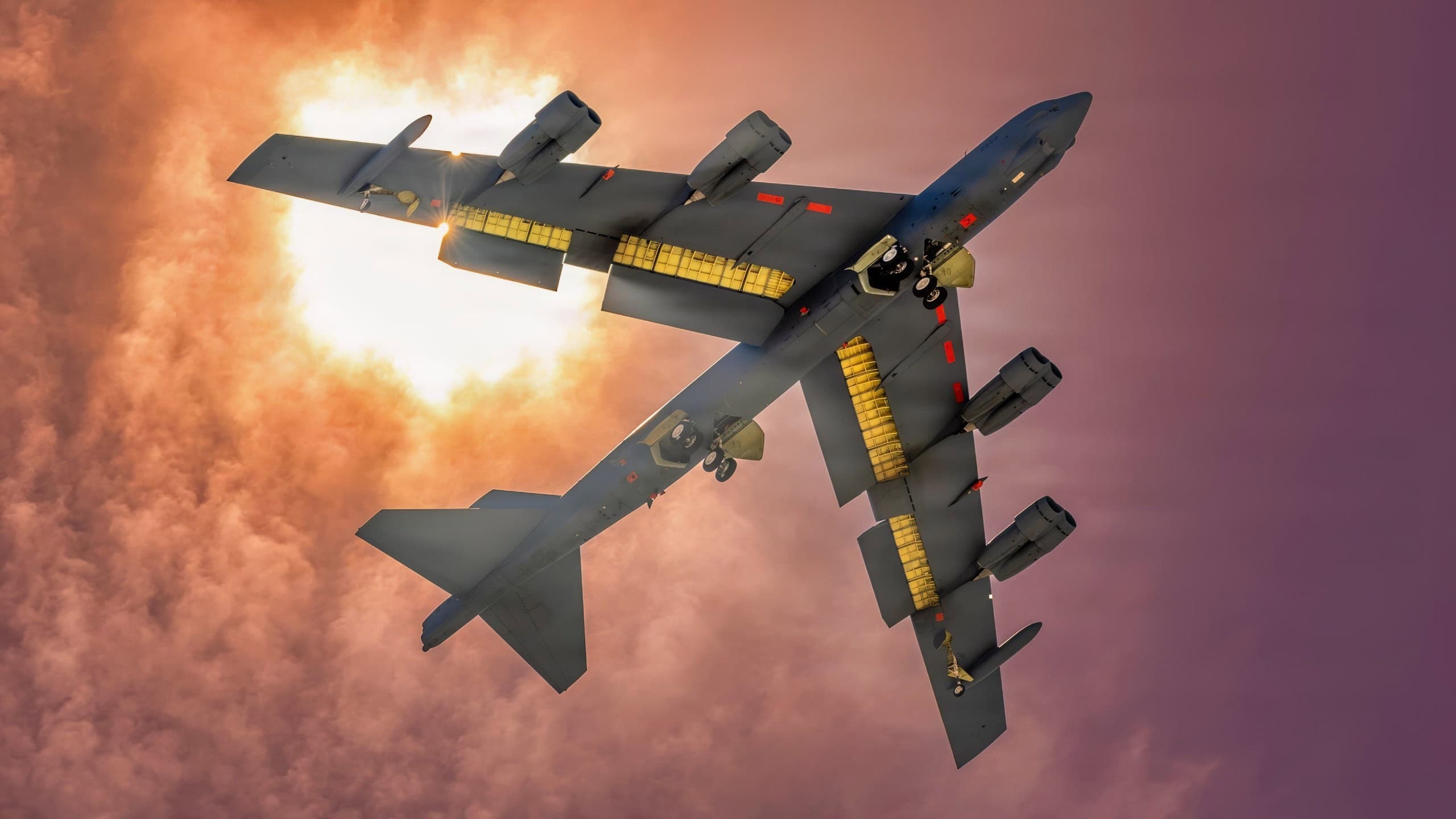
A B-52H Stratofortress assigned to the 419th Flight Test Squadron at Edwards Air Force Base, California, departs for an evening test mission over the Mojave Desert. The B-52H test fleet is in high demand, testing a variety of advanced capabilities for the joint-force. The 412th Test Wing will soon begin developmental test work on new avionics, radar, and engines as part of the B-52J effort, allowing the Stratofortress to serve the warfighter into the 2050’s. (Air Force photo by Todd Schannuth)
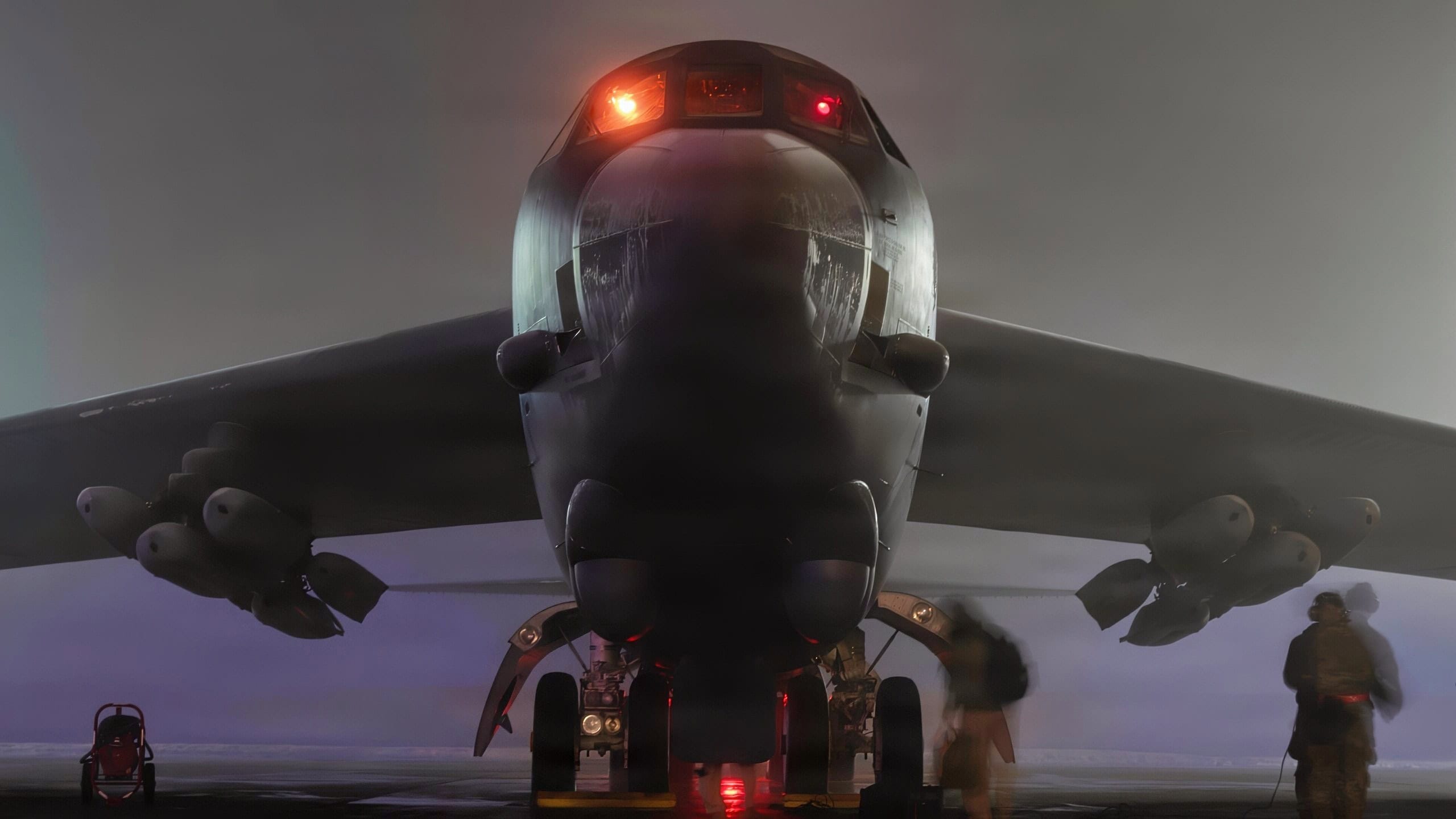
Aircrew members board a B-52H Stratofortress prior to taking off in support of Operation Epic Fury, March 4, 2026. (U.S. Air Force photo)
The honest caveats travel with the milestone. Initial operational capability remains 2033, twelve years after the engine contract was signed, and the full 76-aircraft fleet may not be converted until 2036.
The Pentagon’s own testing office has also warned that the program’s plan to run flight testing largely alongside engine production, a practice called concurrency, is the kind of schedule that has historically produced expensive retrofits when testing finds problems.
The Radar Program That Shrank to Survive
If the engines are the saga’s slow-motion recovery, the radar is its cautionary tale. The Radar Modernization Program‘s costs rose 12.6 percent by late 2023 relative to the 2021 estimate, from $2.34 billion to $2.58 billion, and continued to climb until, in the spring of 2025, the growth exceeded the statutory threshold of the Nunn-McCurdy Act, requiring formal notification to Congress.
GAO’s 2025 review found the program had breached its baseline schedule for both the start of production and initial operational capability, with the radar’s in-service date sliding from 2027 to around mid-2030, production decisions slipping into fiscal 2026 and 2027, software challenges putting even the delayed dates at risk, and what the watchdog called lower-than-expected contractor performance.
The Air Force went so far as to quietly ask industry in March 2025 about alternative radar sources, a remarkable step a half-decade into an integration program. RTX, for its part, said it was delivering radars under the development contract and negotiating toward an anticipated production award in 2026.
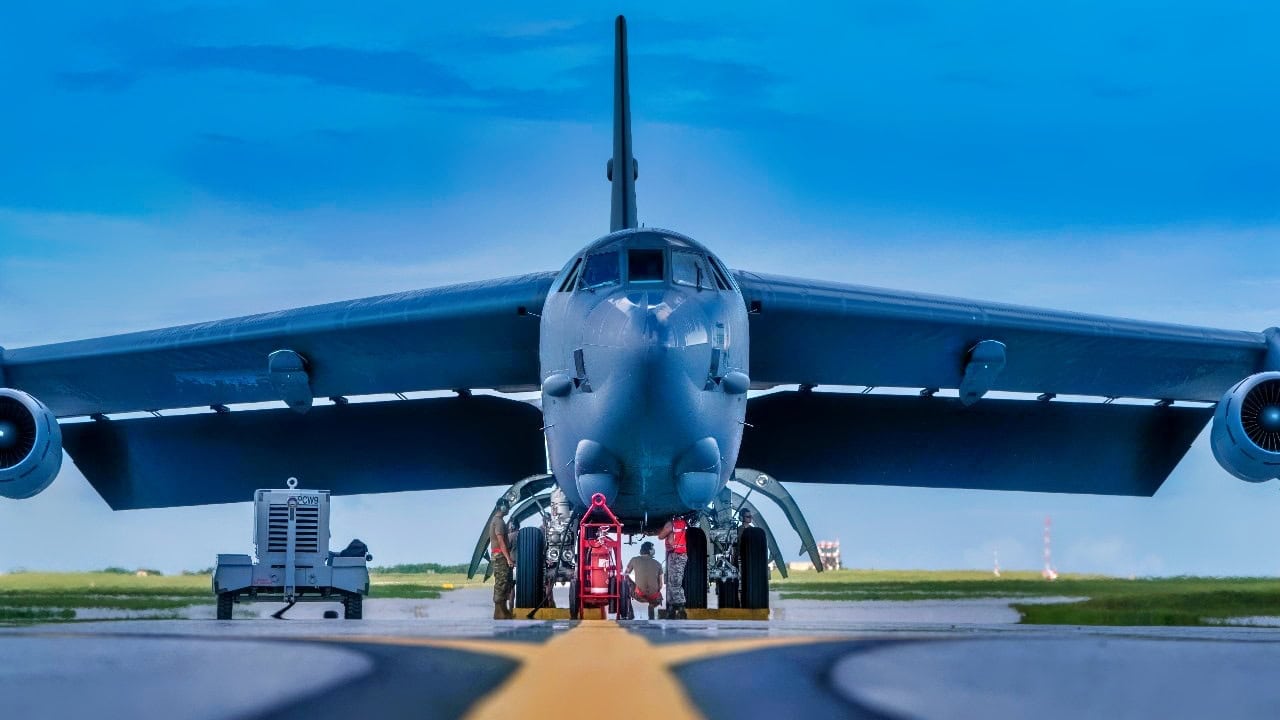
A U.S. Air Force B-52 Stratofortress bomber, deployed from Barksdale Air Force Base, La., lands at Andersen Air Force Base, Guam, July 4, 2020. The B-52 flew the 28-hour mission to demonstrate U.S. Indo-Pacific Command’s commitment to the security and stability of the Indo-Pacific region. (U.S. Air Force photo by Master Sgt. Richard P. Ebensberger)
The service’s answer to the breach arrived in the Pentagon testing office’s report this March: rather than cancel, the Air Force is restructuring the program around what the document calls a “minimum viable product,” a subset of the radar capability originally promised, to get costs under control, with deferred functions presumably following later if budgets allow.
Descoping is an unglamorous survival strategy, but it kept the program alive, and by December 2025, the effort had something it had lacked for years: a flying testbed. A B-52H fitted with the new radar at Boeing’s San Antonio plant was delivered to Edwards to begin flight evaluation, and Air Force Secretary Troy Meink marked the arrival by saying, “We are committed to extending the life of this vital platform.”
The June 15 Crash at Edwards Air Force Base
That aircraft was tail number 60-0061, and on the morning of June 15, it took off from Edwards under the call sign Torch 11 on a test sortie supporting the Radar Modernization Program. Immediately after takeoff, it crashed on the base and burned.
All eight people aboard were killed: Air Force officers of the 419th Flight Test Squadron and the service’s operational test detachment, civilian flight-test engineers, a contractor with test-support firm JT4, and two Boeing employees. It was the deadliest B-52 accident since 1982 and the first crash of the type since 2016. Flight-tracking data analyzed by the Associated Press showed the bomber descending at roughly 5,000 feet per minute in its final moments. The Air Force released the crew’s names on June 17, and their remains were flown to Dover Air Force Base on June 19.
The deputy commander of the 412th Test Wing confirmed on the record that the flight was supporting the radar program, and the base confirmed the aircraft was the radar-equipped jet delivered from San Antonio in December. The cause is under investigation, with initial findings expected within six months.
The airfield reopened June 18, and flight test operations resumed June 22, with no flight restrictions placed on the remaining fleet, according to Air & Space Forces Magazine, which also reported that the crash’s effect on the radar program’s schedule is not yet clear.
What is clear arithmetically is that the Air Force now has 75 B-52s, and that the radar effort’s only flying testbed was destroyed along with eight of the people who worked on it.
Where the B-52J Stands as of July 2, 2026
Set side by side, the ledger reads like this: The engine program has its design review behind it, a bomber preparing to enter conversion at San Antonio this year, engines finishing ground test and delivering for integration in 2027, an initial production decision no earlier than March 2028, operational capability in 2033, and a fleet finished perhaps by 2036.
The radar program has a descoped requirement, a production contract still under negotiation with an award anticipated this year, an in-service date around 2030, an accident investigation underway, and a test aircraft to replace. The combined B-52J will arrive three years late by the official count, and the count assumes nothing else goes wrong.
The strain runs through a small fleet. Every bomber pulled into conversion or testing is subtracted from a force of 75 that remains in constant demand, most recently flying strikes in the war against Iran, and that must bridge the gap until the B-21 Raider arrives in numbers. The bet underneath the whole saga is unchanged: that a structurally sound 64-year-old airframe with new engines, a new radar, and modern connectivity is the cheapest credible way to carry standoff weapons for another quarter century, and that the alternative, buying that capacity new, costs more than fixing what exists. Nothing in five years of delays has changed the Air Force’s answer, and the programs have survived a cost breach, a redesigned inlet, a congressional notification, a descope, and now a tragedy.
The next months will tell more than the last five years did. Watch for the first bomber’s arrival at San Antonio to start engine conversion, the radar production contract award RTX expects this year, whatever the Air Force says about replacing the lost testbed, and the accident board’s findings toward the end of the year.
As of today, the oldest bombers in American service are still flying operational missions, the first true B-52J remains roughly seven years from operational capability, and the people rebuilding the airplane have been reminded, at the highest possible cost, that none of this work is routine.
About the Author: Harry J. Kazianis
Harry J. Kazianis (@Grecianformula) was the former Senior Director of National Security Affairs at the Center for the National Interest (CFTNI), a foreign policy think tank founded by Richard Nixon based in Washington, DC. Harry has over a decade of experience in think tanks and national security publishing. His ideas have been published in the NY Times, The Washington Post, The Wall Street Journal, CNN, and many other outlets worldwide. He has held positions at CSIS, the Heritage Foundation, the University of Nottingham, and several other institutions related to national security research and studies. He is the former Executive Editor of the National Interest and the Diplomat. He holds a Master’s degree focusing on international affairs from Harvard University.

