
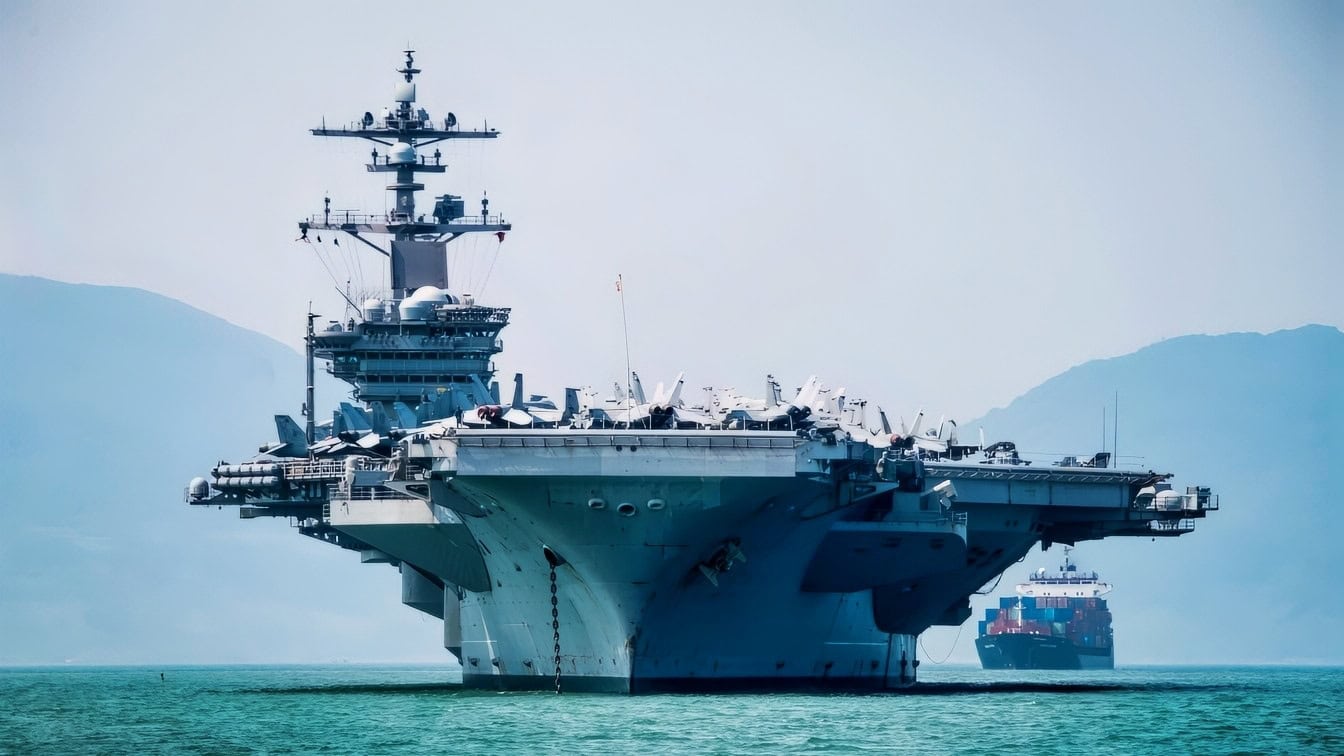
The U.S. Navy Budgeted $562 Million to Retire USS Nimitz. It Will Never Deploy Again – USS Nimitz remains a commissioned American warship in August 2026. Its frontline career is over.
The 51-year-old aircraft carrier reached Naval Station Norfolk on July 9 after sailing around South America and participating in exercises, port visits, and the International Naval Review in New York. The Navy plans to use Nimitz as a training carrier until March 2027, when inactivation begins. Its last deployment certified for national tasking ended in December 2025.
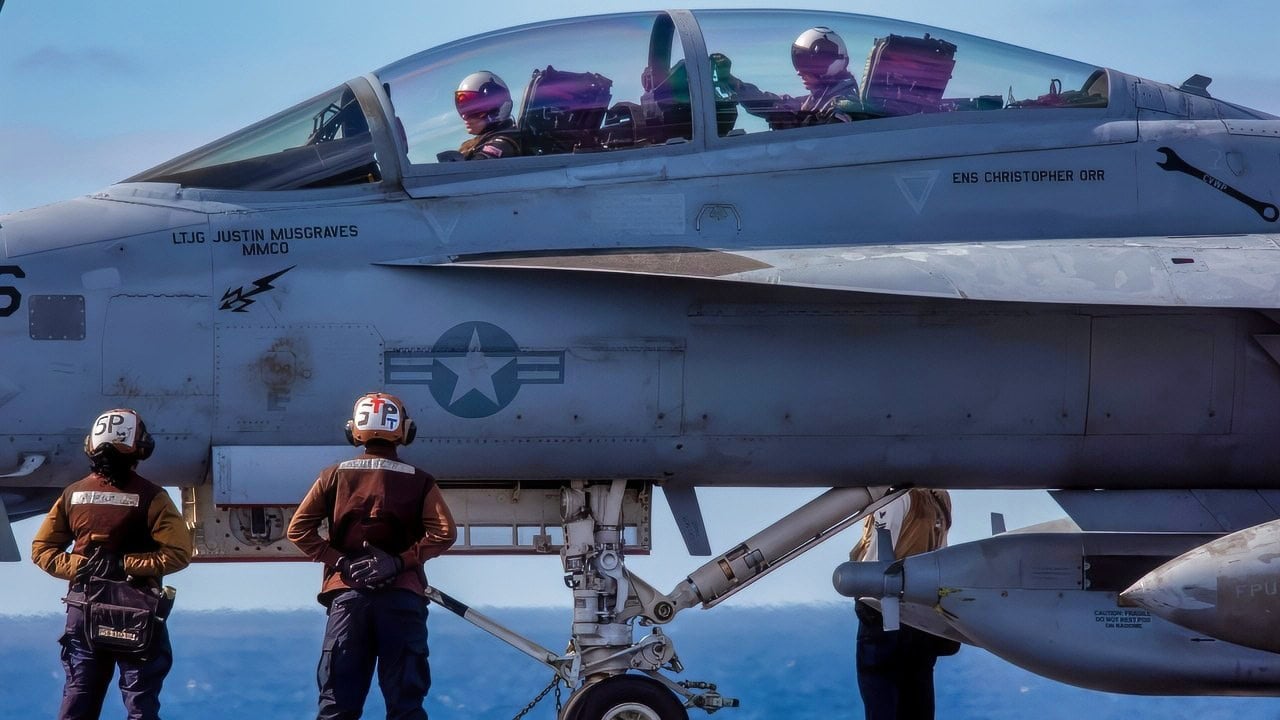
U.S. Navy Sailors prepare to taxi an EA-18G Growler, attached to Electronic Attack Squadron (VAQ) 133, on the flight deck of Nimitz-class aircraft carrier USS Abraham Lincoln (CVN 72) on Nov. 24, 2025. USS Abraham Lincoln (CVN 72), flagship of the Abraham Lincoln Carrier Strike Group, is underway conducting routine operations in the U.S. 3rd Fleet area of operations, demonstrating the U.S. Navy’s long-term commitment to a free and open Indo-Pacific. (U.S. Navy photo by Mass Communication Specialist Seaman Daniel Kimmelman)
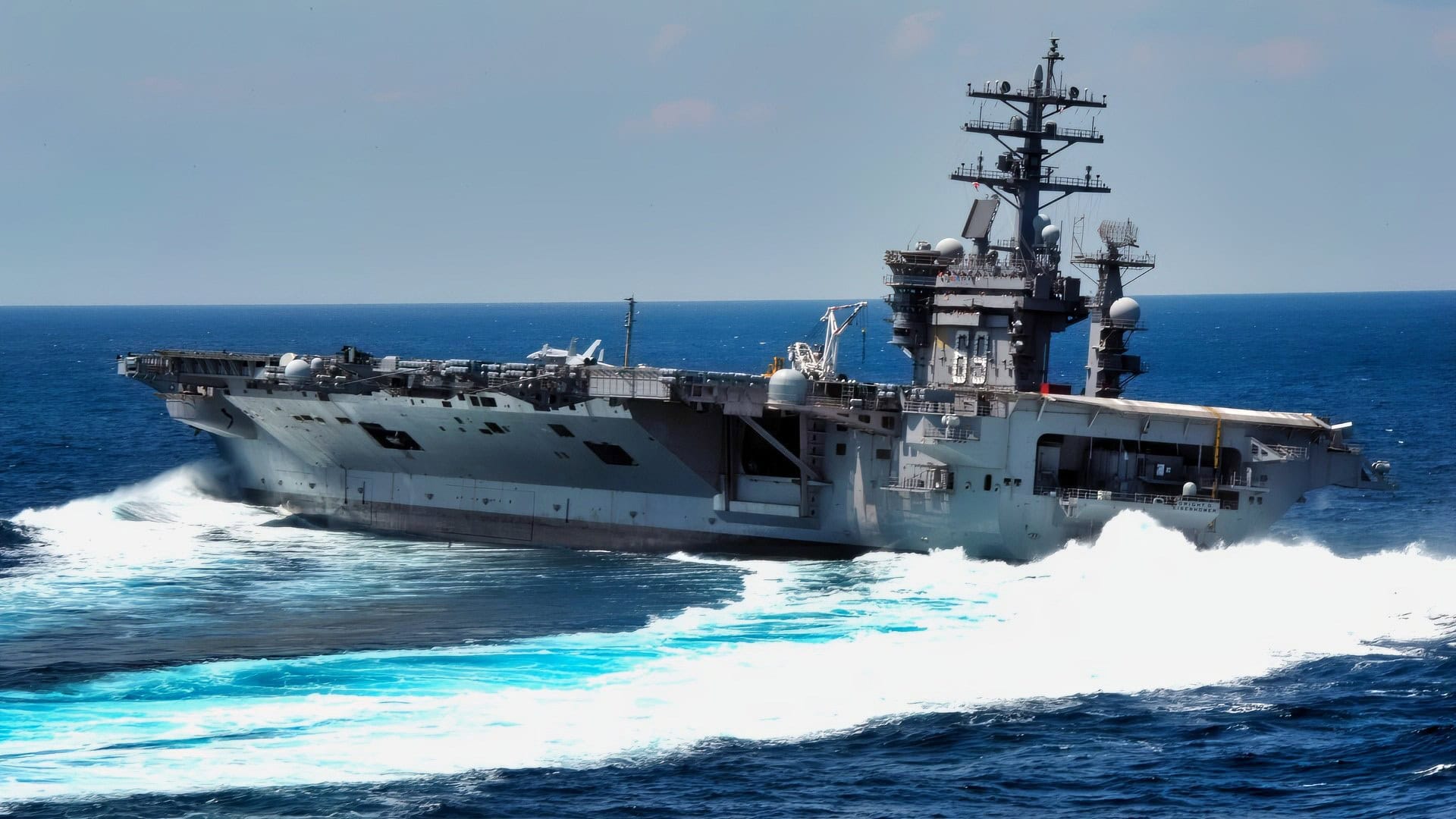
The Nimitz-class aircraft carrier USS Dwight D. Eisenhower conducts rudder turns during sea trials. Dwight D. Eisenhower completed a nine-month planned incremental availability at Norfolk Naval Ship Yard on June 10 and is scheduled to resume underway operations this summer.
Nimitz is not a worn-out hulk. The 1,092-foot carrier still moves under its own power, supports flight operations, and carries a trained crew. Its captain told USNI News the ship’s ability to function had never been questioned. The issue is the work required before another combat deployment.
A return to frontline duty would demand years of work, billions of dollars, and scarce nuclear-shipyard capacity. The Navy has already chosen retirement. It awarded $96 million for inactivation planning and long-lead material, then placed $562 million in the fiscal 2027 plan for the opening phase.
Nimitz Has Completed Its Last Combat Deployment
Nimitz left the West Coast in March 2025 for a nine-month deployment through the Indo-Pacific and Middle East. The carrier strike group operated across the 3rd, 5th, and 7th Fleets, supported strikes against Islamic State targets in Somalia, and completed more than 8,500 sorties and 17,000 flight hours.
The ship returned to Bremerton in December. Three months later, it departed Washington state for the last time and began Southern Seas 2026. The cruise took Nimitz around Cape Horn, through exercises with regional navies, and eventually to Norfolk.
Southern Seas displayed the flag and kept the ship useful. It did not restore Nimitz to the full deployment cycle. USNI reported the March 2025 cruise was the last one certified for national tasking. In Norfolk, its remaining role centers on carrier qualifications and training.
Another deployment would require the carrier, air wing, escorts, and staff to complete another maintenance, training, and certification cycle. Nimitz has only months left before scheduled inactivation.
The Ship Has Reached the End of Its Nuclear Life Cycle
The Navy built the Nimitz class around an approximately 50-year service life divided by one midlife refueling and complex overhaul. Nimitz completed its RCOH in 2001 after five years of planning and three years of execution, according to a RAND study prepared for the Navy.
The overhaul replaced reactor fuel and modernized the propulsion plant, flight deck, combat systems, electrical equipment, piping, tanks, catapults, arresting gear, and living spaces. It reset the ship for the second half of its operating life.
Extending Nimitz for another serious deployment would not resemble a normal pier-side availability. The Navy would have to establish remaining reactor life, inspect a half-century-old hull and steam plant, replace age-driven failures, and modernize systems required for current aircraft and threats.
Reactor-fuel status is classified, so public claims about an “empty” core lack evidence. The budget supplies the stronger answer: the Navy plans to defuel the ship, not refuel it.
No official estimate exists for a second life-extension overhaul. USS John C. Stennis offers a useful comparison. The Navy awarded about $3 billion for its scheduled midlife RCOH, covering more than 2,300 compartments and major work on the propulsion plant, flight deck, catapults, island, and combat systems.
Nimitz would enter a comparable yard period at twice Stennis’s age, without another 25 years of planned service to recover the investment.
The debate over whether to save or scrap the 100,000-ton carrier therefore involved more than sentiment. A multibillion-dollar overhaul lasting several years would return an elderly ship after its replacement joined the fleet.
Scarce Shipyard Capacity Has More Valuable Uses
Newport News Shipbuilding is the only American yard capable of designing, building, and refueling nuclear-powered carriers. It is finishing John F. Kennedy, building Enterprise and Doris Miller, and performing major refueling work on existing Nimitz-class ships.
Kennedy completed acceptance sea trials on August 15, 2026. Preliminary acceptance and further testing remain, but the carrier is far closer to joining the fleet than Nimitz is to completing a hypothetical second overhaul.
Stennis remains in an RCOH extended by about 14 months, while Harry S. Truman has entered its own overhaul. USS Gerald R. Ford began its first scheduled public-shipyard availability in July after a 326-day deployment. The remaining carriers and nuclear submarines also require regular yard time.
The Government Accountability Office found 10 of 18 carrier maintenance periods completed at public yards from fiscal 2015 through 2019 finished late, with an average delay of 113 days. A Nimitz life extension would add the oldest hull to a system already grappling with unplanned work and workforce limitations.
Those pressures help explain why a new nuclear carrier now takes roughly 15 years to build. They also explain why the Navy kept USS Carl Vinson in service after fresh maintenance while moving Nimitz toward retirement.
Vinson is seven years younger and has a funded operational future. Nimitz does not.
The Ten-Month Extension Was a Bridge
The Navy originally planned to inactivate Nimitz in May 2026. It moved the date to March 2027 after Kennedy’s delivery slipped. Federal law requires at least 11 operational carriers, so keeping Nimitz on the list bridged the inventory gap.
The fiscal 2027 force-structure plan lists Nimitz at age 52 against a 50-year expected service life and states Kennedy will replace it. The extension covered operational requirements and the replacement schedule. It did not fund a new deployment cycle or another refueling.
Retirement is already an active program. The Navy’s $562 million inactivation allocation covers only the opening stage.
Workers must shut down systems, remove equipment, drain fluids, demilitarize spaces, and prepare two reactors for defueling. Later dismantlement and disposal will require separate funding and years of nuclear-qualified work.
Conventional carriers sometimes enter reserve as theoretical candidates for reactivation. A nuclear carrier entering defueling and reactor-plant disposal follows a different path. Reversal would require rebuilding systems the Navy is paying to dismantle.
On July 31, about 400 former Nimitz sailors and relatives boarded the carrier at Norfolk for a final reunion. The Navy’s budget keeps 2,705 officers and enlisted personnel associated with the retirement process in fiscal 2027, declining to 600 in fiscal 2030.
About the Author: Harry J. Kazianis
Harry J. Kazianis (@Grecianformula) was the former Senior Director of National Security Affairs at the Center for the National Interest (CFTNI), a foreign policy think tank founded by Richard Nixon based in Washington, DC. Harry has over a decade of experience in think tanks and national security publishing. His ideas have been published in the NY Times, The Washington Post, The Wall Street Journal, CNN, and many other outlets worldwide. He has held positions at CSIS, the Heritage Foundation, the University of Nottingham, and several other institutions related to national security research and studies. He is the former Executive Editor of the National Interest and the Diplomat. He holds a Master’s degree focusing on international affairs from Harvard University.

